




How to Choose PC1250 Excavator Bearings for Mining?
The appropriate bearing choice might be the difference between a mining excavator that is on the move and one that is standing still. Fitted with the improper standard, a 100-tonne Komatsu PC1250 class shovel may lose 8,000-12,000 hours of usable life to premature bearing failure – and a single slewing bearing replacement on a shovel that size might shut a pit down for days. Luoyang Heng Guan Bearing Technology Co., Ltd. (Heng Guan Bearing) offers slewing solutions for heavy equipment with a manufacturing range from 50 mm to 10,000 mm. We’ve learnt that the spec sheet is only the beginning: ore body, duty cycle, and shock loading all determine which design makes it through. This article will assist you in choosing PC1250 Excavator Bearings with confidence. Learn which specs, site circumstances, and quality checks need your attention. Read on.
What Specifications Matter When Choosing PC1250 Excavator Bearings?
Begin with the load route. The PC1250 Excavator Bearings must simultaneously withstand axial load, radial force, and overturning moment. That puts ring material, raceway hardness, and rolling element quality at the top of the list. Heng Guan Bearing offers rings in 50Mn or 42CrMo alloy steel (42CrMo offers 30% more impact durability than 50Mn for this duty class), with raceways through-hardened and surface-quenched to HRC 58-62 to a hardening depth of 8-12 mm, while the core is maintained at HRC 28-32 for toughness — a "hard surface, tough core" combination that absorbs mining shock loads.
The rolling elements are made from P4 quality vacuum-degassed GCr18Mo bearing steel, which offers a 30% increase in fatigue life over normal GCr15. Experienced PC1250 Excavator Bearing Manufacturers additionally check mounting dimensions, tooth type, and accuracy grade before pricing. A mismatch of bolt holes or gear data leads to expensive delays. Heng Guan’s PC1250 slewing bearings are suitable for Komatsu PC1250 series, Caterpillar 6090, Hitachi EX1200, and related mining shovels, and feature outer diameters from 2,200 mm to 3,200 mm, inner bores from 1,800 mm to 2,800 mm, and cross-section heights from 150 mm to 300 mm. Use the table below to begin with the checklist. Send in your sketch, and we will match the design to perfection.
Specification Reference for PC1250 Excavator Bearings
| Parameter | Typical Reference | Why It Matters |
|---|---|---|
| Ring material | 42CrMo (preferred) or 50Mn alloy steel | 42CrMo gives 30% better impact durability; tensile strength≥980 MPa |
| Outer diameter | 2,200 mm – 3,200 mm | Fits PC1250, CAT 6090, EX1200 and equivalents |
| Inner bore | 1,800 mm – 2,800 mm | Direct OEM replacement compatibility |
| Cross-section height | 150 mm – 300 mm | Optimized for combined load capacity |
| Raceway hardness | HRC 58–62 (surface), 8–12 mm case depth | Wear resistance in abrasive mining environments |
| Core hardness | HRC 28–32 | Impact resistance under shock loading |
| Rolling elements | GCr18Mo, P4 precision | 30% improved fatigue life vs. standard GCr15 |
| Precision grade | P0 / P6 / P5 / P4 | Match to machine positioning requirements |
| Gear precision | ISO Grade 6 | Smooth, quiet pinion meshing |
How Do You Match PC1250 Excavator Bearings to Mining Conditions?
Mining sites are demanding. Dust, vibration, shock loading, and long shifts all shape which design works best. For a machine of this size, the three-row roller structure is the right default: two horizontal roller rows carry axial load and overturning moment while the vertical row carries radial load — the geometry that spreads stress over three roller ways and reduces the risk of premature failure during digging cycles.
A double-row ball structure is a workable alternative for lighter 60–90 tonne machines, but for a 100-tonne shovel like the PC1250, the three-row design is the safer bet. Reliable PC1250 Excavator Bearing Manufacturers ask about ore type, working hours, and climate before recommending a design. Heng Guan Bearing offers customized production, so bearings can be adjusted to your duty cycle instead of being forced into a standard size — modifications typically cover mounting holes, gear type, seal layout, and cross-section ratio, with reverse engineering available from physical samples if you cannot match a legacy part number.
For a tailored recommendation, send your machine data to mia@hgb-bearing.com, and our engineers will suggest a structure that fits your site.
PC1250 Excavator Bearings: Sealing, Lubrication, and Gear Requirements
Good sealing and lubrication protect PC1250 Excavator Bearings from the fine abrasive dust common in mines. Seals made from NBR (oil- and wear-resistant nitrile rubber) keep contaminants out and grease in, and the bearing's zinc-nickel + epoxy coating system provides 1,000+ hours of salt-spray protection for high-humidity pits or coastal operations. Regular greasing with EP2 lithium grease containing molybdenum disulfide maintains a strong lubricating film on the raceways — Heng Guan's mining-duty schedule is every 50 working hours in dusty environments and every 100 hours in cleaner conditions, which is shorter than the general industrial interval because abrasive fines shorten grease life.
The gear also matters. Whether your machine uses an internal or external gear, the teeth should be CNC-ground to ISO Grade 6 and mesh smoothly with the pinion at the manufacturer-specified backlash. Heng Guan's installation guide for this product class sets the mounting-surface levelness tolerance at ≤0.5 mm across the bearing diameter, M30 mounting bolts at 800–1,200 N·m tightened in a star pattern, and a bolt re-torque after the first 8 hours of operation. Trusted PC1250 Excavator Bearing Manufacturers supply clear gear data and lubrication guidance with each order. The table below summarizes the key points, so you can compare options quickly and plan maintenance.
Sealing, Lubrication, and Gear Requirements
| Element | Recommended Option | Benefit |
|---|---|---|
| Seals | NBR nitrile rubber (Viton upgrade available) | Dust protection, oil and wear resistance |
| Surface coating | Zinc-nickel + epoxy | 1,000+ hours salt-spray resistance |
| Grease | EP2 lithium grease with MoS₂ | Stable film under shock loads |
| Re-grease interval | Every 50 h (dusty) / 100 h (clean) | Raceway protection, longer life |
| Gear | Hardened teeth, CNC-ground to ISO Grade 6 | Smooth, durable pinion meshing |
| Bolt torque | M30 at 800–1,200 N·m, star pattern | Even clamping, no raceway brinelling |
| Mounting flatness | ≤0.5 mm across the bearing diameter | Prevents raceway distortion |
How Can Buyers Verify PC1250 Excavator Bearing Quality Before Ordering?
Verification starts with documents. Ask for material certificates, hardness test records, dimensional inspection reports, and confirm that the supplier holds quality certifications such as ISO 9001 — Heng Guan also produces in compliance with RoHS and meets ISO / DIN / GB standards across the full product range. Reputable PC1250 Excavator Bearing Manufacturers welcome these questions and answer them openly. Check the packaging as well.
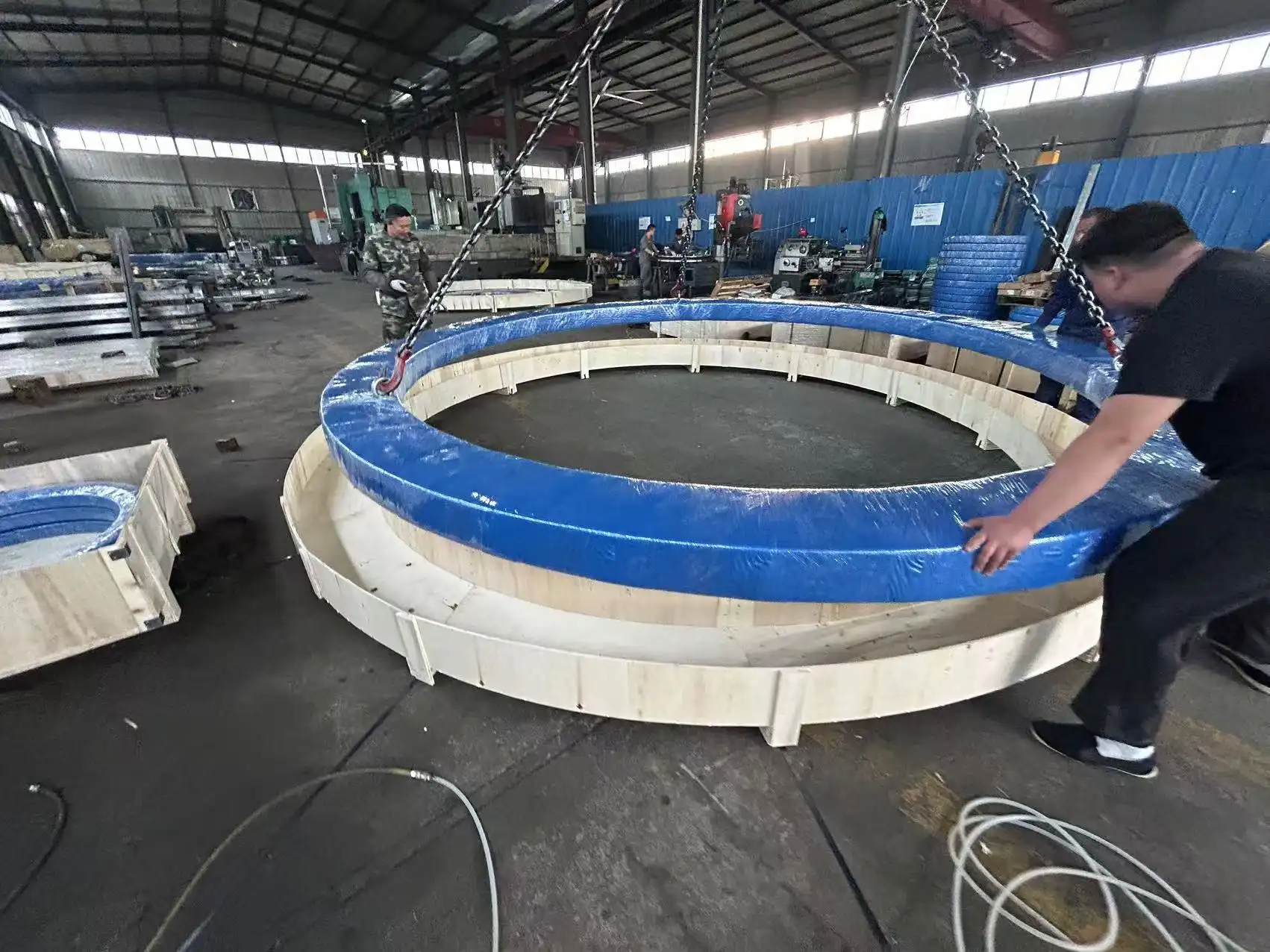
Heng Guan Bearing coats each bearing with anti-rust oil, wraps it in protective film and kraft paper, then ships it in wooden crate packaging — with sturdy-frame or composite wood-plus-iron-frame options for heavy or sea-freight routes — and will recommend the most secure option based on your transport route and environment. Lead times run 15–20 days for standard sizes and 30–45 days for custom builds, which is useful for planning replacements around scheduled shutdowns.
A warranty period and responsive after-sales support also show confidence in the product — under proper mining maintenance, expect 8,000–12,000 operating hours from these bearings. Before placing a large order, request drawings and specifications for your PC1250 Excavator Bearings so every detail is confirmed in writing, including the heat-treatment record showing surface and core hardness and the gear inspection report.
Conclusion
Choosing PC1250 Excavator Bearings comes down to matching specifications to real mining conditions, confirming sealing and lubrication needs, and verifying quality before you order. With clear data and a dependable partner such as Heng Guan Bearing, you can reduce downtime and extend service life.
FAQ
Q1: Which materials suit PC1250 Excavator Bearings?
50Mn or 42CrMo rings with hardened raceways are common choices — 42CrMo is preferred for the PC1250 duty class because it offers 30% better impact durability.
Q2: What raceway hardness should I look for?
A range of HRC 58–62 on the surface (with 8–12 mm case depth) and HRC 28–32 in the core is typical and provides the "hard surface, tough core" combination mining duty demands.
Q3: Which seals work best in dusty mines?
NBR seals offer dependable protection for most mining conditions, with a Viton upgrade available where heat or chemicals attack standard nitrile.
Q4: Can bearings be customized?
Yes, Heng Guan Bearing designs to your drawings and duty cycle, including reverse engineering from physical samples when part numbers are unknown.
Q5: How should I check quality before ordering?
Request material certificates, hardness test records, dimensional and gear inspection reports, and confirm ISO 9001 / RoHS certification plus packaging details in writing.
How Heng Guan Solves Your PC1250 Excavator Bearing Challenges
Ready to upgrade your mining fleet? Send your requirements to mia@hgb-bearing.com, and Heng Guan Bearing will provide a fast, professional quotation. Trust our experienced team to deliver PC1250 Excavator Bearings built for demanding work. Reach out now and keep your equipment productive.
References
1. International Organization for Standardization. (2007). ISO 281: Rolling Bearings – Dynamic Load Ratings and Rating Life.
2. International Organization for Standardization. (2006). ISO 76: Rolling Bearings – Static Load Ratings.
3. Harris, T. A., & Kotzalas, M. N. (2006). Essential Concepts of Bearing Technology. CRC Press.
4. Hamrock, B. J., Schmid, S. R., & Jacobson, B. O. (2004). Fundamentals of Machine Elements. McGraw-Hill.
5. Stachowiak, G. W., & Batchelor, A. W. (2013). Engineering Tribology. Butterworth-Heinemann.
6. Budynas, R. G., & Nisbett, J. K. (2014). Shigley's Mechanical Engineering Design. McGraw-Hill.

WHAT OUR CUSTOMERS SAY
Here is the customer's evaluation of us