




How to Inspect Excavator Slewing Bearing Before Installation?
A few minutes of careful inspection can save days of downtime. Before an Excavator Slewing Bearing goes onto the machine, you need to confirm that it arrived undamaged, fits the mounting structure, and is ready for service. Heng Guan produces slewing bearings in diameters from 50 mm to 10,000 mm, with raceways induction-hardened to HRC 55–60, and a hardened case depth of 2.5–5 mm — but that metallurgy only protects you if the bearing is unpacked, handled, and bolted up correctly. We see most early-life problems trace back to skipped checks during installation, not to the bearing itself. This guide walks you through a practical, step-by-step inspection routine that any maintenance team can follow, drawing on what we teach our own customers in ports, quarries, and construction sites.
What Should You Check on an Excavator Slewing Bearing Before Installation?
First, the papers and the packing. Cross-check the nameplate, drawing, and purchase order to ensure that the model, diameter, accuracy grade, and structure match your excavator – Heng Guan offers inner diameters from 500 mm to 5,000 mm and outer diameters from 600 mm to 5,500 mm with precision grades P0, P6, P5, and P4, so a drawing that doesn’t match will normally surface in the spec table long before it hits the steel. If not, ask for a drawing and inspection record with each unit from an experienced supplier of Excavator slewing bearings.
Check the crate for any impact marks and do not unwrap the bearing until the installation area is ready – units that have been in storage for more than six months should be recoated with protective film before fitting. Heng Guan manufactures single-row four-point contact ball, double-row ball, and three-row roller structures – each appropriate to various load classes from 1-ton mini-excavators to 90-tonne+ mining shovels. So the structure type you check against your machine's tonnage counts.
Then check the outer surfaces for rust stains, dents, or damaged paint. Excavator Slewing Bearing: Do not raise the bearing by the gear teeth or bolt holes, only with suitable lifting slings rated for the bearing mass (a CAT 390D replacement ring weighs approx. 1200 kg).
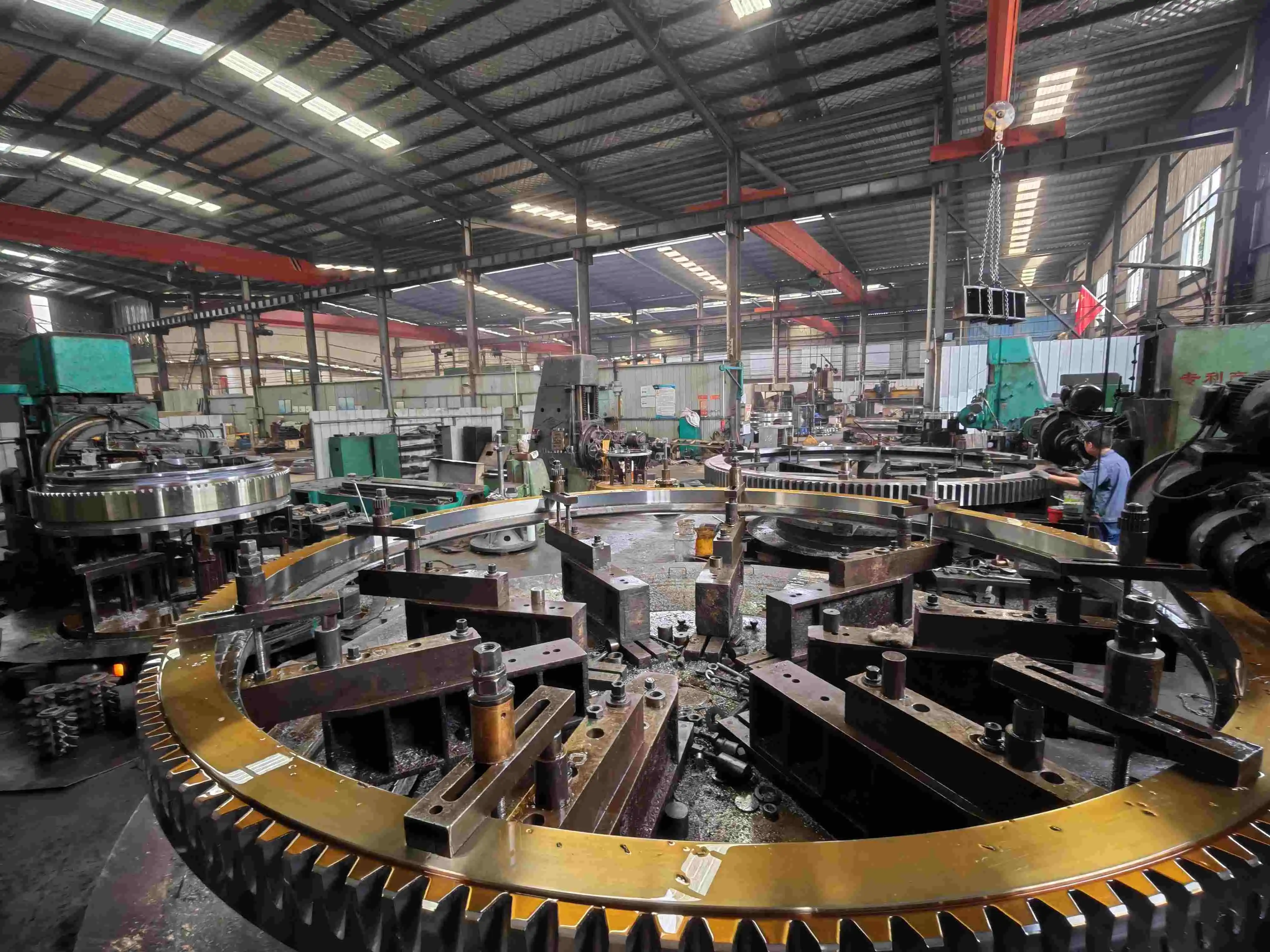
Excavator Slewing Bearing Inspection: Damage, Seals, and Raceway Condition
When packaged, examine the bearing under excellent light. Manually turn the rings and take note of whether it’s smooth and even. Watch for any roughness, tight areas, or clicking. Check the seals around both rings for cracks, gaps, or displacement, as they keep dust and water out of the raceway in a working site — Heng Guan’s excavator line features imported nitrile or fluoroelastomer seals with a double lip geometry that holds grease in and pushes water and fines out, but only when the seal is properly seated.
A good source of Excavator slewing bearings will also ensure that grease was applied at the plant. Check the plugs and oil ports, and check the gear teeth for burrs or chips. Gear teeth are induction hardened to HRC 45-50 to withstand the wear that arises from a misaligned pinion; thus, a visible burr typically signifies a handling accident, not a manufacturing problem. Here is a table to help guide you on what to check for on an Excavator slewing bearing provider.
Pre-Installation Inspection Checklist
| Inspection Item | What to Look For |
|---|---|
| Outer surfaces | No rust, dents, or coating damage |
| Rotation | Smooth, even turning by hand |
| Seals (NBR / FKM double-lip) | Intact, seated, no gaps or hardening |
| Gear teeth (HRC 45–50) | No burrs, chips, or uneven wear |
| Raceway (HRC 55–60) | No visible brinelling or corrosion pits |
| Grease ports and plugs | Present and undamaged |
| Cage (brass / steel / nylon 6/66) | No cracking or loose rolling elements |
If you find anything unusual, photograph it and contact your supplier before installation continues — Heng Guan supports reverse engineering from physical samples if you cannot match a legacy part number.
How Do You Verify Mounting Surface Flatness and Bolt Compatibility?
A perfect bearing still fails on an uneven seat. Clean the mounting surfaces of the undercarriage and the upper frame, then check flatness with a straightedge and feeler gauges or a dial indicator — the product-page installation guide sets the flatness deviation at ≤0.1 mm per meter, and exceeding that turns the thin-sectioned ring into a banana that loads one arc of the raceway much more heavily than the rest. Slewing bearings are thin-sectioned rings, so distortion from a warped surface transfers directly into the raceway.
Confirm that the bolt holes line up and that the bolt grade, length, and thread match the drawing supplied by your Excavator slewing bearing provider. Use new, correctly graded bolts and washers, and plan the tightening sequence in advance — Heng Guan's standard recommendation is a diagonal sequence in three stages (30% → 70% → 100% of specified torque) using a calibrated wrench, with a re-torque after the first 100 hours of operation.
Heng Guan supports customized design, so if your machine has a special hole pattern or flange, share the details early. Also identify the soft spot on the ring, usually marked, and position it away from the main load zone when fitting the Excavator slewing bearing provider — most excavator slew rings are marked with a "soft zone" symbol indicating the lower-race hardened gap that should sit outside the tooth-mesh sector.
Need help reading a drawing or matching bolt specifications? Email mia@hgb-bearing.com, and our engineers at Heng Guan will gladly review your requirements before you order.
Excavator Slewing Bearing Gear Alignment, Backlash, and Lubrication Checks
The last step is to confirm how the bearing will mesh with the drive. Fit the pinion and check the backlash at several positions around the ring, because slight variation is normal but large differences signal misalignment — for excavator drive pinions, backlash typically sits in the 0.2–0.4 mm band, and uneven backlash across the ring is the classic symptom of a twisted upper structure. Adjust until contact is even across the tooth width.
Then top up lubrication through each grease port, rotating the bearing slowly so grease spreads evenly along the raceway — Heng Guan's maintenance schedule is 250–500 hours under normal conditions and 100–250 hours in dusty, wet, or heavy-load environments, using NLGI Grade 2 lithium-based grease as a starting point. An Excavator slewing bearing provider can recommend the right grease for your climate and duty. With proper installation and maintenance, an Excavator Slewing Bearing from Heng Guan is built for 8,000–15,000 working hours of service life. The table below gives a simple final checklist for your Excavator Slewing Bearing.
Final Pre-Commissioning Checklist
| Final Check | Goal |
|---|---|
| Mounting flatness | ≤0.1 mm deviation per meter |
| Bolt tightening (30% / 70% / 100%) | Correct torque, diagonal sequence, re-torque at 100 h |
| Backlash (target 0.2–0.4 mm) | Even at all measured points around the ring |
| Tooth contact | Full and centered across tooth width |
| Lubrication | Fresh grease at every port, slow rotation to spread |
| Trial rotation | Smooth, quiet movement, no irregular noise |
| Seal integrity after first 50 h | No grease weep, no contaminant ingress |
Run a slow trial rotation before returning the machine to full work, and listen for irregular noise. Record the readings so you can compare them at the next service.
Conclusion
Careful inspection of the nameplate, raceway, seals, mounting surface, bolts, gear mesh, and grease gives an Excavator Slewing Bearing the best start. Follow each step, ask your provider whenever something looks doubtful, and Heng Guan will be glad to support your maintenance team.
FAQ
Q1: What should I check first on delivery?
Verify the nameplate, drawing, and packaging condition against your order, and confirm the diameter, accuracy grade, and structure type match your excavator's tonnage class.
Q2: How do I check raceway condition?
Turn the rings by hand and feel for smooth, even rotation, looking for roughness, tight spots, or clicking that would indicate brinelling or contamination.
Q3: Why does mounting flatness matter?
An uneven seat distorts the thin ring and concentrates load on one arc of the raceway, dramatically shortening service life.
Q4: How should backlash be checked?
Measure at several positions around the ring — slight variation is normal, but large differences (more than about 0.1 mm across positions) signal misalignment.
Q5: Can Heng Guan customize a bearing?
Yes, Heng Guan designs slewing bearings to match customer requirements and supports reverse engineering from existing samples.
How Heng Guan Solves Your Excavator Slewing Bearing Inspection Challenges
OEM replacement support. Direct-fit bearings across the major Excavator Slewing Bearing brands — Carter, Komatsu, Liebherr, Volvo, Hitachi, Doosan, JCB, Sumitomo, Sany, LiuGong, Hyundai, Kubota — with reverse-engineering service for legacy or obsolete part numbers from physical samples.
Ready to install with confidence? Heng Guan offers reliable slewing bearings, customized designs, and practical technical support. Send your model, drawing, or working conditions to mia@hgb-bearing.com, and our team will help you choose the right solution quickly.
References
1. Harris, T. A., and Kotzalas, M. N. Essential Concepts of Bearing Technology. CRC Press, 2006.
2. Harris, T. A., and Kotzalas, M. N. Advanced Concepts of Bearing Technology. CRC Press, 2006.
3. ISO 281. Rolling Bearings: Dynamic Load Ratings and Rating Life. International Organization for Standardization, 2007.
4. ISO 76. Rolling Bearings: Static Load Ratings. International Organization for Standardization, 2006.
5. Lugt, P. M. Grease Lubrication in Rolling Bearings. Wiley, 2013.
6. Hamrock, B. J., Schmid, S. R., and Jacobson, B. O. Fundamentals of Machine Elements. 3rd ed. CRC Press, 2013.

WHAT OUR CUSTOMERS SAY
Here is the customer's evaluation of us