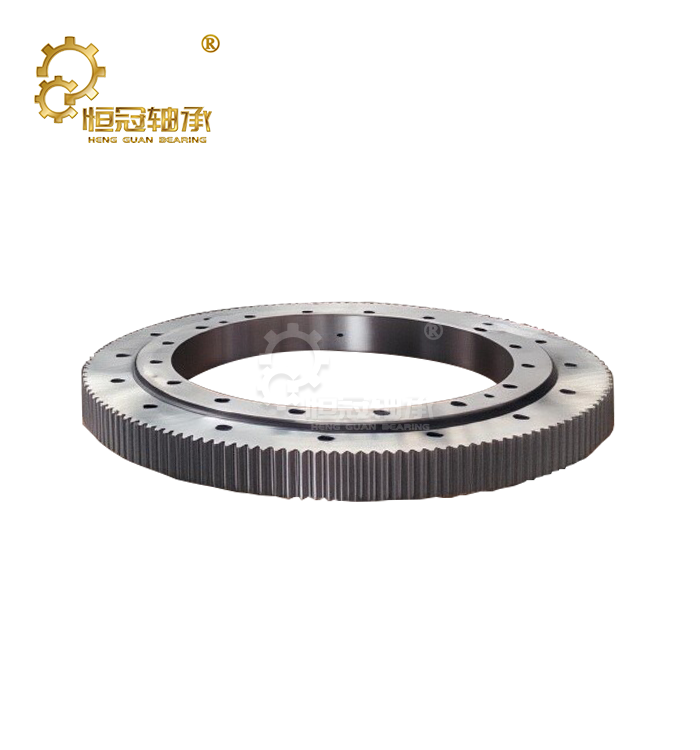




How Ring Stiffness Affects Gear Slew Bearing Performance?
Gear slew bearings are designed to carry combined load with controlled rotation in cranes, excavators, wind-energy systems, construction machinery and industrial positioning equipment. The performance of these bearings depends not only on the rolling elements and raceways, but also on the resistance of the bearing rings to deformation under service loads. Here, the stiffness of the ring is a key design concern. Ring stiffness is a measure of the capacity of the bearing rings to maintain their intended geometry under the application of axial loads, radial loads and overturning moments to the bearing. If the rings are too deformed, the load may not be distributed over the raceway as intended. The ensuing alterations may impair contact stress, rotational precision, gear engagement, seal performance and fatigue behaviour. But a stiffer bearing doesn't necessarily guarantee a better bearing. The needed stiffness relies on the diameter of the bearing, the cross section of the ring, the material, the heat treatment, the mounting arrangement, the external loads and the desired operating precision. The practical goal for engineers and purchasing teams is therefore not only the stiffest possible design, but to provide the correct level of stiffness for the entire bearing and machine structure.Understanding this relationship allows OEMs and equipment makers to better analyse gear slew bearings and to give manufacturers with the necessary technical knowledge for correct customisation.

How Does Ring Stiffness Control Load Transfer?
What Does Ring Stiffness Mean in a Slewing Bearing?
Deformation of the slewing bearing ring occurs during bearing operation under strain. The amount of deformation relies on the ring shape, material qualities, the size of the load, the position of the load, and the stiffness of the structure supporting the bearing.
In a gear slew bearing, the inner and outer rings also serve as the structural routes for the transfer of the operating loads between the rotating and the stationary portions of the machine. A large deflection of a section of the ring can locally affect the raceway geometry. This may cause some of the rolling pieces to carry more load than the others.
Thus, the stiffness of the ring must be considered in conjunction with the entire load-carrying system of the bearing. But significant structural deformation might lead to unfavorable contact conditions, even if the bearing itself has enough theoretical capacity.
The purpose of good engineering design is not to increase the deformation to a permissible limit without disturbing the requisite load distribution and the rotation characteristics.
Why Uniform Load Distribution Matters?
In a slewing bearing, the rolling elements do not constantly bear the same load. External loads and overturning moments will, of course, create varying load levels across the perimeter. This discrepancy can be increased by ring deformation.
If the ring shape is well maintained, the load transfer across the raceway can be better maintained closer to the design intent. In contrast, too much deformation might localize the load in some regions.
Localized loads can increase contact stress and hasten raceway or rolling-element fatigue. That counts. It can also result in irregular wear patterns that become more apparent as operating hours increase.
The problem is of special importance when a large overturning moment acts on the bearing for heavy gear. For example, a crane or excavator can generate a large moment load even if the radial load is not very large. The ring thus needs to have enough structural rigidity to keep its appropriate geometry during the actual operating state.
The Relationship Between Ring Stiffness and Contact Stress
Controlling Raceway Deformation
Contact stress builds up where the rolling elements interact with the raceways. The stress level depends on the load applied, the contact geometry, the material qualities, and the load distribution.
Ring deformation may change the contact conditions in the vicinity of the raceway. If the deformation is too large, the desired contact pattern may vary, and some locations may have higher loads than expected.
A proper ring design can limit this effect. Instead of looking at ring stiffness as a separate specification, engineers should consider it combined with the raceway geometry, rolling-element size, bearing diameter, and the projected mix of axial, radial, and moment stresses.
This method is especially significant in the case of large-diameter bearings since even slight structural deformations can influence the geometry over a broad bearing circle.
Avoiding Localized Stress Concentrations
Localized stress does not necessarily mean immediate bearing failure. The greater concern is repeated exposure to unfavorable loading conditions.
During every operating cycle, the rolling elements pass through different sections of the raceway. If a particular area consistently experiences excessive loading because of deformation, that section may become a critical point for fatigue damage.
Appropriate ring stiffness can help reduce unnecessary load concentration. It does not eliminate contact stress, because contact stress is an inherent part of rolling-element bearing operation. Instead, the goal is to keep the stress distribution within the range expected by the design.
This distinction is important when comparing bearing suppliers. Buyers should not simply ask whether a bearing has a “high stiffness” design. They should ask how the manufacturer evaluates deformation and load distribution under the customer's actual operating conditions.
Why Does Ring Stiffness Matter for Rotational Accuracy?
Managing Runout and Deflection
Rotational accuracy is another area influenced by gear slew bearings ring deformation. Runout describes the deviation of a rotating component from its intended geometric path. Excessive deformation can contribute to unwanted changes in rotational behavior, particularly when the bearing is subjected to changing loads.
For equipment that requires controlled positioning, excessive deflection can be more problematic than it would be in a simple low-precision rotation application.
Applications such as automated machinery, positioning platforms, robotic equipment, and precision handling systems may therefore require tighter control of bearing deformation.
The required level of stiffness should be determined from the machine's actual accuracy requirements. A heavy-duty crane slewing bearing and a precision positioning bearing do not necessarily need the same structural characteristics.
Maintaining Consistent Gear Engagement
For externally or internally geared slewing bearings, ring deformation can also influence gear engagement.
The gear teeth need to maintain an appropriate relationship during operation. If the bearing ring and the supporting structure deform significantly under load, the relative position between the gear and pinion can change. This may lead to uneven tooth contact.
Uneven gear contact can increase local tooth stress and accelerate tooth wear. It may also contribute to noise, vibration, and backlash changes.
This is why ring stiffness should be considered together with gear design. Gear module, tooth geometry, mounting accuracy, pinion alignment, backlash, and operating load all contribute to the final gear-mesh condition.
A manufacturer evaluating a geared slewing bearing should therefore consider the bearing and gear system as a complete assembly rather than treating the bearing ring and gear teeth as independent components.
Ring Stiffness, Preload, and Operating Stability
Why Preload Must Be Considered Carefully?
Some slewing bearing arrangements use preload or controlled internal clearance to achieve the required operating characteristics. The relationship between ring deformation and preload is important because external loads can change the internal contact condition.
If the ring deflects under load, the actual internal condition may differ from the condition measured during assembly. This can influence rotational resistance, contact pressure, and operating behavior.
The correct preload or clearance depends on the bearing design and application. It should not be selected solely by assuming that more preload will provide greater accuracy.
Engineers should instead evaluate preload together with load conditions, temperature, lubrication, mounting accuracy, and required service life.
The Role of Mounting Structure
One common mistake is to evaluate bearing ring stiffness without considering the machine structure.
A slewing bearing is normally bolted to a supporting structure. If the mounting flange or surrounding frame is not sufficiently rigid, the support may deform under load even when the bearing rings themselves are structurally strong.
In this situation, increasing bearing ring stiffness alone may provide limited improvement.
For demanding applications, the bearing manufacturer and machine designer should consider:
bearing ring stiffness;
mounting flange stiffness;
bolt arrangement and preload;
housing or platform deformation;
external load distribution;
overturning moment;
installation flatness.
This system-level approach provides a more realistic evaluation of rotational performance.
How Ring Stiffness Influences Wear and Fatigue Life?
Reducing Uneven Raceway Loading
Bearing fatigue is closely associated with repeated rolling contact. When load distribution is unfavorable, some raceway sections may experience higher contact stress than expected.
Maintaining appropriate ring stiffness can help limit deformation-driven load concentration. This may contribute to more consistent contact conditions and reduce unnecessary localized loading.
Nevertheless, ring stiffness is only one factor affecting fatigue life. Material quality, raceway hardness, heat treatment, lubrication, contamination, installation accuracy, load spectrum, and operating speed also have significant effects.
A technically sound bearing selection therefore considers ring stiffness as part of a broader durability analysis.
Limiting Wear Caused by Misalignment
Wear can become more severe when components operate under unfavorable alignment conditions.
In geared slewing systems, excessive deformation can affect the relationship between the raceway, gear, and pinion. In rolling contact areas, it can change the load distribution. In both cases, the resulting condition may increase localized wear.
The objective of proper ring design is not to eliminate all deformation. Every real component experiences some deformation under load. Instead, the design should control deformation so that it remains compatible with the operating requirements of the equipment.
This is especially important for machinery that performs frequent start-stop cycles, reversing movements, or repeated lifting operations.
 |  |
Ring Stiffness and Sealing Performance
Keeping the Seal in Its Intended Position
Sealing systems protect bearing interiors from water, dust, dirt, and other contaminants while helping retain lubricant.
Ring deformation can affect the relative position of components around the sealing area in gear slew bearings. If deformation becomes excessive, the seal may no longer operate under the conditions assumed during its design.
The effect depends strongly on the specific sealing arrangement and bearing construction. Therefore, it would be inaccurate to assume that increasing ring stiffness alone guarantees longer seal life.
Instead, sealing performance should be evaluated together with:
expected contamination;
water exposure;
operating temperature;
lubrication requirements;
seal material;
relative movement;
ring and housing deformation.
For outdoor equipment such as cranes, wind-energy equipment, and construction machinery, this combined assessment can be particularly important.
Protecting Lubrication Conditions
Contamination and lubricant loss are common concerns in demanding bearing applications. A suitable sealing arrangement helps maintain the intended lubrication environment.
If deformation affects the seal contact condition, the protective function of the seal may be reduced. Maintaining appropriate structural behavior therefore supports the overall bearing system, although seal design and lubricant selection remain separate engineering considerations.
How Engineers Should Specify Ring Stiffness
Start With the Complete Load Spectrum
When requesting a customized gear slew bearing, buyers should provide more than the maximum static load.
Useful design information includes:
maximum axial load;
radial load;
overturning moment;
load direction;
load frequency;
rotation speed;
duty cycle;
required service life;
operating temperature;
installation orientation;
gear requirements;
required rotational accuracy.
The load spectrum is particularly important for applications where the bearing experiences constantly changing forces.
Provide Mounting and Gear Information
Bearing stiffness cannot be evaluated accurately without understanding how the bearing will be installed.
The manufacturer may need information about the mounting flange, bolt circle, bolt size, support structure, installation flatness, gear module, pinion dimensions, and available installation space.
Providing these details early allows the bearing supplier to evaluate the complete interface instead of selecting a bearing solely from nominal diameter and load rating.
Ask for Engineering Evidence
For high-value OEM projects, buyers should ask manufacturers how the proposed bearing design was evaluated.
Depending on the application, useful engineering information may include:
load and deformation calculations;
finite element analysis;
raceway contact analysis;
gear-mesh evaluation;
dimensional inspection data;
material and heat-treatment documentation;
load testing;
runout or clearance inspection results.
Not every application requires all of these documents, but demanding applications benefit from a more detailed engineering review.
How to Choose the Right Ring Stiffness for Your Application
There is no universal ring-stiffness value that is suitable for every slewing bearing. The appropriate design depends on the relationship between bearing size, loading, support structure, accuracy requirements, gear configuration, and expected operating conditions.
For heavy-duty machinery, insufficient stiffness may result in excessive deformation and uneven load transfer. For precision equipment, the primary concern may instead be rotational accuracy and gear positioning. In other applications, durability and resistance to repeated moment loading may be the main priority.
This is why bearing selection should not be based only on outside diameter, static load rating, or price.
A better selection process starts with the actual operating requirements and then evaluates the bearing structure against those requirements. The manufacturer can use this information to determine the appropriate ring geometry, raceway configuration, material, gear arrangement, and manufacturing tolerances.
For OEM buyers, this also makes supplier comparison more meaningful. Two bearings with similar dimensions and nominal load ratings may behave differently if their structural stiffness, mounting interfaces, or internal design are different.
Conclusion
For gear slew bearings to work well, be accurate, and last a long time, the ring must have an appropriate level of stiffness. By properly designing ring stiffness, manufacturers can help control deformation, improve load distribution, maintain more consistent gear engagement, and support the required service life of the bearing system.
Ring stiffness affects much more than simple load capacity. It influences raceway contact conditions, stress distribution, rotational accuracy, gear-mesh behavior, wear, fatigue, and sealing performance. At the same time, stiffness should never be considered in isolation. Bearing dimensions, material properties, mounting structure, bolt arrangement, gear geometry, lubrication, operating loads, and duty cycle all contribute to the final performance.
For engineers and purchasing teams, the most reliable approach is to provide the bearing manufacturer with complete operating and installation data rather than selecting a bearing based only on nominal dimensions. A manufacturer with appropriate engineering and manufacturing capabilities can then evaluate the ring structure against the actual load spectrum and application requirements.
When selecting gear slew bearings for a new machine or replacement project, the key question is therefore not simply whether the ring is “stiff enough.” The more useful question is whether the ring stiffness is properly matched to the loads, support structure, accuracy requirements, and expected operating conditions of the complete system.
 |  |
FAQ
1. How stiff are gear slew bearing rings?
Ring stiffness, the bearing's ability to resist deformation under load, is essential for load distribution and operational precision.
2. How does ring stiffness affect gear slew bearing load capacity?
Bearings with higher ring stiffness can carry more loads without deforming, improving load-carrying capacity and operational stability.
3. Can ring stiffness affect gear slew bearing precision?
Optimized ring stiffness reduces bearing runout and maintains gear mesh accuracy, improving precision and performance.
4. How does ring stiffness affect gear slew bearing durability?
Optimizing ring stiffness improves fatigue life, wear, and sealing, extending bearing life.
Power Your Projects with Precision Slewing Bearings
Luoyang Heng Guan Bearing Technology Co., Ltd. is a top slewing bearing and ring manufacturer. We make precision bearings for various industries using cutting-edge production facilities gear slew bearings, and skilled engineers. Our products meet the highest performance and reliability standards due to our innovation and quality. Our solutions are tailored to customer needs and supported by technical staff. Superior bearings from Heng Guan drive success. Learn how our cutting-edge bearing technology can optimize your applications by emailing mia@hgb-bearing.com.
References
1. Smith, J. D. (2018). "Advanced Bearing Design for Heavy-Duty Applications." Journal of Mechanical Engineering, 42(3), 156-172.
2. Chen, X., & Wang, L. (2019). "Optimization of Ring Stiffness in Large-Diameter Slewing Bearings." International Journal of Precision Engineering and Manufacturing, 20(8), 1345-1358.
3. Thompson, R. A. (2020). "The Impact of Ring Stiffness on Gear Slew Bearing Performance in Wind Turbine Applications." Renewable Energy Systems, 15(2), 78-93.
4. Liu, H., & Zhang, Y. (2017). "Finite Element Analysis of Ring Stiffness Effects on Slewing Bearing Load Distribution." Tribology International, 112, 1-9.
5. Anderson, K. L. (2021). "Advancements in Gear Slew Bearing Design for Improved Durability and Precision." Machine Design and Materials, 56(4), 231-245.
6. Yamamoto, T., & Nakamura, S. (2016). "Experimental Study on the Relationship Between Ring Stiffness and Bearing Runout in Large Slewing Bearings." Journal of Tribology, 138(3), 031101.

WHAT OUR CUSTOMERS SAY
Here is the customer's evaluation of us

_1769754972666.webp)