



What Makes Crossed Roller Bearings Ideal for Automation?
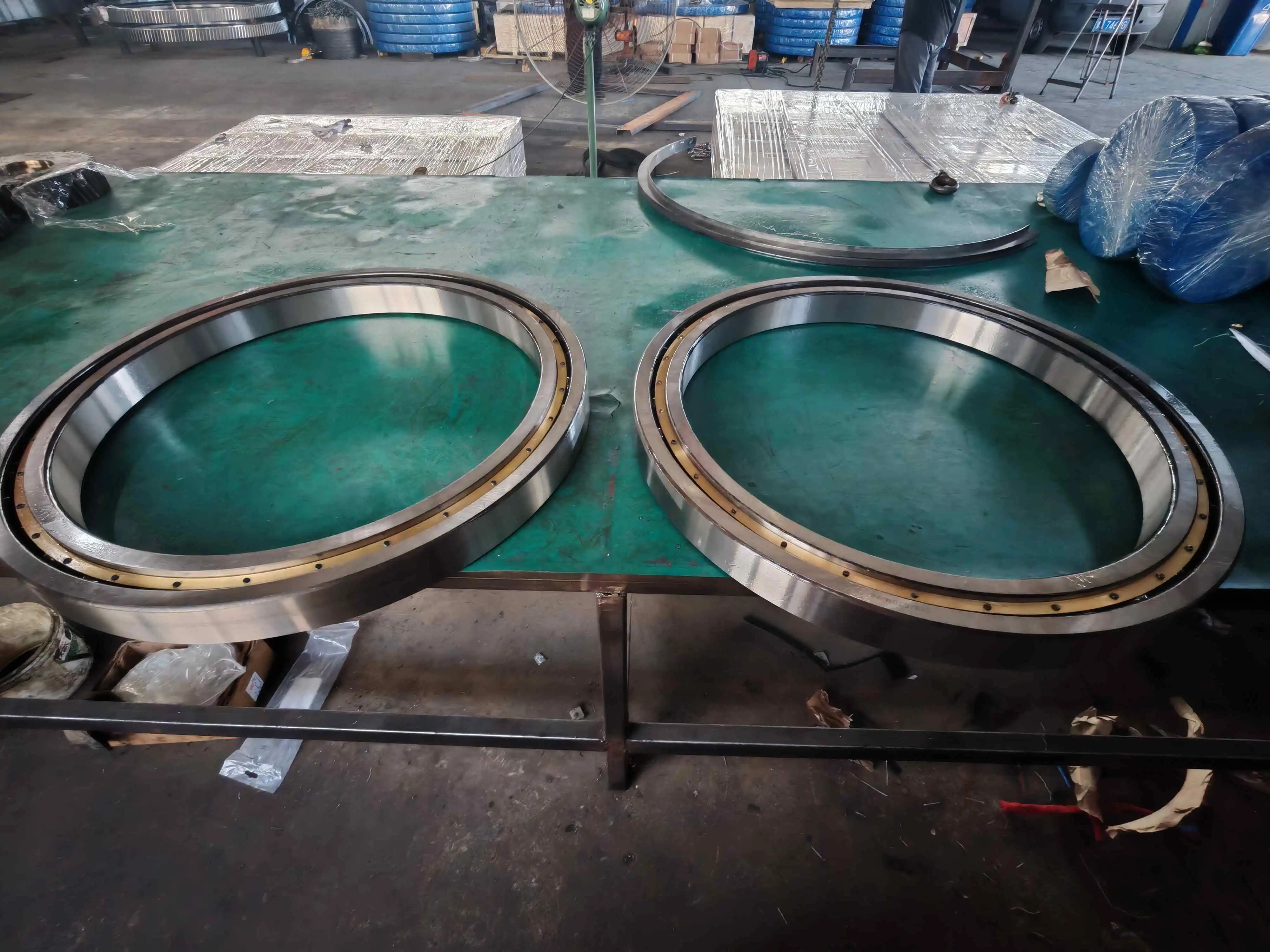
The bearing is usually to blame when an artificial joint moves out of place after a million cycles or when a rotary table develops backlash that makes it impossible to keep part standards. When crossed roller bearings are used, this problem is solved at the design level. This is because the X-shaped cylinder rollers make true line contact instead of point contact, which means that a single pair of raceways can handle radial, axial, and moment loads at the same time. That's what Heng Guan Bearing builds on. The company makes precision crossed roller bearings from GCr15 bearing steel in diameters ranging from 50 mm to 10,000 mm. Robotics, machine tool, and automation equipment builders all over the world trust them. This article talks about what makes this type of bearing so important for applications that need precise motion.
|
|
How Do Crossed Roller Bearings Improve Precision in Automated Systems?
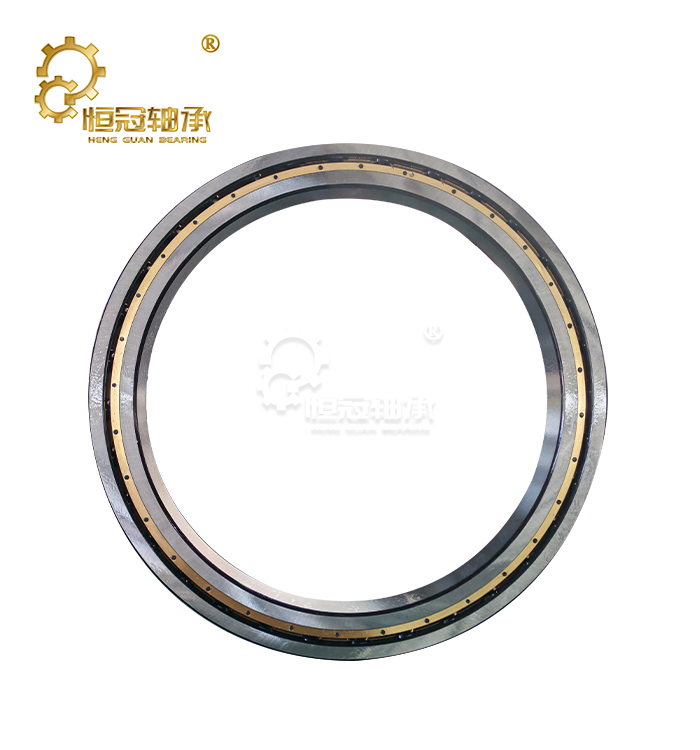
Geometry is the first step to precision. In crossing roller bearings, the circular rollers move back and forth between a single pair of raceways in a pattern that is perpendicular to each other. This way, each roller shares the load along a true line contact instead of a point contact. In this setting, the elastic displacement that causes positioning shift in regular multi-bearing systems is almost completely eliminated. That directly means better accuracy and less backlash over millions of cycles for automatic systems that do pick-and-place cycles, rotating tracking, or precision checking.
Precision crossed roller bearings from Heng Guan Bearing are made from GCr15 bearing steel that has been treated with advanced heat. This makes sure that the raceway hardness stays the same from the first cycle to the millionth. One pair of raceways can handle radial, axial, and moment loads at the same time, so builders don't have to worry about the stack-up limits that come with multi-bearing systems. This makes motion control for automatic equipment smoother and more reliable.
| Precision Factor | Mechanism | Benefit to Automated Systems |
|---|---|---|
| Line contact geometry | Rollers at 90° X-arrangement | Reduces elastic deformation and positioning drift |
| Single raceway design | One pair handles all load directions | Eliminates stack-up tolerance errors |
| Controlled heat treatment | Advanced process on GCr15 steel | Maintains consistent hardness over service life |
| Adjustable clearance | Normal, small, or preload options | Fine-tunes rotational accuracy for exact positioning |
| High manufacturing precision | P0–P4 grades per ISO / DIN / GB | Matches accuracy to application requirements |
What Are the Key Advantages of Crossed Roller Bearings in Automation Equipment?
Beyond precision, precision-crossed roller bearings bring practical advantages that automation engineers consistently value. Rigidity is one of the biggest advantages — the crossed roller arrangement resists deflection far better than standard bearings of similar size, so robotic arms and rotary tables stay accurate even under sudden directional changes. Compactness is another: because one bearing replaces what would otherwise require several separate bearings, machine designers can shrink joint housings and reduce overall weight, which matters enormously in robotics and collaborative automation.
Load versatility rounds out the picture, since these bearings absorb radial, axial, and moment loads at once without supplementary thrust bearings. This simplifies assembly and lowers long-term maintenance, since fewer components mean fewer potential failure points. Heng Guan Bearing offers seven standard model series — RA, RB, RE, RU, CRB, CRBH, and SX — covering a wide range of mounting configurations, plus full custom manufacturing from customer drawings.
| Parameter | Specification |
|---|---|
| Material | GCr15 bearing steel |
| Diameter range | 50 mm – 10,000 mm |
| Standard model series | RA, RB, RE, RU, CRB, CRBH, SX |
| Precision grades | P0, P6, P5, P4 (P4 = highest) |
| Clearance options | Normal, small, preload |
| Load capacity | Radial, axial, and moment loads simultaneously |
| Operating temperature | −20°C to +120°C |
| Lubrication | Grease or oil lubrication |
| Standards compliance | ISO, DIN, GB |
| Custom manufacturing | Available per customer drawings |
For engineers comparing crossed roller bearings against traditional angular contact or four-point contact designs, the combination of rigidity, compactness, and multi-directional load capacity is usually decisive.
Advanced Design Features That Make Crossed Roller Bearings More Reliable
Reliability in automation comes down to how well a bearing resists wear, contamination, and thermal variation across continuous duty cycles. Heng Guan Bearing addresses this through several design features built into every precision crossed roller bearing. The uniform cross-section roller design with single raceway construction ensures compact assembly with minimal runout, while the 90° cross-arrangement distributes stress evenly across all rolling elements.
Clearance management is equally critical. Three options — normal clearance, small clearance, and preload — let designers specify exactly how much rotational freedom the bearing allows, balancing smoothness against positioning accuracy. For high-speed applications, lower-friction configurations reduce heat generation; for heavy-load indexing, tighter preload maximizes stiffness. Sealed variants keep contaminants out of the raceway, essential in dusty factory floors or wash-down environments common in food and pharmaceutical automation.
Should you need help selecting the right configuration, reach out to mia@hgb-bearing.com — the engineering team can walk through model series, preload class, clearance options, and mounting orientation with you.
| Design Feature | Function | Reliability Benefit |
|---|---|---|
| 90° cross-arrangement (X-pattern) | Distributes load across perpendicular rollers | Even stress distribution, reduced wear |
| Single raceway construction | One pair handles all load types | Compact assembly, minimal runout |
| Adjustable clearance (normal/small / preload) | Tunes rotational freedom | Balances smoothness vs. positioning accuracy |
| Advanced heat treatment | Hardens GCr15 raceways uniformly | Consistent performance over service life |
| Sealed variants | Blocks dust, moisture, and contaminants | Extends bearing life in harsh environments |
Why Choose Crossed Roller Bearings for Compact and High-Performance Automation Solutions?
When automation designers need maximum performance from minimum space, crossed roller bearings are frequently the natural choice. Their slim cross-sectional profile lets engineers integrate high rigidity and multi-directional load support into joints, rotary tables, and spindles that simply have no room for bulky bearing stacks. This is especially valuable in collaborative robots and compact machine tools, where every gram and millimeter affects overall system dynamics and energy efficiency.
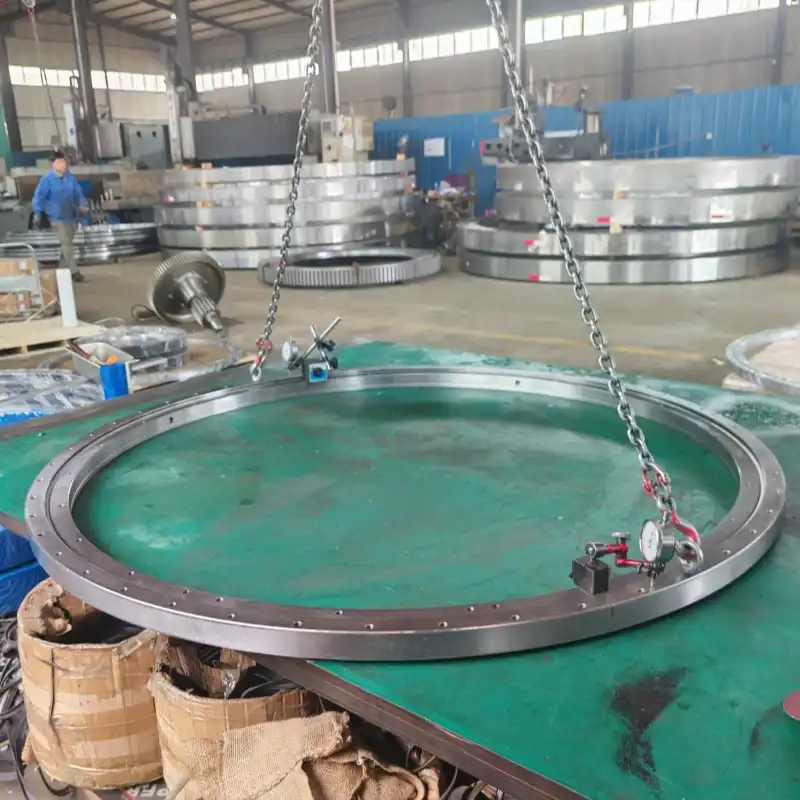
Because Heng Guan Bearing custom-manufactures precision crossed roller bearings from 50 mm to 10,000 mm in diameter across precision grades P0 through P4, automation builders can specify a bearing matched precisely to their torque, speed, and accuracy targets rather than compromising with an off-the-shelf part. Proper installation and maintenance ensure that precision holds over time:
| Interval | Action |
|---|---|
| Pre-installation | Clean all contact surfaces; verify fit dimensions and alignment |
| Installation | Use proper lifting equipment; ensure axial/radial alignment; apply uniform pressure |
| Startup | Apply specified lubricant; manually rotate to verify smoothness; confirm clearance within tolerance |
| Quarterly | Monitor operating temperature and vibration; replenish lubricant per duty cycle |
| Annually | Full assessment — runout, noise, clearance drift, seal condition |
| Immediate | Investigate any abnormal noise, vibration, or temperature rise |
The result is automation equipment that runs smoother, lasts longer, and holds positioning accuracy across demanding schedules.
Conclusion
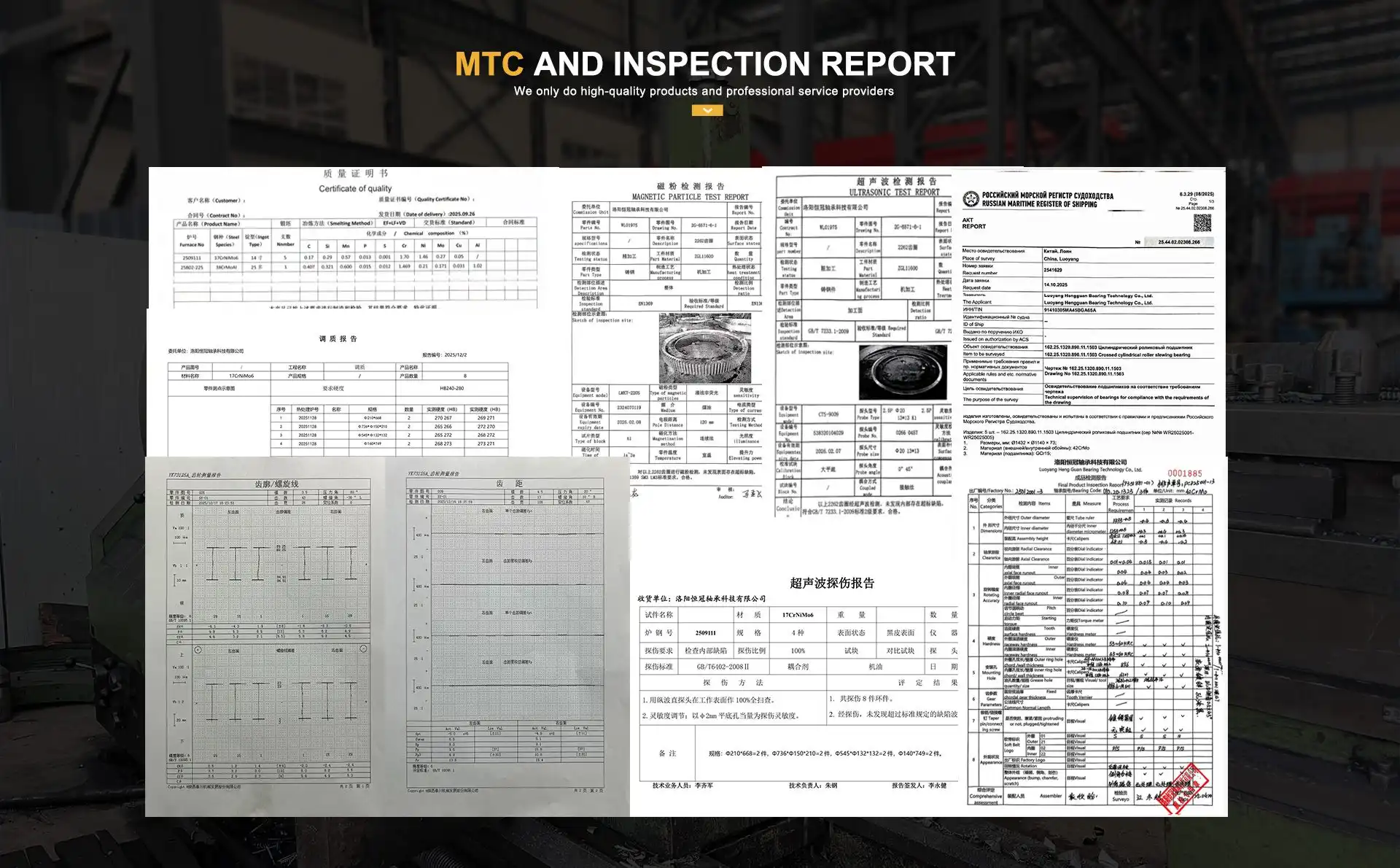
Precision crossed roller bearings from Heng Guan Bearing deliver the rigidity, compactness, and accuracy that automation demands. With GCr15 construction, P0–P4 precision grades, and custom manufacturing from 50 mm to 10,000 mm, the company stands ready to help you engineer the right solution for your next project.
FAQ
Q: What sizes does Heng Guan Bearing produce?
A: Custom diameters from 50 mm to 10,000 mm, available in P0, P6, P5, and P4 precision grades per ISO, DIN, and GB standards.
Q: Can one bearing replace multiple standard bearings?
A: Yes — the 90° cross-arrangement lets a single raceway pair handle radial, axial, and moment loads simultaneously, eliminating the need for supplementary thrust bearings.
Q: Are crossed roller bearings suitable for robotics?
A: Absolutely. Their high rigidity, slim cross-section, and adjustable preload make them ideal for robotic joints, collaborative robot arms, and precision rotary tables.
Q: What materials are used?
A: GCr15 bearing steel with advanced heat treatment for consistent raceway hardness throughout the service life.
Q: What standard model series are available?
A: Seven series — RA, RB, RE, RU, CRB, CRBH, and SX — plus full custom manufacturing from customer drawings.
Engineer Your Next Precision Motion Project with Confidence
Stop compromising on positioning accuracy. Heng Guan Bearing delivers custom-engineered precision crossed roller bearings in GCr15 steel, with seven standard series (RA / RB / RE / RU / CRB / CRBH / SX), P0–P4 precision, and diameters from 50 mm to 10,000 mm — all backed by ISO 9001 certified quality control and a 50-engineer R&D team. Send your drawings or performance requirements to mia@hgb-bearing.com today and get a technical response within 24 hours.
References
1. Harris, T. A., & Kotzalas, M. N., Rolling Bearing Analysis.
2. Brändlein, J., et al., Ball and Roller Bearings: Theory, Design and Application.
3. American Bearing Manufacturers Association, Precision Bearing Standards.
4. International Organization for Standardization, ISO 5593 — Rolling Bearings Vocabulary.
5. Society of Manufacturing Engineers, Robotics and Automation Handbook.
6. Journal of Mechanical Design, Rigidity in Robotic Joint Bearings.

WHAT OUR CUSTOMERS SAY
Here is the customer's evaluation of us
_1767784942887.webp)