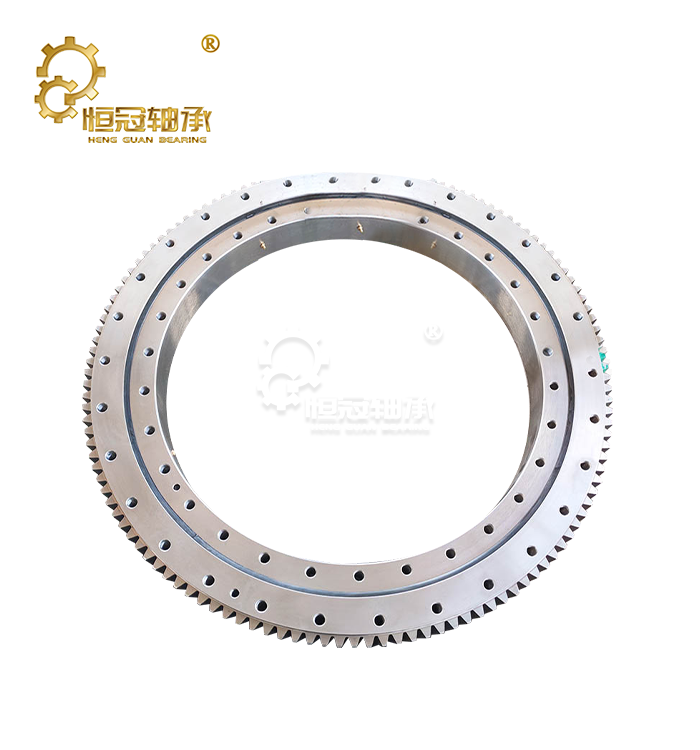




Slewing Ring Manufacturer for Custom Engineering Solutions
When a slewing ring breaks on a wind turbine nacelle or a crane boom, it's not just the part that costs money; it's also the time that the crew has to wait and the project date that gets pushed back. It is rare for generic catalogue bearings to be designed to handle the constant axial, radial, and moment loads that heavy equipment creates. Picking the wrong setup can cut service life in half. That's where Heng Guan Bearing comes in. The company is a slewing ring manufacturer based in Luoyang, China's historic bearing hub. It has 20 years of production experience and a 50-engineer research and development team that works together to create custom rotational solutions with geared slewing rings. This guide talks about what factors are most important when picking a manufacturer, how custom design changes the way equipment works, and the quality procedures that set trustworthy suppliers apart from the rest.
What Are the Key Factors to Consider When Choosing a Slewing Ring Manufacturer?
Picking the right partner is just as important as the part itself. When it comes to manufacturing, accuracy grades from P0 to P4 directly affect how smooth the spinning is and how much runout there is when the load is applied. Next is the quality of the materials: high-strength 42CrMo or 50Mn alloy steel rings, GCr15SiMn rolling elements, and induction-hardened raceways (HRC 55–60) give heavy-duty uses the tough core and wear protection they need.
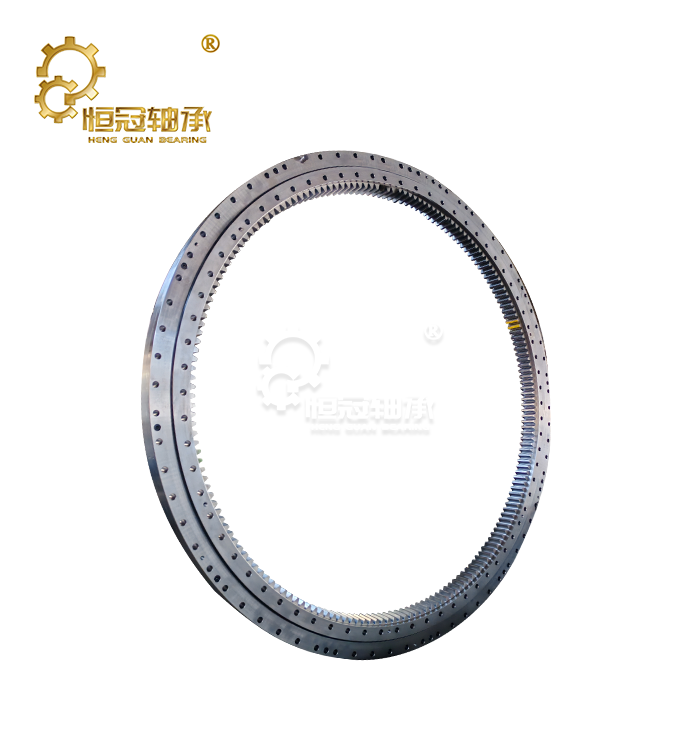
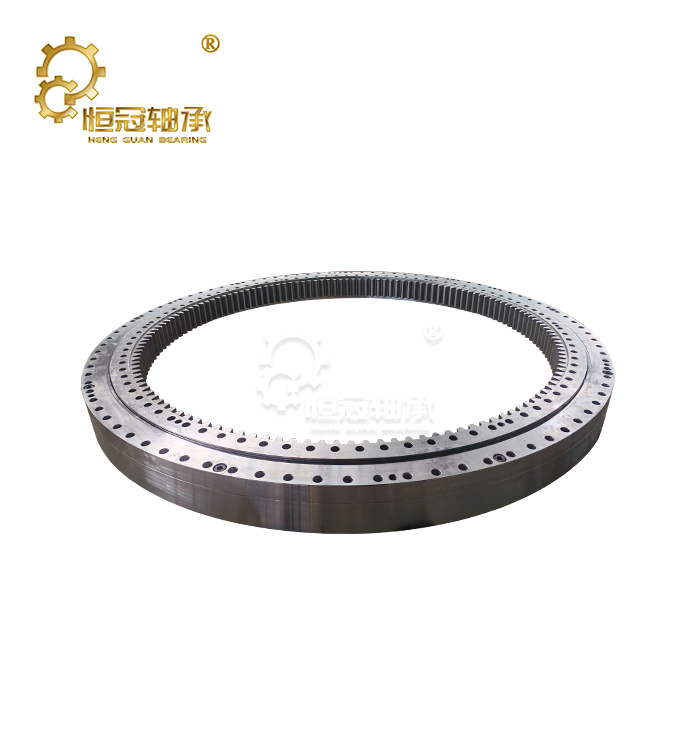
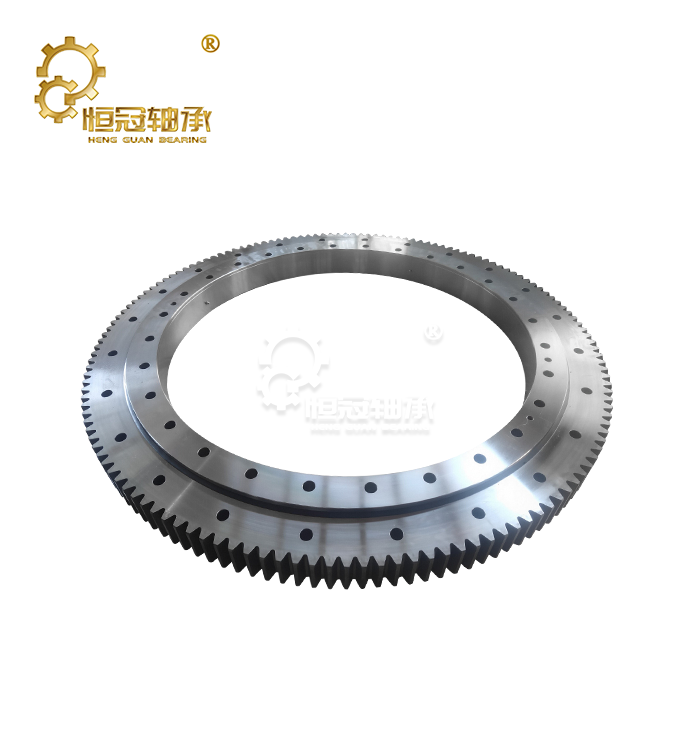
The way the gears are set up is also very important. Ask the manufacturer if they can provide an external gear slewing bearing in addition to an internal gear or gearless option. The placement of the gears affects how the drive is integrated, how easy it is to do maintenance, and how well they protect against contamination. Suppliers of slewing rings you can trust should give technical help from the idea stage to production, not just catalogue items. A good sign of technical development is experience in a wide range of fields, such as building, wind power, port handling, mining, and medical tools.
| Selection Factor | Why It Matters |
|---|---|
| Precision grade (P0–P4) | Determines rotational accuracy, runout, and vibration levels |
| Material composition (42CrMo / 50Mn + GCr15SiMn) | Impacts load capacity, fatigue resistance, and service life |
| Raceway hardness (HRC 55–60, depth 2.5–5 mm) | Ensures wear resistance while maintaining a tough core |
| Gear configuration (external/internal/gearless) | Affects drive integration, inspection access, and contamination protection |
| Engineering support | Ensures the design truly fits your application, not just the catalog |
| Export experience (50+ countries) | Reduces shipping, customs, and documentation complications |
Custom Slewing Ring Design and Engineering Capabilities for Industrial Applications
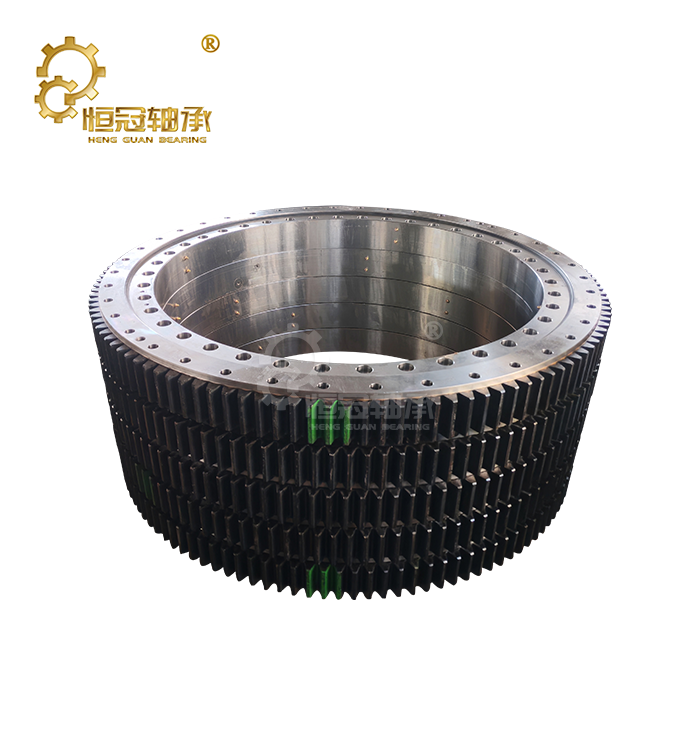
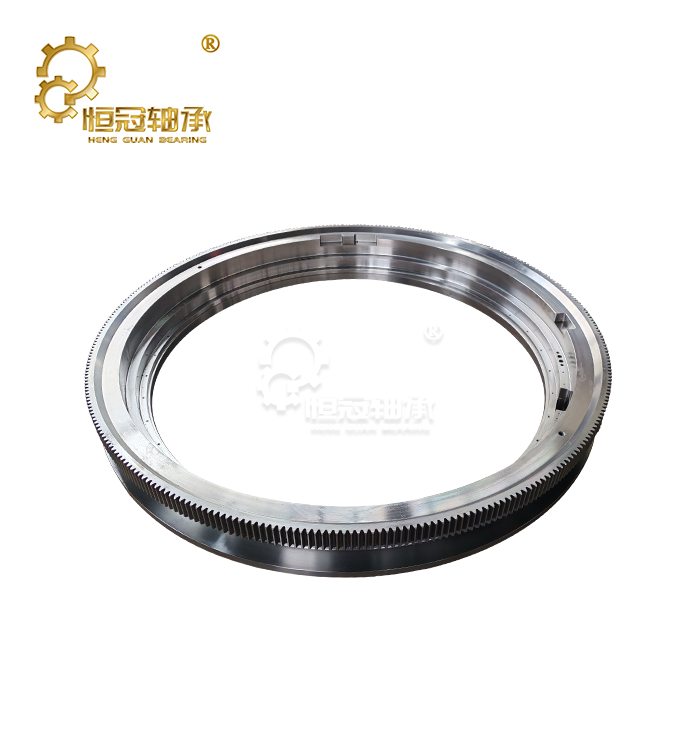
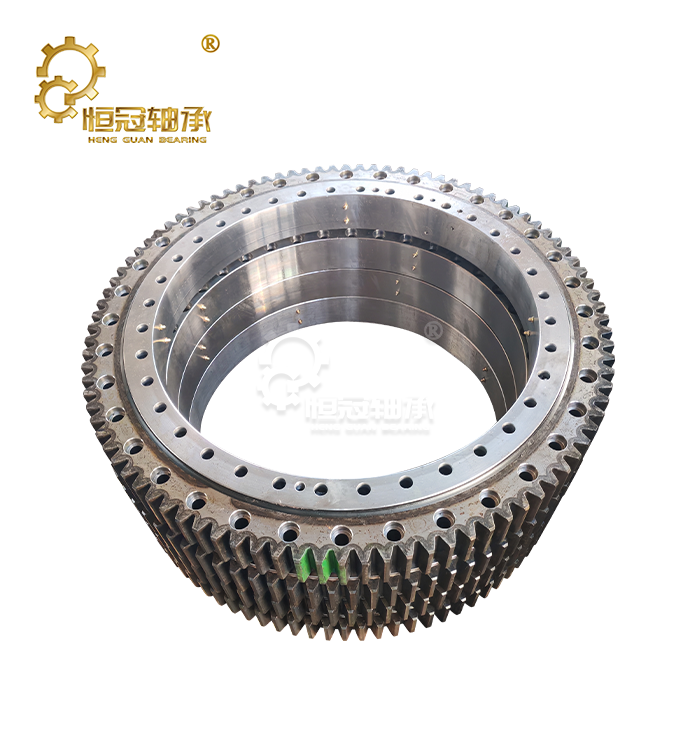
Different machines have different needs for a rotating part. This is why custom engineering sets leading manufacturers apart from generic suppliers. A good slewing ring maker should be able to adjust the structure of the raceway, the type of gear, the mounting interface, and the sealing system to fit your specific needs. When direct inspection and easy cleaning are important, an external gear slewing bearing is usually the best choice. On the other hand, internal gear designs are better for situations that need to keep contaminants inside.
Many different types of structures can be used. Engineers can match the type of load to the best geometry using single-row four-point contact balls, single-row cross rollers, double-row balls of different diameters, three-row rollers, double-row balls, ball-roller combinations, and thin-wall balls. The diameters range from 50 mm to 10,000 mm, which includes small robotic joints and huge port cranes.
| Parameter | Specification |
|---|---|
| Diameter range | 50 mm – 10,000 mm |
| Precision grade | P0, P6, P5, P4 |
| Base material | 42CrMo / 50Mn alloy steel |
| Rolling element material | GCr15SiMn high-purity bearing steel |
| Raceway hardness | HRC 55–60 (induction hardened, depth 2.5–5 mm) |
| Gear tooth hardness | HRC 45–50 (induction hardened) |
| Gear options | External, internal, or gearless |
| Operating temperature | −40°C to +120°C |
| Sealing options | Multiple configurations (NBR / fluoroelastomer) |
| Structure types | Single-row four-point ball, cross roller, double-row ball, three-row roller, ball-roller combo, thin-wall |
| Mounting | Bolt-fixed with precision-machined holes |
If your project calls for something outside standard catalogs, reach out to mia@hgb-bearing.com — the engineering team works directly with clients to translate specifications into working solutions from the design stage onward.
|
|
How Does a Professional Slewing Ring Manufacturer Ensure Quality and Reliability?
Different machines have different needs for a rotating part. This is why custom engineering sets leading manufacturers apart from generic slewing rings suppliers. A good slewing ring maker should be able to adjust the structure of the raceway, the type of gear, the mounting interface, and the sealing system to fit your specific needs. When direct inspection and easy cleaning are important, an external gear slewing bearing is usually the best choice. On the other hand, internal gear designs are better for situations that need to keep contaminants inside.
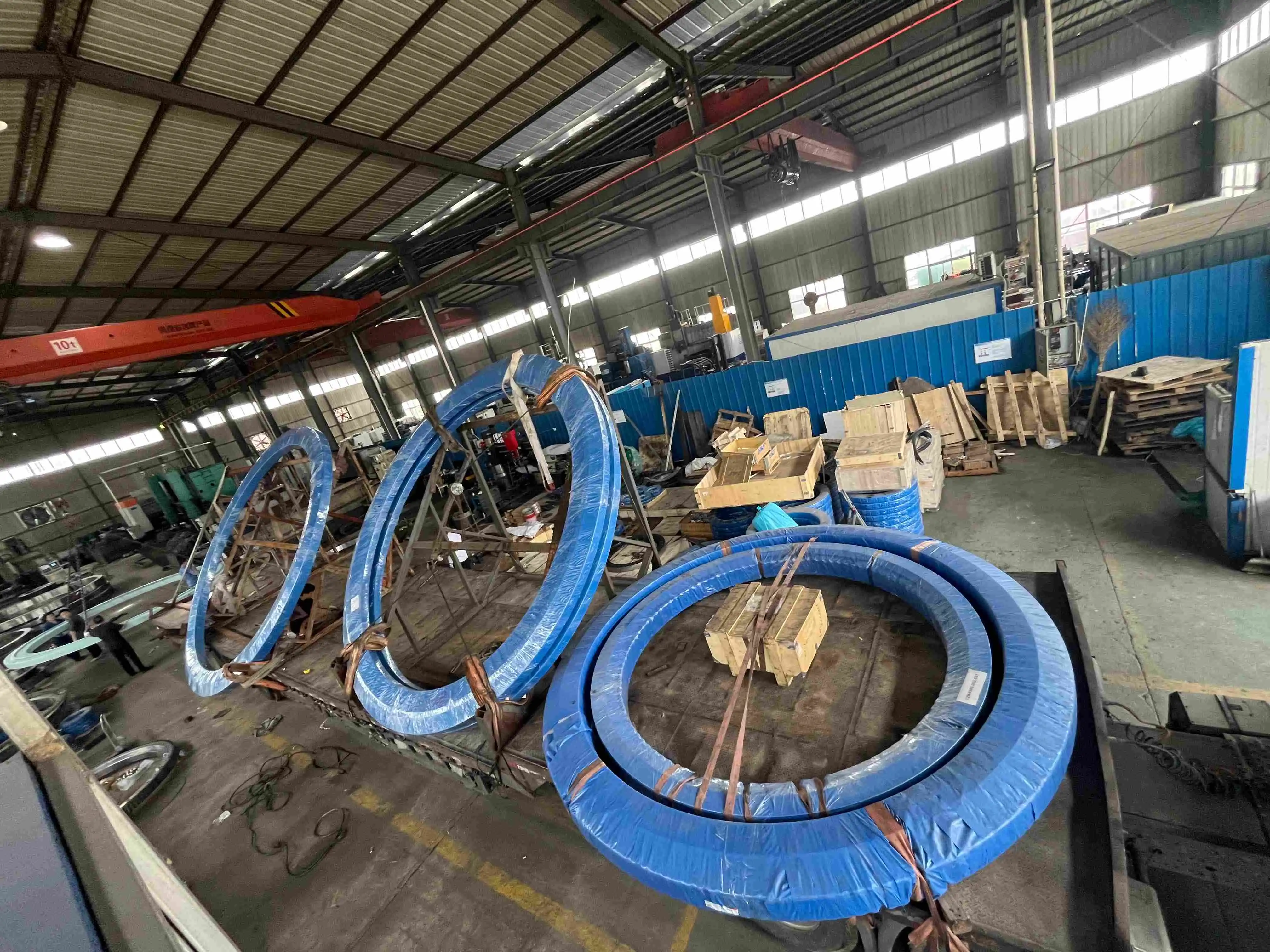
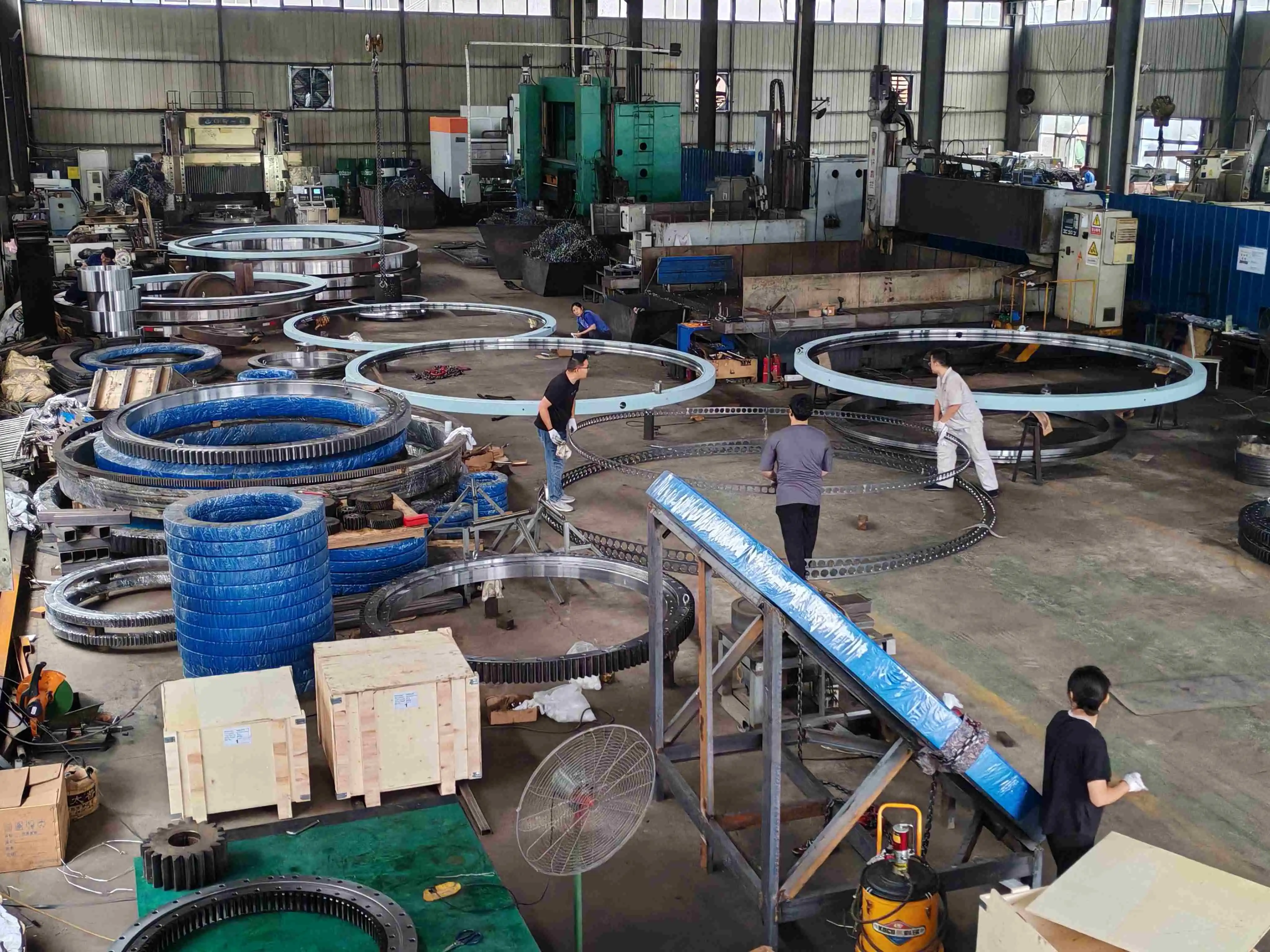
Before a bearing ships, it goes through a series of documented tests. These include checking the dimensions with a coordinate measuring machine (CMM), checking the rotational smoothness with vibration, checking the hardness of the bearing after heat treatment, checking the gears to make sure the teeth are straight, and testing the bearing's life under real-life conditions. Each unit can be tracked from raw steel to final product thanks to full material approval and batch tracking. Buyers of slewing rings can be sure that each gear will work well for years if the sellers have a proven agreement with ISO 9001, CE, and RoHS.
| Quality Stage | Method | Purpose |
|---|---|---|
| Material inspection | Spectral analysis + certification | Confirms alloy composition and defect-free stock |
| Heat treatment | Induction hardening | Achieves HRC 55–60 raceway, HRC 45–50 gear teeth |
| Precision machining | CNC vertical machining centers | Maintains P0–P4 tolerance accuracy |
| CMM dimensional check | Coordinate measuring machine | Verifies diameters, flatness, and hole patterns |
| Vibration testing | Dedicated test rig | Confirms smooth, quiet rotation |
| Gear inspection | Tooth profile measurement | Verifies meshing accuracy and transmission reliability |
Why Choose Custom-Engineered Slewing Ring Solutions for Heavy-Duty Equipment?
Cranes, loaders, stacker reclaimers, and wind turbine nacelles are all examples of heavy machinery that put radial, axial, and moment loads on a single moving point, often all at the same time. A standard off-the-shelf geared slewing ring might fit, but it doesn't usually last as long as it should in these situations. Custom engineering lets the shape of the raceway, the profile of the gear, and the way the seals are set up be perfectly matched to the real load range and environment.
This is especially helpful when adding an external gear slewing bearing to a drive system that needs to be mounted directly and doesn't have any complicated internal mechanisms. When you work with experienced slewing rings suppliers, you can get non-standard flanges, lubrication strategies that are tailored to your application, and advanced sealing systems that keep dust, slurry, or marine contamination from getting into the internal parts.
Both construction and upkeep must be done correctly. Before fitting, make sure all surfaces are clean, use the right lube, make sure the bolts are aligned correctly, and tighten them according to the manufacturer's instructions. The following repair plan helps the service last as long as possible:
| Interval | Action |
|---|---|
| Monthly | Visual inspection for wear, corrosion, or seal damage |
| Quarterly | Lubrication replenishment; bolt torque verification |
| Annually | Full assessment — runout, noise, vibration, gear tooth wear |
| Initial run-in | Check after first 50–100 operating hours; retighten bolts |
| Immediate | Investigate any abnormal noise, vibration, or temperature rise |
A tailored slewing ring reduces friction losses, extends maintenance intervals, and improves reliability — advantages that compound over the machinery's operational lifetime.
Conclusion
A slewing ring determines how reliably your equipment rotates, carries load, and lasts under demanding conditions. With custom engineering, documented quality control, and 20 years of manufacturing expertise, Heng Guan Bearing stands ready to help you design and source the right bearing for your fleet.
|
|
FAQ
Q: What diameter range do custom slewing rings cover?
A: From 50 mm up to 10,000 mm, covering everything from compact robotic joints to massive port cranes and wind turbine yaw systems.
Q: What is the difference between internal and external gear slewing bearings?
A: External gears allow easier visual inspection, direct drive mounting, and simplified lubrication; internal gears provide enclosed contamination protection for harsh environments.
Q: Which industries use custom slewing rings most?
A: Construction machinery, wind power, mining, port handling, medical equipment, marine applications, material handling, and amusement rides.
Q: What precision grades are available?
A: P0, P6, P5, and P4 accuracy grades per ISO/DIN/GB standards, matching everything from general industrial rotation to high-precision medical and aerospace applications.
Q: How do I start a project?
A: Share your load conditions, dimensions, and operating environment with the Heng Guan Bearing technical team for consultation and a custom quotation.
Get Your Custom Slewing Ring Quote Today
Stop settling for catalog parts that barely fit. Heng Guan Bearing delivers custom-engineered geared slewing ring solutions with 42CrMo / 50Mn construction, induction-hardened raceways (HRC 55–60), and P0–P4 precision — backed by ISO 9001 certified quality control and a 50-engineer R&D team. Send your drawings, load specs, or machine model to mia@hgb-bearing.com today and get a technical response within 24 hours.
References
1. Harris, T. A., & Kotzalas, M. N., Rolling Bearing Analysis.
2. Brändlein, J., et al., Ball and Roller Bearings: Theory, Design and Application.
3. American Bearing Manufacturers Association, Slewing Ring Bearing Standards.
4. International Organization for Standardization, ISO 21329 — Rolling Bearings, Slewing Bearings.
5. Burton, T., et al., Wind Energy Handbook.
6. Construction Equipment Engineering Journal, Rotational Bearing Systems in Cranes and Excavators.

WHAT OUR CUSTOMERS SAY
Here is the customer's evaluation of us
_1776668700508.webp)