




What Makes a High-Precision Rotary Table Bearing?
A high-quality Rotary Table Bearing with strict manufacturing tolerances, strong construction, and precise preload provides smooth, accurate rotation under load. But the difference between a bearing that keeps its runout through a full shift of production and one that drifts after a few thousand cycles usually comes down to three things: the accuracy grade you specified, the clearance band the manufacturer actually held, and whether preload was set against your duty cycle or copied from a catalog default. Heng Guan Bearing, a subsidiary of Luoyang Heng Guan Bearing Technology Co., Ltd., develops and manufactures slewing bearings ranging from 50 mm to 10,000 mm, including high-precision versions for automation and indexing equipment. Read on to learn which elements are important when you specify your next Rotary Table Bearing.
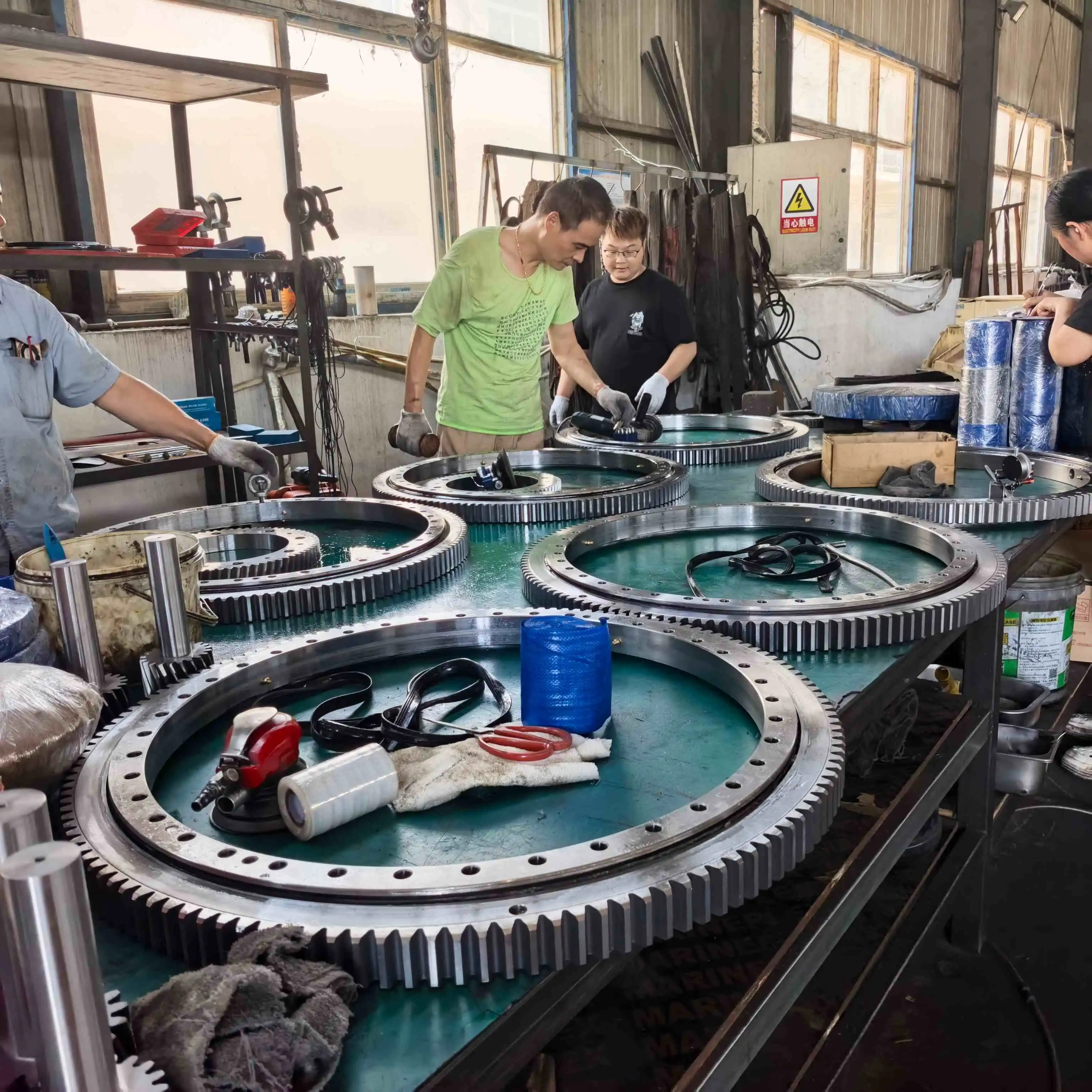
What Factors Determine Rotary Table Bearing Precision?
The accuracy of a rotary table bearing starts in design and continues through each stage of the production process. The raceway shape, the roundness of the rings, and the consistency of the rolling elements all impact the positioning accuracy of the table for its workload. Structure also matters a lot: For rotary tables, cross cylindrical roller designs are common because they take axial, radial, and moment loads in a compact package, providing a stiffness that a single ball race cannot match at the same envelope.
Heng Guan Bearing provides precise grades P0, P6, P5, and P4 to allow purchasers to match the grade with their machine’s positioning demands. Skilled specialists, modern machining equipment, and careful inspection all help guarantee that each ring matches its specified tolerance. On the geared platform, Heng Guan’s ground-gear process achieves Class 6 accuracy with gear surface hardness of HRC 45–55. Axial/radial clearance is controlled to a narrow 0.03–0.04 mm band on the high-precision configuration. If you’re comparing possibilities, first define the accuracy your application genuinely needs; everything else flows from that figure.
Precision Factors at a Glance
| Factor | What It Determines |
|---|---|
| Raceway geometry | Load distribution and rotational accuracy |
| Ring roundness | Runout and positioning repeatability |
| Rolling element consistency | Smoothness and bearing service life |
| Structure type (cross roller) | Rigidity and combined load capacity in a compact envelope |
| Accuracy grade (P0 / P6 / P5 / P4) | Positional accuracy and match to machine class |
| Gear precision (Class 6 ground) | Transmission smoothness and backlash control |
| Internal clearance band | Thermal stability and freedom from binding |
Rotary Table Bearing Accuracy, Runout, Rigidity, and Preload
Four properties define how a Rotary Table Bearing performs in service. Accuracy describes how closely rotation follows its ideal path, while runout measures the small axial and radial deviations during rotation. Rigidity shows how well the bearing resists deflection when loads and moments are applied, and preload removes internal clearance so the table stays stable and repeatable. Together, they determine cutting quality on machine tools, image stability in medical equipment, and repeatability in automated lines.
Heng Guan Bearing tailors these values to each customer's drawing, from single-row four-point contact ball structures to cross roller and combined designs. The manufacturing range spans 50 mm to 10,000 mm in diameter, so both compact indexing tables and large rotary platforms are covered by the same quality system. Use the table below as a quick reference when you prepare your specification.
Accuracy, Runout, Rigidity, and Preload
| Property | What It Controls | How Heng Guan Addresses It |
|---|---|---|
| Accuracy | Positioning quality | Precision grades P0–P4, matched to machine class |
| Runout | Rotation smoothness | Ring roundness controlled by CNC machining and final inspection |
| Rigidity | Resistance to deflection under load and moment | Cross cylindrical roller structure for high stiffness |
| Preload | Stability and repeatability | Set to drawing against actual duty cycle, not a default value |
| Internal Clearance | Freedom from binding as the table warms up | Held to 0.03–0.04 mm on the high-precision platform |
| Gear Accuracy | Smooth transmission at the rotary index | Class 6 ground gear with HRC 45–55 surface |
How Does Preload Affect Rotary Table Bearing Performance?
Preload is one of the most effective tools for improving a Rotary Table Bearing. By applying a controlled internal load, the bearing eliminates clearance between the rolling elements and raceways, which increases stiffness and keeps the table steady during fast indexing or heavy cutting. A well-chosen preload also improves repeatability, meaning the table returns to the same position cycle after cycle.
The right level depends on speed, load, and the operating environment, so it should be agreed with your supplier at the design stage. Too little preload leaves the table soft and prone to chatter; too much raises friction torque and running temperature, and can shorten life where the table runs continuously. Heng Guan's engineers match preload to the duty — a high-speed indexer in a CNC cell has a different sweet spot from a heavy milling table — and adjust the internal geometry to your requirements rather than reusing a catalog value. Our engineers at Heng Guan Bearing can recommend a suitable preload for your rotary table and adjust the design to your requirements. To discuss your project, email us at mia@hgb-bearing.com and share your drawings.
Rotary Table Bearing Material, Lubrication, and Mounting Requirements
Long service life comes from the right material, lubrication, and installation. A quality Rotary Table Bearing is usually made from alloy steel such as 42CrMo or 50Mn, heat-treated and hardened on the raceways to resist wear — Heng Guan uses 50Mn / 42CrMo rings with GCr15SiMn rolling elements, sealed by oil-resistant nitrile rubber to block contamination ingress. Suitable grease keeps friction low and protects the rolling surfaces; the grease must be compatible with the nitrile seals, and over-lubrication should be avoided because it can raise the operating temperature.
A flat, clean, and properly machined mounting surface helps the bearing hold its designed accuracy. Tightening bolts evenly to the specified torque completes a reliable installation. Heng Guan supplies mounting guidance covering surface preparation, mounting sequence, initial setup, and rotational testing before the table goes into production. Standard sizes ship from stock within one week; custom configurations typically require 4–6 weeks depending on size and quantity.
Material, Lubrication, and Mounting Practice
| Requirement | Recommended Practice |
|---|---|
| Material | Heat-treated 50Mn / 42CrMo alloy steel rings; GCr15SiMn rolling elements |
| Gear surface | Class 6 ground gear, HRC 45–55 hardness |
| Sealing | Oil-resistant nitrile rubber — inspect, keep clean and intact |
| Lubrication | Quality grease compatible with nitrile seals; refill on schedule; avoid over-lubrication |
| Mounting surface | Flat, clean, accurately machined — surface deviations transfer directly to accuracy |
| Bolts | Even tightening to the specified torque |
| Verification | Rotational testing at no load and at working load before production release |
Technical Specifications at a Glance
| Parameter | Range / Value |
|---|---|
| Standard Sample Dimensions | 540 × 360 × 60 mm (OD × ID × Height) |
| Manufacturing Range | 50 mm – 10,000 mm (custom sizes available) |
| Axial / Radial Clearance | 0.03 – 0.04 mm |
| Gear Precision | Class 6 (ground gear process) |
| Gear Surface Hardness | HRC 45 – 55 |
| Ring Material | 50Mn / 42CrMo high-strength alloy steel |
| Rolling Element Material | GCr15SiMn bearing steel |
| Seal Material | Oil-resistant, wear-resistant nitrile rubber |
| Precision Grades | P0, P6, P5, P4 |
| Standards Compliance | ISO 9001, ISO, GB, RoHS |
| Lead Time | Standard: from stock within 1 week; custom: 4–6 weeks |
Conclusion
A high-precision Rotary Table Bearing depends on accurate manufacturing, balanced rigidity and preload, quality materials, and careful installation. Heng Guan Bearing brings custom design, dependable quality, and responsive service together, helping customers achieve smooth, repeatable rotation in demanding applications.
FAQ
Q: What structure suits a rotary table?
A: Cross cylindrical roller bearings are widely used for their compact, high-moment capacity and rigidity within a single raceway; single-row four-point contact and combined designs cover lighter or differently proportioned tables.
Q: Which precision grades are available?
A: Heng Guan Bearing supplies P0, P6, P5 and P4 grades — P4 and P5 are typical for CNC rotary tables and precision indexing equipment.
Q: Why is preload important?
A: It removes internal clearance, improving stiffness and repeatability. The correct level depends on speed, load, and duty cycle, and should be agreed at the design stage.
Q: What material is commonly used?
A: Heat-treated alloy steel such as 42CrMo or 50Mn, with GCr15SiMn rolling elements and oil-resistant nitrile rubber seals.
Q: Can I request a custom design?
A: Yes — personalized design and flexible production are available, from standard configurations to full custom engineering, with 4–6 week lead times for custom units.
How Heng Guan Solves Your Rotary Table Bearing Requirements
At Luoyang Heng Guan Bearing Technology Co., Ltd., we bring 20+ years of bearing manufacturing experience to every Rotary Table Bearing program:
- Precision grades P0 through P4, with axial/radial clearance held to 0.03–0.04 mm on the high-precision platform.
- Cross cylindrical roller, single-row four-point contact, and combined structures — matched to the load and rigidity your machine class demands.
- Ground gear process achieving Class 6 accuracy and HRC 45–55 surface hardness, with backlash set against your drive pinion rather than a catalog default.
- Full customization — 50 mm to 10,000 mm diameter range, mounting hole patterns, gear configurations, and sealing options tailored to your drawings, with reverse engineering available from a physical sample.
- Measured quality documentation — dimensional inspection, hardness testing, and functional verification reports with each shipment, ISO 9001 and RoHS compliant, exported to 50+ countries.
If you're specifying a new Rotary Table Bearing for a CNC cell, a robotic positioner, or a precision indexer, send your drawings, load data, and target accuracy grade to mia@hgb-bearing.com — our engineering team will come back with a preload and clearance recommendation matched to your duty cycle.
References
1. Harris, T. A., & Kotzalas, M. N. (2006). Rolling Bearing Analysis: Essential Concepts of Bearing Technology (5th ed.). CRC Press / Taylor & Francis Group.
2. ISO 492:2014. Rolling Bearings — Radial Bearings — Geometrical Product Specifications (GPS) and Tolerance Values. International Organisation for Standardisation.
3. Hamrock, B. J., Schmid, S. R., & Jacobson, B. O. (2014). Fundamentals of Machine Elements (3rd ed.). CRC Press.
4. Schaeffler Group. Precision Bearings for Machine Tool Applications: Technical Handbook.
5. Weck, M., & Brecher, C. (2006). Werkzeugmaschinen: Konstruktion und Berechnung (8th ed.). Springer.
6. Smith, S. T., & Chetwynd, D. G. (1992). Foundations of Ultraprecision Mechanism Design. CRC Press / Taylor & Francis Group.

WHAT OUR CUSTOMERS SAY
Here is the customer's evaluation of us