




Why Choose a Certified Welding Positioner Slewing Bearing Factory?
The welding positioner spins heavy workpieces so that the welding positioner slewing bearing is set at an ideal angle. The slewing bearing within ensures smooth and precise rotation. If the table has to maintain ±0.01° positioning precision after thousands of start-stop cycles, then the bearing is not a commodity part; it’s the heart of the machine. The correct manufacturing choice will thus affect weld quality, operator safety, and equipment life. Heng Guan Bearing is a manufacturer of slewing bearings based in Luoyang, China, known as the “Bearing Town”. The company has more than 2 decades of expertise in manufacturing and employs more than 50 committed experts. This article will cover what purchasers need to verify, what performance features are important, and how production and testing affect the end product.
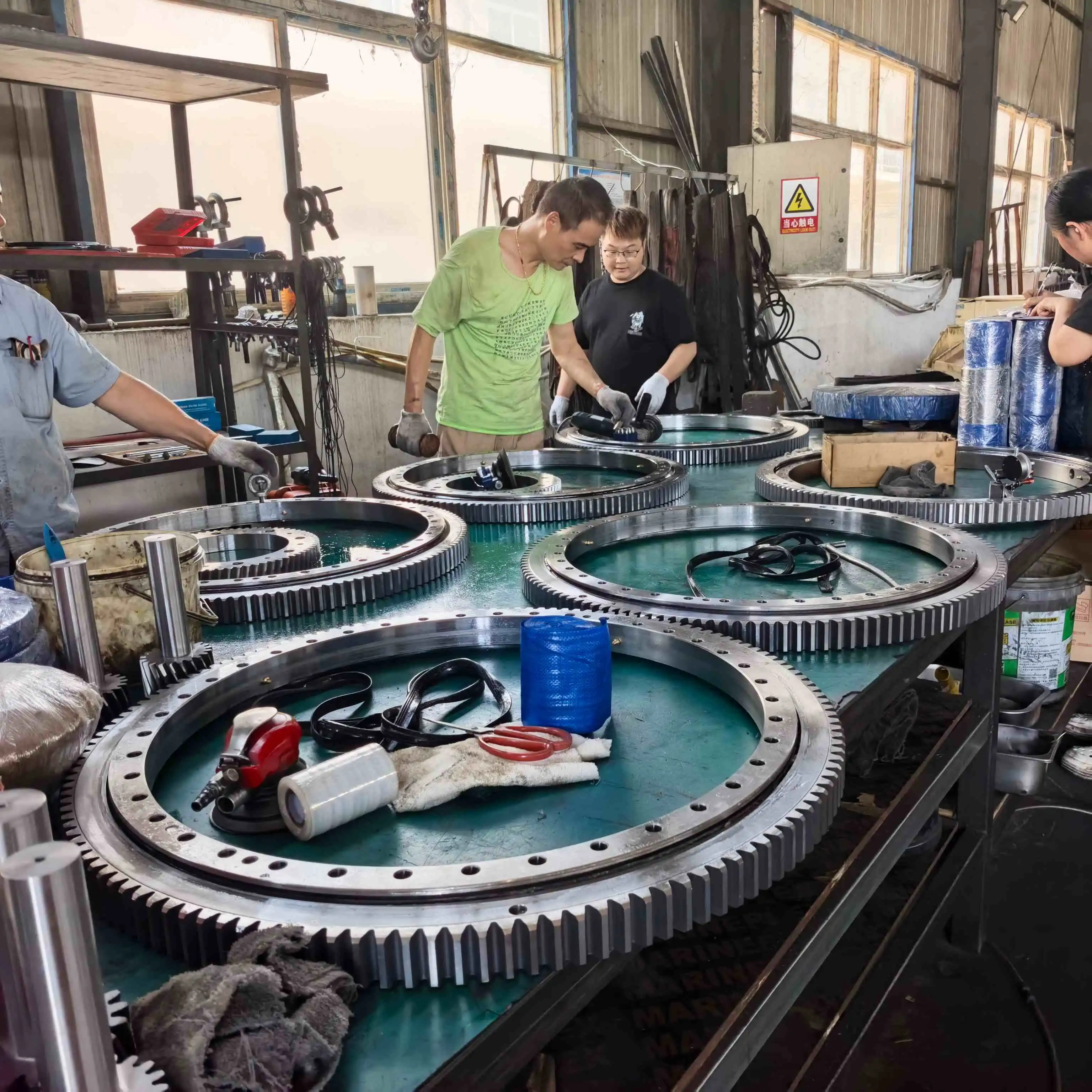
What Should Buyers Check When Choosing a Welding Positioner Slewing Bearing Factory?
Let's start with the genuine capabilities of the factory. A reliable welding positioner slewing bearing manufacturer should design, machine, heat treat, and check in-house, catching faults before they reach your assembly line. Ask about the grades of accuracy available and the bearings available and their size range. Heng Guan Bearing provides slewing bearings from 50 mm to 10,000 mm in diameter, in accuracy grades P0, P6, P5, and P4. For welding positioners, a P5 or above is often preferred, since angular positioning mistakes become direct deviations in the flame path.
Also ensure that the Welding positioner slewing drive provider you pick can give you with drawings, test reports, and quick engineering assistance. Whether you are servicing old positioners without 3D blueprints, ask the supplier whether they can reverse-engineer a replacement from a physical sample. Want a quick review of your requirements? Send them to mia@hgb-bearing.com and our engineers will suggest a suitable option.
Supplier Checklist for Buyers
| Item to Check | Why It Matters |
|---|---|
| Design and R&D capability | Enables custom solutions for nonstandard workpieces |
| Accuracy grades (P0–P4) | Matches rotation precision needs; P5+ recommended for positioners |
| In-house heat treatment | Controls raceway and tooth hardness at the source |
| Testing equipment (CMM, vibration, hardness) | Confirms quality before shipment |
| Reverse engineering support | Reproduces bearings for legacy machines without drawings |
| Export experience (50+ countries) | Smoother logistics and documentation |
Welding Positioner Slewing Bearing: Load Capacity, Precision, and Durability
Positioners carry heavy, often uneven loads while rotating slowly and stopping frequently — a duty profile that punishes anything less than a properly matched bearing. A well-made Welding positioner slewing drive supplier must therefore handle axial, radial, and tilting forces at once, with an optimized contact angle and raceway geometry that spreads combined loads across the rolling elements even when heavy workpieces sit at extended reach.
Structures such as single row four-point contact ball, cross cylindrical roller, and double row designs each offer different strengths, so the choice depends on the weight and overhang of your workpiece. Hardened raceways and quenched gear teeth extend service life in dusty, spatter-filled workshops, and a sealed raceway configuration keeps grinding dust and weld debris out of the rolling path — under rated loads with proper maintenance, Heng Guan bearings are built for 20,000+ working hours and 24-hour continuous multi-shift operation. A knowledgeable Welding positioner slewing drive supplier will help you balance load rating, size, and budget rather than simply selling the largest option.
If you are unsure which structure suits your equipment, Heng Guan Bearing can review your load conditions and recommend a dependable configuration.
Performance Requirements for Welding Positioner Duty
| Requirement | What the Bearing Delivers |
|---|---|
| Combined load handling | Axial, radial, and moment loads spread across rolling elements |
| Repeatability | ±0.01° positioning accuracy, cycle after cycle |
| Frequent start-stop cycles | High-frequency operation without performance degradation |
| Continuous duty | 24-hour multi-shift running, 20,000+ working hours |
| Contamination resistance | Sealed raceway minimizes dust and spatter ingress |
How Does Bearing Quality Affect Welding Positioner Rotation Accuracy?
Welding is a precise job; if the table moves or drifts, the torch moves with it. Bearing quality determines how stable the rotation will be under stress. Tight tolerances, perfect raceway design, and adequate preload decrease clearance — Heng Guan regulates axial clearance between 0.02 and 0.10 mm on its positioner bearings, keeping the table concentric and the movement smooth.
A high-grade Welding positioner slewing drive supplier also reduces vibration and noise, helping welders keep consistent seams and reduce rework; repeatability of ±0.01° means the positioner returns to the same programmed angle every cycle – hugely important for automated and robotic welding cells. Stable rotation also preserves the gearing and the motor, increasing the life of the overall system across an operating region of -20C to +80C. Don't only compare quotations on pricing; ask each Welding positioner slewing drive provider for runout data and inspection records. Heng Guan Bearing: we regulate quality from the source, build precision into the product, not add it at the end.
Welding Positioner Slewing Bearing Manufacturing, Testing, and Customization
Good bearings come from disciplined processes: forged rings, precise turning and grinding, controlled heat treatment, careful assembly, and thorough inspection. Each stage is checked so that hardness, dimensions, and rotation torque meet the drawing. Rings are cut from high-strength 50Mn or 42CrMo alloy steel, and gear teeth receive quench-hardening treatment for wear resistance under continuous meshing.
Every bearing is verified on coordinate measuring machines, vibration-tested for smooth operation, and hardness-tested on heat-treated surfaces — with full traceability from raw material to final inspection under ISO 9001:2015, plus RoHS compliance and production to ISO and DIN standards. Customization matters just as much, because positioners vary widely. Heng Guan Bearing offers personalized optimization design and flexible production — the standard positioner bearing measures 1300 × 998 × 100 mm, but the manufacturing range covers 50 to 10,000 mm — adjusting mounting holes, gear type, seals, and dimensions to fit your machine.
Installation is supported with detailed drawings, star-pattern bolt tightening in three torque stages (30%, 70%, 100%), and backlash typically set to 0.2–0.4 mm for gear-driven units. As a full-service Welding positioner slewing drive supplier and bearing manufacturer, we support projects from concept through delivery, whether you need one prototype or a repeating batch. Share your drawings or requirements at mia@hgb-bearing.com, and we will confirm a suitable welding positioner slewing bearing design.
Typical Manufacturing and Testing Stages
| Stage | Purpose |
|---|---|
| Ring forging and machining | Form accurate base geometry from 50Mn / 42CrMo steel |
| Heat treatment | Improve raceway hardness and wear life |
| Tooth surface quenching | Resist wear under continuous gear meshing |
| Assembly | Set clearance and preload correctly (axial play 0.02–0.10 mm) |
| Final inspection | Verify dimensions, rotation torque, and vibration on CMM |
Technical Specifications at a Glance
| Parameter | Specification |
|---|---|
| Standard sample dimensions | 1300 × 998 × 100 mm |
| Manufacturing range | 50 mm – 10,000 mm (customization supported) |
| Axial clearance | 0.02 – 0.10 mm |
| Positioning accuracy | ±0.01° |
| Precision grades | P0 / P6 / P5 / P4 (P5+ recommended for positioners) |
| Ring material | 50Mn or 42CrMo alloy steel |
| Tooth surface treatment | Quench hardening |
| Operating temperature | -20°C to +80°C |
| Service life | 20,000+ working hours under rated loads |
| Lubrication interval | NLGI Grade 2 lithium grease, every 500 hours or quarterly |
| Lead time | Standard sizes 3–4 weeks; common sizes stocked |
| Standards and certifications | ISO 9001:2015, ISO/DIN standards, RoHS |
Conclusion
Choosing a certified factory protects your welding positioner's accuracy, load capacity, and lifespan. Look for strong design capability, proven precision, thorough testing, and flexible customization. Welding positioner slewing bearing combines all four — 20+ years of manufacturing experience, 50+ engineers, and clients in more than 50 countries — so Contact Us and build your next positioner on a reliable foundation.
FAQ
Q1: What does a welding positioner slewing bearing do?
It supports and rotates heavy workpieces smoothly and accurately, holding positioning repeatability of ±0.01°, so the welding torch reaches every seam at the optimal angle.
Q2: What accuracy grades are available?
P0, P6, P5, and P4 grades are offered. For welding positioners, P5 or higher is ordinarily recommended.
Q3: What size range can Heng Guan Bearing produce?
Diameters from 50 mm to 10,000 mm, with the standard positioner bearing measuring 1300 × 998 × 100 mm.
Q4: Can the bearing be customized?
Yes, mounting holes, gear type, seals, and dimensions can be tailored — and legacy bearings can be reverse-engineered from physical samples.
How Heng Guan Solves Your Welding Positioner Bearing Challenges
Ready to spec the right welding positioner slewing bearing for your machines? Send your drawings, load data, or questions to mia@hgb-bearing.com, and our team will respond quickly with a design and quotation.
References
1. Harris, T. A., & Kotzalas, M. N. (2006). Rolling Bearing Analysis: Advanced Concepts of Bearing Technology and Essential Concepts of Bearing Technology (5th ed., 2-volume set). CRC Press.
2. Hamrock, B. J., Schmid, S. R., & Jacobson, B. O. (2006). Fundamentals of Machine Elements (2nd ed.). McGraw-Hill Higher Education.
3. Budynas, R. G., & Nisbett, J. K. (2006). Shigley's Mechanical Engineering Design (8th ed.). McGraw-Hill.
4. Eschmann, P., Hasbargen, L., & Weigand, K. (1985). Ball and Roller Bearings: Theory, Design, and Application (2nd ed., revised by L. Hasbargen and J. Brändlein). John Wiley & Sons.
5. Kou, S. (2003). Welding Metallurgy (2nd ed.). Wiley-Interscience.
6. Amasorrain, J. I., Sagartzazu, X., & Damián, J. (2003). Load distribution in a four-contact-point slewing bearing. Mechanism and Machine Theory, 38(6), 479–496.

WHAT OUR CUSTOMERS SAY
Here is the customer's evaluation of us