




What Makes a 4 Point Contact Ball Bearing Reliable?
Reliability isn't an accident — it's engineered in from the raceway geometry all the way through to the seal design. Heng Guan Bearing builds every 4 Point Contact Ball Bearing around this principle, because a component tasked with carrying combined axial, radial, and moment loads simply can't afford weak points anywhere in its construction. This article walks through exactly what makes this bearing type dependable, from contact geometry and load capacity to lubrication, sealing, and how to actually select a unit you can trust in demanding applications.
|
|
How Does a 4 Point Contact Ball Bearing Ensure Reliable Performance?
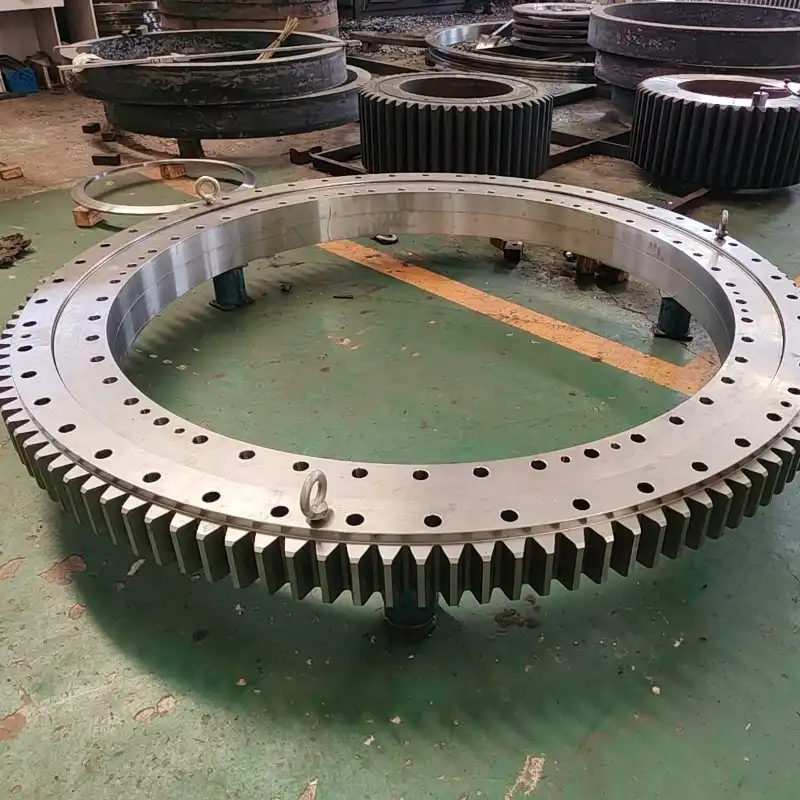
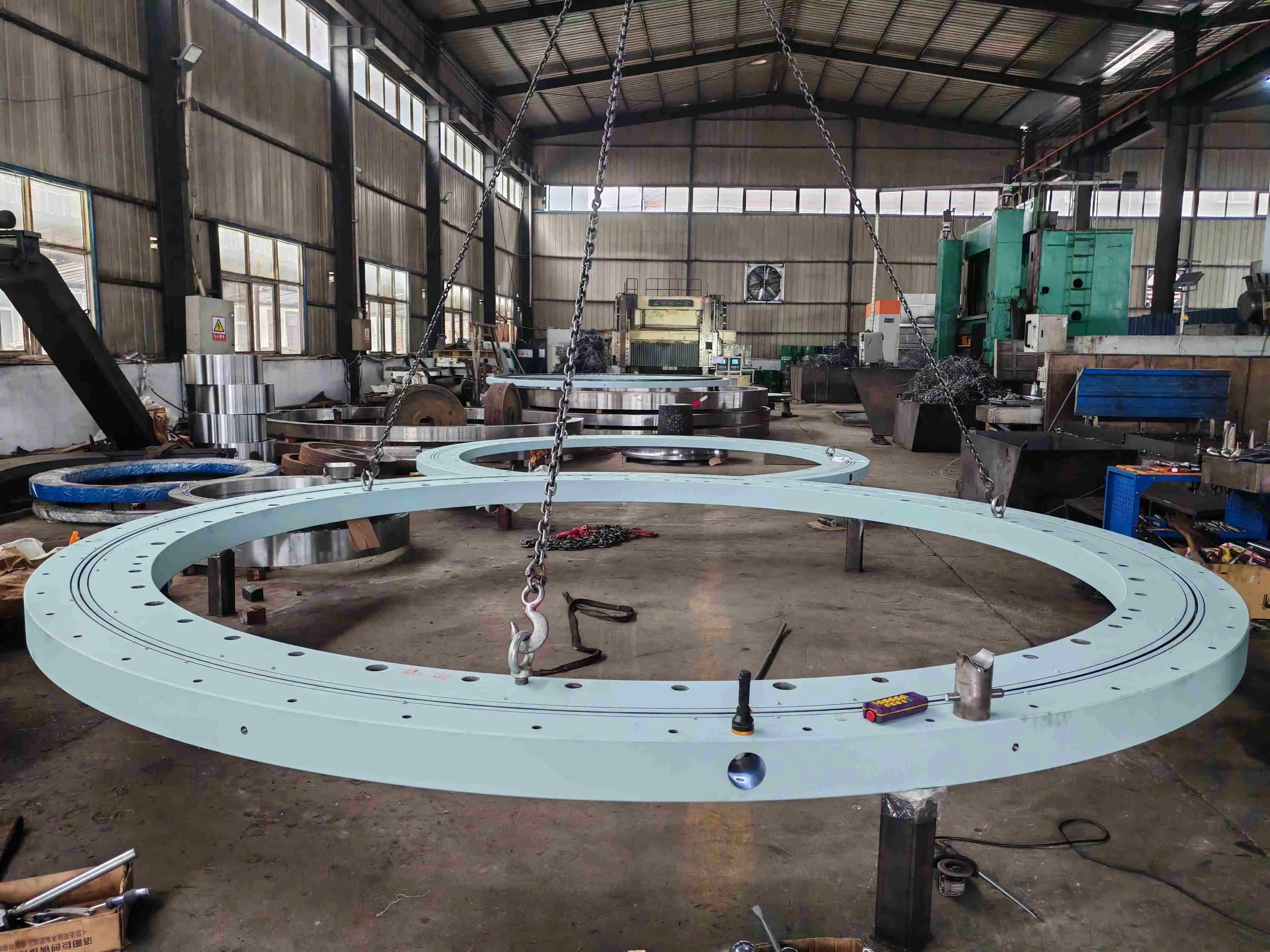
Reliability begins with geometry. The 4 Point Contact Ball Bearing consists of one row of steel balls at a contact angle of around 35°. When subjected to pure radial stress, a ball contacts the raceway at four separate locations, but under axial force, that contact changes to two points per direction. The design allows a single compact bearing to take combined radial, axial, and moment stresses without the need for many rows of stacked bearings, reducing both weight and the number of possible sites of failure in the assembly.
Heng Guan Bearing manufactures these bearings from 42CrMo or 50Mn alloy steel, with induction-hardened raceways, so that the contact geometry remains dimensionally stable, even after years of repeated, uneven loading — which is something that sets reliable Four-point bearing suppliers apart from those who are cutting corners on material quality.
| Load Condition | Contact Behavior |
|---|---|
| Pure Radial Load | Four-point contact across raceway |
| Axial Load (one direction) | Two-point contact |
| Combined/Moment Load | Distributed across multiple contact points |
Because every ball contacts both the inner and outer ring at two points each, the load is spread evenly across the contact zone instead of concentrating stress at a single location. That even distribution is what lets the bearing maintain its rated capacity through millions of rotation cycles, and it's the reason the design is specified so widely in rotating equipment that must run continuously.
Load Capacity and Raceway Design for Long-Term Reliability
The design of the raceway directly controls how long a bearing can operate before wear becomes a problem. Reliability of 4 point Contact Ball Bearing comes from the use of carefully honed Gothic-arch raceways and hardened steel balls that distribute the load across the contact area rather than at a single spot. Heng Guan Bearing provides these bearings in precision grades P0 to P4, enabling engineers to choose the tolerance level that most closely fits the actual rotational accuracy needs of their application – rather than defaulting to overly tight – and costly – tolerances. Raceway hardness is in the HRC 55-60 range, with adequate depth of hardening to prevent surface fatigue. Load capacity remains constant throughout millions of cycles of rotation, providing the kind of long-term performance engineers can expect from any reputable provider of bearings.
| Precision Grade | Typical Application |
|---|---|
| P0 | Standard precision, general machinery |
| P6 | General mechanical equipment |
| P5 | Precision positioning equipment, tighter tolerances |
| P4 | High-precision measuring devices and instruments |
Beyond precision grade, the bearing's construction philosophy matters too. The single-row four-point design achieves load capacity comparable to a double-row angular contact bearing while saving axial space and component weight, and the separable construction — inner ring halves plus a one-piece outer ring — lets technicians install the unit sequentially in confined spaces where a rigid assembly would be impossible. All these details are documented across ISO, DIN, and GB standards, so the finished bearing's dimensional accuracy and material properties can be verified against published benchmarks rather than taken on trust.
How Do Lubrication and Sealing Affect Bearing Reliability?
Even the best raceway geometry fails prematurely without proper lubrication and sealing, so this stage of design deserves just as much attention as the steel itself. A well-sealed 4 Point Contact Ball Bearing keeps contaminants like dust, moisture, and abrasive particles away from the raceway and ball contact points, which is often the single biggest factor separating a bearing that lasts decades from one that fails within a year in harsh environments. Heng Guan Bearing offers multiple sealing configurations, including high-temperature and high-pressure options, tailored to whether the bearing will operate in a dry factory setting or a humid, corrosive port environment.
For guidance on which lubrication and sealing combination fits your specific operating conditions, reach our engineering team directly at mia@hgb-bearing.com, and we'll help you avoid the premature wear that comes from mismatched sealing choices.
| Sealing Type | Best Suited Environment |
|---|---|
| Standard Seals | Indoor, low-contamination settings |
| High-Temperature Seals | Equipment near heat sources |
| High-Pressure/Environmental Seals | Humid, dusty, or marine conditions |
Lubrication intervals are just as important as seal selection. With grease lubrication, a 4 Point Contact Ball Bearing typically needs re-lubrication every 500–2,000 operating hours under normal duty, depending on load and speed. Heavy-duty service, such as crane slewing, requires more frequent intervals — typically around 250 operating hours. Oil-lubricated systems require regular oil quality checks and filter replacement. In practice, a steadily rising operating temperature often signals inadequate lubrication or overload before any visible damage appears, and unusual noise during rotation points to contamination or early wear — both worth investigating immediately rather than waiting for the next scheduled service.
How Should You Select a Reliable 4 Point Contact Ball Bearing?
Selection should start with your actual operating conditions, not a catalog page. Define your maximum combined radial, axial, and moment loads, then compare those figures against published ratings from established Four-point bearing suppliers rather than assuming similar-sized bearings perform identically. Heng Guan Bearing's engineering team routinely walks customers through this process, factoring in precision grade, sealing type, and mounting interface specific to each application, whether it's a rotary conveyor, a small hoist, or heavy construction machinery. Getting these details right at the selection stage is what ultimately determines whether your 4 Point Contact Ball Bearing delivers the reliable, low-maintenance performance your project actually needs.
| Application | Why the 4 Point Contact Design Fits |
|---|---|
| Excavators & cranes | Compact swing drives with combined load capacity |
| Port handling equipment | Large-diameter versions for rotating booms |
| Industrial robots | Precision rotation in a slim joint envelope |
| Wind turbines | Yaw and pitch systems under cyclic loading |
| Medical imaging (CT) | P5/P4 grades for smooth, accurate rotation |
| Tunnel boring machines | Main bearings carrying thrust and misalignment |
Because the design is available from 50 mm up to 10,000 mm in diameter, there is almost certainly a configuration that matches your load envelope without over-engineering. When your project needs a non-standard size, raceway profile, or preload recommendation, a supplier with in-house engineering — rather than a pure reseller — can adapt the design to your duty cycle and document the changes. That combination of published ratings, documented standards compliance, and engineering support is what turns a component purchase into a long-term reliability decision.
Conclusion
Heng Guan Bearing engineers dependable 4 Point Contact Ball Bearing solutions built on precision raceways and proper sealing. Ready to specify yours? Get in touch today.
|
|

FAQ
Q: What loads can a 4 Point Contact Ball Bearing handle?
A: It carries combined radial, axial, and moment loads simultaneously through its four-point contact geometry, with bidirectional axial capacity built in.
Q: What materials does Heng Guan Bearing use?
A: We use 42CrMo or 50Mn alloy steel with induction-hardened raceways and GCr15 bearing steel balls for long-term durability.
Q: What precision grades are available?
A: We offer P0, P6, P5, and P4 grades depending on your rotational accuracy needs, from general machinery to precision instruments.
Q: How does sealing affect bearing life?
A: Proper sealing keeps contaminants out, which is often the biggest factor in preventing premature wear in dusty or humid environments.
Q: How often should a 4 Point Contact Ball Bearing be lubricated?
A: With grease, typically every 500–2,000 operating hours under normal duty, or around 250 hours in heavy-duty service, depending on load and speed; oil systems need regular quality checks.
Q: How do I get help selecting the right bearing?
A: Contact our engineers at mia@hgb-bearing.com for load data and selection guidance.
Talk to Our Team for Dependable Bearing Solutions Today
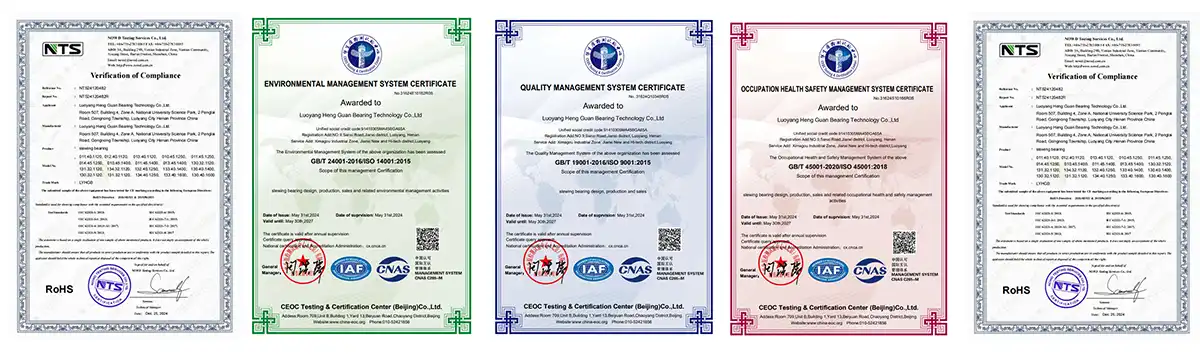
Not all Four-point bearing suppliers deliver the same reliability. Heng Guan Bearing engineers every 4 Point Contact Ball Bearing for long-term, low-maintenance performance, backed by ISO 9001-certified processes, RoHS compliance, and 20+ years of bearing manufacturing experience. Email mia@hgb-bearing.com today to discuss your application.
References
1. Harris, T. A., & Kotzalas, M. N. (2006). Rolling Bearing Analysis, 5th ed., 2-Volume Set. CRC Press.
2. International Organization for Standardization. (2006). ISO 76:2006, Rolling bearings — Static load ratings. ISO.
3. International Organization for Standardization. (2007). ISO 281:2007, Rolling bearings — Dynamic load ratings and rating life. ISO.
4. International Organization for Standardization. (2023). ISO 492:2023, Rolling bearings — Radial bearings — Geometrical product specifications (GPS) and tolerance values. ISO.
5. International Organization for Standardization. (2015). ISO 9001:2015, Quality management systems — Requirements. ISO.
6. Deutsches Institut für Normung. (1982). DIN 620-1:1982-06, Rolling bearings — Gauging methods for dimensional and running tolerances. DIN.

WHAT OUR CUSTOMERS SAY
Here is the customer's evaluation of us
YOU MAY LIKE
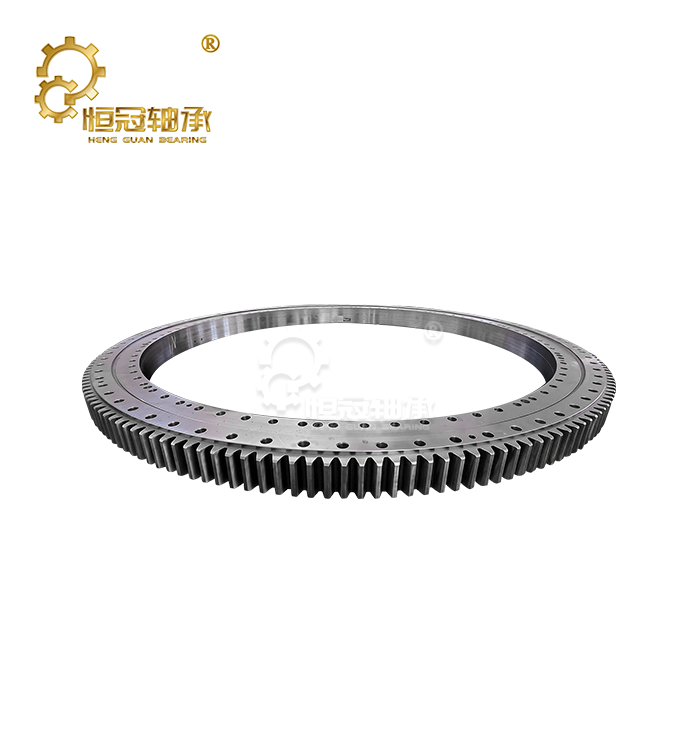 VIEW MORE161.40.2000.890.11.1503 Slewing Bearings
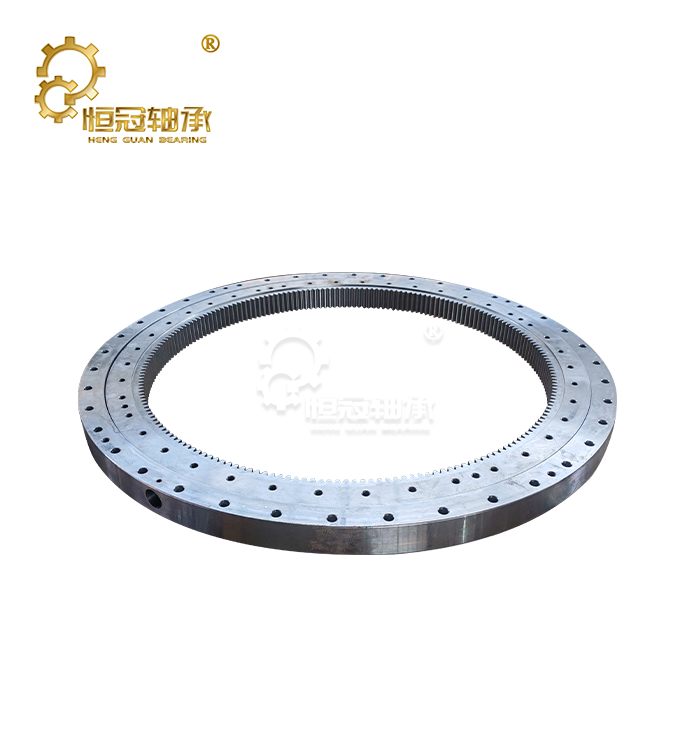 VIEW MORE23 0411 01 slewing bearing
 VIEW MORENew Holland Excavator slewing bearing
 VIEW MOREJohn Deere Excavator slewing bearing
 VIEW MORERoller Bearing Slewing Ring
 VIEW MOREStacker slewing bearing
_1767784942887.webp) VIEW MOREDouble-Row Ball Slewing Ring Bearing
VIEW MOREDouble-Row Ball Slewing Ring Bearing VIEW MORESlewing Ring For Billboard