



Why Choose Four-Point Contact Ball Slewing Bearings for Cranes?
Before you resort to a more complicated or heavier option, consider Four-Point Contact Ball Slewing Bearings if you are selecting a rotating support component for a crane. This bearing type has been specially developed by Heng Guan Bearing to provide the best compromise between small size and actual load-carrying performance, making it one of the most practical alternatives for lifting equipment throughout construction, port, and industrial applications. It is manufactured to this design with a gothic-arch raceway profile, which offers four contact points per ball. It is available with inner diameters from 100 mm to 4,272 mm, and with outer diameters up to 10,000 mm on special order. Precision grades from P0 to P4 are available. This essay will cover how these bearings take crane loads, what capacity range to look at, why their compact design is important, and how to really choose the proper one for your project.
|
|
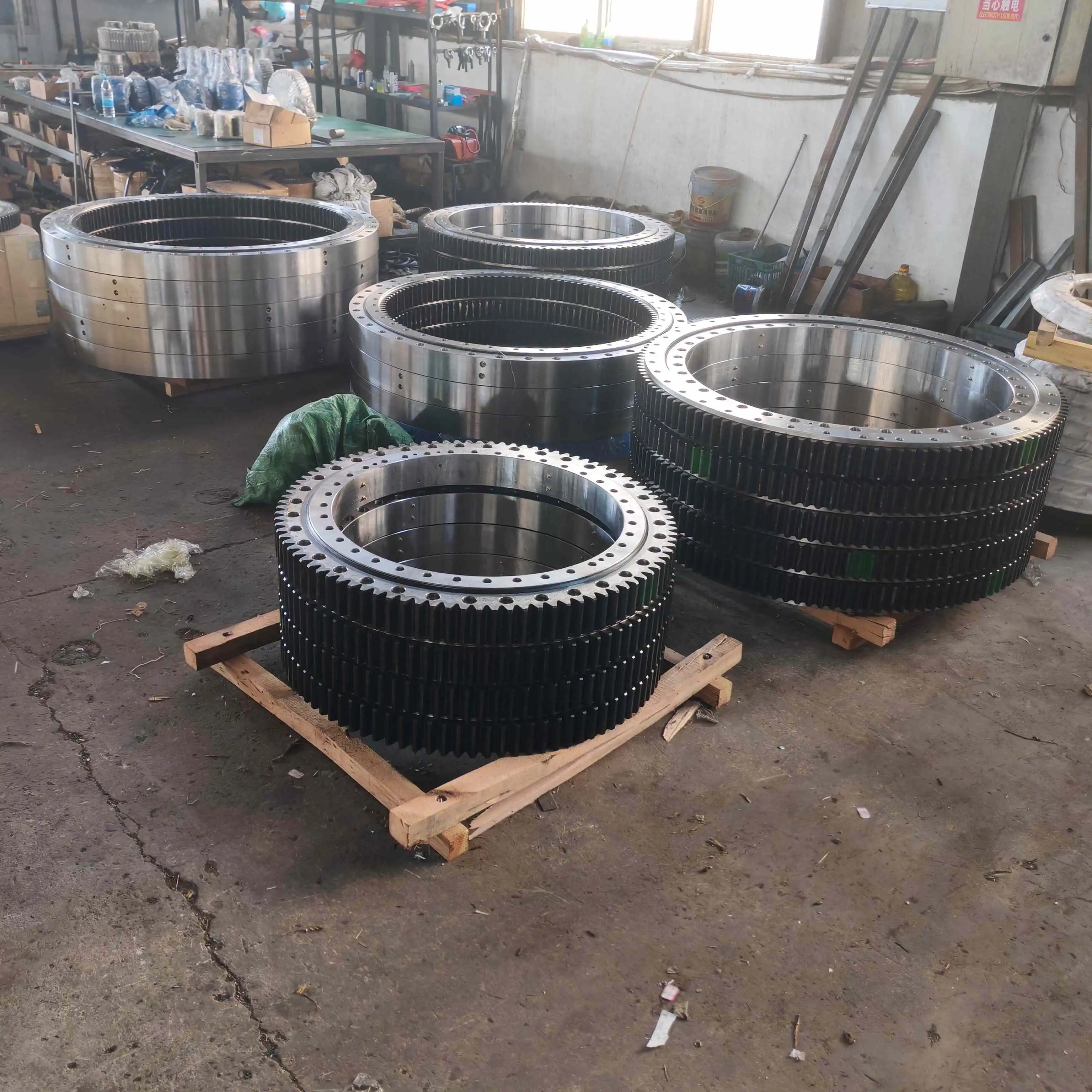
How Do Four-Point Contact Ball Slewing Bearings Handle Crane Loads?
It is the physics of this sort of bearing that makes it function so well under the diverse loading circumstances that cranes create every working day. Four-Point Contact Ball Slewing Bearings include a single row of steel balls arranged in a Gothic-arch racetrack, enabling each ball to contact the raceway at four spots under pure radial force and at two points under axial load. This shape allows a single bearing to accommodate axial, radial, and tilting moment loads at the same time – precisely the combination generated by a crane hoisting an off-center load as it rotates.
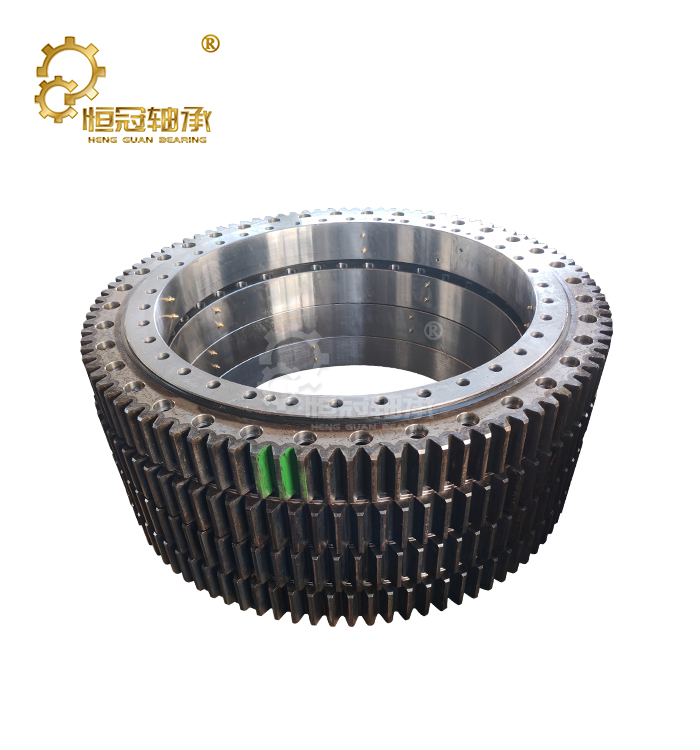
The load is distributed uniformly on all contact surfaces with four-point contact, resulting in reduced stress concentration and a considerably increased service life in comparison to two-point systems. Heng Guan Bearing produces these bearings using 42CrMo or 50Mn alloy steel rings, precision-ground GCr15SiMn bearing steel balls, and imported NBR or FKM seals, so the four-point contact geometry maintains its accuracy despite years of repeated, unequal loading cycles. A removable split inner-ring design facilitates easier on-site installation and removal, minimising downtime during crane maintenance.
| Specification | Value |
|---|---|
| Raceway profile | Gothic arch, four contact points per ball |
| Inner diameter range | 100 – 4,272 mm |
| Outer diameter range | 280 – 4,726 mm (10,000 mm custom) |
| Height range | 25 – 200 mm |
| Ring material | 42CrMo or 50Mn alloy steel |
| Ball material | GCr15SiMn high-purity bearing steel |
| Seal material | Imported NBR or FKM (fluororubber) |
| Precision grades | P0, P6, P5, P4 |
| Standards compliance | DIN, ISO, GB, RoHS |
| Certification | ISO 9001 |
What Load Capacity Should You Consider for Crane Slewing Bearings?
Matching load capacity to your actual crane application is where many buyers either overspend or, worse, underspecify a critical component. Four-Point Contact Ball Slewing Bearings from Heng Guan Bearing are available across a wide diameter range — from compact 280 mm outer diameter units weighing just 20 kg up to 4,726 mm units weighing 4,000 kg — with load-carrying capacity scaling accordingly to suit everything from compact yard cranes to large port and construction machinery. When you're comparing options among different Four-point contact ball slewing bearing suppliers, ask specifically for rated axial load, radial load, and tilting moment figures rather than relying on diameter alone, since two bearings of similar size can carry meaningfully different loads depending on ball count, ball diameter, and raceway hardness.
Also confirm that rated values are calculated per ISO 76 (static load ratings) and ISO 281 (dynamic load ratings and rating life), so you're comparing like-for-like engineering data rather than marketing numbers. For detailed load tables matched to your specific crane model, our engineering team can be reached directly at mia@hgb-bearing.com.
| Model | Type | Outer Dia. (mm) | Inner Dia. (mm) | Height (mm) | Weight (kg) |
|---|---|---|---|---|---|
| 010.20.200 | Gearless | 280 | 120 | 60 | 20 |
| 011.20.200 | External gear | 280 | 120 | 60 | 20 |
| 010.30.500 | Gearless | 602 | 398 | 80 | 75.8 |
| 010.40.800 | Gearless | 922 | 678 | 100 | 220 |
| 010.60.2000 | Gearless | 2,178 | 1,825 | 144 | 1,100 |
| 010.75.3150 | Gearless | 3,376 | 2,922 | 174 | 2,800 |
| 010.75.4000 | Gearless | 4,226 | 3,772 | 174 | 3,600 |
| 010.75.4500 | Gearless | 4,726 | 4,272 | 174 | 4,000 |
Compact Design and High Load Capacity for Crane Applications
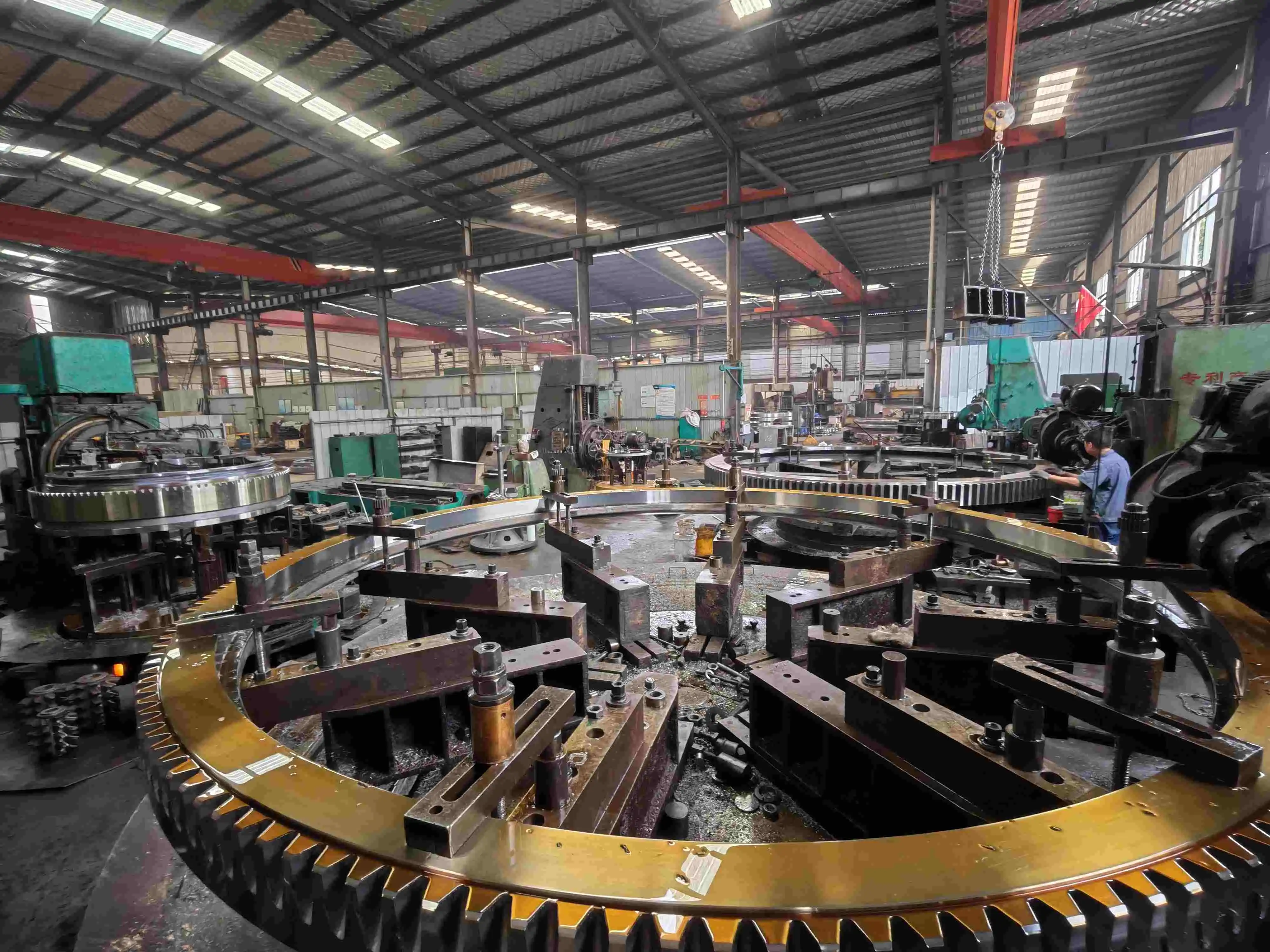
Space constraints on a crane's slewing platform are real, and this is precisely where Four-Point Contact Ball Slewing Bearings earn their reputation. Compared to multi-row roller designs, a single-row four-point contact structure packs axial, radial, and moment load capacity into a noticeably lighter, more compact footprint — a meaningful advantage when every kilogram on a rotating platform affects overall crane stability and fuel efficiency. The four-point contact design allows the largest number of balls per given diameter, which translates into superior load capacity within the same envelope.
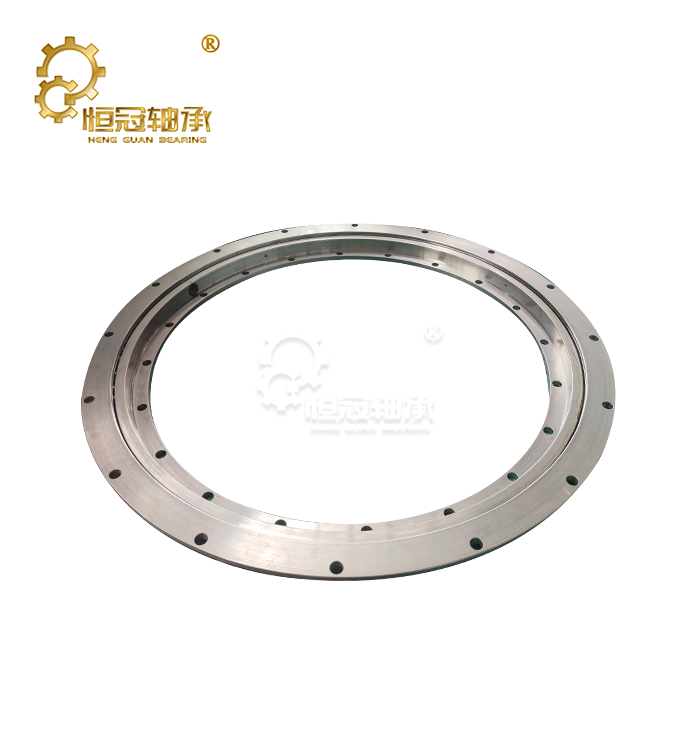
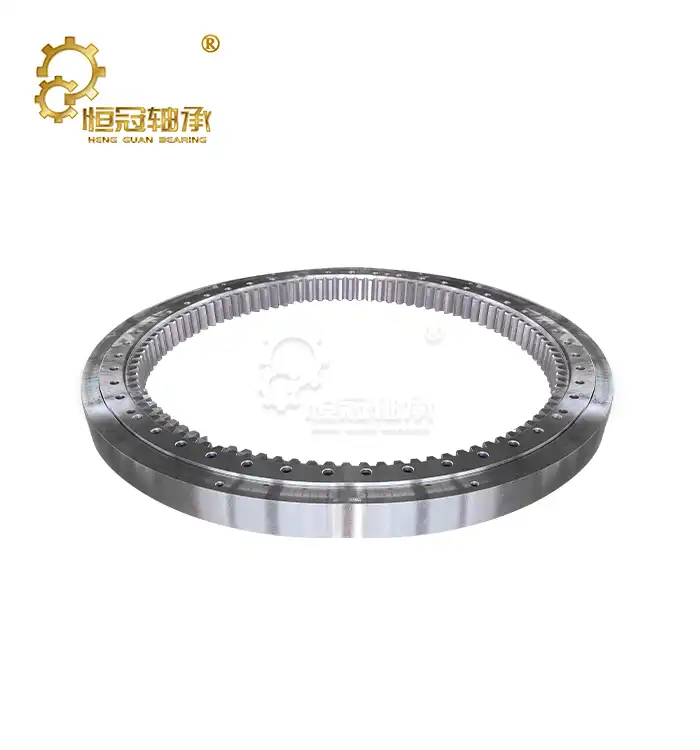
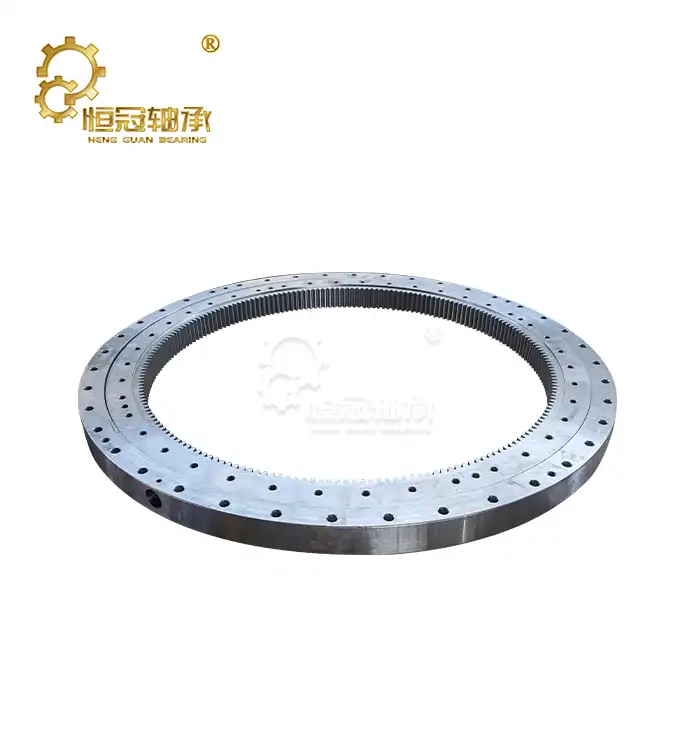
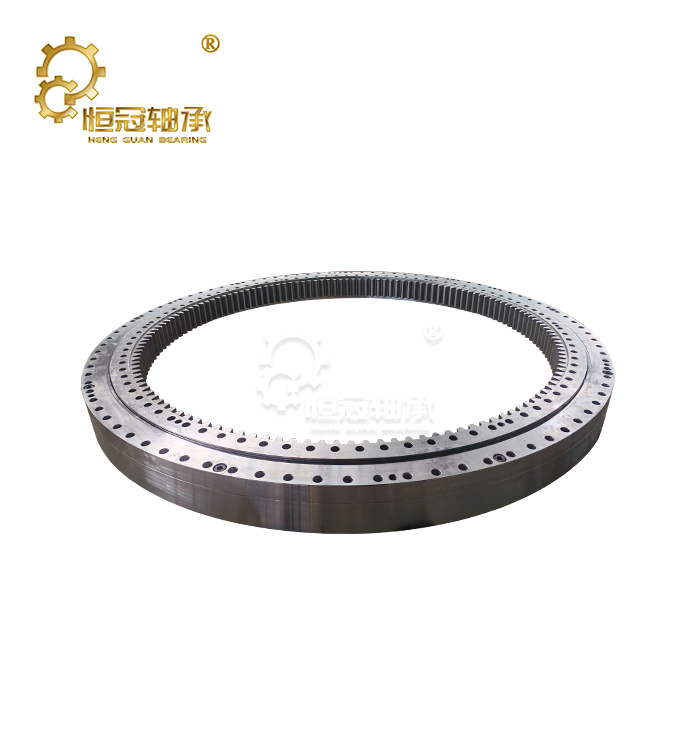
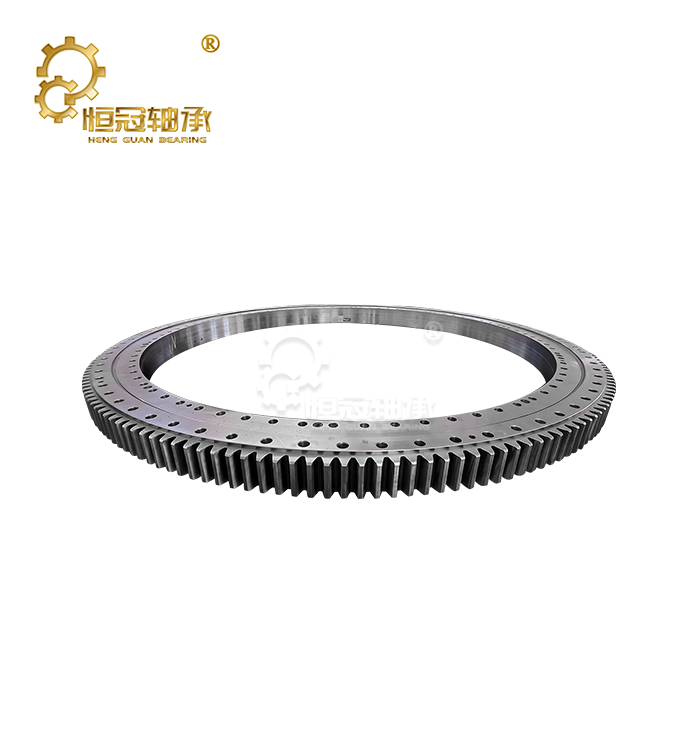
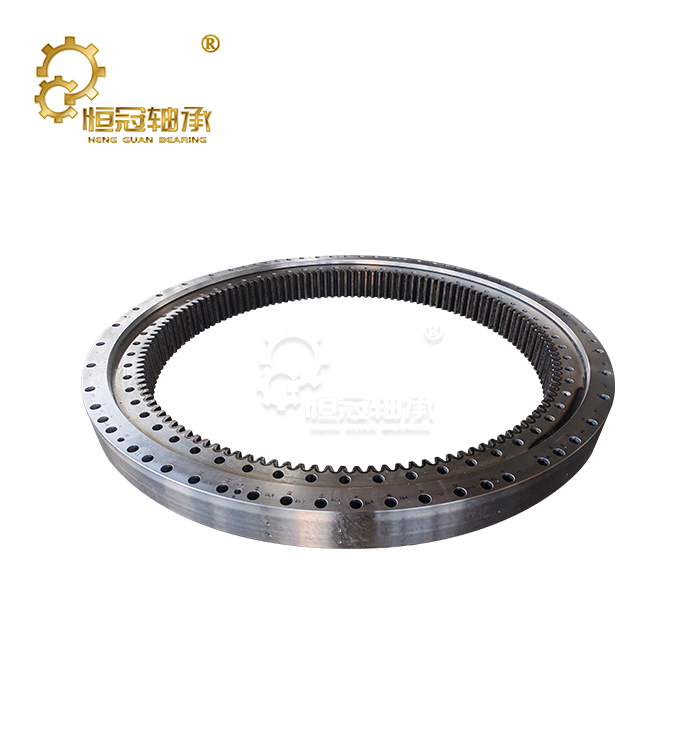
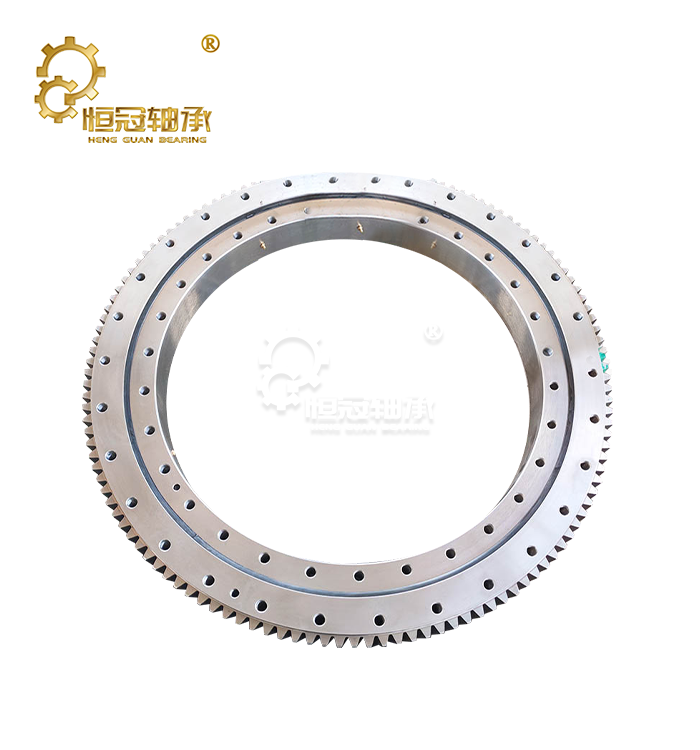
Heng Guan Bearing offers these bearings in no-gear (010 series), internal-gear (012/013 series), and external-gear (011/014 series) configurations, giving crane manufacturers flexibility in how the bearing integrates with the slewing drive mechanism without adding unnecessary bulk to the overall assembly.
| Configuration | Series Prefix | Best Suited For |
|---|---|---|
| No gear | 010.xxx | Applications with external drive systems |
| External gear | 011.xxx / 014.xxx | Easier drive access and simplified maintenance |
| Internal gear | 012.xxx / 013.xxx | Compact installations needing protected gear teeth |
How Do You Select the Right Four-Point Contact Slewing Bearing?
Choosing correctly comes down to matching your crane's actual operating conditions against a supplier's documented specifications rather than guessing from a catalog page. Start by defining your maximum axial load, radial load, and tilting moment under worst-case lifting conditions, then compare those figures against what reputable Four-point contact ball slewing bearing suppliers publish for each bearing size. Next, confirm the precision grade you need — P0 for general crane service, P6 and P5 for smoother operation, P4 for the most demanding positioning applications.
Consider the gear interface as well: module and tooth count must match your slewing drive pinion, and the seal specification should reflect the operating environment, with FKM seals recommended for humid port terminals and chemically aggressive atmospheres. Once installed, plan lubrication every 250 operating hours under normal conditions — more frequently in high-stress crane service — and never direct water jets at the bearing during cleaning, as forced water ingress can damage the raceway.
Heng Guan Bearing's engineering team routinely helps customers work through this selection process, factoring in mounting interface, gear type, and sealing requirements specific to the operating environment. Whether your crane operates in a dusty construction site or a humid port terminal, getting these details right upfront in your Four-Point Contact Ball Slewing Bearings selection prevents costly redesigns later in the project.
| Selection Step | What to Specify |
|---|---|
| Load analysis | Peak axial, radial, and tilting moment under worst case |
| Precision grade | P0 (general) / P6, P5 (smooth) / P4 (precision) |
| Gear interface | Module, tooth count, internal vs. external |
| Seal material | NBR (standard) or FKM (marine/chemical) |
| Lubrication plan | Grease every 250 operating hours (normal duty) |
| Mounting interface | Bolt pattern, locating spigots, split-ring requirement |
Conclusion
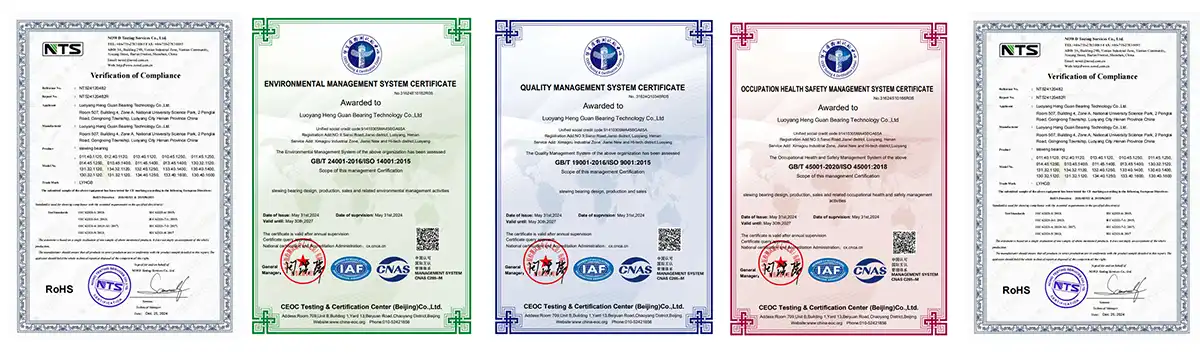
Heng Guan Bearing delivers precision-engineered Four-Point Contact Ball Slewing Bearings built for real crane performance — from compact 280 mm units to 4,726 mm giants, in no-gear, external-gear, and internal-gear configurations, all manufactured to ISO 9001 standards with materials traceable to certified suppliers. With 20+ years of bearing manufacturing experience, 50+ engineers, and customers across 50+ countries, our team helps you match rated loads, precision, and sealing to your exact duty cycle. Ready to specify your project? Reach out today.
FAQ
Q: What loads can Four-Point Contact Ball Slewing Bearings handle?
A: They carry combined axial, radial, and tilting moment loads simultaneously in a single-row design. The Gothic-arch raceway creates four contact points per ball, spreading the load evenly to reduce stress concentration and extend service life.
Q: What gear configurations are available?
A: Heng Guan Bearing offers no-gear (010 series), external-gear (011/014 series), and internal-gear (012/013 series) options depending on your drive setup, with gear modules and tooth counts matched to your slewing drive pinion.
Q: Are these bearings suitable for large port cranes?
A: Yes. Diameters and rated loads scale up to suit large construction and port crane applications — outer diameters range from 280 mm to 4,726 mm standard, with custom sizes up to 10,000 mm, and FKM seals are available for humid, salt-laden port atmospheres.
Q: What materials are used in manufacturing?
A: Rings are made from 42CrMo or 50Mn alloy steel, balls from GCr15SiMn high-purity bearing steel, and seals from imported NBR or FKM — all selected for durability under repeated, uneven crane loading.
Q: How often should a four-point contact slewing bearing be lubricated?
A: Every 250 operating hours under normal conditions, and more frequently in high-stress crane service. Grease should be injected until it appears at the seal band, rotating the bearing slowly to ensure even distribution.
Get Expert Guidance on Crane Slewing Bearings Today
Choosing among Four-point contact ball slewing bearing suppliers shouldn't be a guessing game. Heng Guan Bearing's engineers are ready to help you select the right Four-Point Contact Ball Slewing Bearings for your crane — with load calculations per ISO 76 and ISO 281, gear interface matching, and seal selection for your operating environment. Email mia@hgb-bearing.com today to get started.
References
1. Harris, T. A., & Kotzalas, M. N. (2006). Rolling Bearing Analysis, 5th ed., Vol. 1: Essential Concepts of Bearing Technology. CRC Press.
2. International Organization for Standardization. (2006). ISO 76:2006, Rolling bearings — Static load ratings. ISO.
3. International Organization for Standardization. (2007). ISO 281:2007, Rolling bearings — Dynamic load ratings and rating life. ISO.
4. Deutsches Institut für Normung. (1978). DIN 3967:1978-08, System of Gear Fits; Backlash, Tooth Thickness Allowances, Tooth Thickness Tolerances; Principles. DIN.
5. International Organization for Standardization. (2013). ISO 1328-1:2013, Cylindrical gears — ISO system of flank tolerance classification — Part 1: Definitions and allowable values of deviations relevant to flanks of gear teeth. ISO.
6. International Organization for Standardization. (2015). ISO 9001:2015, Quality management systems — Requirements. ISO.

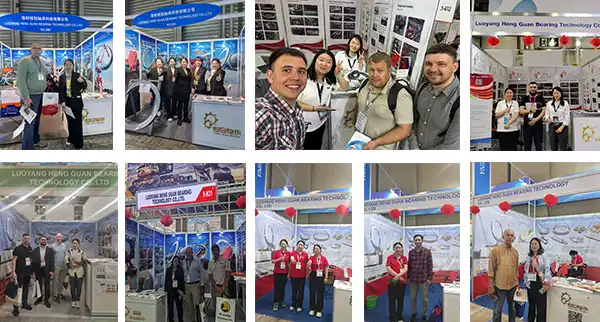
WHAT OUR CUSTOMERS SAY
Here is the customer's evaluation of us