




What Applications Need Slewing Ring Bearing With External Gear?
Not every rotating machine requires the same bearing, and picking the incorrect slewing ring is one of the quickest ways to turn a healthy machine into a maintenance disaster. In our experience at Heng Guan Bearing, warranty claims are almost always the result of one of three mistakes: ordering an internally geared ring when the drivetrain layout called for external gearing, requesting a single-row ball when the duty cycle called for a triple-row roller, or using “Slewing Ring Bearing With External Gear” as a generic search term rather than a specific design choice with its own load, sealing, and maintenance profile. When selecting a crane, an excavator, a port handler, or a wind turbine, the proper question to ask is not “where can external gearing work?” but “what applications really benefit from external gearing, and what configuration suits that duty?” I will guide you through the industries and duty profiles where externally geared slewing rings continuously outperform the alternatives, what configurations Heng Guan Bearing recommends for each, and how to match product specifications to your real load environment.
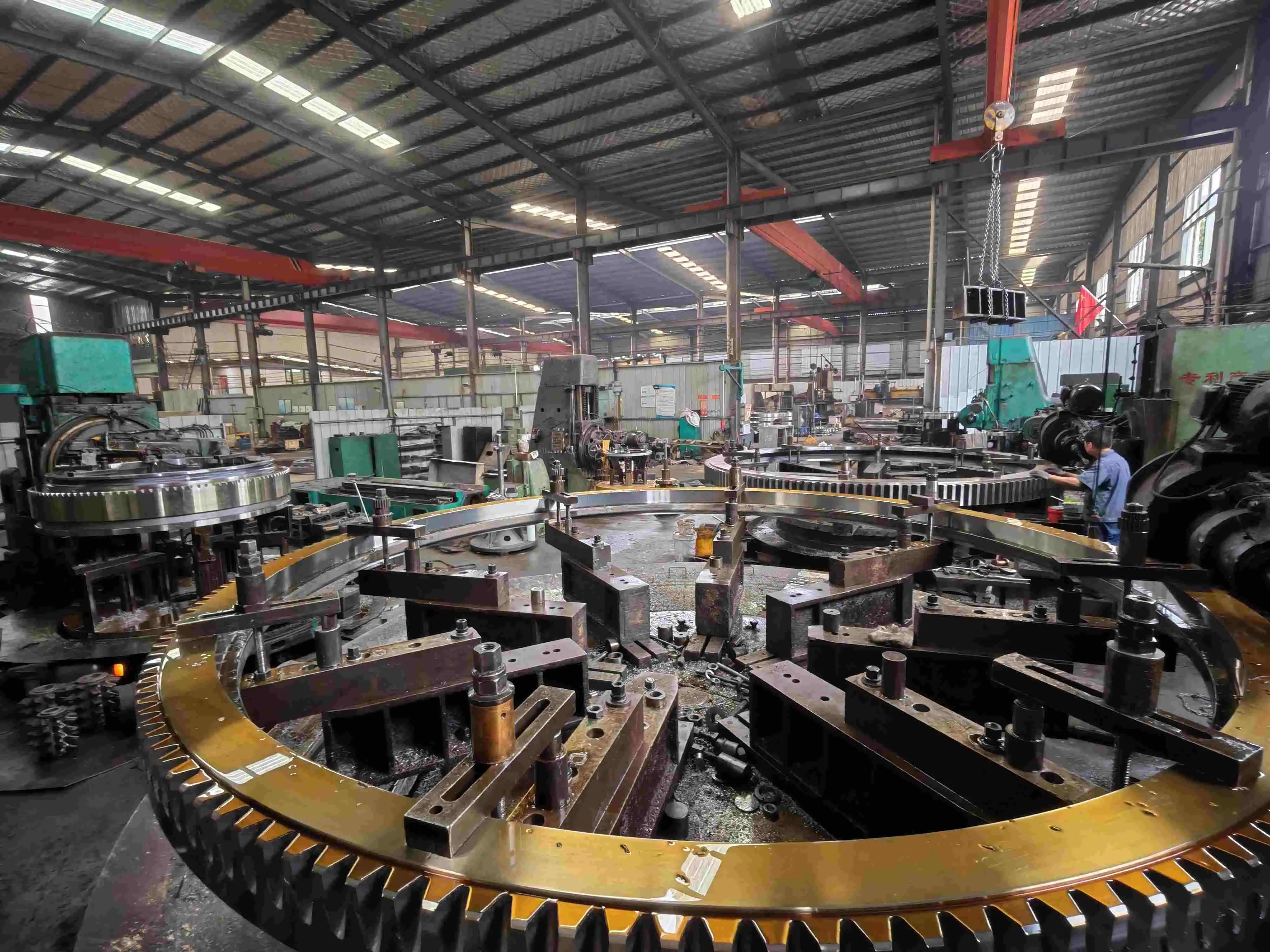
Which Industries Use a Slewing Ring Bearing With External Gear?
In fact, the external-gear slewing ring is used in a remarkably wide variety of industries. The reason is that the design lends itself to versatile drive location and easy access for maintenance. They are used extensively in crane and construction equipment, since crane operators require reliable rotation under changing loads, and exterior tooth access means technicians do not need to enter the hole for regular inspection. Externally geared slewing rings are especially used in mining and metallurgical applications, particularly for rotating equipment that is exposed to dust and debris, since the exterior teeth make cleaning and lubricating easier. The same arrangement is used for continuous, high-cycle operation in salt-air conditions in port and shipping gear, including container handling cranes.
Beyond heavy industries, smaller-diameter variants have uses in new energy, military platforms, and certain automation systems where accuracy over raw load capacity is key. Heng Guan Bearing produces Slewing Ring Bearing with External Gear assemblies ranging from Ø200mm bore diameters to custom Ø10,000mm outer diameters, with gear-module sizes from M4 to M40 designed to fit your current powertrain. Below is a table of the most popular industries and typical applications, and the Heng Guan configuration we propose for each:
Industries and Typical Applications
| Industry | Typical Application | Recommended Configuration |
|---|---|---|
| Construction | Tower cranes, truck cranes, crawler cranes | Single-row ball, double-row ball, three-row roller |
| Mining | Rotary excavators, stacker-reclaimers, draglines | Triple-row roller, double-row ball |
| Port & Shipping | Container handling cranes, portal cranes, ship unloaders | Three-row roller, double-row ball |
| Steelmaking & Metallurgy | Converters, rolling mills, large gantry cranes | Three-row roller |
| Wind Energy | Yaw and pitch drives | Cross-roller, single-row ball (P4 / P5) |
| Defense & Aerospace | Radar pedestals, missile launchers, antenna mounts | Cross-roller, single-row ball (high rigidity) |
| Entertainment & Stage | Rotating platforms, large amusement rides, lighting rigs | Single-row ball (P4 / P5) |
| Automation & Material Handling | Rotary tables, positioning systems, indexing tables | Single-row ball, cross-roller |
Slewing Ring Bearing With External Gear for Cranes, Excavators, and Port Equipment
Cranes, excavators and port equipment have one common requirement: dependable rotation under large and frequently asymmetric loads. This is handled successfully by a Slewing Ring Bearing With External Gear because the external tooth arrangement enables the driving pinion to lie outside the load path, dispersing torque without interfering with the bearing’s basic structural integrity. The triple row roller design is the standard fit for 100–3,000 ton crawler excavators, where continuous rotation is the dominant operating mode. In excavator applications where the upper structure rotates continuously while digging, this design tolerates repeated starts, stops, and changes of direction without excessive wear concentrating in one area.
Port cranes benefit too, especially as they often operate in salt-air or dusty environments where external gearing allows for easier inspection and lubrication routines. In these applications, externally-geared slewing rings are usually coupled with single-row, double-row or three-row roller sets depending on whether the application requires radial capacity or combined moment loading. Double-row ball and cross-roller setups are prevalent for crawler and tower cranes in the 50–500 ton class because they provide a good compromise between compact envelope and positional accuracy. For 6,000 mm-class gantry ring port cranes, Heng Guan’s typical suggestion is a three-row roller with seal modifications for maritime operation.
For detailed load calculations specific to your excavator or crane project, our engineering team can be reached at mia@hgb-bearing.com to discuss configuration options.
How Does an External Gear Design Support Wind Turbine Rotation?
Wind turbines present a particularly interesting case for external gearing, since both yaw and pitch systems require precise, controlled rotation over millions of cycles across the turbine's operating life. Externally geared slewing rings support yaw systems by allowing the turbine nacelle to track wind direction smoothly, while pitch bearings adjust individual blade angles to optimize energy capture and reduce mechanical stress during gusts. The external tooth configuration here supports multi-pinion drive setups, which many turbine manufacturers prefer for redundancy — if one drive motor experiences an issue, others can continue operating without halting the entire system. Heng Guan's externally geared slewing rings are a default fit on many onshore 2–6 MW platforms and the larger offshore units, where pitch bearings take the bulk of fatigue cycles during the turbine's 20-year design life.
Given how remote and difficult wind installations are to service, this reliability factor carries real weight in the selection process. It's also worth noting that gear hardening becomes especially important in wind applications, since teeth must resist fatigue from constant micro-adjustments rather than continuous full rotations — a subtly different wear pattern than cranes typically experience. Heng Guan supplies induction-hardened, ground-finish gears (50–70% tooth contact width verified with gear-marking compound at build, with backlash checked at 0.2–0.5 mm for typical M8–M20 modules) for both onshore and offshore yaw and pitch systems, matched to the multi-pinion architectures that wind OEMs prefer.
External-Gear Slewing Rings in Wind Turbine Applications
| Wind Turbine System | Role of External Gear | Configuration / Spec Note |
|---|---|---|
| Yaw Bearing | Aligns nacelle with wind direction | Cross-roller or large single-row, precision P4 / P5 |
| Pitch Bearing | Adjusts blade angle for efficiency | Cross-roller, P4 / P5, induction-hardened teeth |
| Multi-Pinion Drive | Provides redundancy and reliability | 2–4 pinion layout, gear modules matched within the assembly |
| Tooth Contact Inspection | Verifies mesh quality at build | 50–70% tooth contact width with gear-marking compound |
| Backlash Specification | Balances precision vs thermal binding | 0.2–0.5 mm typical, scaled to gear module |
| Gear Hardening | Resists fatigue from micro-adjustments | Induction-hardened, ground-finish teeth |
How Do Buyers Match External Gear Slewing Bearings to Application Loads?
Matching a slewing bearing to your application starts with honestly assessing combined loads rather than focusing on a single rating figure. Axial capacity matters for vertical thrust, radial capacity handles sideways forces, and moment load capacity accounts for tilting forces generated by offset weights — and all three typically act together in real operating conditions. Buyers should also consider duty cycle: continuous-rotation applications like port cranes wear differently than intermittent-use systems like automation platforms. Precision grade selection matters too, with P4 and P5 grades suited to applications demanding smooth, low-vibration rotation. The application matrix above is a starting point for matching externally geared slewing rings to your load, and Heng Guan's engineering team treats each inquiry as a sizing review rather than a parts-counter quote.
Heng Guan Bearing works directly with customers to review these factors and recommend appropriate structures, whether that's a single-row four-point contact design or a more robust three-row roller configuration for heavier equipment. We supply rings across four standard configurations — single-row ball for light loads, double-row ball for higher axial and radial capacity, cross-roller for maximum rigidity and precision, and triple-row roller for the heaviest extreme-duty applications — and the right match is selected by combining the load profile, the duty cycle, and the precision requirement, rather than picking from a catalog on size alone. Getting this matching process right upfront prevents premature wear and avoids costly mid-project redesigns later on.
External Gear Slewing Ring Configurations
| Configuration | Primary Load Characteristic | Typical Application |
|---|---|---|
| Single-row four-point contact ball | Balanced axial, radial, and moment loads in a compact envelope | Tower cranes, light port equipment, mobile cranes |
| Double-row ball | Elevated radial capacity alongside axial load | Mid-capacity crawler and truck cranes, slewing jibs |
| Cross cylindrical roller | Very high stiffness and precision; minimal deflection | Wind yaw / pitch, CNC tables, defense radar pedestals |
| Triple-row roller | Maximum moment and axial capacity; maximum rigidity | Large port cranes, mining shovels, offshore pedestal cranes |
Technical Specifications at a Glance
| Parameter | Range / Value |
|---|---|
| Inner Diameter (Bore) | 200mm – 5,000mm (custom to Ø10,000mm) |
| Outer Diameter | 300mm – 5,500mm |
| Ring Height | 50mm – 400mm |
| Gear Module | M4 – M40 |
| Base Material | 42CrMo, 50Mn special alloy steel |
| Rolling Elements | GCr15SiMn high-purity bearing steel |
| Seal Material | HNBR / NBR nitrile rubber, fluororubber optional |
| Precision Grades | P0, P6, P5, P4 |
| Internal Configuration | Single-row / Double-row / Cross-roller / Triple-row roller |
| Standards | ISO 9001, RoHS, ISO / DIN / GB |
| Lead Time (standard) | 2–4 weeks |
| Lead Time (custom) | 6–8 weeks |
| Service Life (rated conditions) | Up to 100,000 hours |
Note: Heng Guan's external-gear ring design delivers up to ~30% higher load capacity and ~15% lower assembly weight than conventional bolt-on-gear alternatives, with precision-ground involute teeth verified at up to ~25% higher transmission efficiency than standard gear connections. Send us your duty profile if you would like supporting data for a drivetrain optimization report.
Conclusion
Externally geared Slewing Ring Bearing With External Gears serve cranes, wind turbines, and port equipment reliably when properly matched to load conditions. Heng Guan Bearing provides engineering support and flexible manufacturing to help buyers select the right configuration confidently — whether your project calls for a standard Ø500 mm single-row ball, a custom Ø6,000 mm triple-row roller for an offshore pedestal, or anything in between.
FAQ
Q: What industries benefit most from external gear slewing bearings?
A: Construction, mining, port handling, wind energy, steelmaking, defense, and entertainment — anywhere the duty benefits from external tooth access for maintenance, flexible pinion placement, or both.
Q: Can external gear slewing rings handle continuous rotation?
A: Yes — they're specifically designed for continuous operation in port cranes, ship unloaders, and rotary excavators, with triple-row roller configurations as the standard fit for 100+ ton class service.
Q: Why do wind turbines often use multi-pinion external gear drives?
A: Redundancy. Multi-pinion drives ensure yaw and pitch motion continues even if one drive motor faults — a critical reliability factor in remote, difficult-to-service wind installations.
Q: What diameter range does Heng Guan Bearing offer?
A: Standard inner diameters from 200mm to 5,000mm, with custom designs up to Ø10,000mm, across precision grades P0 to P4.
Q: How do I know which precision grade my application needs?
A: P0 suits general industrial duty; P6 fits smoother commercial rotation; P5 covers high-speed and most wind yaw/pitch applications; P4 is reserved for precision machinery requiring minimal runout, such as CNC tables and radar pedestals.
How Heng Guan Solves Your External-Gear Slewing Ring Application Challenges
At Luoyang Heng Guan Bearing Technology Co., Ltd., we help equipment builders match the right Slewing Ring Bearing With External Gear to the right duty cycle — not the other way around:
- Four standard configurations — single-row ball, double-row ball, cross-roller, triple-row roller — and full customization of bore, height, bolt pattern, and gear module from M4 to M40.
- Material traceability with 42CrMo / 50Mn forged rings, GCr15SiMn rolling elements, dual-lip HNBR seals, and serialized test reports on every shipment.
- OEM-compatible designs for cranes built by Liebherr, Potain, Manitowoc, Terex-Demag, Grove, Tadano, Kobelco, Sany, and most other major manufacturers — send us the OEM part number, and we will quote against it.
- Field-ready engineering support — gear-mesh verification at 50–70% tooth contact width, backlash adjustment to 0.2–0.5 mm, multi-pinion layout review, and installation training on request.
- Lead times that match project schedules — 2–4 weeks for standard configurations and 6–8 weeks for custom-design rings, with ISO 9001 / RoHS / IEC 61400 documentation and warranty coverage included.
If you're specifying a new external-gear ring or trying to reverse-engineer a legacy unit for replacement, send your load data, bolt pattern, and gear requirements to mia@hgb-bearing.com — our engineering team will come back with a configuration proposal matched to your duty envelope.
References
1. Harris, T. A., & Kotzalas, M. N. (2007). Advanced Concepts of Bearing Technology (5th ed.). CRC Press / Taylor & Francis Group.
2. Brändlein, J., Eschmann, P., & Weigand, K. (1999). Ball and Roller Bearings: Theory, Design and Application (3rd ed.). John Wiley & Sons / INA/FAG Publications.
3. American Gear Manufacturers Association (AGMA). Fundamental Rating Factors and Calculation Methods for Involute Spur and Helical Gear Teeth.
4. International Electrotechnical Commission (IEC). IEC 61400 — Wind Energy Generation Systems — Design Requirements.
5. Shigley, J. E., & Mischke, C. R. Mechanical Engineering Design. McGraw-Hill.
6. Childs, P. R. N. Mechanical Design Engineering Handbook. Butterworth-Heinemann.

WHAT OUR CUSTOMERS SAY
Here is the customer's evaluation of us