




Crossed Cylindrical Roller Bearings Buying Guide for Engineers
One such error is picking the incorrect bearing for a precision assembly. This mistake may not surface until you are in prototype testing, and at that point you’ve already committed to a robotic joint cycle, a 5-axis tool path, or a CT-gantry rotation envelope that isn’t changing for the next 6–18 months. In our experience at Heng Guan Bearing, the bearings that come back within warranty tend to show three common patterns: wrong structure variant for the housing (outer-ring-through-bore when flanged rings were needed), preload set by feel rather than specification, or a rigidity assumption that didn't survive contact-stress math at the real load point. If you are choosing Crossed Cylindrical Roller Bearings for a precise system, the safe choice is to slow down at the engineering step. The remainder of this tutorial will take you through the four options that truly drive performance – structural variation, size and clearance, preload strategy, and mounting verification – utilizing Heng Guan Bearing’s production expertise as the reference frame.
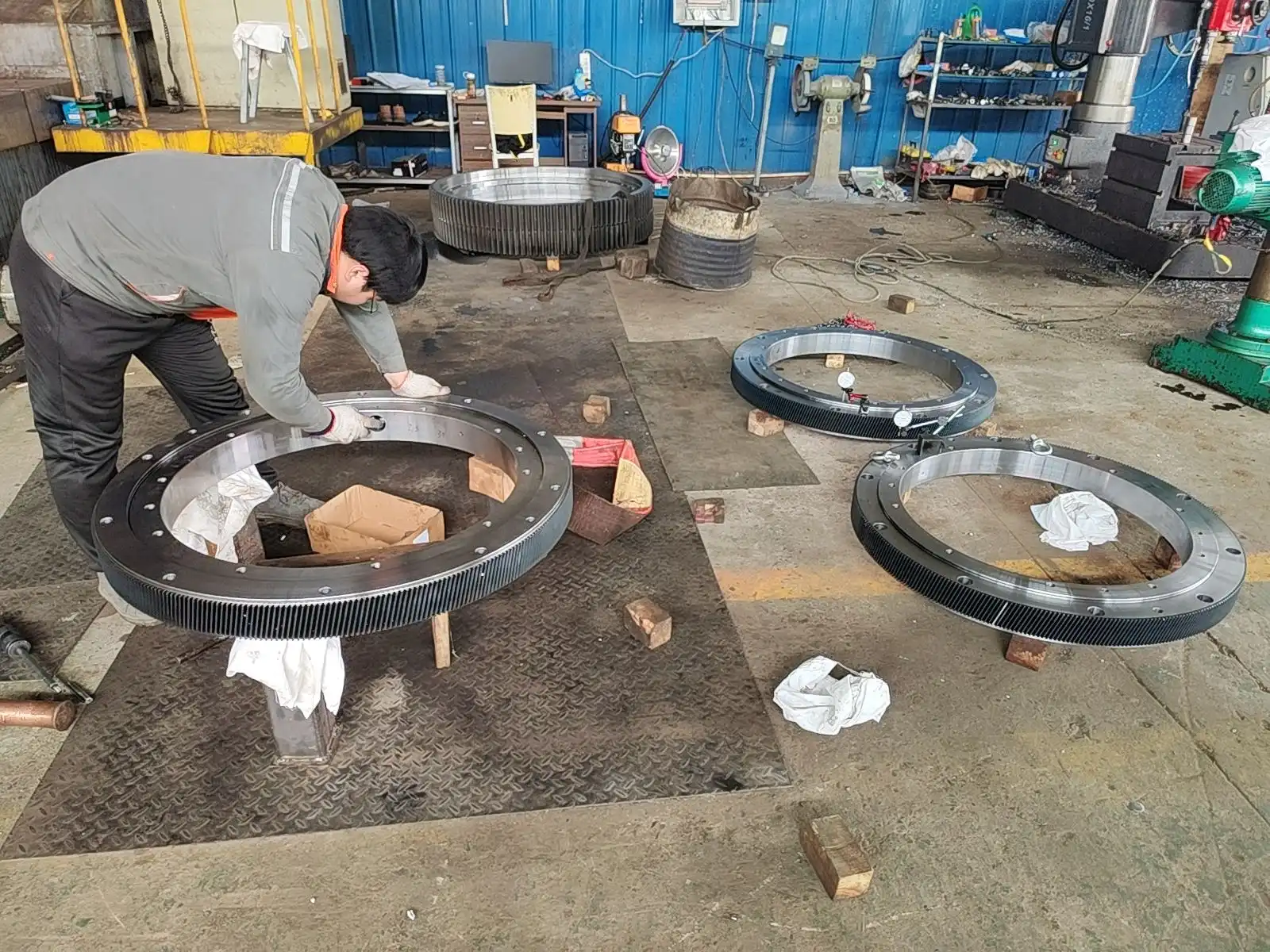
What Factors Should Engineers Consider When Selecting Crossed Cylindrical Roller Bearings?
To choose the correct bearing, it is crucial to understand how crossed roller technology differs from classic ball designs. Crossed Cylindrical Roller Bearings are able to carry radial, axial, and moment loads concurrently in an amazingly small footprint using cylindrical rollers in a V-groove raceway at alternating 90-degree angles. This makes them especially attractive where space available for installation is limited, but load capacity and rotational accuracy are still required to be high – line contact between rollers and raceways provides higher rigidity than the point contact of ball bearings of similar size, which counts for a lot in any application sensitive to deflection under load.
Crossed roller bearings have two main variations of construction, and the first engineering choice is to choose the proper one. Heng Guan Bearing provides:
Outer ring + inner ring (thru-bore) - excellent for hollow Shaft mounting and robotic joint centers when a clean thru-bore is required for cabling or shafting.
Two flanged rings with mounting holes: perfect for direct-mount installations, machine tool spindles, and rotary tables in which the bearing bolts directly into the housing.
Heng Guan produces these bearings with bore sizes from 20mm to 2,000mm, ultra-thin cross sections from 5mm to 50mm and precision ratings from P0 to P4. The larger table below ties the engineering choices to the factors they really drive.
Selection Factor Considerations
| Factor | Consideration |
|---|---|
| Load Type | Radial, axial, and moment loads combined — handled simultaneously in a single raceway |
| Space Constraints | Ultra-thin cross-section (5–50mm) replaces two-bearing assemblies, height reduced up to 40% |
| Rigidity | Line contact between rollers and raceways; superior rigidity to point-contact ball bearings |
| Accuracy Grade | P0 to P4 — chosen by precision requirement rather than catalog default |
| Structure Variant | Outer ring + inner ring (through-bore) vs. two flanged rings with mounting holes |
| Material Construction | 50Mn / 42CrMo rings, GCr15 rollers, NBR seals |
Crossed Roller Bearing Variants
| Variant | Bearing Construction | Best Fit Application | Typical Bore / Cross-Section |
|---|---|---|---|
| Standard crossed roller | Outer ring + inner ring (through-bore) | Robotic joint centers, hollow-shaft designs, medical imaging gantries | 50mm – 1,500mm / 8mm – 30mm |
| Flanged crossed roller | Two flanged rings with mounting holes | Machine tool spindles, rotary tables, direct-mount housings | 80mm – 2,000mm / 10mm – 50mm |
| Customized crossed roller | Modified bore / flange / sealing / preload | Non-standard frame geometry, OEM replacement of legacy units | 20mm – 2,000mm+ / 5mm – 50mm |
How Do You Match Bearing Size, Clearance, and Preload to the Application?
Getting size, clearance, and preload right requires balancing several competing priorities rather than defaulting to a standard catalog value. Bore diameter and cross-section height should match your shaft and housing dimensions precisely, since crossed roller bearings typically mount with tighter tolerances than conventional bearings. Clearance selection affects both accuracy and thermal behavior — too little clearance risks binding as temperatures rise during operation, while excessive clearance introduces unwanted play that undermines positioning accuracy. Heng Guan's standard production is built around zero-clearance, preloaded configurations for this reason, but engineering-grade adjustments are common when the customer's thermal envelope is unusual.
Preload, when applied correctly, increases rigidity and reduces backlash, which matters considerably for robotics and machine tool applications requiring repeatable precision. Heng Guan's preload is set at build against the customer's specified load, speed, and duty-cycle envelope, then verified dimensionally before shipment. For unusual mounting geometries or nonstandard load combinations, customized crossed roller bearings often make more sense than forcing a standard part into an application it wasn't designed for.
If you're unsure which clearance class or preload approach fits your project, our engineering team is available at mia@hgb-bearing.com to review your specifications directly.
Crossed Cylindrical Roller Bearings for Robotics, Machine Tools, and Automation
Crossed roller technology is often the better choice than other options for compact, stiff, and very precise rotation needed by robotics, machine tools, and automation systems. Space is almost always at a premium in robotic joints. Customized crossed roller bearings help designers achieve high torsional stiffness without the bulk of separate radial and thrust bearing assemblies. Heng Guan supplies RV-reducer cross rollers and joint-module cross rollers to most of the major 6-axis robot platforms, with P5 as the standard precision grade and P4 reserved for collaborative robots that require sub-0.02mm positioning repeatability.
Rotary tables for machine tools also benefit, as part quality is directly related to positioning precision, and the combined load handling of crossing rollers lowers table deflection during cutting operations. Heng Guan’s flanged-ring variations are the industry standard for 5-axis machining centers, where the bearing bolts directly into the rotary table housing and takes the complete cutting force without additional thrust bearings.
This bearing type is also used in automation platforms including pick-and-place systems, wafer-handling robots, and rotary indexing tables to provide constant, repeatable motion across millions of cycles. For these applications, Heng Guan Bearing offers custom crossed roller bearings, with different bore sizes, flange configurations, sealing (standard NBR at IP54, with marine-grade upgrades for harsh-environment automation lines), and preload class to match each customer’s particular mechanical layout rather than requiring engineers to redesign around a fixed catalog part.
How Can Engineers Verify Mounting Accuracy, Lubrication, and Service Life?
Verification doesn't end once the bearing arrives — proper mounting practice significantly influences how well it performs over time. Heng Guan's crossed-roller installation guide sets the gatekeeping numbers directly: mounting face flatness within 0.02mm per 100mm of length, concentricity within 0.05mm during installation, and bolt torque applied in three stages (30%, 60%, then 100% of specification) in a star pattern rather than sequentially around the circumference. Following these tolerances preserves the preload class built into the bearing at our Luoyang facility and prevents the early-life wear that drives warranty returns.
Lubrication choice should match the operating speed and temperature range. Lithium-based NLGI Grade 2 grease is the standard recommendation, applied to the raceways before assembly; for high-speed applications above 500 rpm, oil lubrication should be reviewed with our engineering team. Service life is a function of how well these installation and maintenance factors align with the original load calculations used during selection — with contamination control as the single biggest lever, since particles as small as 10 microns can indent the raceway and degrade performance long before rated fatigue life is reached.
Mounting Verification and Service Life Checklist
| Verification Step | Purpose |
|---|---|
| Mounting Surface Flatness | Flat within 0.02mm per 100mm prevents uneven roller loading |
| Concentricity Alignment | Within 0.05mm avoids uneven load distribution and premature wear |
| Bolt Torque Sequence | Star pattern in three stages (30%/60%/100%) distributes clamping force evenly |
| Lubrication Match | NLGI Grade 2 grease for standard duty; oil for high-speed (>500 rpm) duty |
| Seal Integrity Check | NBR seals to IP54; marine-grade upgrades for harsh environments |
| Relubrication Schedule | Every ~2,000 operating hours under normal conditions |
| Contamination Control | Particles ≥10µm can indent raceways and shorten life |
Technical Specifications at a Glance
| Parameter | Range / Value |
|---|---|
| Bore Diameter Range | 20mm – 2,000mm (custom beyond on request) |
| Cross-Section Height | 5mm – 50mm (ultra-thin design) |
| Structure Variants | Outer ring + inner ring / Two flanged rings with mounting holes |
| Roller Arrangement | 90° crossed, V-groove raceway with precision spacers |
| Precision Grades | P0, P6, P5, P4 (P4 / P5 typical for robotics, P0 for general automation) |
| Ring Material | 50Mn, 42CrMo high-strength alloy steel |
| Rolling Elements | GCr15 high-purity bearing steel |
| Seal Material | NBR nitrile rubber (IP54); fluororubber for marine / chemical exposure |
| Load Capacity | Radial, axial, and moment loads combined |
| Operating Temperature | -30°C to +100°C (standard) |
| Standards Compliance | ISO, DIN, GB (ISO 9001, RoHS compliant) |
| Lead Time | Stock: 2–4 weeks; Custom: 4–6 weeks |
Conclusion
Selecting crossed cylindrical roller bearings well requires matching size, clearance, and preload to real application demands. Heng Guan Bearing offers engineering support and customization, helping engineers achieve reliable, precise rotation. The biggest leverage points are usually the structure variant decision and the preload class — get those right at the engineering stage and the bearing will hold its accuracy across millions of cycles.
FAQ
Q: What makes crossed cylindrical roller bearings different from ball bearings?
A: They handle radial, axial, and moment loads together within a single compact raceway, using line contact (rollers) rather than point contact (balls) — higher rigidity in a thinner cross-section.
Q: Are customized crossed roller bearings available for nonstandard applications?
A: Yes — Heng Guan Bearing adjusts bore size, flange design, sealing, and preload class per project, including reverse-engineering from physical samples when drawings are unavailable.
Q: Why does preload matter for robotics applications?
A: Proper preload increases rigidity and removes backlash, which is what makes sub-0.02mm positioning repeatability possible on collaborative robots and pick-and-place systems.
Q: What accuracy grades are offered for these bearings?
A: P0 through P4 are available. P5 fits most industrial robots; P4 is reserved for collaborative robots and high-precision machine tool spindles requiring minimal runout.
Q: How often should lubrication be checked on crossed roller bearings?
A: Under normal conditions, relubricate every ~2,000 operating hours with NLGI Grade 2 grease. Harsh environments (dust, moisture, marine exposure) need shorter intervals and upgraded seals.
How Heng Guan Solves Your Crossed Roller Bearing Selection Challenges
If you're deciding between standard and customized Crossed Cylindrical Roller Bearings, send your housing drawing, expected load, duty cycle, and target precision grade to mia@hgb-bearing.com — our engineering team in Luoyang will come back with a variant and preload recommendation matched to your envelope.
References
1. Harris, T. A., & Kotzalas, M. N. (2007). Advanced Concepts of Bearing Technology (5th ed.). CRC Press / Taylor & Francis Group.
2. Brändlein, J., Eschmann, P., & Weigand, K. (1999). Ball and Roller Bearings: Theory, Design and Application (3rd ed.). John Wiley & Sons / INA/FAG Publications.
3. ISO 76:2006. Rolling Bearings — Static Load Ratings. International Organisation for Standardisation.
4. Shigley, J. E., & Mischke, C. R. Mechanical Engineering Design. McGraw-Hill.
5. Childs, P. R. N. Mechanical Design Engineering Handbook. Butterworth-Heinemann.
6. Slocum, A. H. (1992). Precision Machine Design. Society of Manufacturing Engineers.
7. American Bearing Manufacturers Association (ABMA). Standards for Roller Bearing Components and Assemblies.

WHAT OUR CUSTOMERS SAY
Here is the customer's evaluation of us