




Slew Bearing Essentials: What Manufacturers Want You to Know
Selecting slew bearings is not only a question of fitting a bearing diameter into the area available. In construction equipment, cranes, mining machinery, wind-energy systems and industrial positioning equipment, the slewing bearing is a structural link between the stationary and rotating parts. It may be required to withstand axial loads, radial loads and overturning moments, while at the same time being subjected to shock, vibration, contamination, temperature variations and repeat start-stop cycles. So the most crucial question for the engineers and purchasing teams is not just which bearing is available, but if the selected bearing is adequate for the real load spectrum, mounting structure, operating environment and maintenance plan. Manufacturers consider these elements in combination when suggesting a bearing. Knowing this method helps the customer prevent wrong substitutes, premature wear, installation issues, and unnecessary replacement expenditures.

How Slew Bearings Carry Combined Loads
The Role of a Slewing Bearing in Rotating Machinery
A slew bearing, also called a slewing ring bearing, is a large-diameter bearing designed to allow relative rotation between two machine structures. This is different from a standard bearing, where the bearing is typically just one part of a Shaft and housing assembly. A slewing ring usually contains the raceway, rolling elements, seals, mounting flanges, and, if required, an integral gear.
There are three main load components that the bearing can carry:
Axial load (acts on the axis of rotation).
Radial load (acts perpendicular to the axis).
Tilting or overturning moment (occurs when the loads are displaced from the bearing center).
The link between these loads is significant.
A bearing that appears OK for axial load alone may not be OK if a strong overturning moment is introduced. The machine construction also influences bearing performance, as the stiffness of the flange, the bolt arrangement, the flatness of the mounting, and the deformation of the housing all influence how the load enters the raceway.
This is why manufacturers often ask for application data before recommending a bearing for a tough project.
Design Features That Influence Bearing Performance
The raceway geometry is one of the main elements regulating the load distribution. The raceway profile, contact geometry, rolling element size, and internal clearance determine the way loads are carried through the bearing.
The four-point contact ball arrangements are able to handle combined axial, radial, and moment loads in a relatively small configuration. Crossed roller designs give line contact and can provide high stiffness and moment capacity when the application requires regulated rotation and structural rigidity. For very high load capacity applications, three-row roller arrangements are frequently investigated, separating the distinct load channels.
Sealing is another key design feature. Dust, water, sludge, and abrasive particles can infiltrate the operating environment of excavators, mining equipment, and outdoor machines. Proper sealing arrangements prevent the raceway and lubricant from contamination.
Some slew bearings also have an external or internal gear. The gear teeth must be included in the engineering evaluation if a geared bearing is employed. Instead of just looking at the gear as an accessory, you have to look at the gear module, the tooth geometry, the backlash, the lubrication, the pinion alignment, and the torque that's being transmitted.
How Do Manufacturers Select the Right Bearing Configuration?
Start With the Actual Load Spectrum
The first step in bearing selection should be a realistic description of the machine's operating loads.
Engineers should provide, where available:
Maximum axial load;
Maximum radial load;
Maximum tilting moment;
Operating speed;
Start-stop frequency;
Load direction;
Shock or impact conditions;
Expected duty cycle;
Ambient and operating temperature;
Required service life.
Maximum load alone is not always enough. A machine that occasionally experiences a high peak load may have a different bearing requirement from a machine operating continuously near its rated load.
For equipment with variable operating conditions, manufacturers may need several load cases rather than one nominal value. Providing these cases allows the supplier's engineering team to assess whether the bearing has adequate capacity across the complete operating cycle.
Consider Bearing Type Before Bearing Size
Choosing a larger bearing is not automatically the best solution. The bearing type should first match the mechanical requirements.
Four-point contact ball bearings are commonly considered where combined loading, compact construction, and relatively smooth rotation are important.
Crossed roller bearings can be suitable where rotational accuracy and stiffness are major priorities.
Three-row roller bearings are designed for applications where high radial, axial, and moment capacities are required and where the additional structural size and weight are acceptable.
The final selection depends on the complete application rather than on one specification. A manufacturer should be able to explain why a particular internal configuration is appropriate for the stated loads.
Mounting Accuracy Can Be as Important as Bearing Capacity
Check the Mounting Structure Before Installation
A correctly manufactured bearing can still perform poorly if it is installed on an unsuitable mounting structure.
The mounting surfaces should meet the manufacturer's requirements for flatness, stiffness, cleanliness, and dimensional accuracy. Local high spots or excessive deformation can introduce uneven raceway loading. Over time, this may contribute to abnormal wear, increased running torque, raceway damage, or premature failure.
The bolt circle, hole pattern, flange dimensions, and bolt grades also need to match the approved design. The mounting structure should be capable of transferring the applied loads without excessive deformation.
For this reason, bearing replacement should not be treated as a simple “remove and install” operation. If the previous bearing failed unexpectedly, the mounting structure should also be inspected before a new unit is installed.
Bolt Tightening Requires a Controlled Procedure
Mounting bolts transfer the bearing load into the machine structure, so tightening quality matters.
The correct bolt size, strength grade, lubrication condition, tightening sequence, and target torque or preload should follow the manufacturer's installation instructions and the applicable engineering requirements.
A cross-pattern or otherwise specified tightening sequence is generally used to distribute clamping forces progressively. The exact procedure should not be improvised because friction conditions can significantly affect the relationship between applied torque and actual bolt preload.
Engineers should establish the required radial and axial runout, allowable clearance, rotation speed, and drive arrangement for slewing bearings before finalizing the bearing design.

Materials, Heat Treatment, and Manufacturing Quality
Raceway Hardness and Heat Treatment
Slewing bearing raceways are exposed to repeated contact stresses, making material quality and heat treatment critical to service performance.
Manufacturers may use alloy steels selected for the required combination of strength, toughness, machinability, and wear resistance. Raceway hardening must produce an appropriate hardness profile while maintaining sufficient material toughness beneath the hardened layer.
The specific material grade and heat-treatment route should be selected according to the bearing design and application. Buyers evaluating suppliers should therefore ask for relevant material certificates and, where required, heat-treatment records or inspection documentation.
Machining Accuracy and Inspection
Machining quality affects raceway geometry, mounting dimensions, gear accuracy, and overall bearing behavior. Important inspection points may include:
Raceway dimensions;
Mounting flange dimensions;
Hole position and diameter;
Radial and axial runout;
Gear dimensions and backlash for geared bearings;
Rolling torque;
Internal clearance where applicable;
Surface condition;
Seal installation.
The exact acceptance criteria depend on the bearing design and customer specification. A professional manufacturer should have documented inspection procedures rather than relying solely on final visual inspection.
Application-Specific Requirements for Heavy Equipment
Construction and Excavation Machinery
Excavators, material handlers, drilling machines, and similar equipment expose bearings to substantial loads and repeated shock.
The slew bearing must withstand not only normal operating loads but also transient loads generated by acceleration, braking, digging resistance, uneven ground, and changes in load position.
Contamination control is particularly important in construction environments. Grease condition, sealing performance, mounting bolt condition, and bearing play should be monitored during scheduled maintenance.
Cranes and Lifting Equipment
Cranes and lifting machinery require careful evaluation because bearing loads can change significantly with boom position and lifted load.
The engineering assessment should consider the worst credible operating position, not only the average load. Duty classification, load cycles, braking forces, wind conditions, and structural deflection can all influence bearing loading.
For lifting equipment, purchasing decisions should prioritize documented engineering support and traceable quality controls rather than focusing only on initial bearing price.
Wind, Marine, and Outdoor Applications
Wind energy and marine machinery introduce additional environmental challenges. Bearings may encounter moisture, salt exposure, temperature variation, vibration, and long maintenance intervals.
For these applications, buyers should discuss corrosion protection, seal design, lubricant selection, material requirements, and inspection procedures with the manufacturer before ordering.
The bearing type also depends on its exact function. Pitch, yaw, main shaft, and other rotating positions have different mechanical requirements, so “wind turbine bearing” should never be treated as a single standardized design.
Lubrication and Maintenance Planning
Choose Lubrication Based on Operating Conditions
Lubrication reduces friction and helps protect raceways and rolling elements from wear. However, more grease does not necessarily mean better lubrication.
The lubricant should be selected according to load, speed, temperature, contamination, and the bearing manufacturer's recommendations. Grease compatibility should also be checked before changing lubricant types.
Over-lubrication can increase churning and operating temperature, while insufficient lubrication can accelerate raceway and rolling-element damage.
Automatic lubrication systems may be useful on large or difficult-to-access machinery, but the delivery rate and lubrication intervals still need to be established correctly.
Monitor Early Warning Signs
A maintenance program should track changes rather than waiting for complete bearing failure.
Potential warning signs include:
Increasing rotational resistance;
Abnormal noise;
Unusual vibration;
Excessive bearing clearance or play;
Damaged or hardened seals;
Grease contamination;
Metal particles in lubricant;
Mounting bolt loosening;
Gear tooth wear or abnormal backlash.
These symptoms should be investigated together with operating history. For example, abnormal vibration may originate from the bearing, gear mesh, mounting structure, or another machine component.
Condition monitoring is most useful when baseline measurements are established after commissioning. Comparing later measurements against that baseline can make developing problems easier to identify.
|
|
What Buyers Should Ask a Slew Bearing Manufacturer?
Technical Information to Provide Before Quotation
A manufacturer can provide a more accurate recommendation when the inquiry includes detailed application information for slewing bearings.
A useful RFQ package should include:
Bearing outside diameter, inside diameter, and available installation space;
Axial and radial loads;
Maximum and continuous tilting moments;
Operating speed and duty cycle;
Gear requirements, if applicable;
Mounting-hole pattern;
Environmental conditions;
Expected service life;
Lubrication requirements;
Applicable standards or customer specifications.
Drawings are particularly useful for customized bearings because they allow the manufacturer to check the mounting interface and surrounding structure rather than quoting from diameter alone.
Documents Worth Reviewing Before Purchase
Price comparison should be supported by technical documentation.
Depending on the project, buyers may request:
Product drawings;
Technical data sheets;
Material certificates;
Inspection reports;
Dimensional inspection records;
Heat-treatment information;
Load calculations;
Installation instructions;
Lubrication recommendations;
Quality-system certificates;
Traceability information.
Not every project requires every document, but the supplier should be able to explain which records are available and which are appropriate for the application.
Evaluating Supplier Capability Beyond Price
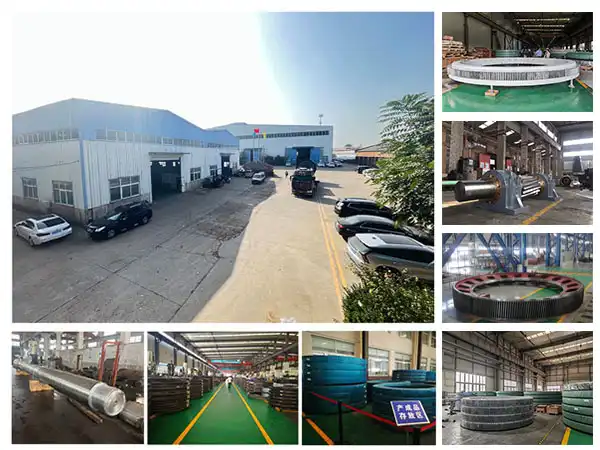
Manufacturing Capacity and Quality Control
A competitive quotation does not necessarily indicate the best total value. For large slewing bearings, buyers should evaluate whether the supplier has the equipment and engineering capability required for the specific product.
Useful questions include:
Does the manufacturer machine the raceways in-house?
How are raceway dimensions inspected?
What heat-treatment processes are available?
How are mounting dimensions verified?
How are gear teeth inspected on geared bearings?
Is product traceability maintained by batch or serial number?
Can the supplier provide application-specific engineering support?
Can the supplier support replacement or troubleshooting after delivery?
These questions help distinguish a manufacturer with genuine engineering capability from a trading company that mainly resells standard products.
Compare Total Cost Rather Than Unit Price
The initial purchase price is only one part of the cost of a slewing bearing.
A lower-priced bearing may become more expensive if it results in:
More frequent replacement;
Longer installation downtime;
Additional machining of the mounting structure;
Unexpected lubrication requirements;
Difficult troubleshooting;
Premature gear or raceway damage.
A higher-quality bearing with appropriate technical support can reduce lifecycle costs when it delivers predictable service and easier maintenance.
For critical machinery, the supplier's responsiveness during engineering, installation, and after-sales support should therefore be included in the purchasing evaluation.
Conclusion
Choosing slew bearings requires more than comparing dimensions and quotations. The correct selection depends on combined loads, operating cycles, bearing configuration, mounting structure, materials, lubrication, environmental conditions, and the quality controls used during manufacturing.
Manufacturers can make better recommendations when buyers provide complete application data and clearly define their performance requirements. Likewise, buyers can reduce procurement risk by reviewing technical drawings, inspection documentation, mounting requirements, and supplier manufacturing capabilities before placing an order.
For demanding applications, the most effective approach is to treat the bearing as part of the machine's structural system rather than as an isolated replacement component. Proper selection, controlled installation, suitable lubrication, and condition-based maintenance can all contribute to longer service life and reduced unplanned downtime.
FAQ
1. How do I choose the correct slew bearing for my machine?
Start with the complete load profile rather than bearing diameter alone. Provide the manufacturer with axial load, radial load, tilting moment, rotational speed, duty cycle, mounting dimensions, environmental conditions, and expected service life. The supplier can then evaluate the appropriate bearing type and configuration.
2. What is the difference between a ball and roller slewing bearing?
Ball-type designs generally offer efficient rolling characteristics and can accommodate combined loads in a compact arrangement. Roller designs provide line contact and can offer higher stiffness or load capacity in applications that demand it. The appropriate choice depends on the load combination, moment, speed, structural requirements, and duty cycle.
3. Can I replace my existing slew bearing with a different bearing type?
Not necessarily. Even when the outside and inside diameters appear compatible, the internal load capacity, mounting requirements, gear configuration, clearance, lubrication, and structural behavior may differ. A bearing substitution should be reviewed by the manufacturer before installation.
4. How can I tell if a slew bearing is beginning to fail?
Common warning signs include abnormal noise, increased rotational resistance, unusual vibration, excessive play, seal damage, contaminated grease, mounting bolt problems, and gear tooth wear. These symptoms should be evaluated with operating history and inspection data to identify the actual root cause.
Working With Heng Guan on Slewing Bearing Projects
Heng Guan provides slew bearings for applications that require large-diameter rotational support and application-specific engineering. Its product range covers different bearing configurations and sizes for demanding equipment and industrial machinery. For a customized project, buyers can provide the bearing drawing, machine application, load information, operating conditions, and mounting requirements for technical evaluation. This allows the engineering team to assess the required configuration instead of treating the project as a simple dimensional replacement. When comparing suppliers, customers should look beyond unit price and evaluate manufacturing capability, dimensional control, material and heat-treatment practices, inspection procedures, documentation, delivery reliability, and technical support. These factors are particularly important when a bearing is a critical component of construction, mining, lifting, wind-energy, or other heavy-duty equipment. A supplier that can support the project from bearing selection through installation and maintenance provides greater value than a supplier that only provides a product quotation. For applications with demanding loads or customized mounting requirements, early technical communication can also help identify potential problems before production begins. Contact mia@hgb-bearing.com today to discuss your requirements and discover how our proven expertise in slew bearing design and manufacturing can optimize your equipment performance while providing exceptional value.
References
1. American Society of Mechanical Engineers. "Design Guidelines for Large Diameter Slewing Ring Bearings in Industrial Applications." ASME Standards Publication, 2023.
2. International Organization for Standardization. "Rolling Bearings - Slewing Rings - Part 1: Dimensions and Tolerances." ISO 12043-1:2022.
3. Johnson, Michael R., and Sarah Chen. "Advanced Materials and Heat Treatment Processes for Heavy-Duty Slewing Ring Applications." Journal of Bearing Technology, Volume 45, 2023.
4. European Wind Energy Association. "Technical Guidelines for Wind Turbine Main Bearing Selection and Maintenance Practices." EWEA Technical Publication, 2023.
5. Roberts, David L. "Failure Analysis and Predictive Maintenance Strategies for Large Diameter Slewing Bearings." Industrial Maintenance Quarterly, Issue 3, 2023.
6. Society of Manufacturing Engineers. "Quality Standards and Testing Protocols for Precision Slewing Ring Bearings." SME Manufacturing Handbook, 8th Edition, 2023.

WHAT OUR CUSTOMERS SAY
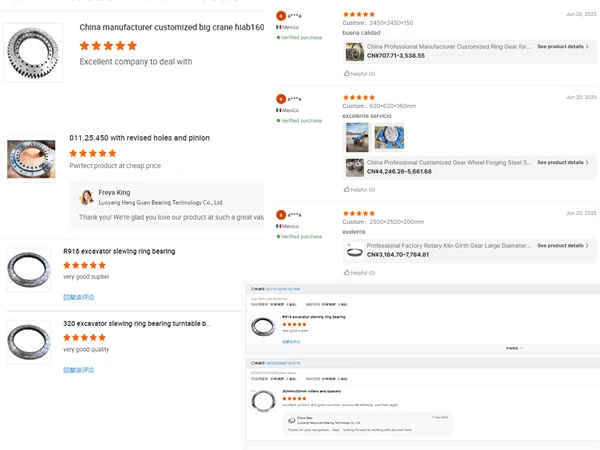
Here is the customer's evaluation of us