




How to Choose Slewing Ring Lubrication and Sealing?
Under large loads, the slewing ring rotates slowly, so its raceways rely on clean grease and dependable seals. At Heng Guan, we manufacture slewing rings and slewing bearings from 50 mm to 10,000 mm in diameter, and we witness a trend again and again: failure is seldom caused by load alone. They begin to fail when the grease runs out or dirt contaminates it, since induction-hardened raceways at HRC 55-60 with 2.5- 5 mm case depth can only maintain their accuracy as long as the grease layer is unbroken and impurities are kept out. This information is to help you in selecting lubrication and seals whether you purchase from a Slewing ring distributor or buy directly from a manufacturer like Heng Guan.
What Factors Should You Consider When Choosing Slewing Ring Lubrication?
Start with duty cycle. A Slewing Ring spins slowly in a crane, excavator, or wind turbine and oscillates under high contact pressure, which seeks to suck grease from the raceway. Think about load, speed, temperature range, moisture, and dust before you decide on anything. Heavy loads demand extreme-pressure additives.
Outdoor equipment needs water-resistant grease. Also consider how you will relubricate: rings with grease holes allow you to push out the old grease via the seals. Ask the slewing ring wholesaler what factory grease is used and how frequently it has to be renewed. Heng Guan offers four-point contact ball, single row cross roller, double row ball, three-row roller and ball-roller combination designs.
Each has slightly different lubrication requirements, so tell us about your working circumstances early. With the same 50 mm – 10,000 mm diameter range and the same 42CrMo / 50Mn ring material with GCr15SiMn rolling elements, six standard constructions are available, so a maintenance plan that works for one configuration will just require translation to your duty cycle.
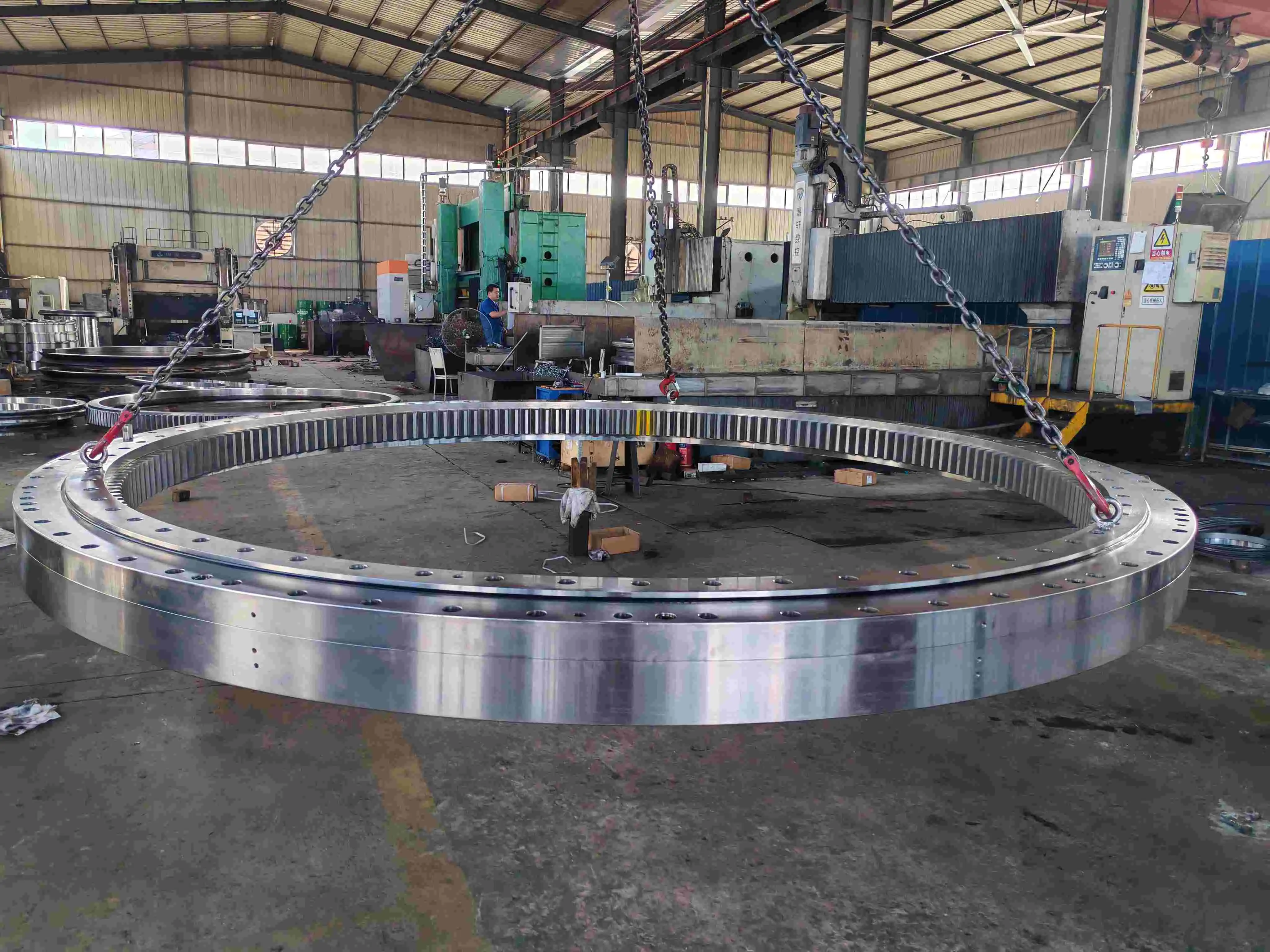
Slewing Ring Lubricant Selection, Grease Compatibility, and Operating Conditions
Most Slewing ring wholesalers run well on lithium-complex or calcium sulfonate grease in NLGI grade 1 or 2 with EP additives. Compatibility matters, because mixing incompatible thickeners can soften grease and cause leakage, so purge thoroughly before changing brands.
A reliable Slewing ring wholesaler will state the base grease on the datasheet, which saves guesswork at the first service. Very low temperatures call for a softer, synthetic-based grease, while hot sites need a high dropping point. Operating temperature across our product range spans -40°C to +120°C, so a single grade is rarely enough for outdoor equipment in a four-season climate — keep a winter and a summer grade on the shelf and switch at the seasonal boundary. The table below offers a starting point for your Slewing Ring, though final selection should follow the supplier's guidance.
| Condition | Suggested Grease |
|---|---|
| Heavy or shock load | EP lithium-complex, NLGI 2 |
| Cold climate | Synthetic-based, NLGI 1 |
| Wet or outdoor | Calcium sulfonate, water-resistant |
| High temperature | High dropping-point complex grease |
Not sure which grease suits your Slewing ring wholesaler? Email mia@hgb-bearing.com, and the Heng Guan team will review your operating conditions and recommend a base grease that fits your duty cycle.
How Do You Select the Right Seal for a Slewing Ring Application?
Seals keep grease in and contaminants out, so choose them for the environment. Poor installation, such as a twisted seal, undoes even the best material, so follow the fitting instructions carefully — clean all mounting surfaces before installation, align the seal squarely in its groove, and avoid hammer blows that pinch the lip. Dusty sites such as mining or ports may need double-lip or labyrinth protection, while marine decks subject seals to salt spray that attacks ordinary nitrile quickly.
When you ask a Slewing ring wholesaler for a Slewing Ring, confirm the seal material and whether upgraded options are available. Heng Guan offers customized design for different customers, so seals can be matched to your equipment and climate rather than forcing a stock configuration into an environment it was never built for. Send us your drawings to get started.
| Seal Material | Best For |
|---|---|
| Nitrile (NBR) | General industrial use, indoor equipment |
| Polyurethane | Abrasive, dusty sites (mining, quarries, cement) |
| Fluoroelastomer (FKM) | Heat and chemical exposure, marine and chemical plants |
| Double-lip / labyrinth | Severe dust, salt spray, and outdoor exposure |
How Do Lubrication and Sealing Work Together to Extend Slewing Ring Life?
Lubrication and sealing are one system. The seal keeps grease where it belongs, and fresh grease forms a barrier that pushes dust and moisture away from the seal lip. Regular purging until clean grease appears at the seal removes contaminants before they reach the raceway, which matters most in slow-oscillating service where the grease film is squeezed back and forth rather than circulated. Inspect seals for cracks or hardening at every service, and follow the maintenance interval recommended for your Slewing Ring — for Heng Guan's standard products, this is typically a check at the first 50 hours of operation, then a 500-hour or quarterly interval, with bolt torque and seal condition reviewed in the same walk-around.
Heng Guan's high-precision rings, from P0 to P4 accuracy, depend on this same discipline, because precision only lasts when the raceway stays clean and lubricated. Following the manufacturer's instructions for bolt-tightening sequences during installation protects both the seal and the raceway from uneven stress that would otherwise shorten both their working lives.
Conclusion
Long Slewing Ring life comes from matching grease to load and climate, choosing seals for the environment, and maintaining both on schedule. Confirm details with your Slewing ring wholesaler or manufacturer before ordering, and Heng Guan will gladly support your project with practical advice today.
FAQ
Q1: What grease is common for a slewing ring?
Lithium-complex or calcium sulfonate grease, NLGI 1 or 2, with EP additives for heavy or shock-loaded applications.
Q2: Can I mix different greases?
Avoid it unless compatibility is confirmed, and purge thoroughly through the seals when changing brands.
Q3: Which seal material suits dusty sites?
Polyurethane or double-lip designs usually resist abrasion well, with FKM reserved for heat and chemical exposure.
Q4: Why purge grease through the seal?
It pushes out contaminants and refreshes the raceway before particles can be worked into the rolling contact.
Q5: Does Heng Guan offer customization?
Yes, Heng Guan designs and produces slewing rings to customer requirements, including seal and grease specifications.
How Heng Guan Solves Your Slewing Ring Lubrication and Sealing Challenges
Service and supply. Standard sizes typically ship within 2–4 weeks, custom designs within 6–8 weeks, with lifetime original-factory technical support included on every order.
Choosing grease and seals should not be guesswork. Heng Guan provides customized slewing rings and professional technical support. Send your load, speed, and environment details to mia@hgb-bearing.com, and our team will recommend a reliable solution for your equipment.
References
1. Harris, T. A., and Kotzalas, M. N. Essential Concepts of Bearing Technology. CRC Press, 2006.
2. Lugt, P. M. "A Review on Grease Lubrication in Rolling Bearings." Tribology Transactions, 2009.
3. Lugt, P. M. Grease Lubrication in Rolling Bearings. Wiley, 2013.
4. ISO 281. Rolling Bearings: Dynamic Load Ratings and Rating Life. International Organization for Standardization, 2007.
5. Flitney, R. Seals and Sealing Handbook. 6th ed. Elsevier, 2014.
6. Hamrock, B. J., Schmid, S. R., and Jacobson, B. O. Fundamentals of Machine Elements. 3rd ed. CRC Press, 2013.

WHAT OUR CUSTOMERS SAY
Here is the customer's evaluation of us