



How to Choose the Right Crossed Roller Bearings for Your Application?
Selecting the right crossed roller bearings is a critical decision in precision mechanical design. The wrong choice can lead to reduced rigidity, premature wear, vibration issues, or even system failure in high-accuracy equipment. Because these bearings are often used in robotics, CNC machines, medical systems, and semiconductor equipment, engineers must carefully evaluate load conditions, accuracy requirements, and installation constraints before making a final selection. In this guide, Heng Guan Bearing breaks down the key engineering factors that determine the right crossed roller bearing for your application, helping you achieve optimal performance, reliability, and service life.
What Are Crossed Roller Bearings and Why Are They Used in Precision Applications?
Before selecting a suitable model, it is essential to understand the structure and working principle of crossed roller bearings.
Crossed roller bearings use cylindrical rollers arranged alternately at 90° angles in a cross configuration within a single raceway system. This unique geometry allows one compact bearing to support radial loads, axial loads, and overturning moment loads simultaneously.
Compared with conventional multi-bearing systems, this design significantly reduces:
- Installation space
- Assembly complexity
- Alignment errors
- System deformation under load
Manufactured using high-strength GCr15 bearing steel, crossed roller bearings achieve high rigidity, excellent wear resistance, and stable rotational accuracy even under continuous operation. Standard series include RA, RB, RE, RU, CRBH, and SX, each optimized for different structural and mounting requirements.
As a result, they are widely used in:
- Industrial robots
- CNC rotary tables
- Medical imaging equipment
- Semiconductor manufacturing systems
- Precision measuring instruments
| Series | Structural Feature | Typical Application |
|---|---|---|
| RA / RA-C | Compact, separable ring design | Robotics, small rotary stages |
| RB / RE | High rigidity structure | Machine tools, precision tables |
| RU | Slim cross-section design | Space-limited systems |
| CRBH / SX | Integrated mounting holes | Automation equipment |
How to Determine Load Capacity Requirements for Crossed Roller Bearings Selection?
Load analysis is the first and most important step in selecting crossed roller bearings.
Unlike conventional bearings that handle loads in separate directions, crossed roller bearings are designed to support combined radial, axial, and moment loads simultaneously. Therefore, engineers must evaluate all force components in the system rather than focusing on a single dominant load.
Key factors include:
- Maximum radial load
- Axial thrust (both directions)
- Overturning moment load
- Duty cycle and operating speed
- Shock or intermittent loads
The X-shaped roller arrangement distributes these forces evenly across the raceway, minimizing localized stress and deformation. However, capacity still depends on bearing size, series selection, and precision grade.
For complex load calculations or model selection support, our engineering team can review your drawings and application requirements directly at: mia@hgb-bearing.com
What Size and Mounting Conditions Should Be Considered When Choosing Crossed Roller Bearings?
After load evaluation, dimensional compatibility becomes the next critical factor.
Crossed roller bearings are available in multiple bore diameters and structural configurations, but correct selection depends heavily on:
- Shaft diameter and tolerance fit
- Housing rigidity and machining accuracy
- Available axial installation space
- Preload and clearance requirements
- Mounting orientation (horizontal or vertical)
Because these bearings are manufactured with tight precision using GCr15 bearing steel, even small machining errors in the housing can affect preload stability and rotational accuracy.
When standard dimensions are not suitable, Heng Guan Bearing provides custom-designed crossed roller bearings based on engineering drawings, including modifications to:
- Inner diameter
- Outer diameter
- Width
- Mounting hole layout
- Preload configuration
Accuracy grade selection is also essential for performance matching:
| Accuracy Grade | Application Level |
|---|---|
| P0 | General industrial machinery |
| P6 | Standard automation systems |
| P5 | Robotics, medical devices |
| P4 | High-precision instruments |
Higher precision grades provide better rotational accuracy and lower runout, but require stricter installation and machining control.
Lubrication, Maintenance, and Service Life Optimization for Crossed Roller Bearings
Proper lubrication and maintenance directly determine the long-term performance of crossed roller bearings.
Before operation, the bearing raceway must be evenly lubricated using the recommended grease or oil type to ensure stable initial running conditions. In continuous-duty applications, regular relubrication is necessary to maintain:
- Smooth rotational motion
- Low friction torque
- Stable temperature performance
- Reduced wear on raceways and rollers
Environmental conditions also play an important role. Dust, humidity, and contamination can significantly reduce service life if sealing and maintenance are not properly managed.
Installation quality is equally important:
- Avoid impact during assembly
- Ensure uniform preload distribution
- Maintain strict alignment between shaft and housing
- Prevent over-tightening or uneven fastening
With a correct lubrication strategy and installation practices, crossed roller bearings can achieve long-term stable performance in high-precision systems.
Conclusion
Choosing the right crossed roller bearing requires careful evaluation of load conditions, dimensional constraints, accuracy requirements, and maintenance strategy. When properly selected, these bearings deliver high rigidity, compact structure, and exceptional multi-directional load performance in a single integrated unit. Based in Luoyang, China’s “Bearing Town,” Heng Guan Bearing combines advanced manufacturing capability with strict quality control to provide reliable crossed roller bearing solutions for global precision industries.
|
|
FAQ
Q1: How do I choose the correct crossed roller bearing size?
A: Match Shaft/housing dimensions with standard series (RA, RB, RE, RU, CRBH, SX) or request a customized solution.
Q2: Can crossed roller bearings handle combined loads?
A: Yes, they are designed to support radial, axial, and moment loads simultaneously.
Q3: What material is used in crossed roller bearings?
A: GCr15 bearing steel, offering high hardness, wear resistance, and stability.
Q4: How important is accuracy grade selection?
A: Very important—higher grades (P5/P4) provide better precision but require stricter installation conditions.
Q5: Can crossed roller bearings be customized?
A: Yes, full customization is available based on engineering drawings and application requirements.
Let Us Help You Choose the Right Bearing
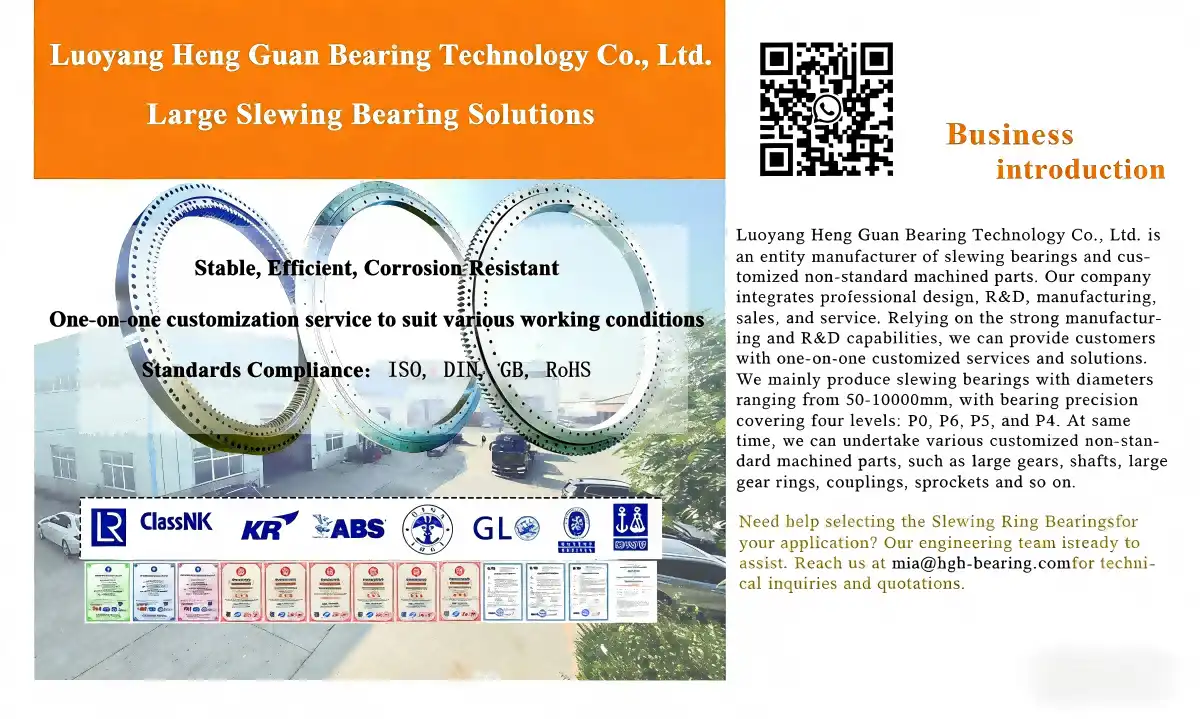
If you're unsure which crossed roller bearing best fits your application, Luoyang Heng Guan Bearing Technology Co., Ltd. provides full engineering support, from early-stage selection guidance to customized design and manufacturing based on your technical drawings. With strong production capacity (covering 20–10,000 mm diameter bearing solutions), multiple precision grades (P0–P4), and flexible non-standard customization capabilities, our engineering team helps optimize bearing performance for complex load and space constraints. For technical consultation, drawing evaluation, or customized solutions, you can contact our engineers directly at: mia@hgb-bearing.com
References
1. THK Co., Ltd. Cross-Roller Ring Series Technical Catalog, No. 382-3E.
2. IKO International (Nippon Thompson Co., Ltd.). Crossed Roller Bearings Product Guide.
3. ISO. ISO 9001 Quality Management Systems — Requirements.
4. Schaeffler Technologies AG & Co. KG. INA Rolling Bearings Catalog.
5. NSK Ltd. Rolling Bearings Technical Report.
6. SKF Group. Cross Roller Bearings Engineering Handbook.

WHAT OUR CUSTOMERS SAY
Here is the customer's evaluation of us
_1769754972666.webp)