




Top China Factory for Thin Section Slewing Bearing Solutions
Compact machines require rotating components that can handle actual loads without sacrificing space or adding weight. That's where the thin section slewing bearing comes in, and picking the appropriate manufacturer dictates whether your equipment will work well for years or suffer from the start. A well-designed thin section bearing saves 30–50% of the weight of a typical slewing ring at the same diameter, and therefore it is now a structural optimization solution and not merely a part of high-end equipment design. Luoyang Heng Guan Bearing Technology Co., Ltd. is a professional company integrating design, research, manufacture, and service in Luoyang, the “Bearing Town”, with more than 20 years of engineering expertise and 50 R&D team members. In this article, we’ll discuss what to look for in a manufacturer, how these bearings hold up in terms of load and accuracy, how they reduce weight and space, and how to evaluate a supplier’s OEM credentials.
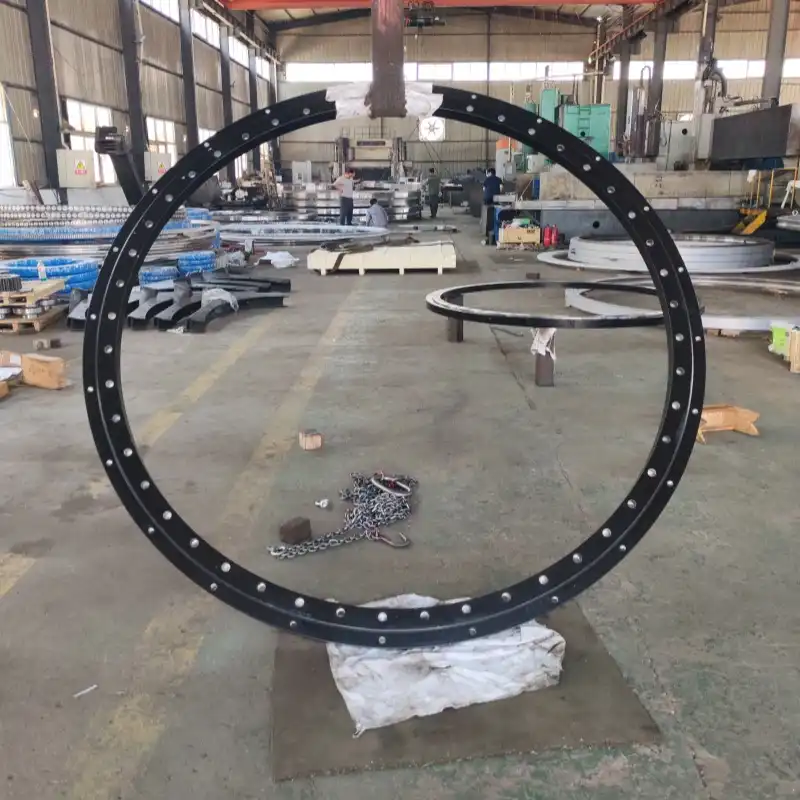
What Should Buyers Check When Choosing a Thin Section Slewing Bearing Factory?
Capability first, not cost. A quality ultra-thin slewing bearing manufacturer will have a regulated procedure for engineering, machining, heat-treating, assembling, and inspecting their goods, leaving nothing to chance in terms of quality. Inquire about sizes, constructions, and precise grades available. Heng Guan Bearing manufactures slewing bearings with diameters from 50 mm to 10,000 mm, in P0, P6, P5, and P4 precision grades, using 42CrMo and 50Mn special alloy steel in a single-row four-point contact ball structure, the configuration that distributes axial, radial, and moment loads simultaneously through optimized contact angles.
And inspect the factory's testing equipment and its export expertise, since paperwork and packaging count for international orders. A capable manufacturer verifies every ring on coordinate measuring machines, measures axial and radial runout, checks raceway geometry and mounting hole position accuracy, and vibration-tests before shipment. If you would like a quick capability review, email your requirements to mia@hgb-bearing.com, and we will point you toward a suitable thin section slewing bearing.
Factory Selection Checklist
| Check Point | What to Look For |
|---|---|
| Design ability | Custom engineering support, reverse engineering from samples |
| Size range | 50 mm – 10,000 mm diameters to suit your machine |
| Precision grades | P0 (general machinery) to P4 (medical imaging) options |
| Testing tools | CMM dimensional reports, runout and vibration data available |
| Heat treatment control | Induction hardening with ±2°C quench temperature stability |
| Export experience | Documentation, packing, and delivery to 50+ countries |
Thin Section Slewing Bearing Design, Load Capacity, and Precision
A thin section slewing bearing keeps the cross-section constant while the diameter grows, so it stays slim even in larger sizes. Despite the slim profile, well-designed versions handle radial, axial, and tilting loads at the same time, especially in four-point contact ball and cross roller layouts. The raceways are induction-hardened to HRC 55–62, providing wear resistance where it matters most while keeping the mounting surfaces machinable for your assembly process.
Precision is equally important: robotics, medical equipment, and automation systems rely on steady, low-friction rotation, and that starts with accurate raceways and careful assembly. Precision-ground raceways and optimized ball spacing also minimize friction at startup, giving these bearings a low starting torque that matters in battery-powered robotics and precision positioning systems where every watt counts. A capable ultra-thin slewing bearing manufacturer will select materials, heat treatment, and clearance to match your duty cycle. Heng Guan Bearing offers personalized optimization design, so a thin-section slewing bearing can be tuned for the loads, speeds, and mounting arrangement of your specific machine.
Design Elements and What They Deliver
| Design Element | Performance Impact |
|---|---|
| Constant reduced cross-section | Slim profile maintained at any bore diameter |
| Four-point contact ball geometry | Simultaneous axial, radial, and moment load handling |
| Induction-hardened raceways (HRC 55–62) | Wear resistance with machinable mounting surfaces |
| Precision-ground raceways, optimized ball spacing | Low starting torque for servo and battery-powered drives |
| High stiffness-to-weight ratio | Deflection resistance comparable to heavier assemblies |
How Does a Thin Section Slewing Bearing Reduce Weight and Space?
Weight and space are precious in modern equipment. A conventional bearing may need a bulky housing and heavy support structure, while a thin-section slewing bearing offers a lightweight ring with integrated mounting holes, shrinking the overall assembly — the thin-section design saves 30–50% of the weight of standard slewing rings of equivalent diameter, which directly reduces energy consumption during acceleration and improves payload capacity in mobile applications.
Engineers can open up the constant cross-section's hollow center for cables, Shafts, or hoses, integrating large-diameter hollow shafts without adding unnecessary bulk and creating cleaner, more compact layouts. Lower weight also reduces motor demand and improves energy efficiency, which suits mobile and automated equipment. The constant cross-section across diameter ranges also simplifies product-line engineering: once you validate a bearing interface for one equipment size, scaling to larger or smaller models requires minimal redesign effort.
Applications range from collaborative robot joints and CT/MRI gantries to satellite communication arrays, lightweight port cranes, and automated production lines. An experienced ultra-thin slewing bearing manufacturer such as Heng Guan Bearing can help you choose the slimmest profile that still meets load and lifetime targets. Share your space limits at mia@hgb-bearing.com for practical suggestions.
Where Slim Profiles Add Value
| Application | Benefit |
|---|---|
| Robotics and automation | Compact joints, lighter arms, lower inertia, faster dynamic response |
| Medical imaging (CT/MRI gantries) | Large bore for patient positioning, ultra-smooth rotation, P5/P4 grades |
| Aerospace ground support | Gimbal components for satellite arrays and radar positioning |
| Packaging machinery | Space-saving rotary tables and indexing mechanisms |
| Port and material handling | Lighter cranes and AGVs with mobility advantages |
How Can Buyers Verify Thin Section Slewing Bearing OEM Capability?
True OEM capability shows in the details. Ask whether the factory can build from your drawings or samples, adjust mounting holes, gear type, seals, and dimensions, and deliver consistent batches. A genuine manufacturer will accept an existing bearing sample or even a working-condition description, and provide professional reverse engineering without complete 3D drawings. Request inspection reports, material records with full traceability from steel-mill certification to final inspection, and references from customers in similar industries.
Heng Guan Bearing serves fields such as new energy, medical, automation, lifting, mining, and aerospace, and exports to more than 50 countries across Europe, America, and Asia, which reflects practical experience with varied requirements. Vertical integration also matters: CNC vertical lathes machining rings up to 10 meters in diameter, gear hobbing machines for integral pinion processing, precision grinding equipment for raceway finishing, and multi-axis machining centers for complex mounting interfaces all shorten lead times — typically 4–6 weeks for standard configurations and 8–12 weeks for custom diameters or special mounting patterns.
A trustworthy ultra-thin slewing bearing manufacturer will also answer technical questions clearly and quickly, because good communication predicts good production. If you need a custom thin section slewing bearing, send your drawings or specifications to our team, and we will confirm feasibility, lead time, and pricing.
Technical Specifications at a Glance
| Parameter | Specification |
|---|---|
| Bearing type | Single-row, four-point contact ball |
| Diameter range | 50 mm – 10,000 mm |
| Precision grades | P0 / P6 / P5 / P4 |
| Material | 42CrMo, 50Mn special alloy steel |
| Raceway hardness | HRC 55–62 (induction hardened, ±2°C quench control) |
| Sealing options | Lip seal, labyrinth seal |
| Mounting | Integrated bolt holes, factory-drilled to specification |
| Operating temperature | -40°C to +120°C |
| Load capacity | Simultaneous axial, radial, and moment loads |
| Weight saving | 30–50% vs. standard slewing rings of equivalent diameter |
| Lead time | Standard 4–6 weeks; custom 8–12 weeks |
| Maintenance | Bolt torque check at 50 h, then every 500 h/quarterly; NLGI 2 lithium grease |
| Standards and certifications | ISO 9001, RoHS, ISO/DIN/GB |
Conclusion
A dependable factory combines design skill, precision manufacturing, testing, and OEM flexibility. Thin section slewing bearings then deliver strong performance in a slim, lightweight package. Heng Guan Bearing offers all of these strengths, so Contact Us today and start building your next compact machine on a solid foundation.
FAQ
Q1: What is a thin section slewing bearing?
It is a slewing bearing with a slim, constant cross-section maintained even at larger diameters, saving 30–50% of the weight of a standard ring of equivalent size.
Q2: Which precision grades are offered?
P0, P6, P5, and P4 grades — P0 for general machinery, P6 for automation, P5 for precision robotics, and P4 for medical imaging.
Q3: Can it carry combined loads?
Yes, radial, axial, and tilting loads are handled together through the four-point contact ball geometry.
Q4: Is customization available?
Yes, dimensions, mounting holes, gears, and seals can be tailored, including reverse engineering from existing samples.
Q5: How can I request a quote?
Email your drawings or requirements to mia@hgb-bearing.com.
How Heng Guan Solves Your Thin Section Bearing Challenges
Manufacturing depth you can verify. CNC vertical lathes machining rings up to 10 meters in diameter, CNC quenching machines with ±2°C temperature stability, gear hobbing machines for integral pinion processing, and precision grinding equipment for raceway finishing.
Precision across four grades. P0 for general machinery, P6 for automation equipment, P5 for precision robotics, and P4 for medical imaging systems — so your thin section slewing bearing matches the accuracy your machine actually needs.
Custom engineering without barriers. Send an existing sample or a working-condition description; our engineers provide professional reverse engineering even without complete 3D drawings, and we have solved structural integration challenges for clients in over 50 countries.
Quality traceability. ISO 9001 certified and RoHS compliant, with CMM verification, axial and radial runout measurement, raceway geometry inspection, mounting hole position checks, vibration testing, and optional combined load testing before every shipment.
Ready to spec the right thin section slewing bearing for your compact machine? Send your drawings, space limits, or load data to mia@hgb-bearing.com, and our team will respond promptly with a suitable design and a clear quotation.
References
1. Harris, T. A., & Kotzalas, M. N. (2006). Rolling Bearing Analysis: Advanced Concepts of Bearing Technology and Essential Concepts of Bearing Technology (5th ed., 2 vols.). CRC Press.
2. Hamrock, B. J., Schmid, S. R., & Jacobson, B. O. (2006). Fundamentals of Machine Elements (2nd ed.). McGraw-Hill Higher Education.
3. Budynas, R. G., & Nisbett, J. K. (2006). Shigley's Mechanical Engineering Design (8th ed.). McGraw-Hill.
4. Eschmann, P., Hasbargen, L., & Weigand, K. (1985). Ball and Roller Bearings: Theory, Design, and Application (2nd ed.). R. Oldenbourg Verlag; Wiley.
5. Heras, I., Aguirrebeitia, J., Abasolo, M., Coria, I., & Escanciano, I. (2019). Load distribution and friction torque in four-point contact slewing bearings considering manufacturing errors and ring flexibility. Mechanism and Machine Theory, 137, 23–36.

WHAT OUR CUSTOMERS SAY
Here is the customer's evaluation of us