




Why Use a Crossed Roller Internal Gear Bearing in Robotics?
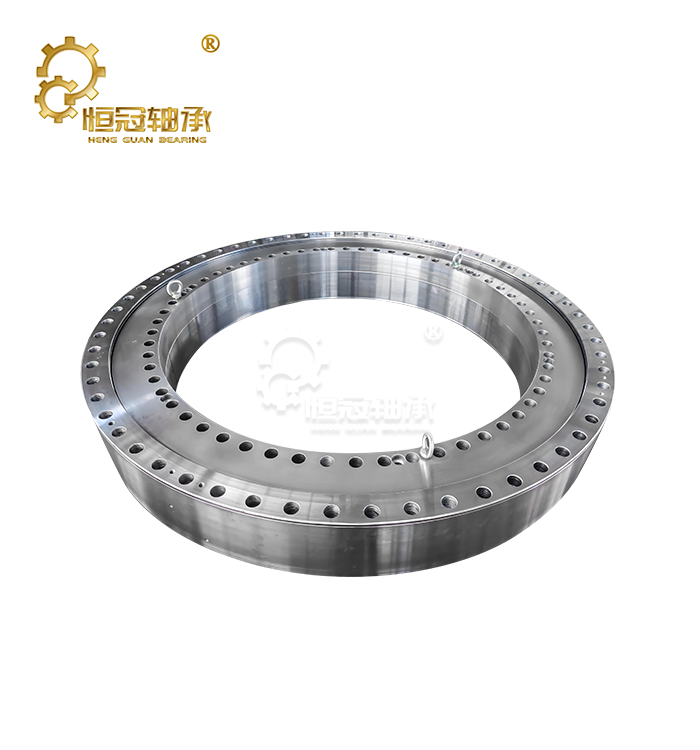
Robotics engineers are constantly seeking components that provide accuracy, stiffness, and load capacity in a smaller footprint, and that’s precisely why the crossed roller internal gear bearing has become a go-to for contemporary robotic joints. This kind of bearing is a single-row crossed-cylindrical roller where rollers are set at 90 degrees to each other on one raceway and support radial, axial, and moment loads at the same time, combining an internal gear directly in the inner ring bore. Standard raceway diameters from 500 to 1,000 mm, bespoke sizes above 2,800 mm, precision grades from P0 to P4, and 17 standard configurations are available for these bearings (Series 07) manufactured by Heng Guan Bearing. In this post, we’ll discuss how a crossed roller internal gear bearing may enhance joint performance, why compactness is important, and how to choose the proper bearing for your next robotic project.
How Does a Crossed Roller Internal Gear Bearing Improve Robot Joint Precision?
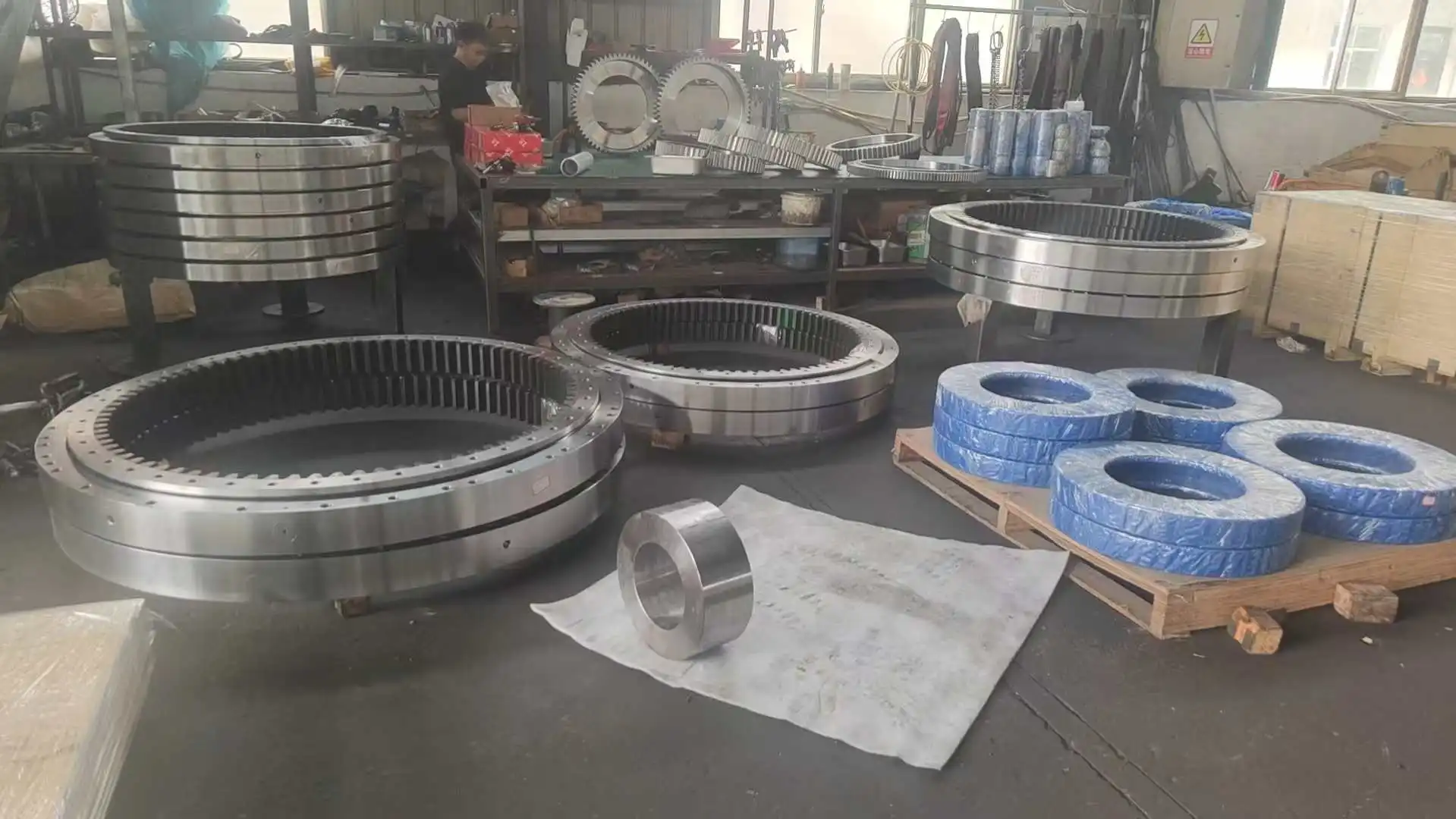
So let's start with accuracy, since that's really the crux of the problem for robot joints. In the crossed roller internal gear bearing, cylindrical rollers are arranged at 90° to each other on a single raceway, such that radial, axial, and moment loads are handled by one compact bearing rather than by numerous separate components. The design cuts down clearance and deflection quite a lot, so a robotic arm can repeat the same motion path with much tighter tolerances.
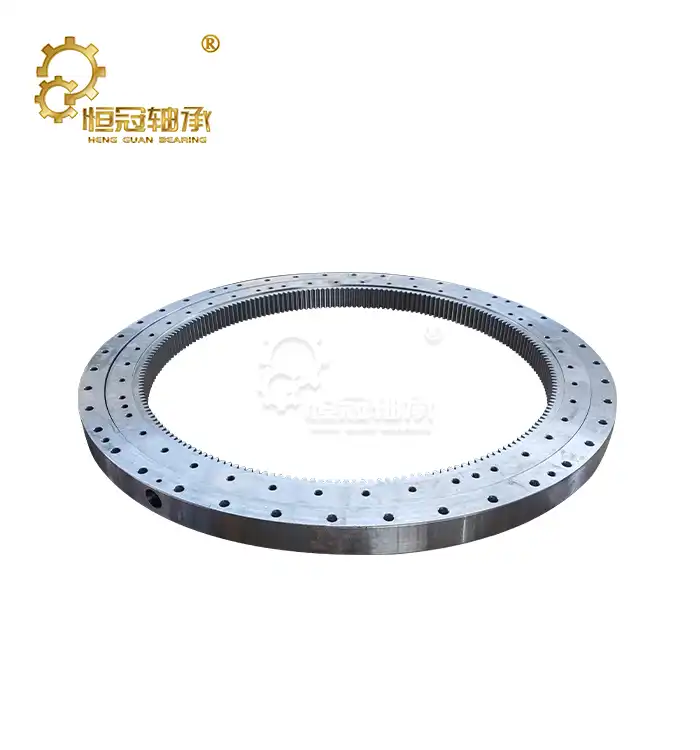
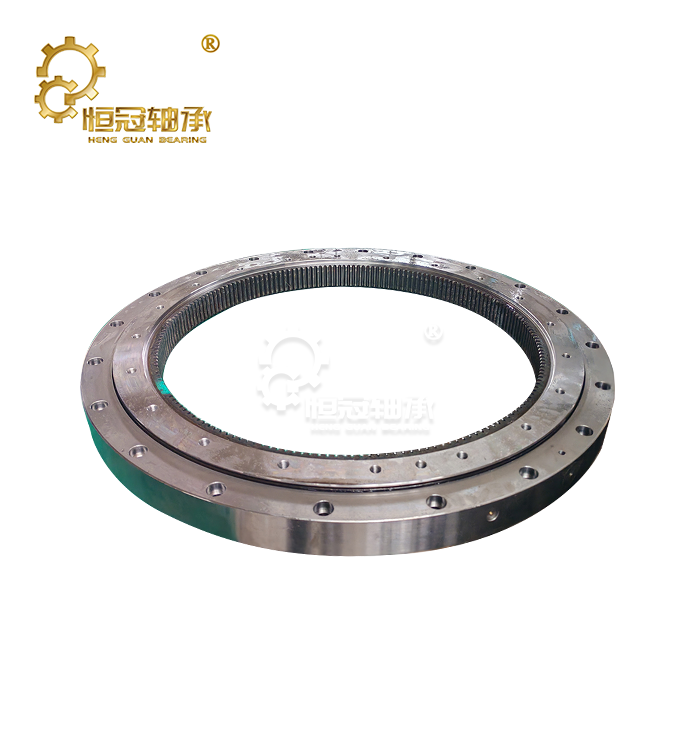
That is, as you might guess, a huge deal for things like handling semiconductors or surgical robots, where a small fraction of a millimetre of mistake is intolerable. The internal gear is CNC milled with involute teeth profiles at a 20-degree pressure angle. The main advantage is that there is no need for a separate ring gear, and the overall joint assembly is simplified. The integrated internal gear on the inner ring bore is similar to a Rollix crossed roller slewing ring internal gear seen on precision turntables, and lowers the part count and sources of backlash and wear over the bearing's operational life.
The bearing exhibits a constant positional precision even under cyclic loadings that would lead to a slow deterioration of a softer surface, raceway surfaces being induction-hardened to 55-62 HRC and gear tooth surfaces to 52-58 HRC.
| Specification | Value |
|---|---|
| Structure type | Single-row crossed cylindrical rollers (90° arrangement) + internal gear |
| Raceway center diameter (standard) | 500 – 1,000 mm |
| Raceway center diameter (custom) | Up to 2,800+ mm |
| Precision classes | P0, P6, P5, P4 |
| Ring material | 42CrMo alloy steel (50Mn or corrosion-resistant alloy optional) |
| Raceway hardness | 55 – 62 HRC (induction hardened) |
| Gear tooth hardness | 52 – 58 HRC (surface hardened) |
| Gear type | Internal, integrated into inner ring bore |
| Gear module range | M5 – M18 |
| Pressure angle | 20° (standard, involute) |
| Seal type | Double-lip NBR contact seals (both sides) |
Crossed Roller Internal Gear Bearing Design for Compact Robotic Joints
Space is always at a premium inside a robotic joint, so compactness is a real design priority. Because the crossed roller internal gear bearing combines the gear and the bearing raceway into a single unit, engineers can shrink the overall joint diameter without sacrificing stiffness or load rating. This is particularly useful in collaborative robots and articulated arms, where every millimeter saved around the joint improves reach and reduces the moving mass the motor has to drive. The line-contact design of cylindrical rollers — as opposed to point contact in ball bearings — provides 3 to 4 times higher rigidity in the same envelope, meaning a smaller crossed roller bearing can often replace a significantly larger ball bearing.
It's worth noting that the same compact, all-in-one philosophy shows up in other slewing ring internal gear products too — for example, a pelletizer slewing ring internal gear achieves similar space savings in industrial rotating equipment, just at a larger scale. For robotics specifically, Heng Guan Bearing customizes tooth profile, bore size, and flange pattern so the bearing integrates directly with the motor and harmonic reducer, keeping the joint assembly as slim as possible while still meeting torque requirements. The table below shows three representative Series 07 models that illustrate the diameter-to-height ratio achievable with this design.
| Parameter | 07-0673-00 (Medium) | 07-0770-00 (Heavy-Duty) | 07-1075-01 (Large Marine) |
|---|---|---|---|
| Inner diameter (ID) | 541 mm | 635 mm | 962 mm |
| Outer diameter (OD) | 771 mm | 872 mm | 1,176 mm |
| Total height (HT) | 70 mm | 70 mm | 90 mm |
| Ring height (He) | 60 mm | — | — |
| Gear type | Internal | Internal | Internal |
| Preloaded design | Yes | Yes | Yes |
| Typical application | Pelletizer / robotics | Heavy-duty rotary table | Marine crane / large robotics |
Why Does High Rigidity Matter in Robotic Motion Systems?
Rigidity is often underestimated until a robot starts vibrating or overshooting its target position. Simply put, a joint that flexes under load cannot hold an accurate position, and that flex compounds across every additional axis in a multi-joint arm. A properly designed crossed roller internal gear bearing resists both radial and axial deflection thanks to its crossed roller geometry, which distributes load more evenly than a standard ball bearing arrangement — the line contact between cylindrical rollers and raceway provides 3 to 4 times the stiffness of a comparable point-contact ball bearing.
This translates directly into smoother acceleration, less overshoot, and better settling time when the robot changes direction quickly. The preloaded design, achieved through a precision-ground spacer rather than adjustable shims, maintains a controlled negative clearance throughout the bearing's service life, ensuring zero backlash and consistent rotational torque from the first cycle to the last. It's also worth mentioning that high rigidity extends component life elsewhere in the drivetrain, since motors and reducers experience less reactive stress when the supporting bearing isn't flexing.
If you'd like engineering input on stiffness requirements for your application, feel free to reach out to mia@hgb-bearing.com, and our team at Heng Guan Bearing will help you match bearing rigidity to your robot's duty cycle.
Crossed Roller Internal Gear Bearing Load Capacity and Backlash Control
Load capacity and backlash go hand in hand when evaluating a crossed roller internal gear bearing for robotics. Generally speaking, the crossed roller design supports higher combined loads in a smaller envelope than needle or ball bearings of similar size, which is why it's favored in high-payload robotic arms and rotary tables alike. The bearing simultaneously carries axial, radial, and moment (overturning) loads — a capability that eliminates the need for separate thrust and radial bearings in the joint. Backlash control is equally important, since any play between the gear teeth translates directly into positioning error at the end effector.
The internal gear teeth are CNC-shaped to involute profiles with a standard 20-degree pressure angle, and tight raceway tolerances keep backlash to a minimum. Preloading the bearing during assembly — through a precision-ground spacer that creates controlled negative clearance without shims — further tightens this up and ensures zero backlash throughout the bearing's 20,000 to 50,000 operating-hour service life.
It's a similar principle to what you'd find in a Rollix crossed roller slewing ring internal gear used on precision positioning tables, just scaled down for robotic joints. Choosing the correct preload class for your application prevents excess wear while still keeping backlash within acceptable limits for repeatable, accurate motion. In harsh or washdown environments, FKM (fluorocarbon) seals can be specified in place of the standard NBR double-lip seals to maintain lubrication integrity and exclude contaminants.
| Parameter | Specification |
|---|---|
| Load types supported | Axial, radial, and moment (simultaneous) |
| Rigidity vs. ball bearing | 3–4× higher (line contact vs. point contact) |
| Preload method | Precision-ground spacer (no shims required) |
| Backlash | Zero throughout service life |
| Service life | 20,000 – 50,000 operating hours (properly lubricated) |
| Standard seal | Double-lip NBR contact seals, both sides |
| Optional seal | FKM (fluorocarbon / Viton) for marine and high-dust |
| Lubrication | Outer ring grease nipple, field re-lubrication without disassembly |
How to Choose the Right Crossed Roller Internal Gear Bearing for Robotics?
Choosing the right bearing starts with understanding your robot's actual duty cycle rather than guessing at a standard size. First, define the combined radial, axial, and moment loads at the joint, since undersizing a crossed roller internal gear bearing leads to premature wear while oversizing simply adds unnecessary weight. Next, decide on the gear module and tooth count needed to match your motor and reducer interface, keeping backlash requirements in mind — Heng Guan Bearing offers modules from M5 to M18 with customizable tooth counts and pressure angles. It also helps to consider the environment: dusty or washdown conditions may call for FKM seals and additional corrosion protection, much like what's specified for a pelletizer slewing ring internal gear operating in harsh industrial settings.
With 17 standard configurations in Series 07 alone — covering raceway diameters from 380 mm to 2,810 mm — most robotics applications can be served directly, but for non-standard mounting interfaces or extreme load profiles, custom engineering is available with a 35–45 day lead time, including design review, material procurement, and quality testing. Working with an experienced supplier like Heng Guan Bearing means you get support on custom bore sizes, flange patterns, preload selection, and finite element analysis (FEA) of the bearing under your specific load case, rather than trying to force a generic bearing into a specialized robotic application.
| Selection Criterion | What to Define |
|---|---|
| Combined loads | Peak and dynamic radial, axial, and moment loads at the joint |
| Precision class | P0 (general) / P6 (standard) / P5 (precision) / P4 (ultra-precision) |
| Gear interface | Module (M5–M18), tooth count, pressure angle to match motor/reducer |
| Seal type | NBR (standard) or FKM (marine, chemical, high-dust) |
| Mounting | Bolt pattern, bore diameter, flange configuration |
| Lead time | Standard models: 15–20 days; Custom: 35–45 days |
| Certification | ISO9001, RoHS compliance; FEA and FAT reports available |
Conclusion
A crossed roller internal gear bearing delivers the precision, rigidity, and compact design that robotics demands. From the 90-degree crossed roller geometry that provides 3–4× the stiffness of ball bearings, to the integrated internal gear that eliminates separate components and backlash, every design element serves the goal of accurate, repeatable motion in a smaller footprint. Choose the right bearing with Heng Guan Bearing's engineering support — including custom sizing, preload selection, and FEA-backed load analysis — for reliable, accurate robot motion that lasts 20,000 to 50,000 operating hours.
FAQ
Q: What makes a crossed roller internal gear bearing different from a standard bearing?
A: It combines radial, axial, and moment load support with an integrated internal gear in one compact unit. The 90-degree crossed roller arrangement provides 3–4× higher rigidity than ball bearings of the same size, and the precision-ground spacer preload eliminates backlash entirely throughout the bearing's service life.
Q: How does this bearing reduce backlash in robot joints?
A: The internal gear teeth are CNC-shaped to involute profiles with tight tolerances, and the bearing is preloaded to a controlled negative clearance via a precision-ground spacer — no shims required. This ensures zero backlash and consistent rotational torque from commissioning through end of life.
Q: Can a crossed roller internal gear bearing handle high payloads?
A: Yes. The line-contact design between cylindrical rollers and the induction-hardened raceway (55–62 HRC) supports higher combined axial, radial, and moment loads than similarly sized ball bearings. Representative Series 07 models range from 541 mm inner diameter to over 962 mm, covering medium to large robotic joints.
Q: Is this bearing suitable for compact robotic arms?
A: Yes. Its all-in-one design saves space compared to separate bearing and gear components, and the lower profile (height-to-diameter ratio) means a smaller, lighter joint. This directly improves reach and reduces the moving mass the motor must drive in articulated and collaborative robot arms.
Q: How do I select the correct preload class?
A: Base it on your required positioning accuracy versus acceptable friction and heat generation. Higher preload increases rigidity and reduces backlash but also raises friction torque. Heng Guan Bearing provides FEA-backed load analysis and engineering support to help you select the optimal preload class for your duty cycle.
Ready to Upgrade Your Robotic Joint?
Looking for a reliable crossed roller internal gear bearing for your next robotics project? Heng Guan Bearing's engineers can help you select the right Series 07 model, preload class, gear module, and seal configuration. With 17 standard configurations and full custom engineering available, we'll match the bearing to your exact load case. Email mia@hgb-bearing.com today to get started.
References
1. Slocum, A. H. (1992). Precision Machine Design. Society of Manufacturing Engineers (SME), Dearborn, MI, USA.
2. Harris, T. A., & Kotzalas, M. N. (2006). Rolling Bearing Analysis: Essential Concepts of Bearing Technology (5th ed.). CRC Press, Boca Raton, FL, USA.
3. Craig, J. J. (2017). Introduction to Robotics: Mechanics and Control (4th ed.). Pearson Education, Boston, MA, USA.
4. International Organization for Standardization. (2004). ISO 9409-1:2004 Manipulating industrial robots — Mechanical interfaces — Part 1: Plates. ISO, Geneva, Switzerland.
5. International Organization for Standardization. (2007). ISO 281:2007 Rolling bearings — Dynamic load ratings and rating life. ISO, Geneva, Switzerland.
6. International Organization for Standardization. (2013). ISO 1328-1:2013 Cylindrical gears — ISO system of flank tolerance classification — Part 1: Definitions and allowable values of deviations relevant to flanks of gear teeth. ISO, Geneva, Switzerland.

WHAT OUR CUSTOMERS SAY
Here is the customer's evaluation of us
_1776668700508.webp)