



Where Is Slewing Ring Bearing With External Gear Used?
Heavy-duty cranes rely on precise and durable rotation systems to move heavy loads safely and efficiently. Behind the smooth 360° movement of tower cranes, mobile cranes, and other lifting equipment is a critical component: Slewing Ring Bearing With External Gear.The bearing performs two functions: it transmits rotary drive and carries loads in one structure. Cranes can be operated under high axial loads, radial loads, and overturning moments.
LYHGB (Luoyang Heng Guan Bearing Technology Co., Ltd.) specializes in the production of customized slewing bearings for heavy-duty industrial applications such as construction cranes, port machinery, wind turbines, and other heavy-duty rotating equipment. HGB, with optimized bearing dimensions, gear design, material selection, and sealing structures, assists customers to achieve stable rotation performance under tough working situations. This article talks about how external gear slew bearings operate, where they are utilized, why crane manufacturers like this design, and what to consider when picking a trustworthy provider.
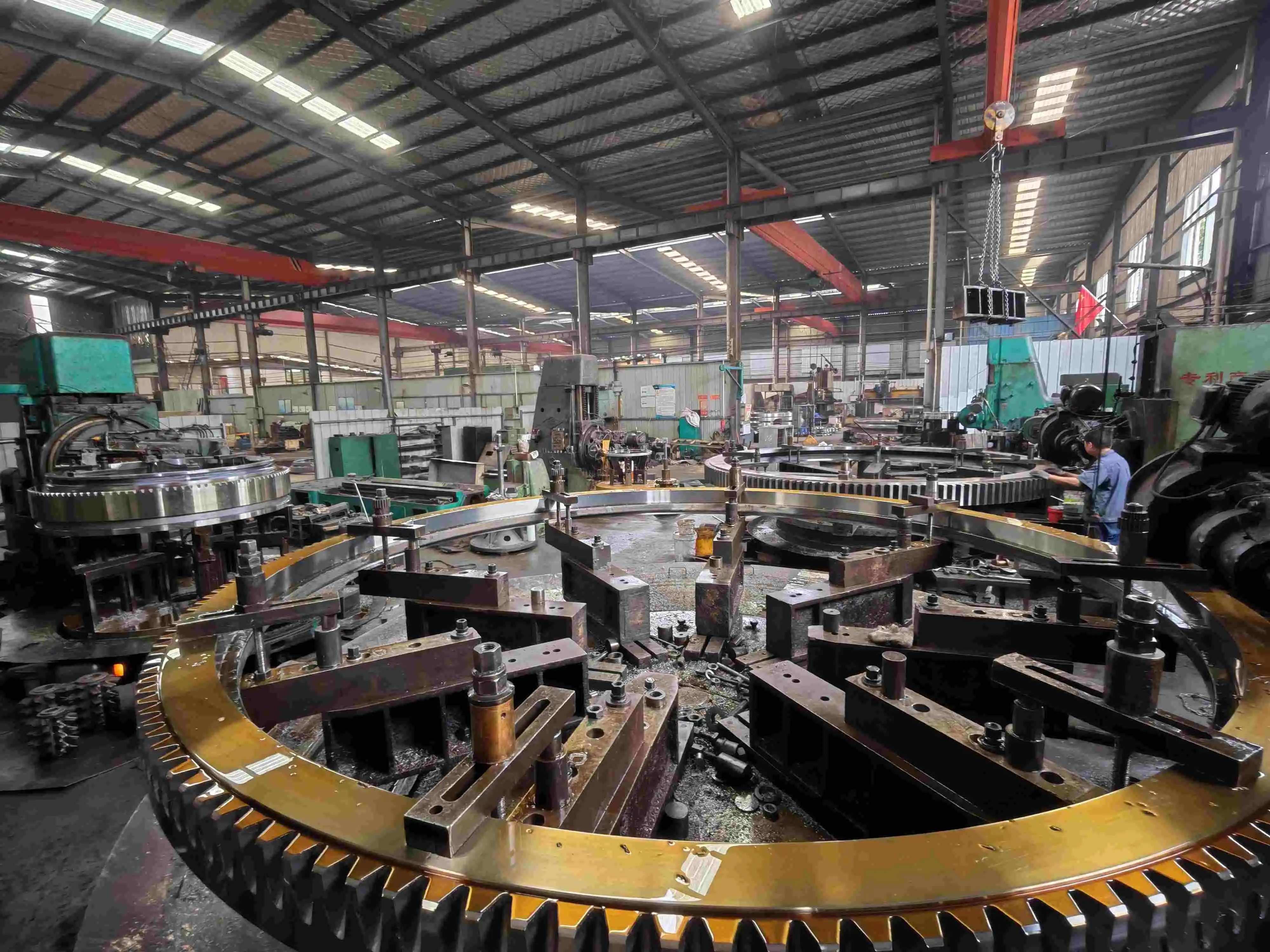
How Do External Gear Slewing Bearings Support Heavy Crane Rotation?
The upper framework of a crane has to revolve smoothly while bearing large and continuously varying loads. The upper assembly is connected to the fixed base by a slewing bearing, enabling rotational movement while ensuring structural integrity.
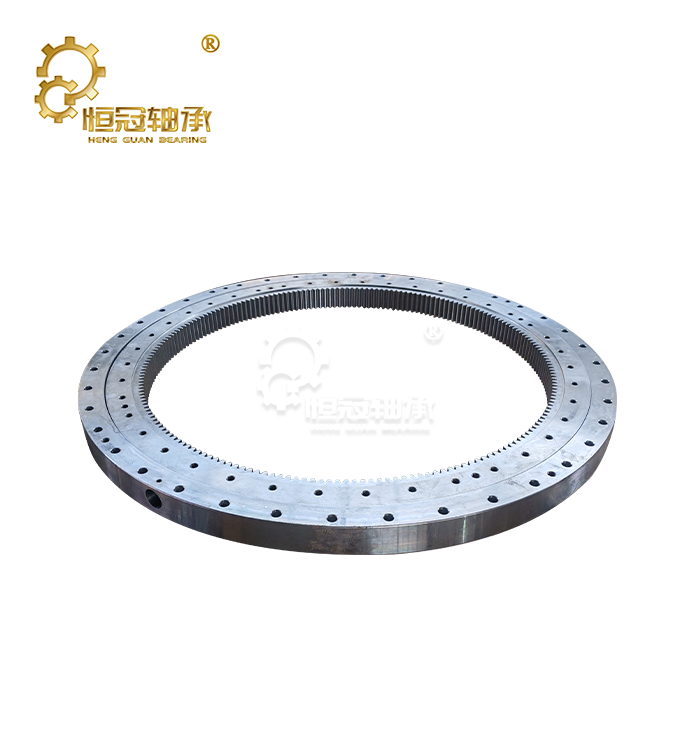
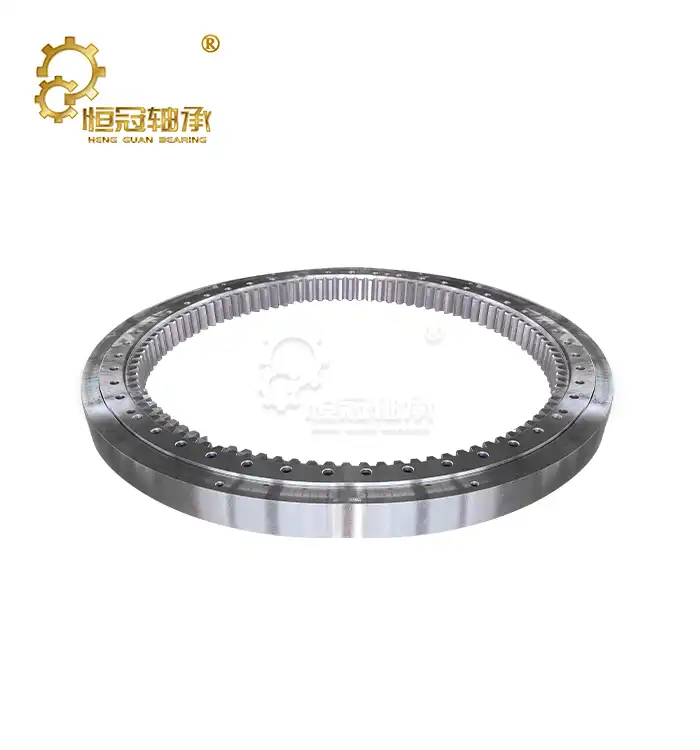
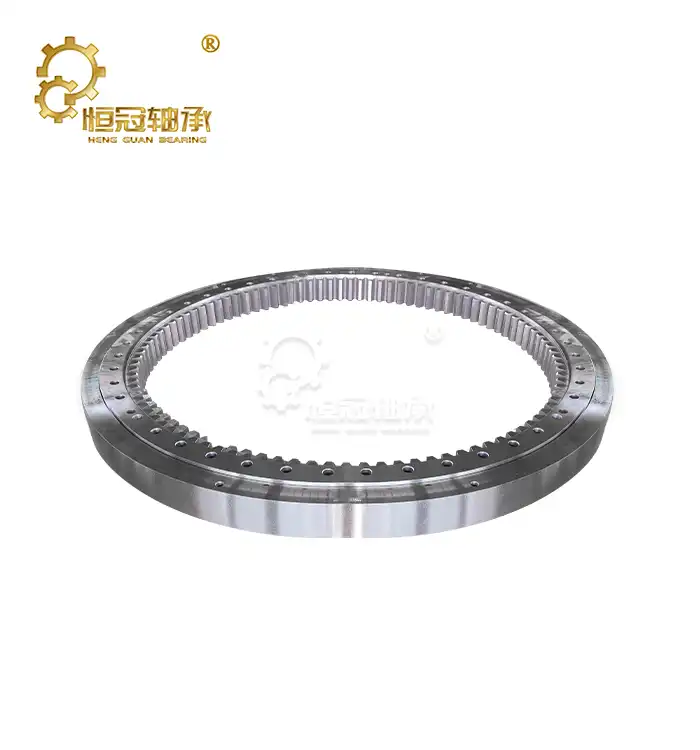
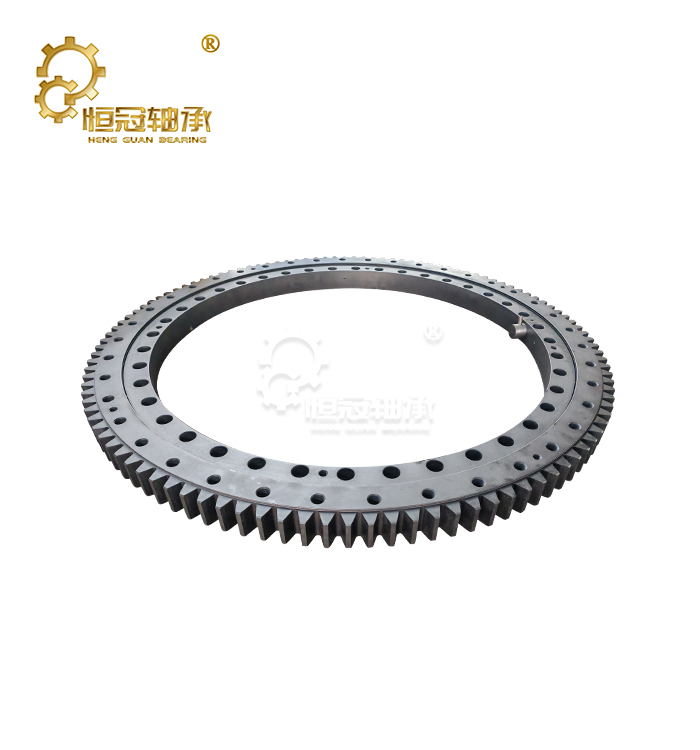
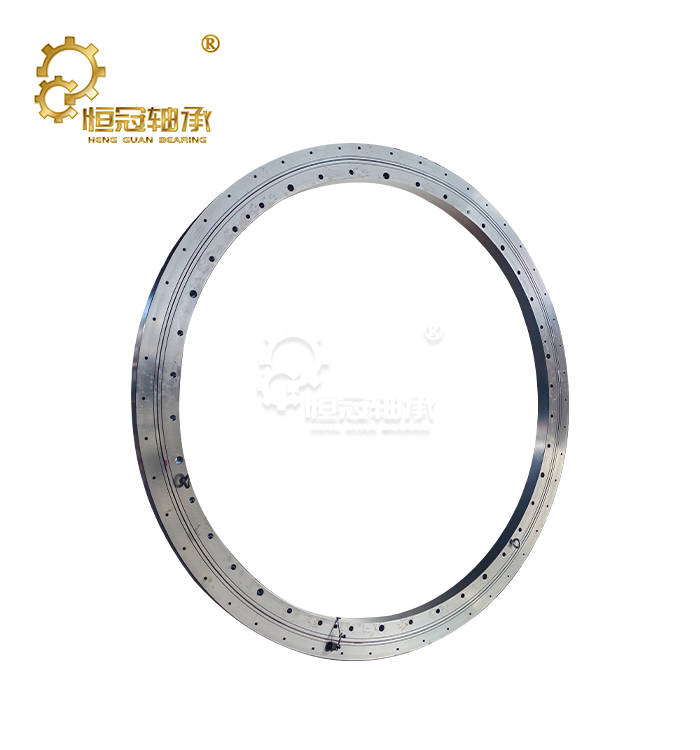
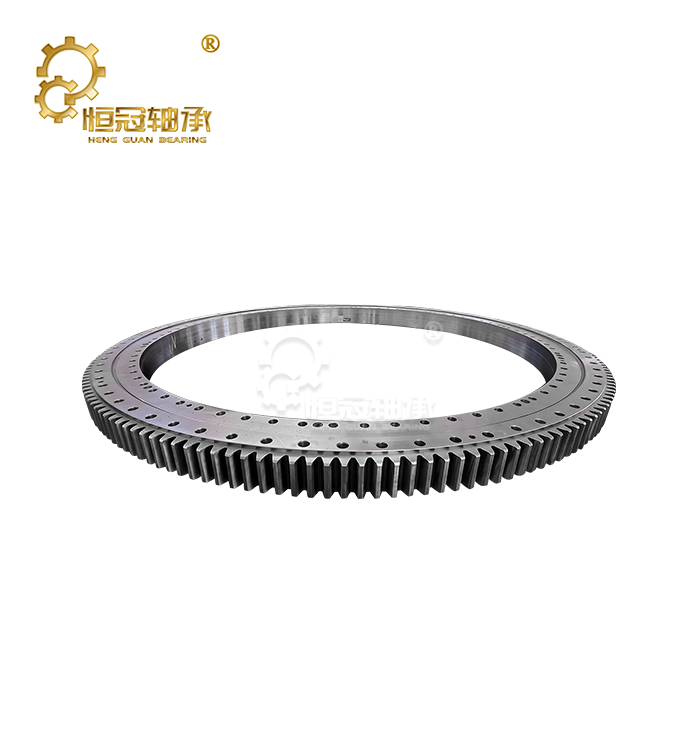
A slewing ring bearing with an external gear is a component that integrates two fundamental functions:
Bearing the weight and driving forces of the rotating structure
Transmission of driving torque by the exterior teeth
The external gear is machined directly into the outside ring of the bearing. In the course of running, a gear or pinion motor takes hold of these teeth to provide controlled rotation. The gear and bearing as a single integrated unit require fewer components than separate ring-gear designs.
This integrated structure has some practical advantages, particularly for heavy cranes:
- Easy to install
- Better transmission stability
- "Maintenance access is easier
- Improved use of space inside the equipment
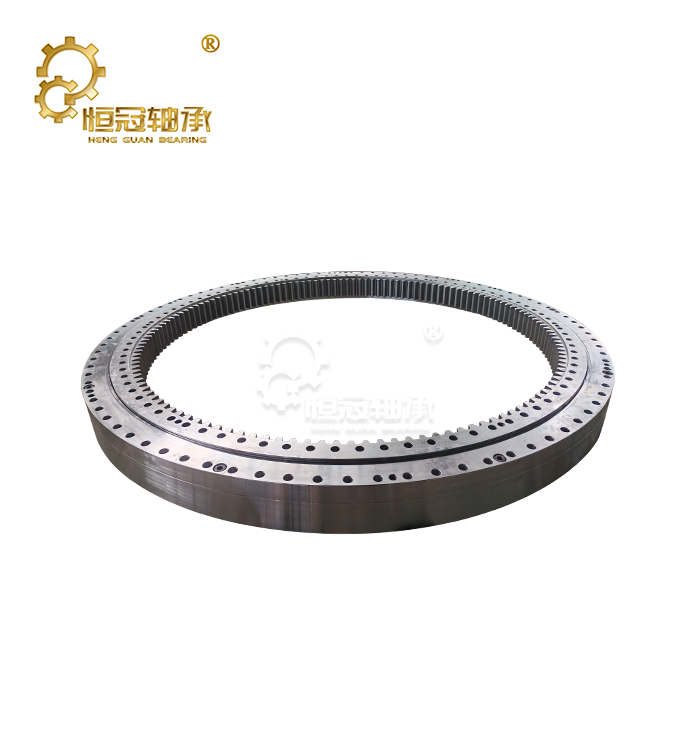
The open inner bore of the bearing also offers additional space for the installation of electrical cables, hydraulic lines, and other internal systems. This is especially helpful for large cranes and industrial equipment where several systems must pass through the rotating center.
Why Do Tower Cranes and Mobile Cranes Use Heavy-Load Slewing Bearings?
Cranes work in demanding environments where reliability of equipment is critical to project efficiency and safety. The slewing bearing must continue to operate with repeated starts and stops, varying loads, vibration, and environmental exposure.
Tower Crane Slewing Bearing Requirements
Tower cranes are commonly utilized in construction projects, especially in the construction of high-rise structures and infrastructure development. During operation, the crane's top structure rotates to place loads in different operating radiuses.
The slewing bearing supports the main components such as:
- The turntable
- Cab driver’s stand
- Counterweight system.
- Lifting apparatus
The bearing is required to provide a steady performance under the variable moment loads since tower cranes usually lift loads of varying weights in each operating cycle.
Tower cranes employ external gear slewing bearings because the gear teeth are outside the bearing, making them easier to check and lubricate. Maintenance personnel can inspect the health of the gears without having to remove significant crane components, which can save downtime.”
Mobile Crane Slewing Bearing Requirements
Because mobile cranes often go from one work site to the next, they need rotational systems that are both robust and compact. Mobile cranes are subjected to increased vibration and impact loads during transit and operation, in comparison with fixed equipment.
A properly built crane slewing bearing assists mobile cranes in achieving the following:
- Rotating smooth top structure
- Accurate placement of the load
- Consistent performance across varying conditions
Mobile crane manufacturers need to evaluate the bearing size, gear strength, sealing performance, and installation correctness before selecting an appropriate slewing ring.
Where are slewing ring bearings with external gears commonly applied?
External gear slewing bearings are employed in various industries where controlled rotary movement and high load capacity are required, but crane equipment is one of the main uses.
Port and Material Handling Equipment
Ports manage big machinery and have to work with heavy freight all the time. Bearings used in equipment such as ship unloaders, cargo cranes, and stacker reclaimers have to sustain enormous rotating constructions and transfer significant torque.
These applications are suited for external gear slewing bearings, as they provide the following:
- Excellent capacity to transmit torque
- Stable rotation at high loads
- Convenient access to services
For outdoor machinery, good sealing and material selection are especially crucial to protect the internal raceway system from dust, moisture, and corrosion.
Wind Turbine Systems
In wind turbines, slew bearing systems are applied in yaw and pitch mechanisms to alter the direction of the nacelle and the angle of the blades.
External gear design offers benefits, as the central opening permits convenient passage of the following:
- Power cords
- Wiring for Control
- Hydraulic systems
For equipment used in renewable energy, high service life and low maintenance requirements are especially significant because turbines are often situated in remote places where repair work is expensive.
Industrial Rotating Machinery
Rotary platforms, steel processing machinery, and huge mechanical positioning systems are among the heavy industrial equipment that typically needs tailored slewing bearing solutions.
In these applications the bearing must resist the following:
- High moment loads
- Constant rotation
- Positioning requirements
External gear slewing bearings provide an integrated solution for structural support and drive transmission.
Radar and Specialized Positioning Systems
Precise positioning and smooth movement are necessary for precision equipment such as radar platforms and rotating observation systems.
External gear design of a slewing ring bearing with an external gear offers regulated rotation and support for the mechanical loads of large rotating assemblies.
Key Advantages of External Gear Slewing Bearings for Heavy Machinery
Engineers use external gear slewing bearings because this design has practical advantages for operation and maintenance.
Easier Gear Inspection and Maintenance
The gear teeth are on the outside of the bearing so maintenance workers can visibly inspect the gear surface and apply lubrication more efficiently.
This helps to see typical concerns such as:
- Tooth wear, abnormal
- Not enough lubrication
- Gear damage overload
Early inspections can prevent unexpected equipment shutdowns.
Large Open Center Design
Large machinery sometimes requires space inside for wires, pipes, or Shafts. The open bore design of a slewing ring allows components to flow through the center without interfering with the bearing construction.
This makes the design suitable for wind turbines, cranes, and sophisticated industrial equipment.
Multiple Drive Compatibility
External gear slewing bearings can be driven by a single or several pinions depending on the equipment requirements.
Multiple drive systems can help distribute the torque more uniformly, which is advantageous for huge rotating constructions that require higher operating reliability.
Simplified Installation Structure
Equipment manufacturers do not need to incorporate an additional separate ring gear when integrating the gear into the bearing ring.
This facilitates assembly and improves the alignment of the bearing and drive system.
How to Select the Right External Gear Slewing Bearing for Crane Applications?
Choosing the correct slewing bearing is essential for ensuring crane safety, operational efficiency, and long-term service performance. A bearing that is incorrectly selected may experience accelerated wear, excessive backlash, unstable rotation, or premature failure.
Before ordering a slewing ring bearing with an external gear, engineers and equipment manufacturers should evaluate several important factors.
Consider Load Conditions and Operating Forces
The first step is understanding the actual loads applied to the bearing during operation.
Heavy cranes usually generate three major types of forces:
- Axial loads caused by vertical lifting forces
- Radial loads created by horizontal movement and structural weight
- Tilting moments caused by extended booms and uneven load positions
A reliable slewing bearing supplier should evaluate these combined loads rather than selecting a bearing only according to diameter or equipment size.
For tower cranes and mobile cranes, accurate load calculation helps determine the appropriate raceway design, rolling element size, and structural strength.
Match Gear Design with Required Torque
The external gear is responsible for transferring driving force from the motor or pinion to the rotating structure. Therefore, gear design directly affects crane rotation performance.
Important gear considerations include:
- Gear module selection
- Tooth strength
- Backlash requirements
- Pinion compatibility
- Operating speed
For heavy-duty cranes requiring high torque output, a stronger gear design is necessary to prevent excessive tooth stress and maintain smooth transmission.
Evaluate Operating Environment
Cranes often work in challenging environments, including construction sites, ports, offshore areas, and outdoor industrial facilities.
Environmental factors that should be considered include:
- Dust and contamination exposure
- Temperature changes
- Humidity and water exposure
- Corrosive conditions
A suitable sealing system helps protect the internal raceway and rolling elements from external contaminants. For harsh environments, material treatment and corrosion protection may also be required.
Confirm Installation Requirements
Even a high-quality slewing bearing cannot perform properly without correct installation.
Important installation factors include:
- Mounting surface accuracy
- Bolt tightening procedure
- Gear alignment
- Lubrication before operation
Professional suppliers should provide technical guidance to ensure the bearing works correctly after installation.
HGB Manufacturing Capability for Heavy-Duty Slewing Bearings
Selecting the right manufacturer is just as important as selecting the correct bearing design. For large crane applications, customers need a supplier with engineering experience, manufacturing capability, and strict quality control processes.
At LYHGB (Luoyang Heng Guan Bearing Technology Co., Ltd.), we focus on developing slewing bearing solutions for heavy machinery and industrial applications.
Our manufacturing process includes:
- Engineering analysis based on customer equipment requirements
- Customized bearing structure design
- Precision machining of raceways and gear teeth
- Material quality control
- Dimensional inspection before delivery
Each project is evaluated according to the actual working conditions of the equipment. Instead of supplying only standard products, HGB works with customers to select suitable slewing ring bearings with external gear dimensions, gear specifications, sealing structures, and performance requirements.
This customized approach helps ensure that the bearing matches the application rather than forcing the equipment to adapt to a general-purpose solution.
Manufacturing Quality Factors That Affect Slewing Bearing Performance
The service life of a crane slewing bearing depends heavily on manufacturing precision and quality control.
Precision Raceway Machining
The raceway is the main load-supporting area of the bearing. Accurate machining helps distribute loads evenly across the rolling elements.
Poor raceway accuracy may lead to the following:
- Uneven load distribution
- Increased friction
- Abnormal vibration
- Reduced service life
For heavy crane applications, raceway quality is especially important because the bearing operates under combined loads.
Gear Manufacturing Accuracy
The external gear must maintain proper engagement with the driving pinion.
Important factors include:
- Tooth profile accuracy
- Gear surface quality
- Correct backlash
- Stable tooth contact
A properly manufactured gear system helps reduce noise, vibration, and unnecessary stress during operation.
Material Selection and Heat Treatment
Large slewing bearings require materials that can withstand repeated loading cycles.
Common materials such as 42CrMo alloy steel and 50Mn steel are widely used because they provide:
- High mechanical strength
- Good toughness
- Resistance to fatigue loading
Proper heat treatment further improves the ability of the bearing components to handle demanding working conditions.
Sealing and Lubrication Protection
Lubrication plays a key role in reducing friction and preventing premature wear.
Effective sealing systems help maintain lubricant performance by preventing:
- Dust contamination
- Water entry
- External particles entering the raceway
For outdoor cranes and port equipment, reliable sealing is especially important because maintenance intervals may be longer.
Common Problems Caused by Poor-Quality Crane Slewing bearings
Using an unsuitable or low-quality slewing bearing can create operational problems that affect equipment safety and productivity.
Excessive Gear Wear
Improper gear design, insufficient lubrication, or incorrect alignment may cause accelerated tooth wear.
Signs include:
- Increased operating noise
- Irregular rotation
- Visible gear damage
Selecting a bearing with suitable gear specifications helps reduce these risks.
Raceway Damage
The raceway carries the main operating loads. Overloading or poor manufacturing accuracy can result in:
- Surface fatigue
- Pitting
- Abnormal wear
Correct load calculation and quality manufacturing are essential to avoid these issues.
Increased Maintenance Requirements
A poorly designed bearing may require frequent lubrication, adjustment, or replacement.
For heavy cranes, reducing maintenance frequency is important because equipment downtime directly affects project schedules.
Working with an experienced manufacturer helps ensure the bearing is designed according to actual operating conditions.
Why Choose HGB for Slewing Ring Bearings with External Gear Solutions?
For heavy-duty crane applications, customers need more than a bearing supplier. They need a technical partner who understands equipment requirements and can provide reliable engineering support.
HGB provides:
- Customized slewing bearing design
- Support for large-diameter applications
- Engineering recommendations based on load conditions
- Manufacturing quality control
- Solutions for cranes and other heavy rotating equipment
Whether the application involves tower cranes, mobile cranes, port machinery, or industrial rotating systems, HGB works with customers to develop suitable external gear slewing bearing solutions.
By combining manufacturing experience with application knowledge, HGB helps customers improve equipment reliability, reduce maintenance challenges, and achieve stable long-term operation.
Conclusion
From tower cranes and mobile cranes to wind turbines and industrial machinery, slewing ring bearing with external gear provides a reliable solution for heavy-load rotary applications. Its integrated gear structure, large load capacity, and convenient maintenance characteristics make it an important component in modern heavy equipment.
For crane manufacturers and industrial equipment users, selecting the right slewing bearing supplier is essential for achieving safe and efficient operation. Factors such as load requirements, gear design, material quality, sealing performance, and manufacturing accuracy should all be carefully evaluated.
With professional engineering support and customized manufacturing capabilities, HGB provides external gear slewing bearing solutions designed to meet the demanding requirements of heavy-duty rotating equipment. Contact HGB with your equipment specifications and application requirements to receive a suitable bearing recommendation for your project.
FAQ
1: What is a slewing ring bearing with an external gear used for?
It's used to enable controlled rotation in heavy machinery such as cranes, excavators, wind turbines, and material handling equipment.
2: Why is external gear better than internal gear for some applications?
External gear designs offer an open inner bore for cable routing, easier maintenance access, and a lighter assembly since the gear is machined directly into the outer ring.
3: Can HGB Bearing provide a customized slewing ring bearing with an external gear?
Yes, we design bearings from 200 mm to 10,000 mm in diameter, tailored to your specific torque, speed, and mounting needs.
4: Does external gear design support multiple drive motors?
Yes, externally geared slewing rings can be driven by two or more pinions simultaneously for higher torque and redundancy.
Talk to Our Engineers About Your Slewing Ring Needs
Looking for a reliable Slewing Ring Bearing with External Gear for your next project? Contact HGB's team at mia@hgb-bearing.com today, and let's design a solution built around your equipment's exact load, torque, and space requirements — backed by ISO 9001-certified processes, 20+ years of manufacturing experience, and a 50+ member engineering team serving customers in over 50 countries.
References
1. Harris, T. A., & Kotzalas, M. N. (2006). Rolling Bearing Analysis, 5th ed. CRC Press.
2. ISO 76:2006. Rolling Bearings — Static Load Ratings. International Organization for Standardization, 2006.
3. ISO 281:2007. Rolling Bearings — Dynamic Load Ratings and Rating Life. International Organization for Standardization, 2007.
4. ISO 1328-1:2013. Cylindrical Gears — ISO System of Flank Tolerance Classification — Part 1: Definitions and Allowable Values of Deviations Relevant to Flanks of Gear Teeth. International Organization for Standardization, 2013.
5. DIN 3967:1978-08. System of Gear Fits; Backlash, Tooth Thickness Allowances, Tooth Thickness Tolerances; Principles. Deutsches Institut für Normung, 1978.
6. ISO 9001:2015. Quality Management Systems — Requirements. International Organization for Standardization, 2015.

WHAT OUR CUSTOMERS SAY
Here is the customer's evaluation of us