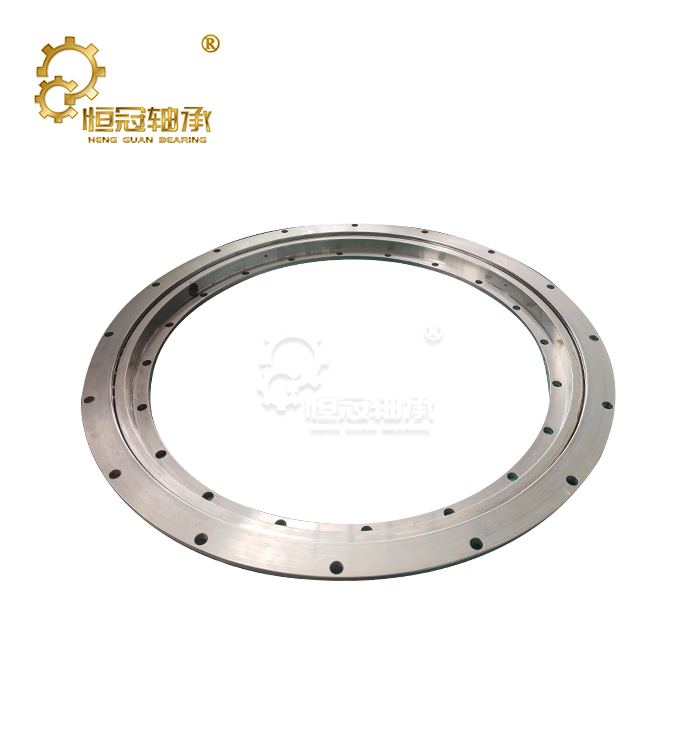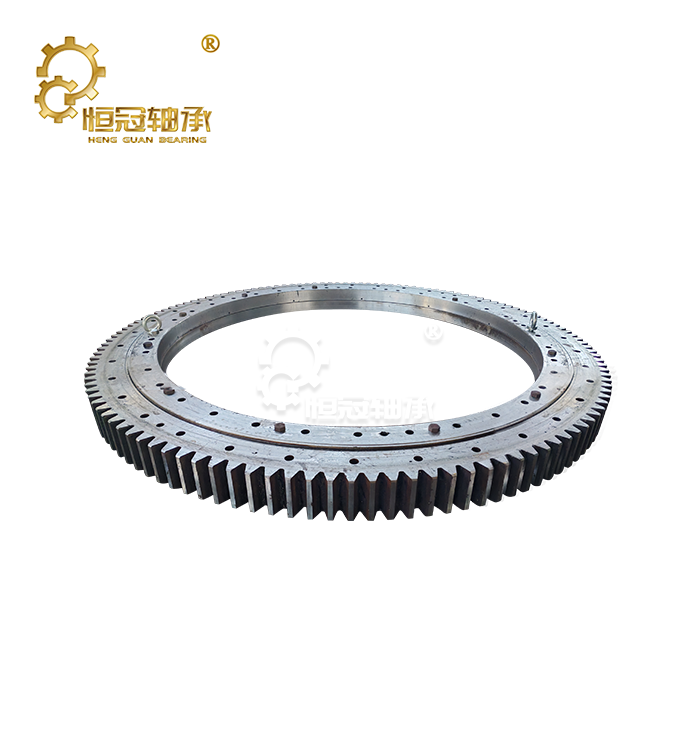




What Should You Check Before Buying a Crane Slew Ring?
Buying a crane slew ring isn't a decision to rush, since this single component carries the load, the rotation, and the safety of the whole lifting operation. That's why Heng Guan Bearing encourages buyers to verify a few key points before placing an order. As a manufacturer of slewing rings ranging from 500 mm to 10,000 mm in diameter, Heng Guan Bearing has seen how the right checks up front prevent costly failures later. Let's walk through what deserves your attention before you buy.
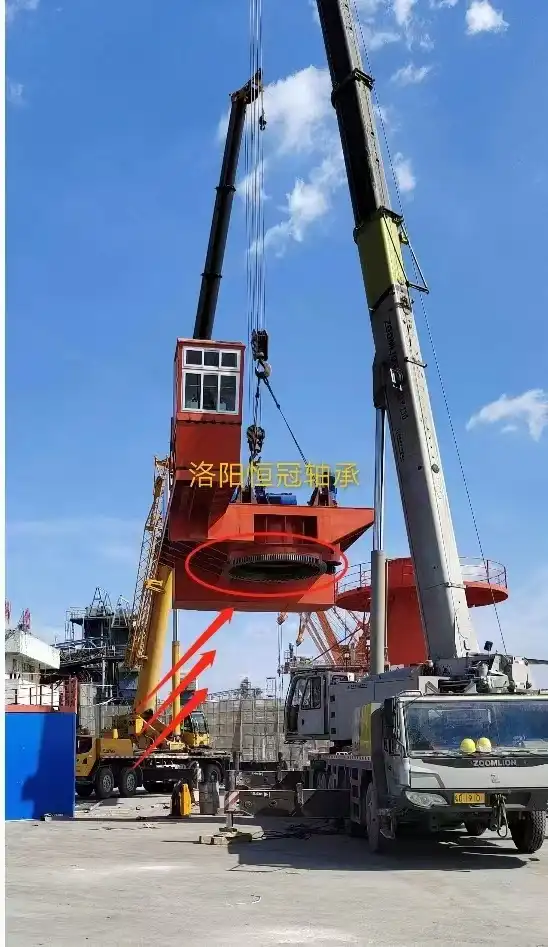
Crane Slew Ring Types, Load Capacity, and Structural Design Considerations
Not every crane slew ring is built the same way, and knowing which structure fits your crane matters more than most buyers realize. Single-row four-point contact ball designs suit lighter-duty rotation — a practical rule is that they fit when overturning moment is less than 1.5 × axial load × radius. Three-row roller structures handle extreme overturning moments up to three times what a single-row can carry, making them the go-to for long-boom tower and mobile cranes. Double-row-reducing ball designs offer a middle ground when both compact size and higher capacity matter. Before you commit, check the rated load in all three directions — not just axial — since a crane slew ring under-rated for moment load is one of the most common causes of premature wear.
| Structure Type | Best Suited For | Load Handling | Moment Capacity |
|---|---|---|---|
| Single-row four-point contact | Light to medium cranes, limited height | Moderate radial/axial | Moment < 1.5 × axial × radius |
| Double-row reducing ball | Medium cranes needing compact size | Balanced axial & radial | Higher than single-row in same envelope |
| Three-row roller | Heavy tower & mobile cranes, long booms | Very high combined loads | Up to 3× single-row moment capacity |
What Quality Standards and Certifications Should a Crane Slew Ring Meet?
Quality on paper and quality in the field aren't always the same, so it helps to ask specific questions before purchase. A dependable crane slew ring should be produced under a documented ISO 9001:2015 quality system, with full traceability from raw-material inspection through to final assembly.
Precision grade matters — accuracy ratings from P0 through P4 (ISO standard) give you a way to compare suppliers objectively, while gear tooth accuracy should reach ISO 1328-1 Grade 6. Raceway hardness must be verified at the surface and at 3 mm depth, confirming HRC 55–62 on the wear surface with a tougher HRC 30–35 core for impact resistance. It's also reasonable to ask for material certificates (EN 10204 compliant), hardness test reports, and CMM dimensional inspection records for the specific batch you're buying — not just general company documentation. If a supplier hesitates to share this, that's worth noting.
| Inspection Item | Method / Equipment | Acceptance Standard |
|---|---|---|
| Raceway geometry & bolt-hole position | CMM (coordinate measuring) | Per ISO tolerance for selected precision grade |
| Raceway surface hardness | Portable Rockwell hardness tester | HRC 55–62 at surface; HRC 30–35 at 3 mm depth |
| Gear tooth profile | CMM gear measurement | ISO 1328-1 Grade 6 |
| Rotation torque | Bench torque test vs. calculated value | Startup & running torque within spec |
| Vibration analysis | Spectrum analysis | No abnormal peaks indicating raceway or roller defects |
| Material traceability | Mill test certificate (EN 10204) | 42CrMo / 50Mn / GCr15SiMn confirmed |
Material Selection, Lubrication, and Maintenance Tips for Crane Slew Rings
Material choice and ongoing care determine how long a crane slew ring actually lasts once installed. Raceways are induction-hardened 42CrMo or 50Mn alloy steel, and the depth and consistency of that hardening layer directly affect fatigue resistance under repeated lifting cycles. Sealing design keeps contaminants away from the rolling elements — standard NBR lip seals with labyrinth channels work for most construction sites, while fluororubber (FKM) seals are specified for coastal or corrosive environments where standard seals would degrade prematurely. Once installed, NLGI Grade 2 lithium-complex grease should be replenished every 200–300 operating hours, or every 100 hours in dusty or coastal conditions. Periodic inspection of bolt torque (quarterly on a 10% sample basis), seal condition (monthly), and gear tooth wear (quarterly) catches minor issues before they become expensive ones.
If you'd like a maintenance schedule tailored to your crane's duty cycle and operating environment, our engineering team is reachable at mia@hgb-bearing.com — we'll confirm grease type, relubrication intervals, and inspection checkpoints within 24 hours.
| Maintenance Task | Frequency | Key Detail |
|---|---|---|
| Grease replenishment | 200–300 h (standard) / 100 h (harsh) | NLGI Grade 2 lithium-complex grease |
| Noise & seal inspection | Monthly | Check for abnormal sounds, seal cracks, or grease leakage |
| Bolt torque spot-check | Quarterly, 10% sampling | Verify against specified torque per bolt grade & diameter |
| Gear tooth inspection | Quarterly | Look for pitting, wear, or abnormal contact pattern |
| Rotation resistance measurement | Annually | Must be within ±15% of baseline value |
| Raceway bore-scope inspection | Annually via inspection hole | Check for spalling, fatigue, or contamination |
How Can You Evaluate a Reliable Crane Slew Ring Manufacturer and Supplier?
Choosing the right manufacturer is arguably the most important check of all, since even a well-designed crane slew ring underperforms if poorly made. Look for a supplier with genuine production capability rather than a trading company reselling unknown-origin parts — CNC vertical lathes, induction quenching equipment, and CNC gear-forming machines are reasonable things to ask about.
Heng Guan Bearing's facility in Luoyang, long recognized in China as a hub of bearing manufacturing, combines a 50-person technical team with 20+ years of slewing-bearing experience, dedicated testing tools, and reverse-engineering capability for replacement parts when original drawings are unavailable. It's also worth asking about customization: non-standard diameters beyond 10,000 mm, internal/external/non-geared configurations, alternative seal and cage materials, and custom bolt-hole patterns are all available. Standard catalog sizes (500–3,000 mm) ship in 4–6 weeks; custom configurations take 8–12 weeks depending on complexity. Before signing off on a supplier, request references, sample inspection reports, and a clear answer on lead time and after-sales support.
| Technical Parameter | Specification Range |
|---|---|
| Inner diameter | 500 mm – 8,000 mm |
| Outer diameter | 700 mm – 10,000 mm (oversized custom available) |
| Height | 100 mm – 500 mm |
| Precision grade | P0, P6, P5, P4 (ISO) |
| Gear tooth accuracy | ISO 1328-1 Grade 6 |
| Ring material | 42CrMo / 50Mn alloy steel (Q+T treated) |
| Rolling element material | GCr15SiMn high-purity bearing steel |
| Cage material | Brass/steel/engineering plastic |
| Sealing | NBR lip + labyrinth (standard) / FKM (corrosive environment) |
| Raceway hardness | HRC 55–62 surface, HRC 30–35 core |
| Gear type | Internal/external / non-geared (CNC form-cut) |
| Operating temperature | -40 °C to +80 °C |
| Positioning repeatability | ±0.2° |
| Lead time | Standard 4–6 weeks / Custom 8–12 weeks |
Conclusion
Checking load capacity, certifications, materials, and manufacturer reliability protects your crane's performance and safety. Heng Guan Bearing combines 20+ years of engineering expertise, ISO 9001:2015 certified manufacturing, and a 500 mm to 10,000 mm production range to deliver crane slew ring solutions you can trust.
FAQ
Q: What load factors matter most when selecting a crane slew ring?
A: Radial load, axial load, and overturning moment must all be checked — moment load is the most frequently overlooked. For single-row structures, confirm that moment is less than 1.5 × axial load × radius; for heavier applications, three-row roller structures carry up to three times that moment capacity.
Q: What accuracy grades are available?
A: Four ISO precision grades: P0, P6, P5, and P4. Gear tooth accuracy reaches ISO 1328-1 Grade 6, and positioning repeatability is ±0.2°.
Q: How often should a crane slew ring be lubricated?
A: Replenish NLGI Grade 2 lithium-complex grease every 200–300 operating hours under standard conditions, or every 100 hours in dusty, coastal, or otherwise harsh environments.
Q: What documentation should I request before purchase?
A: Material certificates (EN 10204 compliant), hardness test reports covering surface and 3 mm depth, CMM dimensional inspection records, and rotation-torque test results for the specific batch — not just general company literature.
Q: Can crane slew rings be customized for specific crane models?
A: Yes — structure type, diameter (including oversize beyond 10,000 mm), gear configuration, sealing material, cage material, and bolt-hole pattern can all be tailored. Reverse engineering from a worn sample is available when original drawings are unavailable.
Verify Your Crane Slew Ring Spec Before You Buy
Don't leave your crane's safety to chance. Heng Guan Bearing delivers ISO 9001:2015 certified crane slew ring solutions in 42CrMo / 50Mn steel with GCr15SiMn rolling elements, three structure types, P0–P4 precision, and diameters from 500 mm to 10,000 mm — backed by 20+ years of engineering experience, CMM and torque testing, and full material traceability. Send your crane model, drawings, or load specifications to mia@hgb-bearing.com today and receive a tailored recommendation with a quotation within 24 hours.
References
1. American Bearing Manufacturers Association — Slewing Ring Bearing Standards.
2. Harris, T. A. — Rolling Bearing Analysis, CRC Press.
3. Brändlein, J., Eschmann, P., Hasbargen, L., & Weigand, K. — Ball and Roller Bearings: Theory and Application, Wiley.
4. International Organization for Standardization — ISO 76: Rolling Bearings — Static Load Ratings.
5. American Society of Mechanical Engineers — ASME B30: Safety Standards for Cableways, Cranes, Derricks, Hoists, Hooks, Jacks, and Slings.
6. Crane Industry Services — Guidelines for Slewing Bearing Inspection and Maintenance.

WHAT OUR CUSTOMERS SAY
Here is the customer's evaluation of us
_1767784942887.webp)