




How Does a Double Row Ball Slewing Bearing Improve Operational Stability?
Here's a question that keeps maintenance managers up at night: why do some heavy rotating machines hum along trouble-free for years while others shake themselves apart within months? More often than not, it comes down to one part — the slewing bearing. And if you're dealing with combined loads and demanding duty cycles, a Double Row Ball Slewing Bearing is usually the right call. At Luoyang Heng Guan Bearing Technology Co., Ltd., we've been designing and manufacturing these bearings for over 20 years, and we've watched customers solve stability problems that single row bearings just couldn't handle.
The Structural Engineering Behind Operational Stability
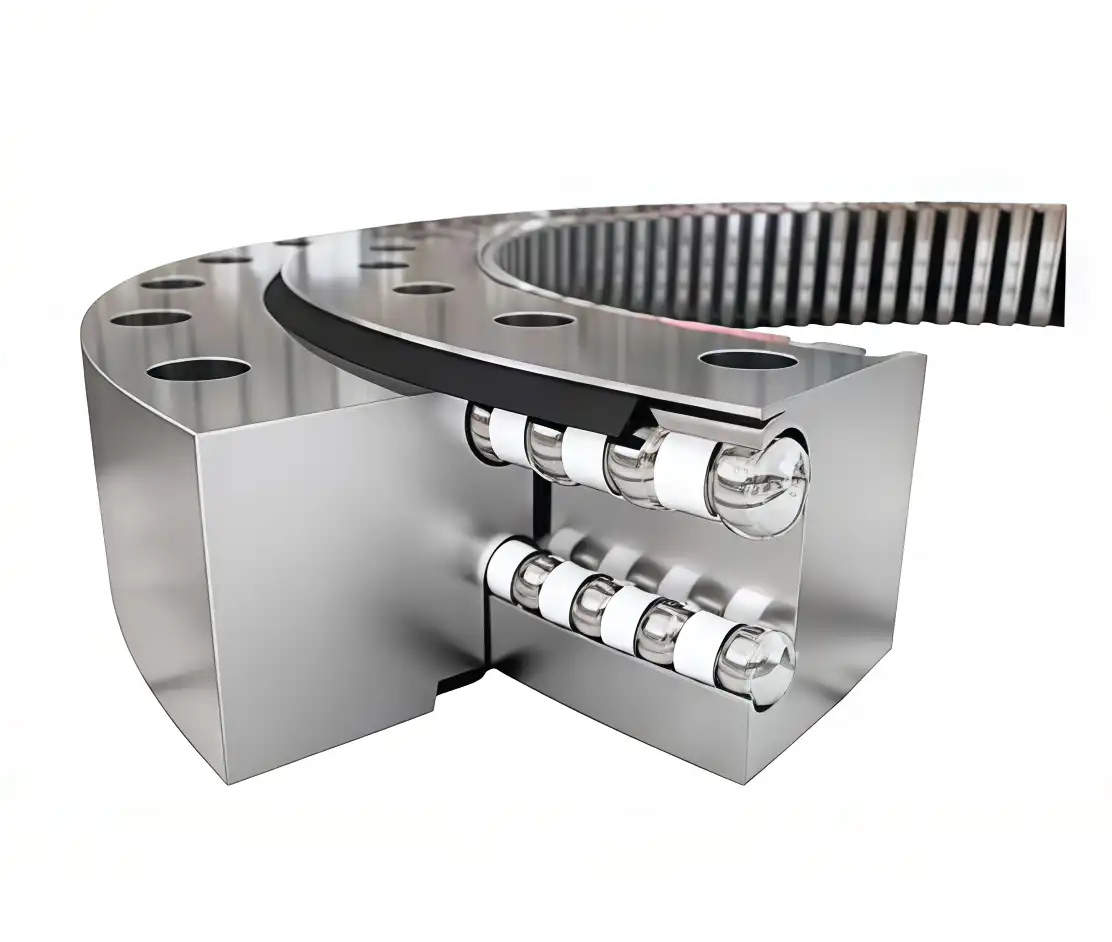
So what's actually going on inside a Double Row Ball Slewing Bearing? Picture two concentric rows of steel balls sitting in precision-ground raceways. We're talking GCr15SiMn steel here — the good stuff. Instead of cramming all the load onto one row (like a single row design does), these two rows share the work. That's the whole game right there: spread the stress, and nothing gets pushed past its limit.
What really matters is how this plays out in the real world. Take a look at the double row ball bearing vs single row side by side:
| Performance Factor | Double Row Ball Slewing Bearing | Single Row Slewing Bearing |
|---|---|---|
| Load Distribution | Load shared across two ball rows — reduced peak stress per contact point | Concentrated on a single row — higher localized stress |
| Axial & Moment Capacity | Simultaneously handles axial, radial, and overturning moment loads | Limited multi-directional load capacity |
| Operational Stability | Two rows of balls dampen vibration and resist displacement under external disturbance | More susceptible to vibration and sway under interference |
| Compactness | Higher load capacity within the same dimensional footprint | Requires a larger diameter to match double row ratings |
| Typical Applications | Tower cranes, wind turbines, port machinery, concrete pump trucks, heavy rotary tables | Light-duty turntables, small positioning systems |
Here's where Luoyang Heng Guan Bearing Technology Co., Ltd. comes in. We run sizes from 500 mm all the way up to 5,500 mm inner diameter, precision grades P0 through P4. Rings are 42CrMo or 50Mn alloy steel, heat-treated to HRC 55–62 on the raceways. Not because it sounds impressive — because if you cut corners on material or heat treat, the stability falls apart before the bearing even sees its first real load.
Key Performance Advantages That Reduce Downtime
Let's get practical. A Double Row Ball Slewing Bearing doesn't just sit there looking stable — it delivers stuff you can actually measure.
Low starting torque, for one. Sounds technical, but here's what it means: you can spec a smaller drive motor and shave money off your energy bill every month. Multiply that across a fleet of tower cranes or port machinery, and it adds up fast.
Then there's rotational accuracy. The raceways on a Double Row Ball Slewing Bearing are ground to tolerances that would make a machinist smile. For a CNC rotary table or a radar antenna platform, that precision isn't optional — it's the difference between good parts and scrap, between tracking a target and missing it entirely.
And don't overlook the seals. Imported NBR or FKM, labyrinth-plus-elastomer design. Two rows of balls mean two sealing zones protecting the internals. Contamination kills bearings faster than almost anything else, and the double row layout gives you twice the defense.
Got a specific application in mind? Our engineering team deals with this stuff every day. Drop us a line at mia@hgb-bearing.com — we'll run load calculations, walk through the options (internal gear, external gear, gearless, module sizes M16 through M40), and help you land on the right configuration.
Understanding Slewing Ring Bearing Failure Causes
Here's something worth thinking about: if you don't understand why bearings fail, you can't really appreciate why a Double Row Ball Slewing Bearing holds up better. What slewing ring bearing failure causes do we see most often? They fall into a handful of categories, and the double row design pushes back against each one:
| Failure Category | Root Cause | How Double Row Design Addresses It |
|---|---|---|
| Lubrication Failure | Insufficient quantity, wrong grease type, or degraded lubricant | Lower contact stress reduces lubrication demand; re-greasing every 100 operating hours |
| Contamination Damage | Dust, moisture, or abrasive particles entering through failed seals | Dual sealing zones with labyrinth + elastomer on both ball rows |
| Overload & Fatigue | Repeated cyclic loading exceeding rated capacity | Loading shared across two rows substantially increases fatigue life |
| Installation Misalignment | Uneven mounting surface or improper bolt torque sequence | Factory pre-drilled holes and supplied procedures ensure correct setup |
| Structural Deformation | Support framework flexing under load | Higher inherent stiffness resists deformation transfer |
LYHGB doesn't leave this stuff to chance. ISO 9001 certified, and every single Double Row Ball Slewing Bearing gets checked — dimensions, raceway hardness, rotational smoothness — before it leaves the shop. When you skip those checks, you roll the dice on slewing ring bearing failure causes showing up early. We'd rather not gamble with your uptime.
Heavy-Duty Slewing Bearing Maintenance for Long-Term Stability
Look, even the best Double Row Ball Slewing Bearing isn't magic. Skip the maintenance, and it'll still fail — just later than the alternative. Heavy-duty slewing bearing maintenance doesn't need to be complicated, but it does need to be consistent:
Lubrication: Hit it every 100 operating hours, or once a month at minimum. Dirty, wet, or high-load environment? Do it more often. And rotate the bearing while you grease — otherwise half the raceway stays dry.
Seal Inspection: Quarterly. Look for hardening, cracks, anything out of place. A bad seal is pretty much an open invitation for dirt and moisture to wreck your bearing from the inside out.
Bolt Torque: First check at 50 hours, then every year. Uneven bolts warp the mounting surface. Warped mounting surface equals vibration. Vibration means trouble.
Rotational Check: Dial indicator, full 360° rotation. If it starts dragging or making noise, stop and investigate. Don't just hope it goes away — it won't.
What's nice about the double row layout from a maintenance angle? Wear happens more slowly and evenly. Two rows sharing the load means no single point takes a beating. You get more runway between service intervals. A properly maintained Double Row Ball Slewing Bearing from Luoyang Heng Guan Bearing Technology Co., Ltd. will outlast expectations — we've seen it happen across hundreds of installations.
Conclusion
Here's the bottom line: a Double Row Ball Slewing Bearing delivers operational stability by doing one thing really well — spreading the load. Dual-row architecture, precision-ground raceways, dual sealing, and higher stiffness. Those aren't just bullet points; they're the reasons these bearings survive where single row designs fall short. The slewing ring bearing failure causes that keep showing up in the field — fatigue, contamination, misalignment, overload — the double row design pushes back against everyone. Pair that with sensible heavy-duty slewing bearing maintenance, and you've got a setup that runs longer, vibrates less, and holds accuracy better than the alternatives. If stability-related downtime is eating into your numbers, it's worth taking a hard look at making the switch.
|
|
FAQ
1. What's the real difference between a double row ball bearing vs single row?
Simple version: load distribution. Single row puts everything on one track. Double row splits it across two. That means the double row handles way more axial, radial, and overturning moment load in the same footprint — and does it without breaking a sweat. Result? A noticeably more stable bearing when the loads get complicated.
2. How often should heavy-duty slewing bearing maintenance happen?
Every 100 hours or monthly for lubrication — whichever hits first. Seals quarterly. Bolt torque at 50 hours, then annually. If you're in dust, moisture, heat, or continuous heavy loading, tighten all those intervals up. Common sense stuff, but you'd be surprised how many operations let it slide.
3. What causes slewing ring bearing failure most often?
Bad lubrication (wrong grease, not enough, or old and degraded), contamination sneaking past failed seals, pushing loads past the bearing's rating, sloppy installation (uneven mounting or wrong bolt torque), and structural flex in the surrounding frame. Almost all of it is preventable with the right spec, the right install, and the right maintenance habits.
Enhance Equipment Stability with Double Row Ball Slewing Bearings
Stability problems don't fix themselves — but the right bearing partner changes the equation. LYHGB has spent over 20 years focused on one thing: slewing bearings that perform. ISO 9001 certified. Products from 20 mm to 10,000 mm across P0 to P4 precision grades. Our engineers don't just quote specs — we work with you on custom designs and optimized solutions that actually fit your application. Standard bearings ship in 2–3 weeks. Customs take 4–6. We've delivered to customers in over 50 countries. Ready to sort out your stability issues? Reach our team at mia@hgb-bearing.com and let's talk.
References
1. Heng Guan Bearing. "Double Row Ball Slewing Bearing — Product Specifications."
2. CHG Bearing. "How Do Double Row Ball Slewing Bearings Improve Stability in Rotating Systems?"
3. LDB Bearing. "Advantages of Using Double-Row Ball Slewing Bearings."
4. SDTFL Bearing. "7 Frequent Slewing Bearing Failures and Their Warning Signs."
5. Chengshun Metals. "Slewing Ring Bearings: Common Causes of Early Failure."
6. BY Bearings. "Complete Guide to Double Row Ball Slewing Bearings."

WHAT OUR CUSTOMERS SAY
Here is the customer's evaluation of us
YOU MAY LIKE
 VIEW MOREFour-Point Contact Ball Slewing Bearings
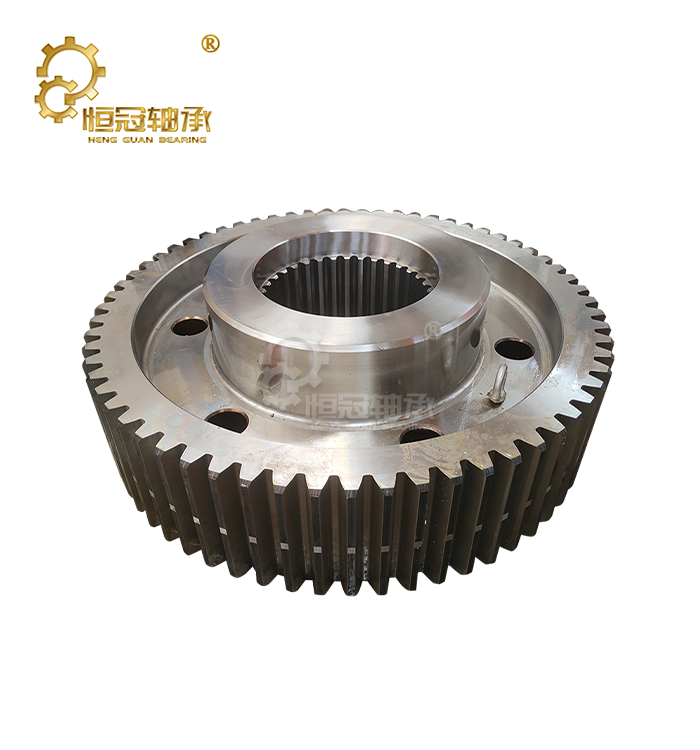 VIEW MOREMining Machinery Girth Gear
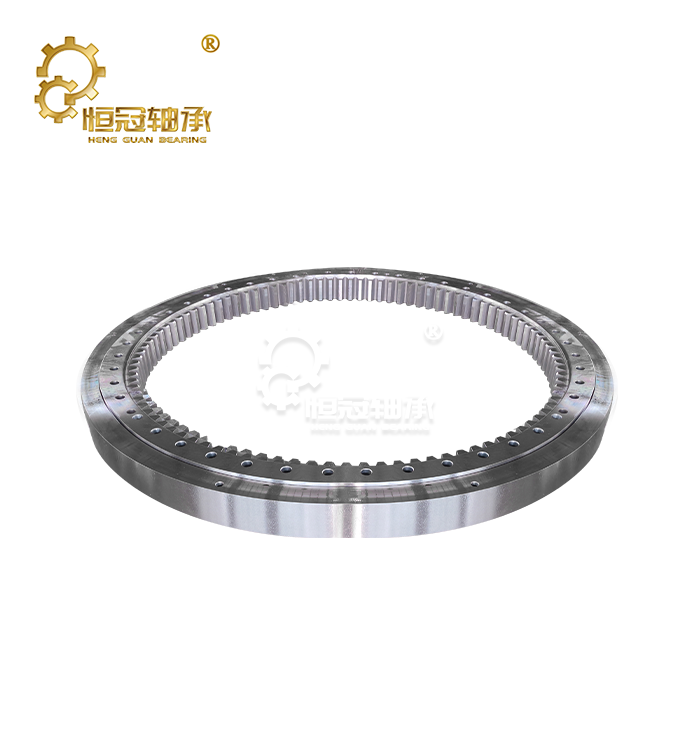 VIEW MOREThree Row Roller Slewing Bearings
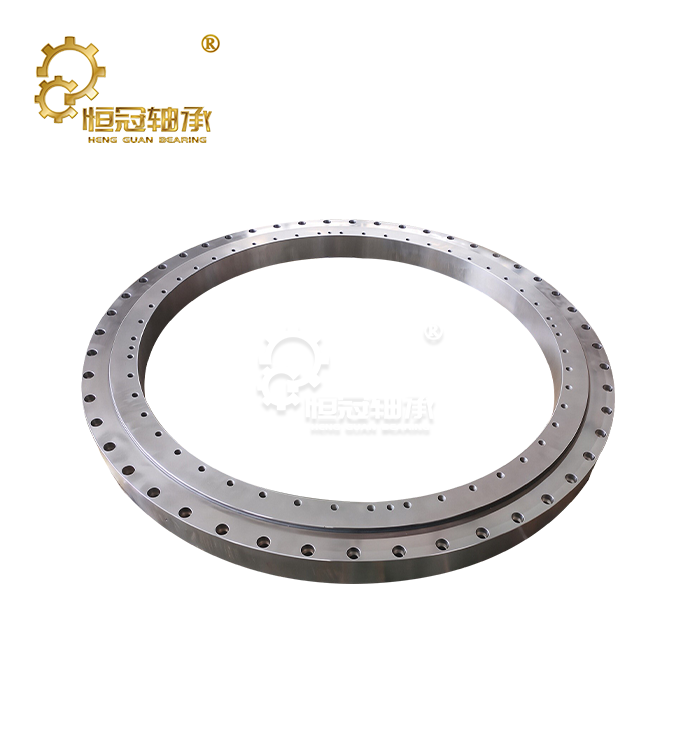 VIEW MORENo Gear Slewing Bearing
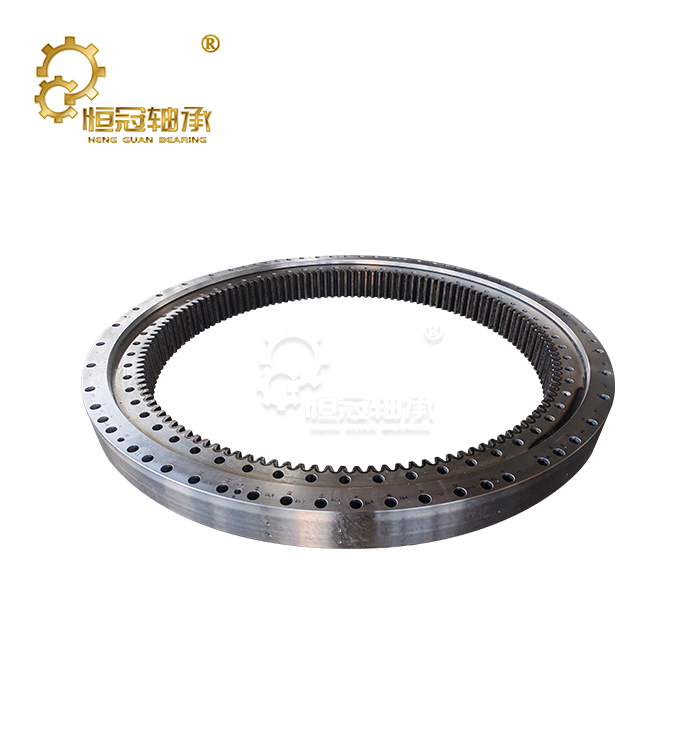 VIEW MOREBall Bearing Slewing Ring
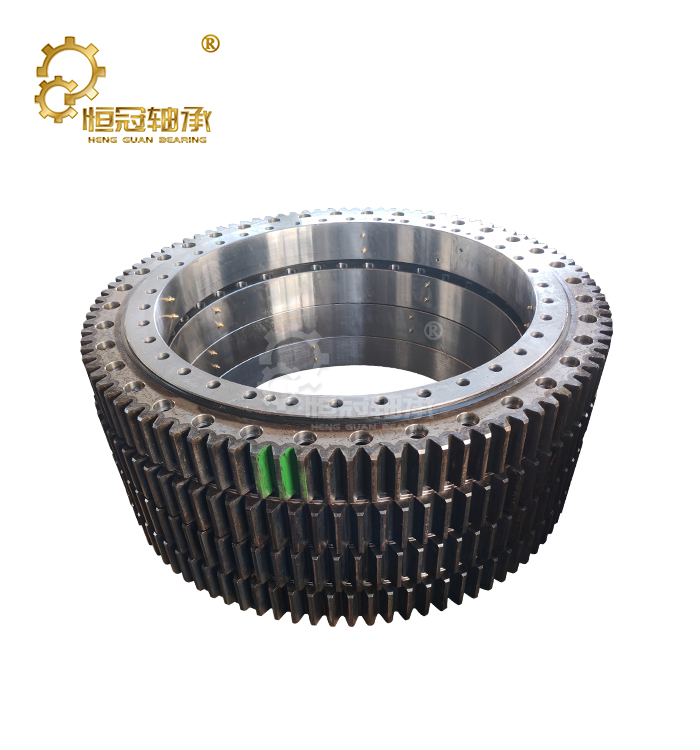 VIEW MOREGantry Crane Slewing Ring
 VIEW MORECrossed Roller Bearing
_1767784942887.webp) VIEW MOREDouble-Row Ball Slewing Ring Bearing
VIEW MOREDouble-Row Ball Slewing Ring Bearing