




How Do Externally Geared Slewing Rings Improve Torque Transfer?
Every minute a crane, an excavator, or a wind turbine is stopped due to a seized or worn-out slewing ring, it costs real money and real project time. Most of that downtime is due to a few common mistakes: gear teeth that wear out too fast under high torque, pinions that aren’t the same hardness as the ring’s teeth, backlash that’s too loose for accurate positioning or too tight for thermal growth, and raceways that lose preload because the installation wasn’t dialed in. If you hear any of these faults in your equipment, the cure is not generally a larger motor or quicker drive. It’s selecting a correctly designed externally geared slewing ring and matching it with a manufacturer that knows the gearing and the externally geared slewing rings beneath it. That’s precisely what we do at Luoyang Heng Guan Bearing Technology Co., Ltd.
|
|

How Do Externally Geared Slewing Rings Transfer Torque Efficiently?
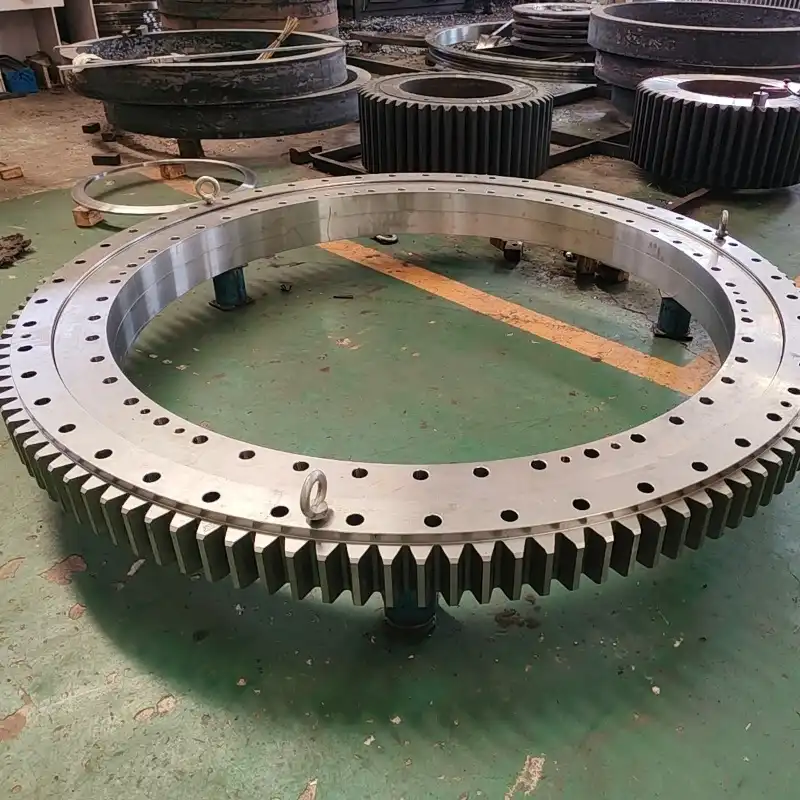
One way to comprehend torque transfer is to think about the pinion-to-gear connection from the outside in. Externally geared slewing rings possess teeth that are machined directly onto the outside race, enabling a driving pinion to engage from outside the bearing, as opposed to from inside a central bore. This configuration allows the engineers more flexibility in the positioning of the motors, simplifies the construction of the housing, and greatly facilitates regular inspection on the shop floor. But when the pinion turns, the force is dispersed over many teeth at once, dispersing the load and minimizing the tension at any one contact point. This is precisely why a correctly designed Slewing Ring Bearing with external gearing tends to run cooler, mesh more quietly, and survive longer under repeated start-stop cycles.
At Luoyang Heng Guan Bearing, we machine every exterior tooth profile to client torque, speed, and duty-cycle requirements, so that power loss via backlash or misalignment is kept to a minimum. The heat treatment is then adjusted to a consistent raceway hardness so the gear teeth and the rolling surfaces wear together as opposed to against one another. The result is a gear that not only spins, but turns reliably, frequently, and with regulated resistance throughout the working life of the equipment.
External Gear Advantages at a Glance
| Feature | External Gear Advantage | Field Benefit |
|---|---|---|
| Tooth Access | Teeth sit on the outer race | Easier inspection, lubrication, and field service |
| Load Distribution | Multiple teeth in simultaneous mesh | Lower contact stress, cooler running, longer life |
| Motor Placement | Pinion mounts outside the ring | Flexible drivetrain layout, simpler housing |
| Maintenance | No need to disassemble the bore | Shorter service windows and lower lifetime cost |
| Contamination Control | Sealed raceway, open gear face | Easier cleaning of the mesh area, longer grease life |
These advantages are why externally geared Slewing Ring Bearing designs have become the default for mobile cranes, port cranes, stacker-reclaimers, and the yaw and pitch drives on utility-scale wind turbines.
Externally Geared Slewing Rings: Gear Geometry, Load Capacity, and Drive Design
Gear geometry plays a surprisingly large role in how much torque a slewing ring can realistically deliver to the load. Module size, pressure angle, tooth width, and helix configuration all influence how load moves from the pinion into the raceway and onward into the foundation structure. Larger modules generally support higher torque per tooth but require more radial space, so drive design becomes a balancing act between compactness, stiffness, and capacity. Externally geared slewing rings pair especially well with single or dual pinion drives — a common architecture for applications that need either torque redundancy or finer positioning control, such as wind turbine yaw and pitch systems.
It's worth noting that raceway hardness and rolling element type also shape how consistently torque translates into smooth rotation across thousands of operating cycles. Heng Guan Bearing manufactures externally geared rings from 50mm to 10,000mm in diameter, covering single-row four-point contact ball, double-row ball, crossed cylindrical roller, and three-row roller configurations — each tailored to a different mix of axial, radial, and moment load. The table below summarizes how each structure maps to real torque and duty demands.
Slewing Ring Configurations for Externally Geared Applications
| Configuration | Primary Load Characteristic | Typical Application |
|---|---|---|
| Single-row four-point contact ball | Balanced axial, radial, and moment loads in a compact envelope | Mobile cranes, truck-mounted cranes, light port equipment |
| Double-row ball | Elevated radial capacity alongside axial load handling | Tower cranes, slewing jibs, deck crane slewing ring assemblies |
| Crossed cylindrical roller | Very high stiffness and precision; minimal deflection | CNC rotary tables, medical imaging, satellite antennas |
| Three-row roller | Maximum moment and axial capacity; maximum rigidity | Large port cranes, offshore pedestal cranes, heavy gantry systems, mining shovels |
All rings are produced from 50Mn and 42CrMo high-strength alloy steel with GCr15SiMn precision rolling elements, heat-treated to uniform raceway hardness for consistent wear across the gear face and the load path. Each unit is machined to ISO-compliant tolerances between P0 and P4, RoHS-compliant for international equipment programs, and serialized for full traceability from forging to final inspection. For technical drawings, custom gear modules, or reverse-engineered replacements of legacy units, our engineering team is one email away at mia@hgb-bearing.com.
What Gear and Pinion Specifications Affect Slewing Ring Torque Transfer?
Several pinion and gear specifications directly govern how much torque your externally geared slewing rings can actually deliver without premature wear, and getting any one of them wrong can shorten service life considerably. Module and number of teeth set the gear ratio, which trades output torque against rotational speed. Pressure angle — typically 20° in modern slewing gearing — controls how meshing forces resolve between the teeth, balancing tooth strength against smoothness of engagement. Backlash tolerance is another parameter worth pinning down early: too little backlash causes binding under thermal expansion, while too much introduces positioning inaccuracy that no drive software can fully correct in real time.
Surface hardening of the gear teeth, most commonly achieved through induction hardening to a specified case depth, is what resists wear from continuous meshing under heavy moment loads. When you specify an externally geared slewing ring bearing, it's generally good practice to match pinion material and through-hardened case depth to the ring's tooth surface, so the two components wear at compatible rates rather than one wearing the other out. Heng Guan Bearing's standard mating pinions are cut and induction-hardened to the same precision grade as the ring (P0–P4), and tooth data is serialized on the ring so the right pinion is easy to identify on site.
Specification Impact on Torque Transfer
| Specification | Impact on Torque Transfer | Recommended Practice |
|---|---|---|
| Module Size | Sets load-carrying capacity per tooth | Match module to peak torque × applied service factor |
| Pressure Angle | Controls meshing smoothness and tooth strength | Stay on standard 20° unless geometry requires otherwise |
| Number of Teeth | Sets gear ratio and contact ratio | Keep contact ratio ≥ 1.2 for smooth, quiet engagement |
| Backlash Tolerance | Balances positional precision vs. thermal binding | Specify at assembly operating temperature, not ambient |
| Tooth Hardness | Resists pitting, micro-fatigue, and adhesive wear | Induction-hardened ring and pinion to matched case depth |
| Tooth Surface Finish | Reduces friction and noise at the mesh | Ground finish preferred for high-cycle or precision duties |
Done well, these specifications add up to a drivetrain that holds backlash, holds preload, and holds geometry — meaning your equipment holds its rated performance.
How Do You Select Externally Geared Slewing Rings for Heavy-Duty Equipment?
Selecting the right slewing ring starts with understanding your equipment's actual load profile, not just its rated capacity on a nameplate. Consider axial, radial, and tilting moment loads together, because real-world operation rarely applies force in just one direction. Precision grade matters equally: applications like CNC rotary tables or medical imaging equipment typically demand P4 or P5 accuracy, while construction machinery may run perfectly well with P6 or P0 grades, which keeps cost in line with duty. Environmental exposure — dust, moisture, salt spray, ambient temperature swings — should drive sealing and lubrication choices up front, not be retrofitted after the first failure.
Heng Guan Bearing supports personalized optimization on every order, offering flexible production runs from 50mm to 10,000mm in diameter rather than forcing a one-size-fits-all catalog product. Our 50-person engineering team in Luoyang carries out load analysis, bearing selection, installation guidance, and aftermarket support, so the gearing, raceways, and mounting interface all work together as a coherent system rather than mismatched parts assembled under pressure. Whether you're building a mobile crane, a port stacker-reclaimer, a mining shovel, or a wind power yaw drive, working with an experienced manufacturer helps ensure that what shows up on the dock is the right Slewing Ring Bearing for the duty.
Technical Specifications at a Glance
| Parameter | Range / Value |
|---|---|
| Inner Diameter | 200mm – 8,000mm |
| Outer Diameter | 80mm – 10,000mm |
| Height Range | 80mm – 400mm |
| Precision Grades | P0, P6, P5, P4 |
| Ring Material | 50Mn, 42CrMo high-strength alloy steel |
| Rolling Elements | GCr15SiMn precision bearing steel |
| Seal Material | NBR nitrile rubber |
| Operating Temperature | -40°C to +120°C |
| Gear Options | Internal / External / No gear |
| Load Capacity | Custom engineered per application |
| Certifications | ISO 9001, RoHS-compliant |
Need help matching a specific crane model or retrofitting an older machine? Send us the original drawing or a few photos of the existing ring and our engineering team will come back with a specification within 48 hours.
Conclusion
Externally geared slewing rings deliver efficient, predictable torque transfer when gear geometry, raceway hardness, and drive design are matched to the duty — and they fall short when any one of those is treated as an afterthought. At Luoyang Heng Guan Bearing Technology Co., Ltd., we combine engineering precision with flexible manufacturing, helping equipment builders achieve reliable rotation, longer service life, and confident performance under demanding operating conditions. Whether you're sizing a new build, replacing a failed unit, or trying to extend the service life of a fleet, the right externally geared Slewing Ring Bearing is a strategic decision, not just a parts purchase.
FAQ
Q: What makes externally geared slewing rings different from internally geared ones?
The gear teeth sit on the outer race, allowing external pinion access, easier maintenance, and a more flexible drivetrain layout. Internal gearing keeps the teeth inside the bore and typically protects the mesh from debris, but at the cost of accessibility and motor-placement options.
Q: What diameter range does Heng Guan Bearing produce?
Externally geared slewing rings from 50mm to 10,000mm in diameter, manufactured to precision grades from P0 through P4, with custom diameters available outside this range on request.
Q: Which industries commonly use externally geared slewing rings?
Mobile cranes, port cranes, tower cranes, mining shovels, wind turbine yaw and pitch drives, stacker-reclaimers, and other heavy-duty material handling equipment.
Q: Does backlash affect torque transfer accuracy?
Yes — excessive backlash reduces positioning precision and can introduce impact loads at reversal, while insufficient backlash causes binding under thermal expansion. Backlash should be specified at the operating temperature of the assembly, not at room temperature.
Q: Can slewing rings be customized for specific torque requirements?
Yes — gear module, pressure angle, tooth count, surface hardening, raceway treatment, and sealing can all be tailored to match your torque, speed, and duty-cycle requirements.
How Heng Guan Solves Your Torque Transfer Challenges
At Luoyang Heng Guan Bearing Technology Co., Ltd., we combine engineering expertise, in-house manufacturing, and direct technical support to deliver externally geared slewing rings that hold their rated torque, hold their backlash, and hold up in service:
- Externally geared sleeves from 50mm to 10,000mm in diameter, manufactured to P0–P4 precision under ISO 9001 quality systems.
- Custom gear geometry — module, pressure angle, tooth count, and surface hardening tailored to your drive design and duty cycle.
- Engineering support for load analysis, bearing selection, installation guidance, and reverse-engineered replacements of legacy units.
- Material traceability with 42CrMo / 50Mn rings, GCr15SiMn rolling elements, and serialized inspection records on every unit shipped.
- Proven field performance across mobile cranes, port cranes, tower cranes, mining equipment, and wind power installations in 50+ countries.
If your equipment is suffering from premature gear wear, lost preload, or unexpected downtime, reach out at mia@hgb-bearing.com — our engineering team will review your duty profile and propose a ring that fits the application the first time.
References
1. Eschmann, P., Hasbargen, L., & Weigand, K. (1985). Ball and Roller Bearings: Theory, Design and Application. John Wiley & Sons.
2. Harris, T. A., & Kotzalas, M. N. (2007). Advanced Concepts of Bearing Technology (5th ed.). CRC Press / Taylor & Francis Group.
3. ISO 76:2006. Rolling Bearings — Static Load Ratings. International Organisation for Standardisation.
4. American Gear Manufacturers Association (AGMA). Fundamental Rating Factors and Calculation Methods for Involute Spur and Helical Gear Teeth.
5. Rothe Erde GmbH Technical Editorial. (2012). Slewing Ring Bearings: Engineering Principles and Calculation Methods for Large-Diameter Rotary Connections.
6. Shigley, J. E., & Mischke, C. R. Mechanical Engineering Design. McGraw-Hill.
7. Childs, P. R. N. Mechanical Design Engineering Handbook. Butterworth-Heinemann.

WHAT OUR CUSTOMERS SAY
Here is the customer's evaluation of us