




4 Point Contact Ball Bearing OEM Solutions for Industrial Equipment
OEM buyers rarely want a generic catalog part — they need a bearing engineered around their specific machine, and that's exactly where 4 Point Contact Ball Bearing OEM solutions come in. At Heng Guan Bearing, we work with equipment manufacturers across construction, automation, and material handling who need this bearing type specified, customized, and manufactured to fit precise mechanical and performance requirements, with diameters from 50 mm up to 10,000 mm available within our standard manufacturing scope. If you're sourcing this component for an OEM program, this guide walks through specification basics, customization options, manufacturing quality control, and how to keep performance consistent across production runs. Let's start with how to specify the bearing correctly in the first place.
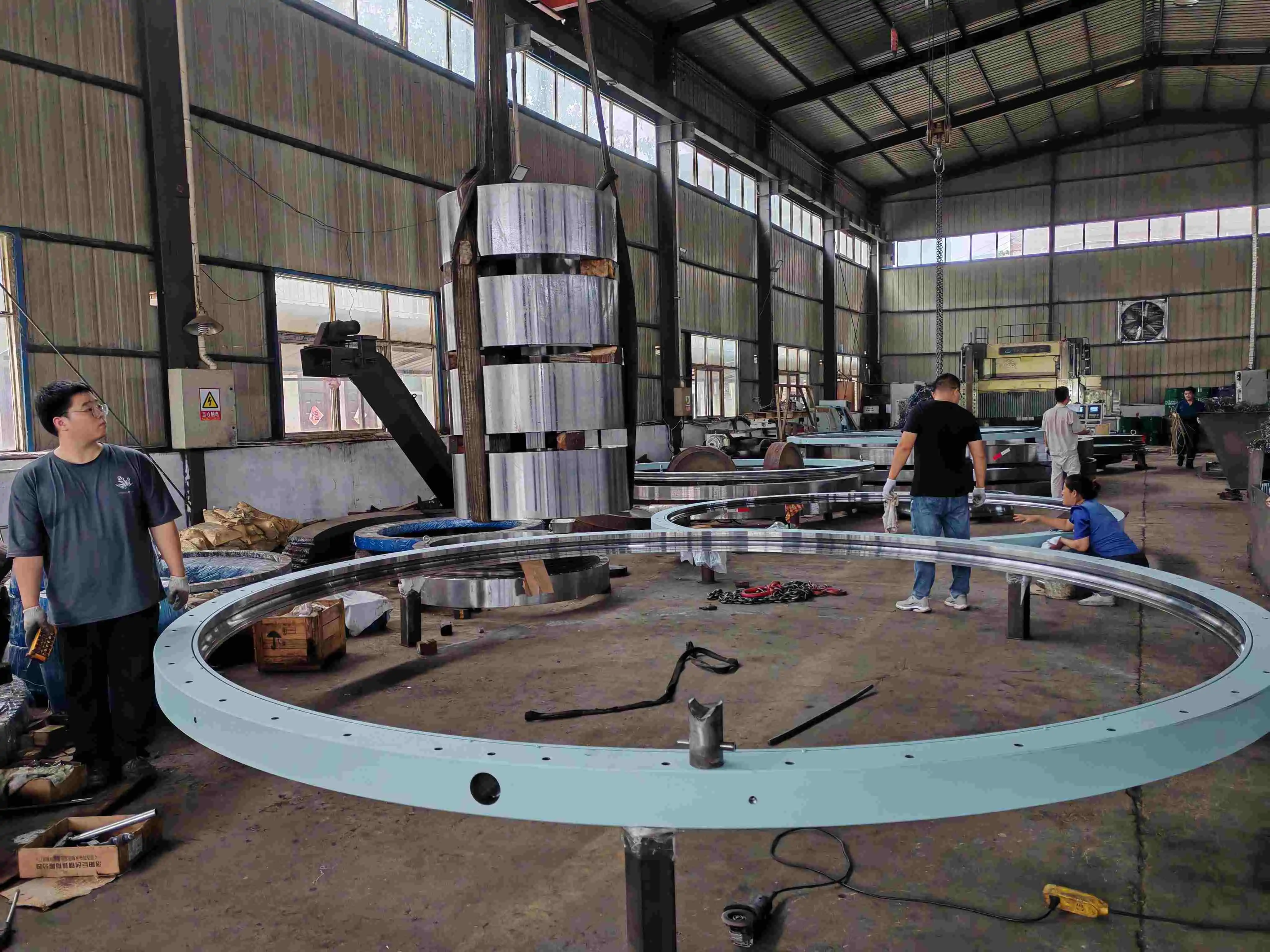
How Do OEMs Specify the Right 4 Point Contact Ball Bearing for Industrial Equipment?
The accurate specification of a 4 Point Contact Ball Bearing begins with describing the real load situation that will be applied to your equipment. Axial force, radial force, and tilting moment all operate concurrently on this bearing type, as the raceway shape is designed exactly for this combined loading condition. The Heng Guan Bearing is constructed with a single-piece inner and outer ring, and a unique raceway geometry that allows each steel ball to contact the raceway at four points.
The symmetrical contact design can take bidirectional axial loads, making it ideal for OEM programs where the load direction will reverse as part of the normal duty, such as excavator swing drives or slewing articulation joints. In addition, OEM engineers should also consider the rotational speed, duty cycle, and anticipated service environment (the usual working envelope is -20 °C to +120 °C) before finalizing the dimensions, since they are as important as the static load ratings for selecting a raceway’s hardness and clearance.
Rather than the isolated numbers, sharing full application context with your supplier helps. Many Four-point bearing suppliers can recommend adjustments to contact angle or ball size once they understand how the bearing will actually be used in your machine, which often improves both cost and performance outcomes compared with a purely spec-sheet-driven approach.
| Specification Factor | What to Define | Why It Matters for OEM |
|---|---|---|
| Load case (axial / radial / moment) | Static + dynamic envelope | Drives ball size and raceway depth |
| Operating temperature | -20 °C to +120 °C standard | Defines seal and grease choice |
| Mounting style | Separable outer ring + inner ring halves | Eases installation in confined spaces |
| Bidirectional loading | Symmetrical contact design | Supports reversing duty cycles |
| Precision grade | P0 / P6 / P5 / P4 (P4 for CT scanners) | Matches positional accuracy target |
What Customization Options Support 4 Point Contact Ball Bearing OEM Projects?
Customization is where OEM programs really differentiate themselves from standard component sourcing. A 4 Point Contact Ball Bearing can be adapted through mounting hole pattern, flange design, sealing type, and gear tooth configuration when internal or external gearing is required for the application.
Heng Guan Bearing routinely supplies non-standard dimensions and special gears for OEM customers — including Middle East mining customers whose specifications other suppliers declined to quote — so working with experienced Four-point bearing suppliers early in the design phase, rather than after drawings are finalized, tends to surface these options before tooling decisions lock them out.
Material selection also plays a meaningful role — Heng Guan Bearing's standard scope uses 50Mn or 42CrMo high-strength alloy steel rings with GCr15 high-precision bearing steel balls and an engineered cage for optimal ball spacing and lubrication distribution, with custom material options available on request for corrosion-resistant or heavy-cyclic-duty programs. Below is a general overview of common customization parameters OEM buyers typically discuss during early design reviews.
| Customization Parameter | Typical OEM Consideration |
|---|---|
| Mounting hole pattern | Matched to existing chassis or turntable design |
| Sealing configuration | Adjusted for indoor vs. outdoor exposure |
| Gear integration | Internal or external teeth per drive requirements |
| Material grade | Balanced against load, corrosion, and cost targets |
| Dimensional envelope | Non-standard 50–10,000 mm scope available |
4 Point Contact Ball Bearing Manufacturing, Quality Inspection, and Testing
Manufacturing quality ultimately determines whether an OEM program succeeds long term, so it's worth understanding what happens between raw forging and finished bearing. Ring forging, heat treatment, precision grinding of raceways, and final assembly all need tight process control, since even small deviations in raceway hardness or roundness can affect how a 4 Point Contact Ball Bearing performs under combined loading.
Heng Guan Bearing runs CNC vertical lathes for large-diameter ring machining, CNC quenching machines for controlled heat treatment, gear shapers for tooth geometry, and precision grinding equipment for raceway finishing, with a 50+ engineer team overseeing process discipline and full traceability documentation from raw material to finished bearing. Reputable manufacturers typically run dimensional inspection, hardness testing, and runout checks at multiple production stages rather than only at final inspection, which catches issues earlier and reduces scrap in OEM production runs.
Requesting sample inspection reports before committing to volume production is a reasonable step for any OEM buyer evaluating a new supplier relationship, since documentation reveals more about process discipline than a finished part alone can.
| Production Stage | Process Step | What to Verify |
|---|---|---|
| Raw forging | Ring blank forming | Material certificate, heat number |
| Heat treatment | Raceway hardening | Hardness distribution, depth profile |
| Rough machining | CNC turning | Dimensional envelope, roundness |
| Raceway grinding | Precision finishing | Surface roughness, profile accuracy |
| Gear shaping (if geared) | Tooth cutting | Module, pressure angle, tooth finish |
| Final assembly | Ball loading, preload setting | Running torque, runout, axial play |
| Pre-delivery test | Functional verification | Rotation smoothness, marking legibility |
How Can OEM Buyers Ensure Reliable 4 Point Contact Ball Bearing Performance?
Reliable long-term performance depends on more than the bearing itself — it depends on choosing a manufacturing partner who understands OEM production realities like tolerance stack-up, delivery consistency, and engineering responsiveness. It's worth asking prospective Four-point bearing suppliers how they handle design revisions mid-program, since OEM projects often evolve after initial prototypes are tested.
Heng Guan Bearing draws on more than 20 years of bearing manufacturing experience, exports to 50+ countries, and supplies OEM customers across European crawler cranes (extreme weather duty), North American port ship-to-shore cranes (abrasive-contaminant resistance), Middle Eastern mining excavators (high-shock loading), U.S. wind turbine main drives (extreme wind tolerance), and U.S. CT scanner gantries (near-silent operation), with engineering responsiveness built into the standard program.
Our team at mia@hgb-bearing.com regularly supports OEM buyers through exactly this kind of ongoing technical dialogue, from initial specification through production scale-up, and adjustments can typically be made without restarting the entire qualification process, which OEM buyers tend to find valuable when timelines are tight.
| Reliability Factor | Why It Matters for OEM Programs |
|---|---|
| Consistent raceway hardness | Ensures uniform wear behavior across batches |
| Responsive engineering support | Speeds up design revisions during qualification |
| Documented test history | Builds confidence for repeat production orders |
| Full-process traceability | Supports field-issue root-cause analysis |
| Multi-industry reference base | Validates capability across duty profiles |
Conclusion
Reliable 4 Point Contact Ball Bearing OEM solutions depend on precise specification, thoughtful customization, and disciplined manufacturing. Heng Guan Bearing is ready to support your next OEM program from concept to production.
FAQ
Q1: What loads does a 4-point contact ball bearing typically handle?
A: It manages axial, radial, and tilting moment loads simultaneously through its four-point raceway geometry, with a symmetrical contact design that supports bidirectional axial loading.
Q2: Can this bearing be customized for specific OEM equipment?
A: Yes — Heng Guan Bearing routinely produces non-standard dimensions (within the 50–10,000 mm scope) and special gear configurations, with material, sealing, and dimensional adjustments per the OEM specification.
Q3: How is manufacturing quality verified for OEM orders?
A: Through dimensional inspection, hardness testing, and runout checks at multiple production stages (raw forging, heat treatment, grinding, gear shaping, final assembly), with full traceability documentation from raw material to finished bearing.
Q4: What should OEM buyers ask suppliers before committing to volume production?
A: Request sample inspection reports, clarify how design revisions are handled during qualification, and confirm full-process traceability plus reference customers in similar duty profiles (construction, port, mining, wind, medical imaging).
Q5: Does Heng Guan Bearing support ongoing engineering changes during OEM programs?
A: Yes, our 50+ engineer in-house design team can adjust specifications, materials, sealing, or gear data without restarting the full qualification process.
Q6: Can Heng Guan Bearing supply 4 Point Contact Ball Bearings with non-standard dimensions or special gears?
A: Yes — Heng Guan Bearing's standard manufacturing scope covers 50 mm to 10,000 mm diameters, and the team has delivered non-standard sizes plus custom gear configurations that other suppliers declined to quote, backed by ISO 9001 and RoHS compliance.
Ready to Start Your OEM Bearing Program?
Looking for a dependable partner for your 4 Point Contact Ball Bearing OEM project? Heng Guan Bearing's engineering team is ready to help with specification, customization, and quality support, drawing on 20+ years of manufacturing experience across construction, port, mining, wind, and medical-imaging applications. Email mia@hgb-bearing.com to begin.
References
1. International Organization for Standardization. ISO 76:2006 — Rolling Bearings: Static Load Ratings.
2. International Organization for Standardization. ISO 281:2007 — Rolling Bearings: Dynamic Load Ratings and Rating Life.
3. American Bearing Manufacturers Association. ANSI/ABMA STD 26.2-2014 — Load Ratings for Slewing Ring Bearings.
4. International Organization for Standardization. ISO 15:2017 — Rolling Bearings: Radial Bearings, Boundary Dimensions, General Plan.
5. Deutsches Institut für Normung. DIN 623-1:1991 — Rolling Bearings: General Plans for Radial Bearings.
6. Harris, T. A., & Kotzalas, M. N. (2006). Rolling Bearing Analysis (5th ed.). CRC Press.

WHAT OUR CUSTOMERS SAY
Here is the customer's evaluation of us