



What Are the Top Applications for a Single Row Ball Slewing Bearing?
The single row ball slewing bearing is often the first component that springs to mind for engineers who require a compact, dependable solution for rotational motion under combined stresses. Luoyang Heng Guan Bearing Technology Co., Ltd. designs and manufactures this type of bearing for construction, energy, and industrial automation customers. In this article, we take you through where these bearings are used, why they work so well, and what makes them a smart choice for modern rotating equipment. If you're searching for rotary support solutions for your next project, keep reading – the parts that follow will help you grasp just why so many engineers choose this design.
Where Are Single Row Ball Slewing Bearings Commonly Used in Industrial Equipment?
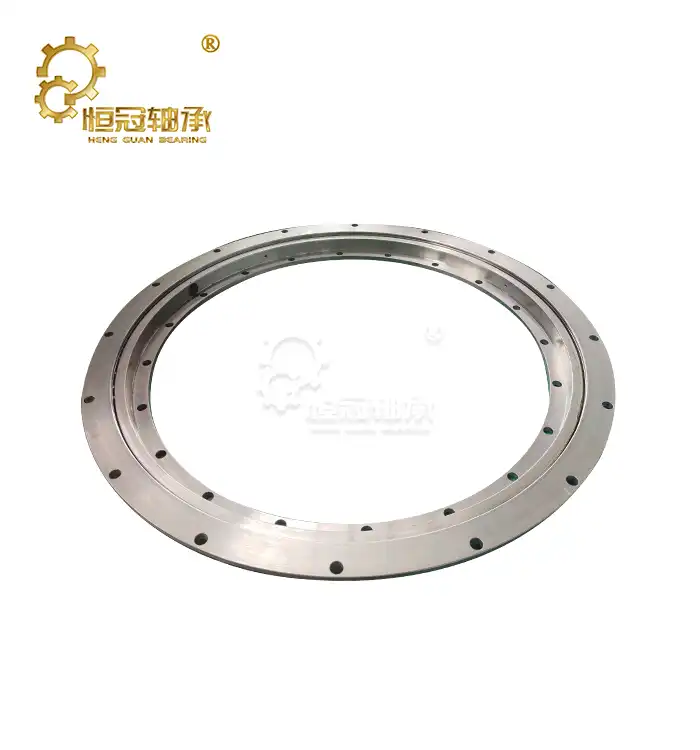
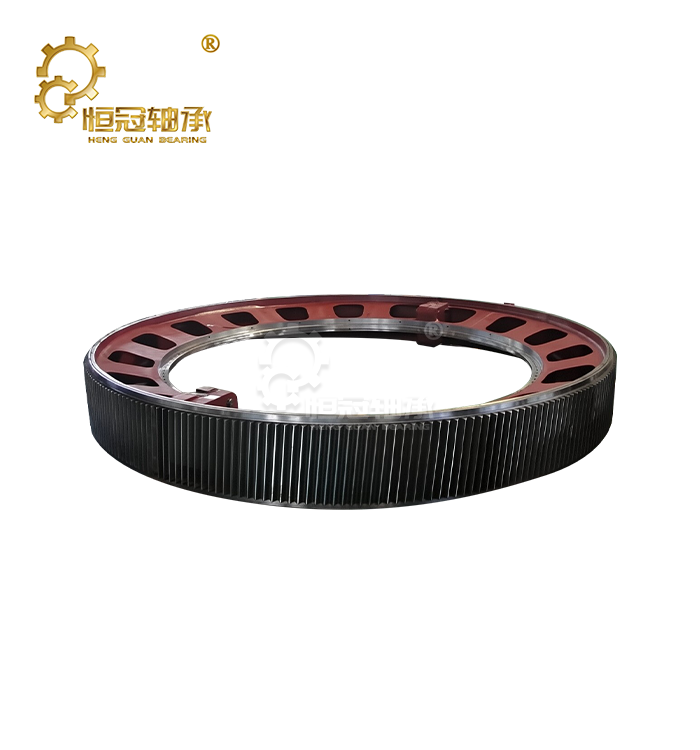
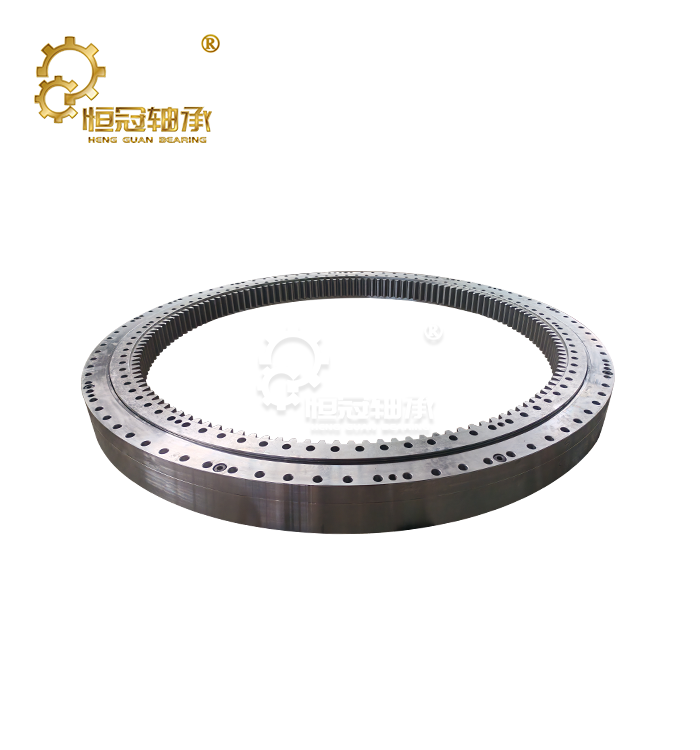
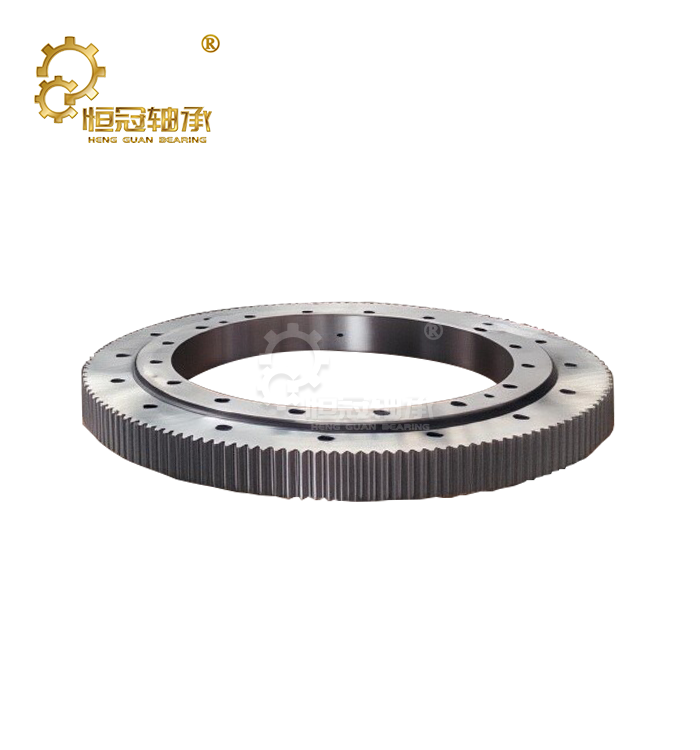
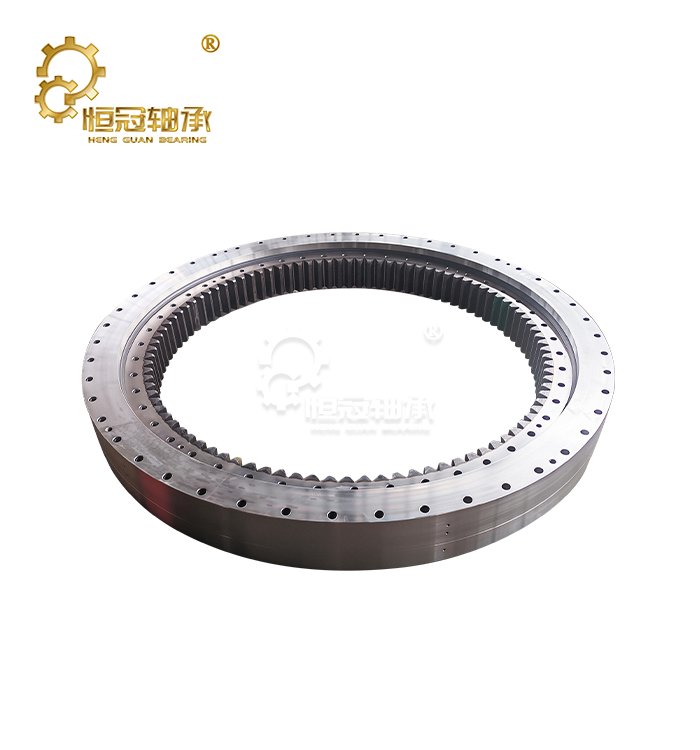
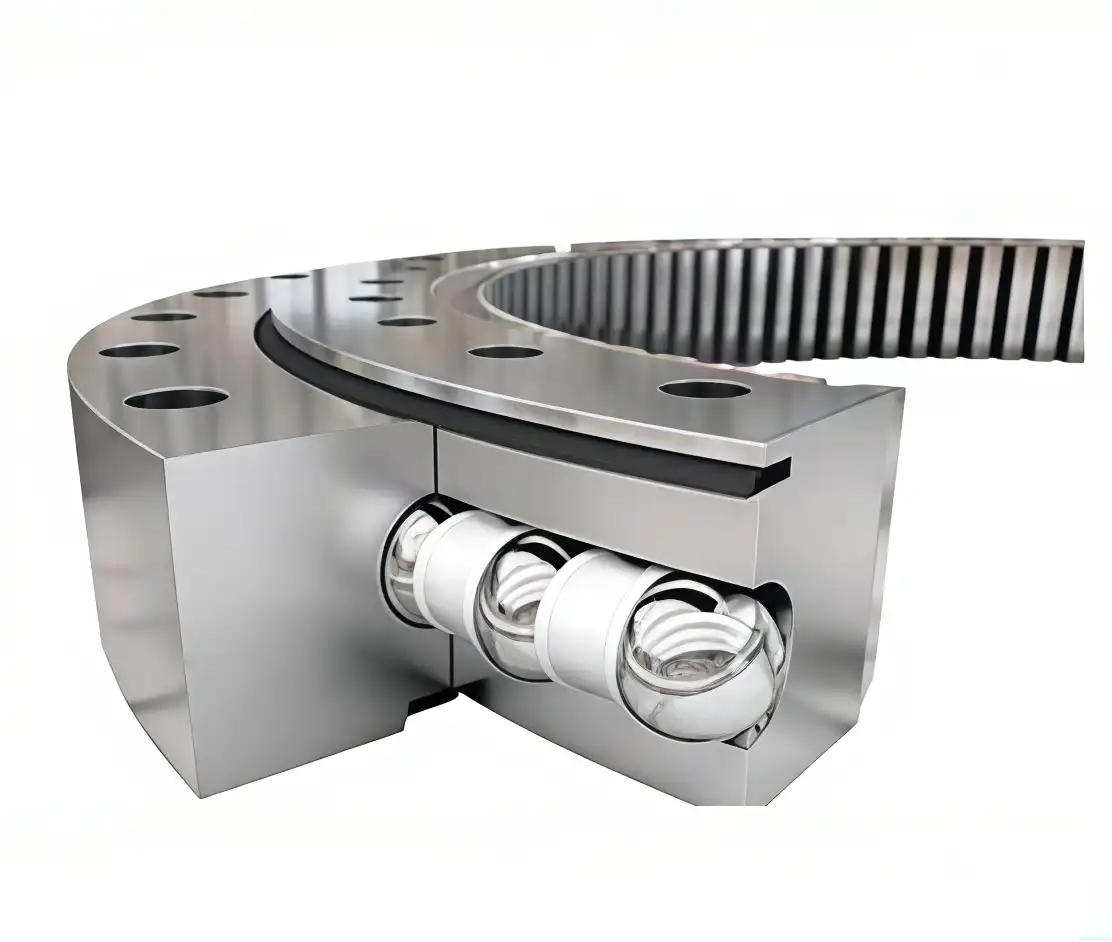
The single row ball slewing bearing has two seat rings and four contact points between the steel balls and raceway. It can bear axial force, radial force, and tilting moment at the same time. The single row ball slewing bearing may be installed in a reasonably small and lightweight design. This structural efficiency is responsible for its widespread use in industrial equipment that requires smooth, regulated rotation. You’ll find it under rotating tables, packing machinery turntables, material handling arms, solar tracking systems, and small to medium hoisting equipment.
The design maintains total height and weight low compared to multi-row alternatives, and is particularly well suited to equipment where space and payload are restricted but rotational precision still counts. The raceway is induction hardened to 55–62 HRC to prevent surface fatigue from repetitive cyclic loads due to continuous indexing or positioning actions. Let's take a deeper look at how these benefits translate into real-world equipment. The same properties that make it effective in ordinary industrial settings also make it a favourite for heavier-duty gear, which we'll look at next. Heng Guan Bearing, as a reputed producer of slewing bearings, keeps improving the hardness of raceways and optimising contact angles to prolong the service life in these different applications.
| Industrial Equipment | Typical Bearing Function | Operational Requirement |
|---|---|---|
| Rotary tables & turntables | Smooth low-friction rotation | High positioning accuracy (P5/P4) |
| Solar tracking systems | Precise angular positioning | 25-year field service life |
| Packaging & automation lines | Continuous indexing rotation | Low friction coefficient (0.003–0.008) |
| Small hoisting equipment | Combined axial/radial support | Compact two-ring mounting envelope |
Single Row Ball Slewing Bearing Applications in Cranes, Excavators, and Renewable Energy Systems
The most well-known use is the excavator slewing bearing, where the single row design links the top structure to the undercarriage and enables the boom assembly to spin 360 degrees under heavy dynamic loads. The four-point contact geometry at a normal 45° contact angle manages to spread the stress uniformly and resist the overturning moment, helping to enable a longer service life under challenging site circumstances as excavators are subject to repeated starts, stops and shock loading during digging cycles. In standard 1 – 30 tonne class excavators from companies such as Caterpillar, Komatsu, Hitachi, Kobelco and Volvo, a well-maintained single row ball slewing bearing provides about 8,000 – 12,000 working hours of dependable operation.
The same idea applies to truck-mounted cranes and smaller lifting equipment, where a single-row ball slewing bearing provides a good balance of load capacity, cost, and compact size in comparison to larger multi-row options. Bearings of this sort are used in renewable energy, especially in wind power yaw and pitch systems and solar tracker arrays, to provide the repetitive, exact rotation necessary to maintain equipment correctly aligned during years of continuous operation. For solar tracker applications, for example, a 25-year field service life with daily sun-tracking cycles requires optimised raceway quenching depth, premium NBR or FKM sealing, and corrosion-resistant coatings for coastal installations.
As construction fleets and renewable installations get larger and larger all over the world, the need for dependable rotary support components keeps growing, and Heng Guan Bearing has added production lines to serve manufacturers of excavators and cranes who need consistent, quality-tested products.
| Application Sector | Key Equipment | Load Characteristic | Bearing Configuration |
|---|---|---|---|
| Construction machinery | Excavators (1–30 ton) | High dynamic + shock loads | Internal or external gear |
| Mobile cranes | Truck-mounted, small crawler | Moderate axial + overturning | No-gear or external gear |
| Renewable energy | Wind yaw/pitch, solar trackers | Continuous slow rotation | No-gear with triple seal |
| Material handling | Conveyor arms, positioning jibs | Moderate combined loads | External gear (011/012) |
How Does a Single Row Ball Slewing Bearing Improve Equipment Rotation Performance?
The performance advantage of a single row ball slewing bearing comes down to how the balls and raceway interact. With GCr15SiMn bearing-steel balls contacting the arc raceway at roughly 45 degrees, the bearing achieves genuine three-directional load support — axial, radial, and moment — from a single row rather than requiring separate rows for each load type. This lowers friction during rotation to a coefficient of just 0.003–0.008, improves positioning accuracy, and reduces the overall envelope needed to house the bearing, which is valuable whenever equipment designers are trying to save weight or space. Optimized raceway quenching depth and hardness in the 55–62 HRC range further extend fatigue resistance under repeated cyclic loading, something particularly important in excavator slewing bearing applications where rotation happens almost continuously throughout a workday.
The triple-seal architecture — combining a labyrinth seal groove, an elastomer seal element, and a grease-retention channel — keeps dust, slurry, and moisture out even under high-pressure washdown conditions common on construction and mining sites. If you'd like a deeper technical breakdown for your specific load case, our engineering team is happy to walk through the numbers with you — feel free to reach out at mia@hgb-bearing.com, and we'll help you match the right bearing configuration to your equipment. Below is a quick comparison showing how contact geometry relates to typical performance characteristics.
| Design Feature | Specification | Resulting Performance Benefit |
|---|---|---|
| Four-point ball contact | 45° contact angle (35° optional) | Combined axial, radial, moment capacity |
| Compact two-ring structure | Section height 30–150 mm | Lower weight, smaller mounting envelope |
| Optimized raceway hardening | 55–62 HRC, induction quenched | Extended fatigue and wear resistance |
| Triple-seal architecture | Labyrinth + NBR/FKM + grease channel | Dust/moisture exclusion under washdown |
| Precision rolling elements | GCr15 (SAE 52100) hardened steel balls | Smooth rotation, friction 0.003–0.008 |
Key Industries Using Single Row Ball Slewing Bearings: Features and Benefits
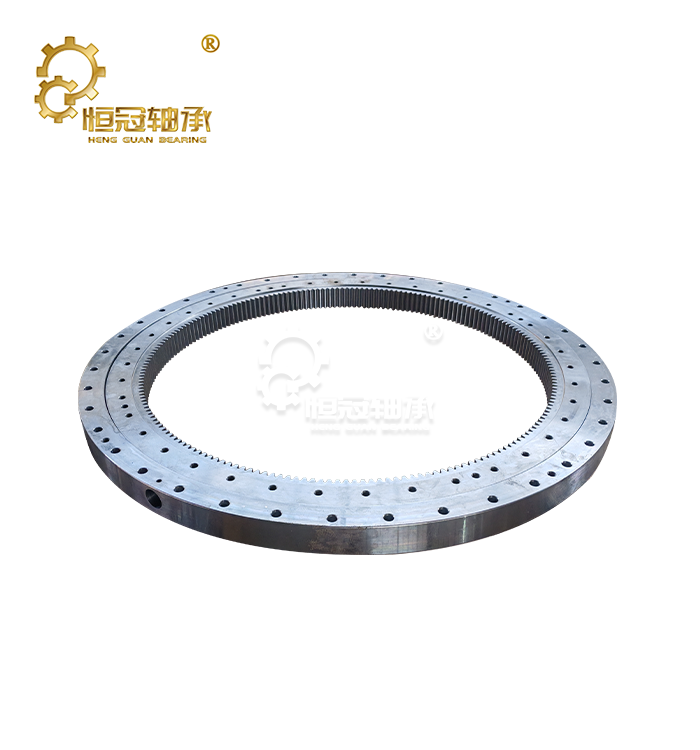
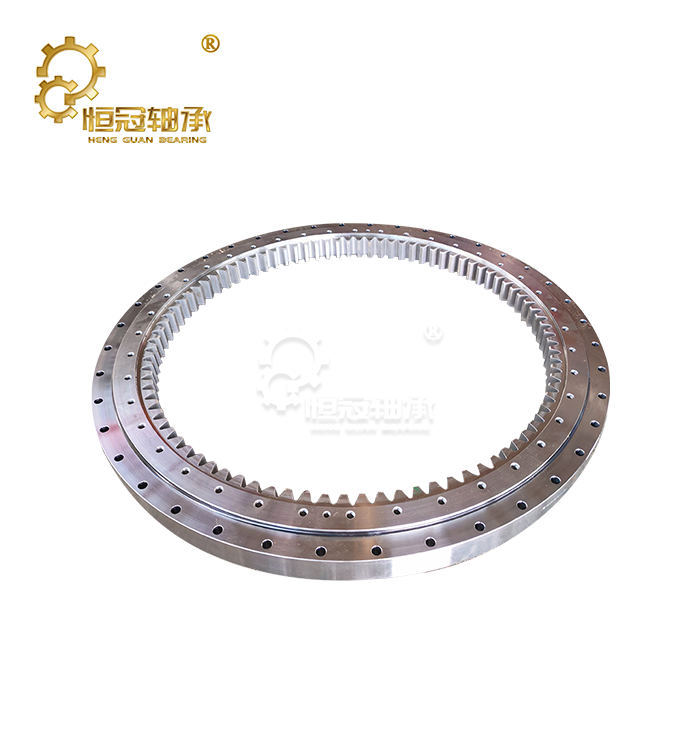
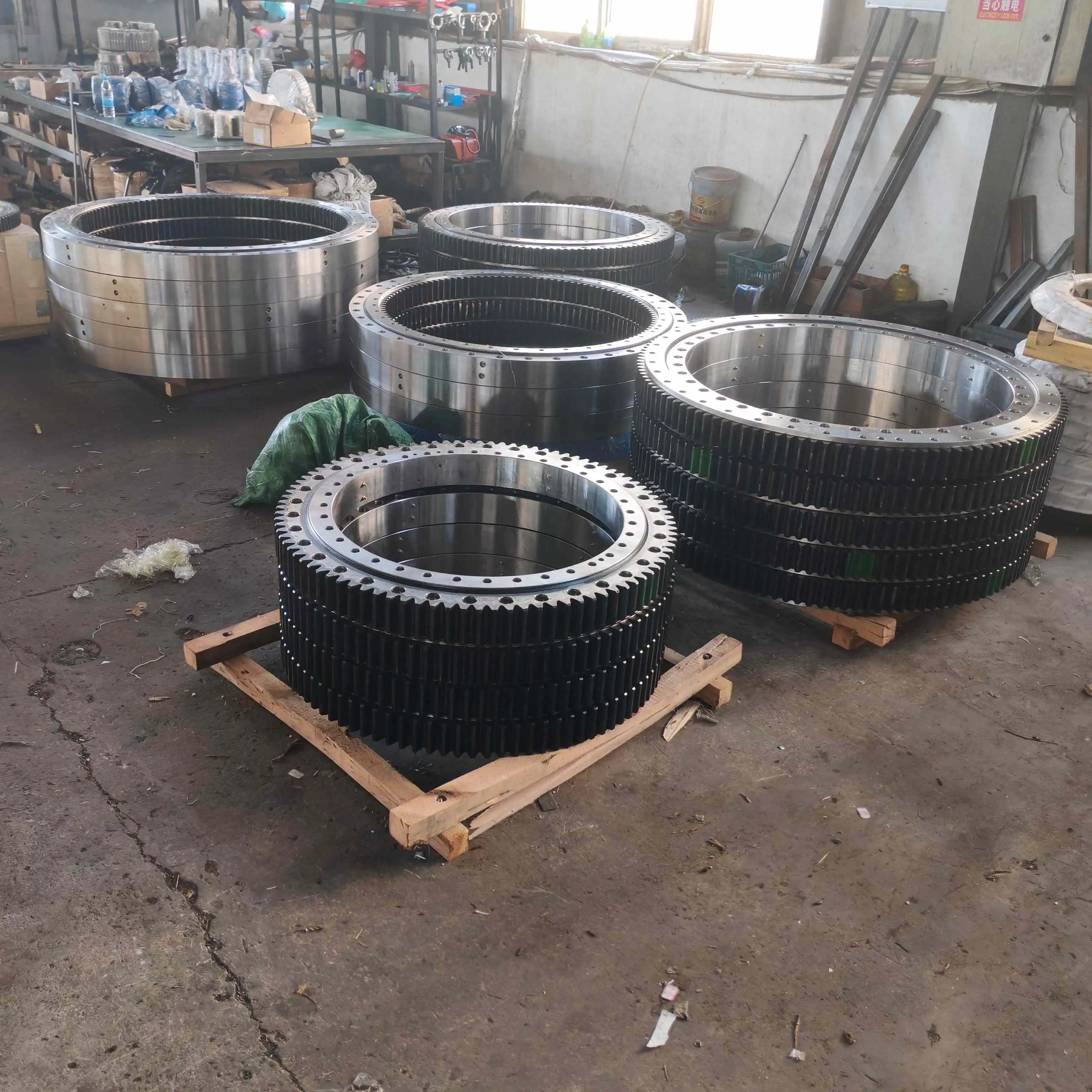
Beyond construction machinery, single row ball slewing bearings serve a genuinely broad set of industries, and that versatility is part of what makes the design so widely adopted. Mining and metallurgy equipment use them on rotary conveyors and material handling arms; ports rely on them for smaller crane and gantry rotation systems; medical equipment manufacturers use miniaturized versions for imaging and positioning devices; and automation and robotics applications use them wherever a compact rotary joint needs to carry moderate loads reliably. Heng Guan Bearing produces this bearing type across a 50–10,000mm diameter range with accuracy grades covering P0, P6, P5, and P4, so customers across these different industries can specify exactly the precision level their application requires. Gear configurations are equally flexible: the 010 series offers no-gear designs for hydraulic-motor-driven systems, the 011/012 series provides external gears for standard pinion-driven applications, and the 013/014 series uses internal gears where the drive must be protected inside the bearing envelope to save radial space.
For applications with strict vertical-space constraints, the Q-series thin-section variant minimizes height while maintaining adequate load capacity, while the L1/L2 lightweight series reduces weight for battery-powered aerial work platforms and robotic systems. This broad accuracy range, combined with the option for customized flanges, sealing, and gear configurations, is why engineers across so many sectors continue turning to single-row ball slewing bearing designs rather than defaulting to bulkier alternatives. Whatever your industry, understanding these shared benefits should make it easier to evaluate whether this bearing type fits your next rotating assembly.
| Industry Sector | Typical Application | Diameter Range (mm) | Recommended Series & Accuracy |
|---|---|---|---|
| Construction & mining | Excavator swing circle, conveyor arm | 200–2,000 | 013/014 internal gear, P6 |
| Renewable energy | Solar tracker, wind yaw system | 300–2,200 | 010 no-gear, P5/P4 |
| Port & lifting | Small crane, gantry rotation | 400–3,000 | 011/012 external gear, P0/P6 |
| Medical & robotics | Imaging turntable, robot joint | 50–500 | Q/L series, P4 |
| Industrial automation | Packaging, welding positioner | 200–1,500 | 010/011, P6 |
Conclusion
A single row ball slewing bearing delivers compact, reliable rotation across cranes, excavators, renewable energy, and industrial equipment. Heng Guan Bearing combines engineering precision with dependable manufacturing to support your project's rotational performance needs.
FAQ
Q: What loads can a single row ball slewing bearing support?
A: It supports axial force, radial force, and tilting moment simultaneously through its four-point ball contact design at a 45° contact angle, eliminating the need for separate bearing rows for each load direction.
Q: Is a single row ball slewing bearing suitable for excavators?
A: Yes, the excavator slewing bearing application is one of the most common uses. The single row design connects the upper structure to the undercarriage for full 360° rotation and typically delivers 8,000–12,000 working hours under normal lubrication in 1–30 ton class excavators.
Q: What diameter range and accuracy grades does Heng Guan Bearing manufacture?
A: Heng Guan Bearing produces slewing bearings from 50mm to 10,000mm in diameter, across P0, P6, P5, and P4 accuracy grades, with gear options including no-gear (010), external gear (011/012), and internal gear (013/014) configurations.
Q: How does this bearing type compare to double row designs?
A: A single row ball slewing bearing is lighter and more compact with a section height of 30–150mm and a friction coefficient of 0.003–0.008. Double row designs offer higher load capacity for heavier-duty equipment but come with greater weight and a larger mounting envelope.
Q: Can the bearing be customized for specific equipment?
A: Yes, Heng Guan Bearing offers customized flange, sealing (NBR or FKM), and gear configurations, including Q-series thin-section and L1/L2 lightweight variants. Standard products ship in 7–15 days; custom designs typically take 4–6 weeks depending on complexity.
Ready to Upgrade Your Rotating Equipment?
Talk to Heng Guan Bearing's engineering team today about your single row ball slewing bearing or excavator slewing bearing needs. Email mia@hgb-bearing.com for a tailored quote, technical drawing review, and fast 24-hour response for your project.
References
1. Anderson, M.J., Bearing Technology in Heavy Construction Equipment, Journal of Construction Engineering and Machinery.
2. Harris, T.A. & Kotzalas, M.N., Rolling Bearing Analysis, CRC Press.
3. Brändlein, J., Eschmann, P., Hasbargen, L., & Weigand, K., Ball and Roller Bearings: Theory, Design, and Application, Wiley.
4. American Gear Manufacturers Association, Design Guidelines for Slewing Ring Bearing Applications in Heavy Machinery.
5. Zhang, L. & Wang, H., Fatigue Life Analysis of Four-Point Contact Slewing Bearings Under Cyclic Loading, Mechanism and Machine Theory.

WHAT OUR CUSTOMERS SAY
Here is the customer's evaluation of us