




What are the Benefits of Using a No Gear Slewing Bearing over a Geared One?
Choosing the right slewing bearing depends on more than the bearing diameter or rated load. The way the bearing interfaces with the machine drive can also affect maintenance, installation, noise, positioning, and overall system design. A No Gear Slewing Bearing eliminates the integrated gear teeth of a geared slewing bearing so that engineers can utilise a separate rotation-drive system when applicable to the application. This may simplify some machine designs, and eliminate gear tooth wear as a maintenance issue. Even without gears, a Slewing Bearing still does the main job of a bearing, which is to carry axial loads, radial loads and overturning moments, while permitting regulated rotation between connected structures. But eliminating the gear ring does not mean that the machine no longer needs a drive system. Rotation may be provided by a friction drive, belt or chain gearbox, direct drive arrangement or other external mechanism depending upon the equipment. So, the big question for engineers and procurement teams is not whether a gearless design is better for everyone. A more useful question is whether the removal of the integrated gear is appropriate for the machine’s load, speed, accuracy, installation space, drive concept and maintenance requirements.
How Does a No-Gear Slewing Bearing Work?
A slewing bearing typically comprises an inner ring, an outer ring, rolling elements, raceways, seals, and mounting features. Depending on the design, the rolling elements can be balls or rollers. The bearing is loaded in multiple directions and allows one ring to rotate relative to the other.
A toothed slewing bearing is a bearing that has teeth on either one of its rings. The bearing is rotated by a pinion or other driven gear mechanism engaging these teeth. In a no-gear slewing bearing, gear teeth are removed. So the bearing is for load-bearing and guidance in rotation. The machine designer provides some other way to provide rotational torque.
This distinction is crucial because it enables the bearing and drive system to be viewed as two linked but different things. This offers more flexibility in the positioning of motors, actuators, or gearbox components for specific machines.
Main Components and Material Selection
The bearing rings are generally made from bearing or structural alloy steels chosen based on the specified load capacity, hardness, toughness, heat treatment, and operating circumstances. The rolling elements can be made of bearing steels such as GCr15-series materials, depending on the design of the manufacturer. The slewing bearing rings can be made of materials such as 42CrMo or 50Mn as necessary.
The material choice cannot be treated separately from the heat treatment and raceway design. The ultimate performance of a slewing bearing depends on the interaction between material qualities, raceway hardness, rolling-element shape, clearance or preload, lubrication, and applied stresses.
Sealing materials must also be compatible with the operational environment. While standard elastomers are adequate for ordinary industrial circumstances, applications involving extreme temperatures, chemicals, dust, water, or other harsh environments may call for a specialized sealing solution.
Common Structural Configurations
A no-gear slewing bearing can be made in several structural configurations. The selection of the correct design depends on the interplay of axial load, radial load, overturning moment, stiffness, rotation speed, available mounting space, and needed precision.
The single-row four-point contact ball bearing can provide a comparatively compact solution for combined load situations with limited installation space. It finds application in small construction equipment, positioning systems, work platforms, and other machines with appropriate load spectra.
A double-row ball arrangement can give more load-carrying capacity than a compact single-row design. It can be useful when the equipment needs a higher capacity and yet wants to use a ball bearing setup.
Conventionally, a three-row roller arrangement has been considered in applications where high load capacity and stiffness are the main goals. Such a structure may be required for heavy gear such as cranes, material handling equipment, and huge excavation systems where their load and moment needs are greater than those of smaller designs.
A cross-roller arrangement has rollers arranged in different orientations to support loads applied from multiple directions in a reasonably compact construction. It can be beneficial in precision positioning equipment, radar systems, inspection equipment, welding positioners, and others where stiffness and rotation accuracy are crucial.
It should be selected from actual operating loads, not from bearing size alone. The correct configuration
Raceway Geometry and Manufacturing Accuracy
The raceway is the most significant functional area of a slewing bearing, where the load is transferred between the rings via the rolling elements. The bearing performance depends on the raceway shape, surface finish, hardness, clearance, and manufacturing precision.
The needed accuracy for precision applications should be included in the engineering drawing or technical specification. Manufacturing companies might offer different dimensional tolerances or accuracy classes, if applicable. But a higher grade of precision does not necessarily make a bearing right for every machine. The ultimate rotation behavior is further influenced by the mounting surface accuracy, the housing rigidity, the bolt preload, and the system alignment.
This is why a reliable supplier must take into account the entire operational state, not only select a racetrack accuracy level alone.
No-Gear Slewing Bearing vs. Geared Slewing Bearing
The only difference between the two designs is that one has an integrated gear ring and the other does not. This has implications for the driving arrangement and several engineering considerations.
Gear Teeth and Mechanical Wear
A geared slewing bearing transmits rotational torque by use of gear teeth. Thus, the bearing and pinion have to function as a matched mechanical system. That is relevant to system maintenance. Condition of the gear teeth, lubrication, alignment, backlash, contact pattern.
No gear slewing bearing without gear teeth built in. This removes gear tooth contact, tooth wear, and gear mesh inspection from the bearing. Proper lubrication and inspection are still required of the bearing, but maintenance can be directed to the raceways, rolling elements, seals, mounting condition, and lubricant.
That doesn’t mean a bearing without gears is maintenance-free. It just takes away one mechanical contact that you have to take care of.
Drive-System Integration
The lack of gear teeth gives the machine designer more freedom in selecting the bearing rotation. Instead of a pinion next to a gear ring, the designer may utilize another driving concept that is suitable for the machine.
Possible alternatives are friction wheels, belts, chains, linear actuators, or direct-drive setups. The right solution depends on the torque, speed, positioning accuracy, space available, ambient conditions, and control needs needed.
This can be a significant advantage for a machine that already has an independent drive system. Alternatively, the equipment can be developed around a standard pinion and ring gear system, in which case a geared slewing bearing may be the more feasible option.
Noise, Backlash, and Rotational Behavior
Noise and vibration can be generated from the gear engagement, particularly when the gear alignment, lubrication, tooth condition, or operating circumstances are not effectively managed. Eliminating the gear mesh can lessen this particular form of mechanical noise.
A gearless bearing doesn't get rid of all operational noise. Rolling elements, seals, the external drive, structural vibration, and motor or actuator noise might still affect the overall sound level.
Backlash is something we also need to think about carefully. The gear teeth removal eliminates the gear-mesh backlash, but the positioning accuracy of the whole machine still depends on the bearing clearance, drive-system characteristics, structural deformation, control resolution, and assembly precision.
For precise equipment, engineers should consequently consider the bearing and drive system as a whole.
What Are the Main Benefits of a No-Gear Slewing Bearing?
The advantages of a gearless design are most significant when they match the requirements of the machine.
Reduced Gear-Related Maintenance
The most direct benefit is the removal of gear teeth from the bearing. There is no bearing-integrated gear mesh that needs to be lubricated, inspected, or replaced as it wears.
Maintenance teams can instead concentrate on the bearing's lubrication condition, seals, raceways, mounting bolts, and operating behavior. This can simplify maintenance planning, particularly in machines where access to the gear and pinion is difficult.
The actual maintenance interval should still be determined by the manufacturer's recommendations and the machine's operating conditions rather than by assuming that every gearless bearing requires only periodic inspection.
Greater Flexibility in Machine Design
A gearless bearing can provide more flexibility when the machine designer has a preferred drive arrangement that does not require a bearing gear ring.
For example, an equipment manufacturer may already have a motor, actuator, or friction-drive system that can provide the required rotational torque. In that situation, integrating a gear ring into the bearing may add components without providing a practical benefit.
Separating the bearing function from the drive function can also make it easier to position the drive components according to the machine's available space.
Potentially Lower Gear-Mesh Noise
Because there is no gear-tooth engagement within the bearing, the system avoids noise generated specifically by gear mesh. This can be valuable in indoor machinery, inspection equipment, positioning systems, and environments where mechanical noise is a design consideration.
However, engineers should compare the complete system rather than the bearing alone. The motor, gearbox, friction drive, structure, seals, and rolling elements can all contribute to operating noise.
Simplified Inspection of the Bearing Assembly
A geared system requires attention to both bearing condition and gear condition. Engineers may need to inspect tooth wear, tooth damage, lubrication, backlash, and pinion alignment in addition to conventional bearing checks.
With a no-gear slewing bearing, the inspection scope associated with the bearing itself is more focused. Raceway condition, rolling-element behavior, seals, lubrication, mounting bolts, and abnormal temperature or vibration remain important inspection points.
This can make troubleshooting more straightforward when gear-related failure modes are not required by the machine design.
Suitable for Precision and Positioning Applications
A gearless bearing can be useful in applications where the machine already uses a precision drive system and does not require the bearing ring itself to transmit torque through gear teeth.
This may include antenna positioning equipment, inspection systems, welding positioners, medical or laboratory equipment, and other rotary platforms.
However, precision should never be attributed to the bearing design alone. The complete system needs to be evaluated, including bearing runout, clearance, mounting accuracy, drive resolution, structural stiffness, and control software.
Are There Situations Where a Geared Slewing Bearing Is Better?
A balanced engineering comparison should also recognize where the conventional design remains advantageous.
A geared slewing bearing can be attractive when the machine requires a proven pinion-and-ring-gear transmission arrangement. The integrated gear provides a direct way to transfer rotational torque from a drive pinion to the bearing ring.
This can be particularly useful in large construction equipment, cranes, excavators, and other machinery where the drive concept has already been optimized around a gear ring.
A geared configuration may also simplify the overall system when the machine manufacturer already has established pinion drives, lubrication systems, and maintenance procedures. Replacing that arrangement with a separate gearless drive may introduce additional design work rather than reducing it.
The choice of a no gear slewing bearing should therefore be based on the complete machine architecture rather than assuming that one bearing type is always superior.
Where Can No Gear Slewing Bearings Be Used?
Construction and Material-Handling Equipment
Compact construction machinery, lifting platforms, material-handling equipment, and rotary platforms can use gearless slewing bearings when the selected external drive can provide the required torque and control.
The key design factors include overturning moment, radial load, axial load, operating speed, shock loading, and the stiffness of the mounting structure.
Wind and Renewable Energy Equipment
Renewable-energy systems often use large rotating structures that require controlled movement and reliable support. A gearless bearing may be considered when the equipment has an independent drive concept and the bearing does not need to transmit torque through an integrated gear ring.
Environmental conditions are especially important in these applications. Designers should consider wind loading, temperature variation, moisture, contamination, lubrication, sealing, and long-term maintenance access.
Precision Positioning Equipment
Radar platforms, antenna systems, welding positioners, inspection equipment, and other rotary positioning systems can benefit from a bearing design that does not introduce gear-mesh backlash.
The final positioning performance still depends on the entire mechanical and control system. Bearing accuracy, mounting deformation, drive resolution, structural stiffness, and control strategy should therefore be specified together.
Medical and Laboratory Equipment
Rotating assemblies in medical, laboratory, and inspection equipment may have strict requirements for smooth movement, compact dimensions, cleanliness, and operating noise.
For these applications, engineers should pay particular attention to bearing runout, rotational resistance, sealing, lubrication compatibility, accuracy, and the available installation envelope.
How Should You Specify a No-Gear Slewing Bearing?
Selecting a bearing only by inner and outer diameter can lead to an unsuitable design. A manufacturer needs enough application information to calculate capacity and recommend the correct structure.
Define the Load Conditions
At minimum, provide:
Axial load
Radial load
Overturning moment
Static and dynamic operating conditions
Shock or impact loading
Required safety factors
If the load changes during operation, providing a load spectrum is more useful than providing only the maximum value.
Confirm Speed and Rotation Requirements
The supplier should also know the normal and maximum rotational speed, acceleration, duty cycle, rotation angle, and expected number of operating cycles.
Intermittent positioning and continuous rotation can produce very different bearing requirements even when the applied load is similar.
Check Mounting and Structural Conditions
The bearing is only as reliable as the structure supporting it. Mounting surface flatness, housing stiffness, bolt arrangement, bolt preload, and alignment can affect raceway loading.
The mounting hole pattern should therefore be specified together with the bearing dimensions rather than treated as a secondary detail.
Discuss the drive arrangement.
For a no-gear slewing bearing, the drive concept is particularly important.
The manufacturer or machine designer should determine:
required drive torque
rotational speed
holding torque
positioning accuracy
acceleration requirements
available installation space
friction or transmission interface
environmental conditions
This ensures that the bearing and external drive operate as a compatible system.
Consider Operating Environment and Maintenance
Dust, water, salt spray, chemicals, temperature extremes, vibration, and outdoor exposure can all affect bearing selection.
The specification should identify the operating environment and expected maintenance conditions so that the supplier can recommend suitable seals, materials, lubrication, surface treatments, and protective measures.
|
|
What Should Procurement Teams Ask the Manufacturer?
A qualified supplier should be able to provide technical information rather than only a product price.
Ask for dimensional drawings, material information, applicable tolerances, load ratings, lubrication recommendations, sealing details, mounting requirements, and inspection documentation where relevant.
For customized bearings, procurement teams should also clarify the following:
production lead time
minimum order requirements
inspection procedures
quality documentation
customization capability
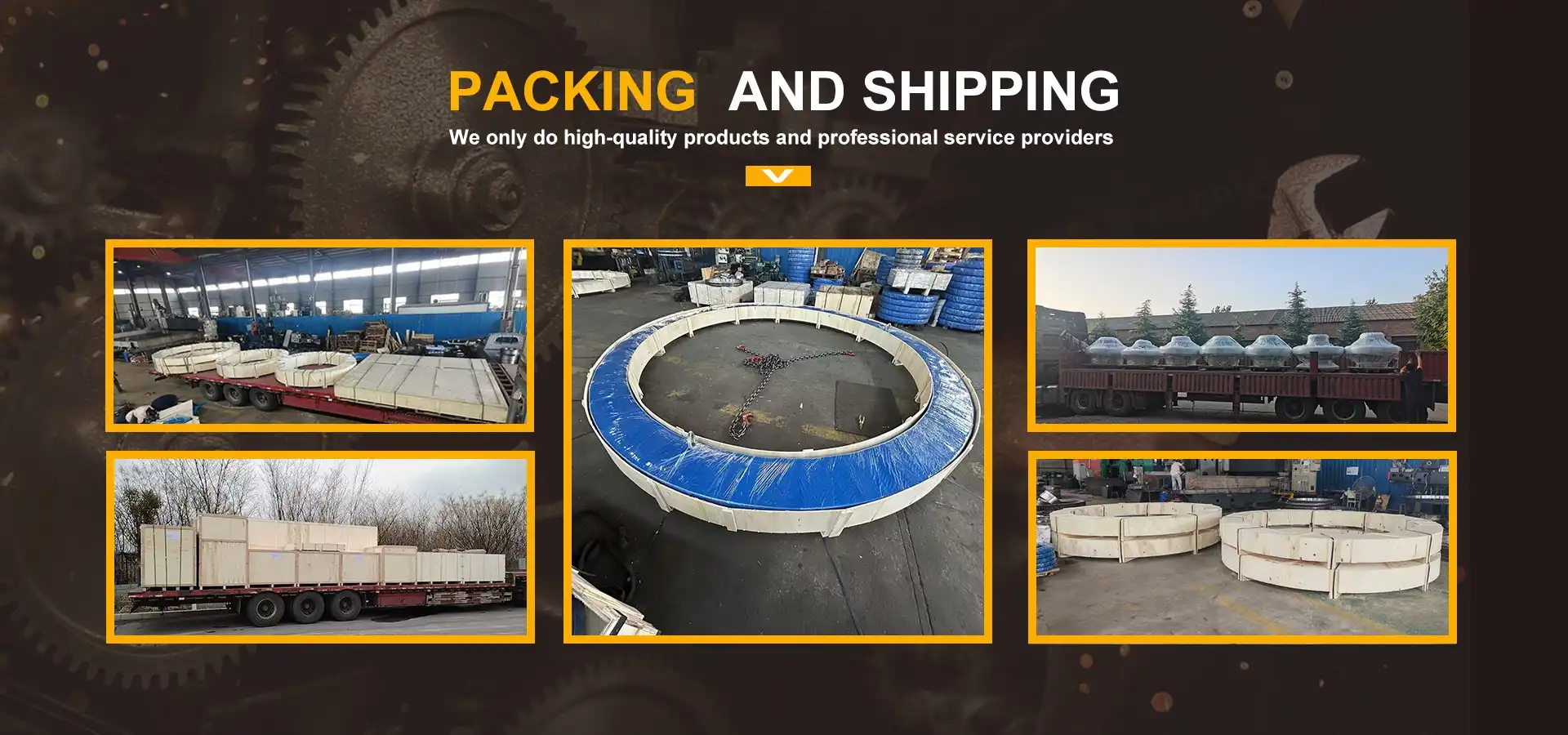
packaging method
spare-part availability
technical support
warranty terms
If the bearing is being used in safety-critical or high-value machinery, the procurement process should also define acceptance criteria before production begins.
At Luoyang Heng Guan Bearing Technology, customization can be discussed according to the machine's load, dimensional envelope, mounting arrangement, operating environment, and rotation requirements. Instead of selecting a bearing only from a catalog dimension, the engineering team can use the application data to determine the appropriate structure and configuration.
Conclusion
A no gear slewing bearing can offer meaningful advantages over a geared design when the application does not require an integrated bearing gear ring. By removing gear teeth, the design eliminates gear-mesh wear from the bearing assembly and can simplify certain maintenance and inspection tasks. It can also give equipment designers more flexibility in selecting an external drive system and may be attractive where low mechanical noise, compact integration, or precision positioning is important.
However, a gearless design should not be treated as an automatic replacement for every geared slewing bearing. Bearing life still depends on load, raceway design, material, lubrication, sealing, mounting accuracy, structural stiffness, and operating conditions. Likewise, removing the gear ring does not remove the need for a suitable rotation-drive system.
For engineers and procurement teams, the best approach is to compare the complete bearing-and-drive system rather than focusing on the bearing alone. If the machine can benefit from a separate drive arrangement and does not need an integrated gear transmission, a no-gear slewing bearing can be a practical option for construction equipment, positioning systems, renewable-energy equipment, industrial machinery, and other rotary applications. The final selection should be based on verified load calculations, dimensional requirements, operating conditions, accuracy targets, and the manufacturer's technical recommendations.
FAQ
1. What maintenance does a gearless slewing bearing require?
A no gear slewing bearing needs regular care that includes checking the seals to make sure they are intact and keeping contaminants out, keeping an eye on the oil level and adding more as needed, and looking at the raceways to see if they are spalling, corroding, or wearing in a way that doesn't make sense. Depending on how they are used, maintenance periods are usually between 6 and 12 months. This is a lot longer than with geared bearings, which need to be oiled and inspected every month. Less specialized knowledge is needed for the simplified maintenance processes, which cuts down on service costs and machine downtime.
2. How does load capacity compare between gearless and geared slewing bearings?
Load capacity is mostly affected by the size of the bearings, how the structure is set up, and the quality of the material, not by the presence of gears. If you specify it correctly, a no-gear slewing bearing can handle the same axial, radial, and moment loads as similar geared systems. Ratings for load depend on whether the structure is set up with one row, two rows, or three rows. For big equipment, three-row roller systems offer the highest capacity. Our engineering team does thorough load rating studies to make sure that the bearings chosen meet the needs of the application and have the right safety factors.
3. What operational lifespan can be expected under heavy-duty conditions?
When properly maintained and used in the right way, gearless slewing bearings often have operating lives of more than 80,000 hours. Service life is affected by the load, the speed of movement, the quality of the lubrication, and the surroundings. Heavy-duty uses with constant high loads may have shorter equipment lifespans, while intermittent-duty equipment often lasts much longer than expected. Not having to worry about gear tooth wear, which is what usually limits how long a geared bearing lasts, makes gearless designs much more durable.
Partner With Heng Guan for Superior Gearless Slewing Bearing Solutions
Luoyang Heng Guan Bearing Technology has a lot of technical knowledge and the ability to make bearings, so they can help you with your bearing specifications and buying needs. Our line of No Gear Slewing Bearing products comes in sizes ranging from 50 mm to 10 meters in diameter. They come in single-row, double-row, three-row roller, and cross-roller designs, and their levels of accuracy range from P0 to P4. We offer personalized optimization design services that change the bearing specs based on your exact load needs, available room, and environmental factors. As an experienced company that makes gearless components, we use cutting-edge production tools, skilled workers, and strict quality control to make sure that our products always work well in harsh industrial settings. Get in touch with our experts at mia@hgb-bearing.com to talk about your needs with No Gear Slewing Bearing.
References
1. American Bearing Manufacturers Association. "Slewing Bearing Design and Application Guidelines." ABMA Standards Publication, 2021.
2. Harris, T.A., and Kotzalas, M. N. "Advanced Concepts of Bearing Technology: Rolling Bearing Analysis, Fifth Edition." CRC Press, 2020.
3. ISO 12043:2007. "Rolling Bearings - Single Row Cylindrical Roller Bearings - Chamfer Dimensions for Inner Ring and Outer Ring." International Organization for Standardization, 2007.
4. Machinery's Handbook, 31st Edition. "Bearings - Rolling Contact Bearings." Industrial Press, 2020.
5. Schmid, S.R., Hamrock, B.J., and Jacobson, B. O. "Fundamentals of Machine Elements: SI Version, Third Edition." CRC Press, 2014.
6. Society of Tribologists and Lubrication Engineers. "Slewing Bearing Lubrication and Maintenance Best Practices." STLE Technical Paper Series, 2019.

WHAT OUR CUSTOMERS SAY
Here is the customer's evaluation of us