




How to Maintain the Double Row Ball Slewing Bearing for Normal Operation?
A Double Row Ball Slewing Bearing supports rotational movement while carrying axial, radial, and overturning loads in many types of heavy machinery. Its two rows of rolling elements can provide a high load-carrying capability, but reliable operation still depends on correct installation, lubrication, sealing, bolt condition, and load management. For equipment used in construction, mining, wind power, material handling, and other demanding applications, maintenance should not be limited to adding grease when noise appears. A practical maintenance program should establish inspection points, record operating conditions, monitor wear, and address abnormal changes before they develop into major failures. The exact maintenance procedure varies with bearing design, operating load, rotation frequency, environmental conditions, sealing arrangement, lubricant, and the manufacturer's instructions. Therefore, the recommendations below should be used as a maintenance framework rather than as a replacement for the bearing drawing, installation manual, or equipment manufacturer's specifications.
What Makes a Double-Row Ball Slewing Bearing Different?
A double-row ball slewing bearing has two rows of balls between its rings. A two-row configuration can give more load capacity and resistance to overturning moments in a suitable envelope than some single-row designs. This is appropriate for machinery where the bearing has to take combined loading and at the same time allows the upper structure to spin.
But higher load capacity does not indicate that the bearing can withstand poor maintenance. Raceway contamination, poor lubrication, improper mounting, severe operating loads, or lack of bolt preload can still exacerbate wear. Therefore, the bearing system as a whole should be maintained and not only the rolling parts.
How do the two ball rows carry loads?
Each of the two rows of balls provides individual rolling contacts within the bearing. The real load distribution is determined by the internal geometry of the bearing, the clearance, the applied axial and radial loads, the overturning moment, and the deformation of the supporting structure.
This is relevant for maintenance, as unequal loading may not be seen from the outside. A bearing may look like it has good seals and lubrication but develop aberrant contact conditions because the mounting structure has been deformed.
Therefore, maintenance workers should not only depend on visual inspection but also focus on any change in operating behavior, mounting conditions, and measured wear.
Why Do Seals and Mounting Surfaces Matter?
The raceways and the rolling parts are contained in a sealed area, whereas the bearing itself is open to the atmosphere. Seals assist in keeping water, dust, and other contaminants out of the raceway and help keep oil in the bearing.
The mounting surfaces are also crucial. The slewing bearing needs to be well supported by the structure it is linked to. In case of an uneven, distorted, dirty, or not rigid enough support surface, the bearing rings are subject to undesirable deformation. Therefore, the professional installation guidelines emphasize the cleanliness and proper support of the mating surfaces and controlled mounting circumstances.
Which Maintenance Problems Should Be Detected Early?
Most problems with slewing bearings don’t begin with unexpected catastrophic failure. Changes are slow and arise through lubricant degradation, contamination, seal damage, bolt preload loss, raceway wear, or mounting distortion.
Raceway and Rolling Element Wear
Repeated loadings give rise to contact stress between the balls and the raceways. Normal fatigue can cause wear over time, and contamination or lack of lubrication can increase surface degradation.
When inspecting, look for the following:
excessive running noise;
vibration changes;
increased operating temperature;
evident lubricant contamination;
metal particles in used grease;
unusual rotational resistance;
changes in axial movement or tilting clearance.
One symptom does not mean a bearing failure. Instead, maintenance professionals should compare the current state to earlier inspection records.
Lubricant Deterioration
Contamination, oxidation, high temperature, water ingress, or incompatibility with another lubricant can all cause grease to lose its effectiveness. Filling it with new grease without finding the reason will temporarily mask the symptoms but does not solve the problem.
If samples of the lubricant are available, the state of the lubricant can also give useful information on wear and contamination. Lubricant analysis is part of the condition assessment in the professional slewing bearing inspection programs.
Seal Damage and Contamination
A compromised seal permits the ingress of water, dust, abrasive particles, and chemicals into the raceway. This is particularly so for equipment used outside, near the seaside, in mines or dusty areas.
Check the seal for:
fissures,
cuts,
separation,
hardness,
deformation,
abnormal leakage of grease.
If the seal is damaged, it is better to replace the seal rather than just adding more lubricant. Seals are designed to keep outside contaminants out of the raceway system and to hold lubrication in.
Essential Maintenance Practices for Double Row Ball Slewing Bearings
To keep the Double Row Ball Slewing Bearing in good shape, maintenance should include regular checks, exact lubrication, careful cleaning, and alignment changes. Using these best practices will make bearings last longer and make sure they work reliably and safely in a wide range of industry settings.
Regular Inspection Protocols
Visual inspections should be done at times that are proper for the seriousness of the work, which can be anywhere from once a week in harsh settings to once a month in normal ones. Check the stability of the seal for cracks, thickening, or movement that could let contamination in. Using measured torque tools, check that the mounting bolts are tight. If they become loose, it could mean that there are problems with the base or the alignment. Check the fastening surfaces for grinding wear patterns that show how the parts are moving in relation to each other.
Monitoring vibrations can show problems early on, before they show any obvious signs. Set standard readings when the system is first turned on, and then keep track of how they change over time. If the vibration intensity or frequency range changes quickly, it means that the ball is damaged, the raceway is breaking down, or there is contamination present. Temperature tracking finds problems with grease or too much friction before they cause major damage. Infrared thermography finds hot spots that form around areas that are damaged.
Precision Lubrication Management
Sticking to the types and plans of lubrication that are suggested stops the damage caused by friction that causes most early failures. Choose grease formulations based on the temperature range, load size, speed of spinning, and exposure to the surroundings. Synthetic greases can handle high temperatures, while lithium complex greases are good for general use. Before re-greasing, make sure that the new and old oils will not react chemically, which could hurt performance.
How often you need to lubricate depends on how the machine is used. Heavy loads and tough settings need more frequent service. Schedules usually run from 100 to 500 hours of operation, but the makers of certain equipment may mention different needs. Apply lubricant through the right valves until clean grease comes out of the seals. This will make sure that the whole space is filled without putting too much pressure on the seals, which could damage them. Spread the oil out evenly by turning the bearing slowly while you apply it.
Contamination and Corrosion Prevention
Using the right cleaning methods to stop contamination and rust protects the integrity of bearings from external dangers. Keep the seal in good shape by checking it often and replacing it right away if it gets damaged. In corrosive settings, protect objects that are out in the open by covering them. Put on environmental caps or boots that keep seals from coming into direct contact with pollution.
Before installing, make sure the fixing surfaces are completely clean. Get rid of any paint, rust, scale, or other dirt that could make the support conditions uneven. Use cleaning products that aren't acidic and won't damage seal materials or leave behind leftovers that make it hard to lubricate. Before putting rust inhibitors on open areas, surfaces must be completely dry. Make cleaning rules that keep dust and wetness from building up around bearing areas as little as possible.
Alignment and Load Management
Making sure the fitting and load conditions are right prevents mechanical stress that speeds up damage from wear. Before fitting, make sure the mounting surface is flat and fix any damage or warping that stops the touch from being even. Follow the steps for tightening the bolts so that the pressure is spread out evenly around the outside. Use calibrated torque tools to get the numbers you need, and retorque after the first use to account for settling.
Keep an eye on the working loads to make sure they stay within the stated capacity. Because it speeds up contact stress fatigue, overloading greatly shortens the service life. Peak stresses are higher when loading patterns are dynamic than when they are steady, so the right derating factors are needed. Check that the operation of the equipment stays within the design limits set by the original makers.
How Should Mounting Bolts and Alignment Be Checked?
The bearing cannot operate correctly if the supporting structure or fastening system is unstable.
Check Bolt Condition and Preload
Mounting bolts are critical structural components. Loose or damaged bolts can alter the load distribution and may allow relative movement between the bearing and supporting structure.
During inspection:
check for looseness or abnormal movement;
inspect bolt heads, nuts, and washers;
verify the specified bolt grade;
use calibrated equipment where torque or preload needs to be measured;
follow the specified tightening sequence;
record inspection results.
For a double row ball slewing bearing, the required tightening torque depends on factors such as bolt strength, thread friction, contact-surface friction, lubrication condition, and the specified tightening method.
It should therefore come from the bearing or equipment documentation rather than from a generic torque table.
Check the mounting structure.
If the supporting structure becomes distorted, even a correctly installed bearing may experience abnormal loading.
Look for:
uneven contact;
cracks around mounting areas;
deformation;
loose fasteners;
changes in gear mesh where applicable;
unusual movement during rotation.
For large slewing bearings, installation guidance may specify permissible surface-evenness values according to bearing size and design. These values are not interchangeable between bearing types, so the manufacturer's installation drawing should be treated as the controlling document.
How Can Bearing Wear Be Monitored?
Condition monitoring provides a more reliable basis for maintenance decisions than simply replacing parts at arbitrary intervals.
Record a Baseline During Commissioning
After installation, record the initial condition of the bearing and equipment. Depending on the application, useful baseline data may include:
vibration;
operating temperature;
rotational resistance;
noise;
axial movement;
tilting clearance;
bolt condition;
lubricant condition.
A baseline makes it easier to identify gradual changes.
Professional slewing bearing inspection procedures may establish an initial wear measurement during commissioning and repeat it at suitable intervals. Changes in axial movement or tilting clearance can indicate wear in the running system.
Compare Trends Instead of Isolated Readings
A single temperature or vibration reading is difficult to interpret without context. Trend data is more useful.
For example, if vibration remains stable for several inspection cycles and then begins increasing, maintenance personnel have a reason to investigate. The same principle applies to temperature, lubricant contamination, and bearing clearance.
A trend-based approach can help distinguish normal operating variation from developing mechanical problems.
Investigate Abnormal Clearance
Increasing clearance can indicate wear of the rolling system. The acceptable limit depends on the bearing design, ball diameter, application, and manufacturer's criteria.
For some double-row ball bearing slewing ring designs, manufacturers provide specific permissible wear values for axial reduction or tilting-clearance measurements. These values should never be generalised to all slewing bearings.
What Installation Practices Support Long Service Life?
Maintenance starts before the bearing enters operation. Incorrect installation can create problems that later appear to be lubrication or wear issues.
Inspect the Bearing Before Installation
Confirm:
model and dimensions;
mounting-hole arrangement;
gear configuration, if applicable;
seal condition;
preservation condition;
visible surface damage;
accompanying installation documentation.
Do not install a bearing that has suffered impact damage during transportation without first evaluating its condition.
Use the Correct Handling Method.
Large slewing bearings should be lifted using the designated lifting points and suitable equipment. Avoid uncontrolled radial impacts and prevent the rings from being distorted during handling.
Professional installation guidance emphasises careful transport and handling because slewing bearings can be heavy and sensitive to improper lifting or impact.
Follow the Manufacturer's Bolt Tightening Sequence
After positioning the bearing, install the specified fasteners and tighten them according to the manufacturer's sequence and procedure. Crosswise or staged tightening may be specified to achieve more uniform fastening.
Do not substitute an arbitrary bolt grade or tightening value simply because the dimensions appear similar.
Perform a Controlled Commissioning Test
After installation:
rotate the bearing at low speed;
listen for abnormal noise
check for unusual resistance;
monitor temperature;
verify the gear engagement where applicable;
gradually introduce the operating load;
record baseline operating data.
If abnormal behaviour appears during commissioning, stop and investigate rather than continuing operation in the hope that the bearing will “settle in".
When Should Maintenance Personnel Stop the Equipment?
Not every abnormality requires immediate bearing replacement, but certain symptoms should trigger an investigation before continued operation.
Pay particular attention to:
sudden increases in operating temperature;
severe grinding or knocking sounds;
rapid vibration changes;
visible structural damage;
significant grease contamination;
damaged seals;
abnormal rotational resistance;
unexpected axial movement;
changes in tilting clearance;
loose or damaged mounting bolts.
Conclusion
For critical equipment, personnel should follow the machine manufacturer's shutdown and inspection procedures. Internal raceway inspection or major bearing disassembly should be performed only by qualified personnel because large slewing bearing assemblies can contain significant stored mechanical energy and structural loads. Kaydon's maintenance guidance similarly warns that internal inspection should only be undertaken by qualified personnel.
Maintaining a double row ball slewing bearing is not simply a matter of adding grease at regular intervals. Reliable operation depends on the combined condition of the rolling system, lubricant, seals, mounting bolts, supporting structure, and operating loads. Regular inspections can identify contamination, seal damage, lubricant deterioration, loose fasteners, abnormal vibration, temperature changes, and increasing bearing clearance before they develop into more serious problems.
The most effective maintenance strategy is based on the actual application and the manufacturer's specifications. Establish a baseline after installation, use the correct lubricant, keep contaminants away from the raceways, verify mounting conditions, monitor bolt condition, and record changes in wear and operating behaviour. For demanding applications such as construction machinery, mining equipment, wind turbines, cranes, and other large rotating systems, condition-based inspection can provide a more reliable basis for maintenance decisions than a fixed schedule alone.
When a bearing requires replacement or a customised design, buyers should also verify the bearing's load ratings, mounting dimensions, sealing arrangement, material specification, gear configuration, lubrication requirements, and applicable quality documentation. Working with an experienced slewing bearing manufacturer can help ensure that the selected double-row ball slewing bearing matches the actual load, speed, environment, and installation requirements rather than relying on a generic bearing specification.
|
|
FAQ
1. How Often Should Lubrication Be Performed?
How often you need to lubricate depends on things like the load, the speed of spinning, and the severity of the surroundings. Regreasing should be done every 100 to 500 working hours, but equipment makers may give you different instructions. Heavy-duty uses that are used in dirty areas may need to be serviced more often, maybe every 50 to 100 hours. For light-duty systems inside, the time between checks may be 500 hours or longer. Set up plans based on how things are actually running instead of the date, since equipment that isn't being used doesn't use up lubricant service life.
2. What Signs Indicate Bearing Failure?
Unusual noises that happen while the machine is turning, like grinding, clicking, or rumbling sounds, are often signs. When temperatures rise above their standard ranges, it means that there is friction, which could be caused by not enough greasing or damaged parts. Monitoring systems that pick up changes in vibration frequency or intensity are signs that problems are starting to happen. Damage to the seal, oil leaks, rust stains, or fretting wear on the mounting surface are all signs that can be seen. Operational signs include needing more drive power, getting stuck while rotating, or moving in strange ways.
3. Is Specialized Expertise Required for Maintenance?
Trained maintenance workers can do basic maintenance jobs like lubrication, eye inspection, and checking the torque on bolts as long as they are done the right way. Expertise is helpful for tasks that are hard to do, like replacing bearings, fixing alignment issues, or figuring out how bad damage is. Hiring experienced techs makes sure that the right steps are taken and that mistakes don't happen that could affect reliability. Manufacturers often offer training classes and technology support to help repair workers get the skills they need.
Partner with Heng Guan for Superior Slewing Bearing Solutions
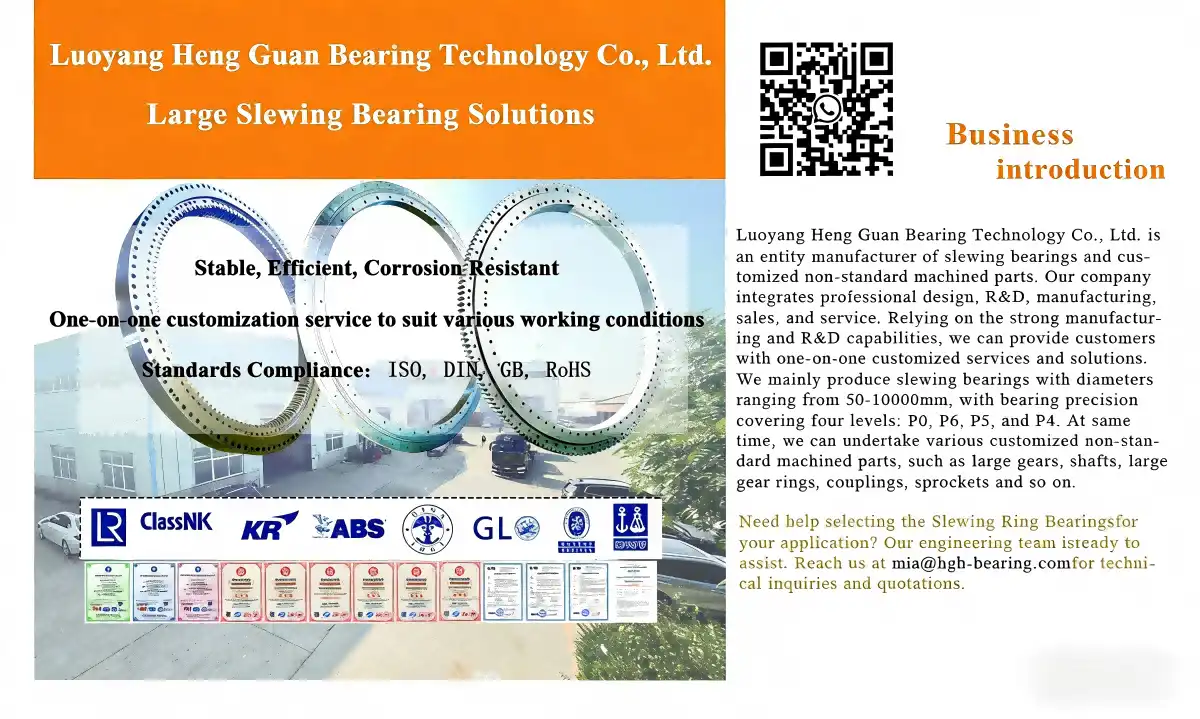
As a reliable company that makes Double Row Ball Slewing Bearing products for customers in the US, Germany, Australia, and more than 50 other countries, we offer quick expert help and low bulk prices that make our products a great value. Our research team at Luoyang Heng Guan Bearing Technology has more than 20 years of experience designing and making slewing rings, so they can help you with the problems your equipment is having. We know that solid bearing performance has a direct effect on how well your production runs and how much time your equipment is up and running. Our wide range of products includes diameters from 20mm to 10,000mm and includes precise grades from P0 to P4 to meet the most exacting needs in medical, aerospace, and automation applications. We also offer strong solutions for building, mining, and port machinery.
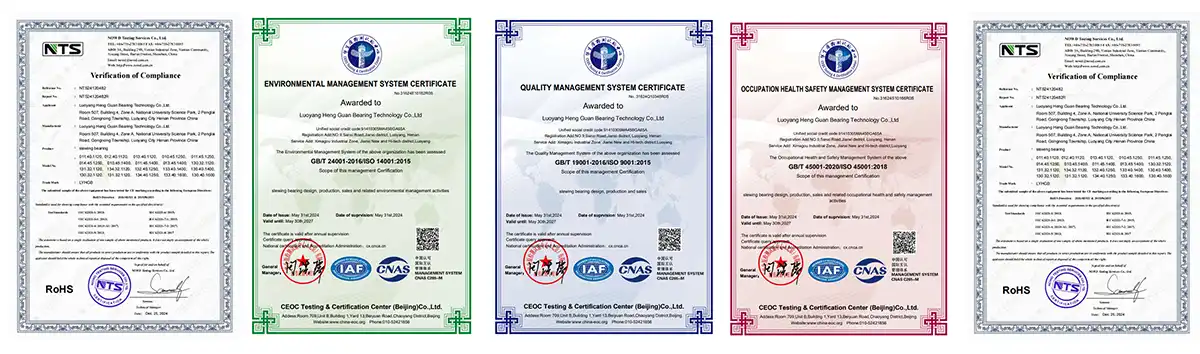
Advanced CNC vertical lathes, precision cutting tools, and specialized heat treatment systems are used in our factory to make sure that strict quality control is maintained throughout production. RoHS compliance and ISO 9001 approval make sure that products are always of high quality and are accepted by markets around the world. We offer full customization services, such as designing non-standard bearings, reverse engineering from samples that already exist, and unique tuning for specific uses. Whether you need standard setups or custom solutions for equipment that isn't common, our technical team works closely with you to come up with the best specs. Email our team at mia@hgb-bearing.com to talk about your unique needs, get detailed information, or get quotes for your next project.
References
1. Harris, T.A. & Kotzalas, M.N. (2006). Advanced Concepts of Bearing Technology: Rolling Bearing Analysis. CRC Press, Taylor & Francis Group.
2. Eschmann, P., Hasbargen, L. & Weigand, K. (1985). Ball and Roller Bearings: Theory, Design and Application. John Wiley & Sons, Inc.
3. American Bearing Manufacturers Association (2015). Slewing Ring Bearing Application, Specification and Technical Design Guide. ABMA Engineering Committee Publication.
4. Budynas, R.G. & Nisbett, J.K. (2011). Shigley's Mechanical Engineering Design. McGraw-Hill Education, Ninth Edition.
5. ISO 12043:2007. Rolling Bearings – Single Row Cylindrical Roller Bearings – Chamfer Dimensions for Loose Rib and Non-Rib Side Faces. International Organization for Standardization.
6. Wensing, J.A. (1998). On the Dynamics of Ball Bearings. PhD Thesis, University of Twente, Netherlands.

WHAT OUR CUSTOMERS SAY
Here is the customer's evaluation of us