



Triple-Row Roller Slewing Rings: Maximum Capacity Solutions
For heavy machinery, the slewing bearing is more than a rotating connection. It is a load-bearing component that transfers axial forces, radial forces, and overturning moments between the rotating and stationary structures. roller slewing rings with three roller rows are designed for applications where load capacity, structural stiffness, and compact installation are major priorities. Unlike many slewing bearings that are based on balls, the multi-row roller construction ensures line contact between the rolling elements and raceways. The rolling elements of the bearing enable the bearing to carry large loads with controlled rotation. Triple-row designs are therefore suited for large cranes, excavators, mining equipment, ship loaders, material handling systems, and other machinery exposed to complex load combinations. But the load capacity alone does not determine the proper bearing. The engineer must evaluate the load spectrum, the overturning moment, the rotation speed, the operating temperature, the pollution, the lubrication, the mounting stiffness, the bolt arrangement, and the predicted service circumstances. A correctly designed triple-row slewing ring will offer a sturdy solution, but its performance will depend on good design, manufacture, installation, and maintenance.
How a Three-Row Slewing Bearing Handles Heavy Loads?
Structural Configuration and Load Paths
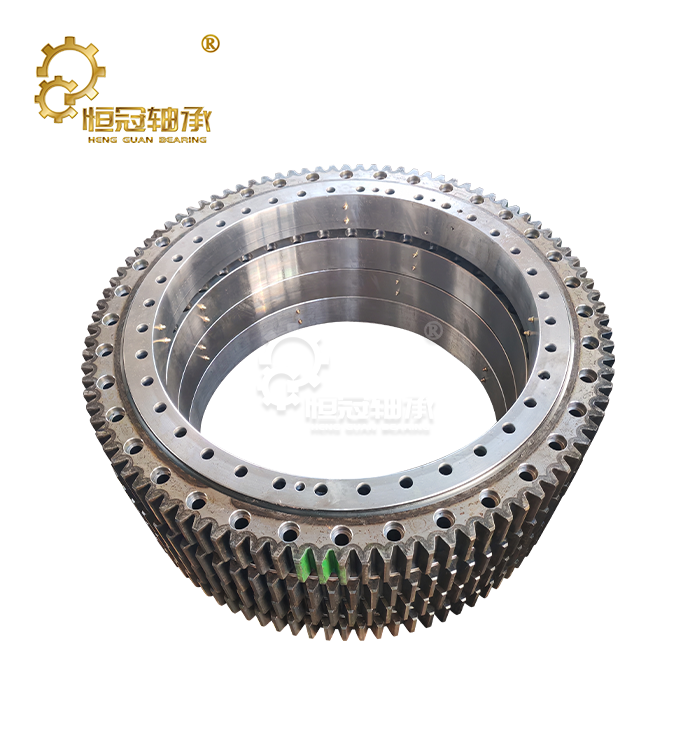
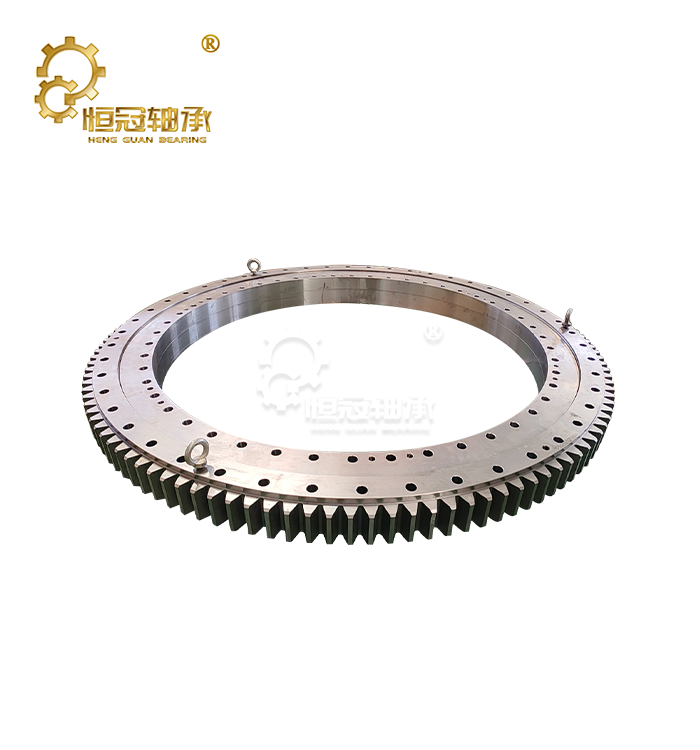
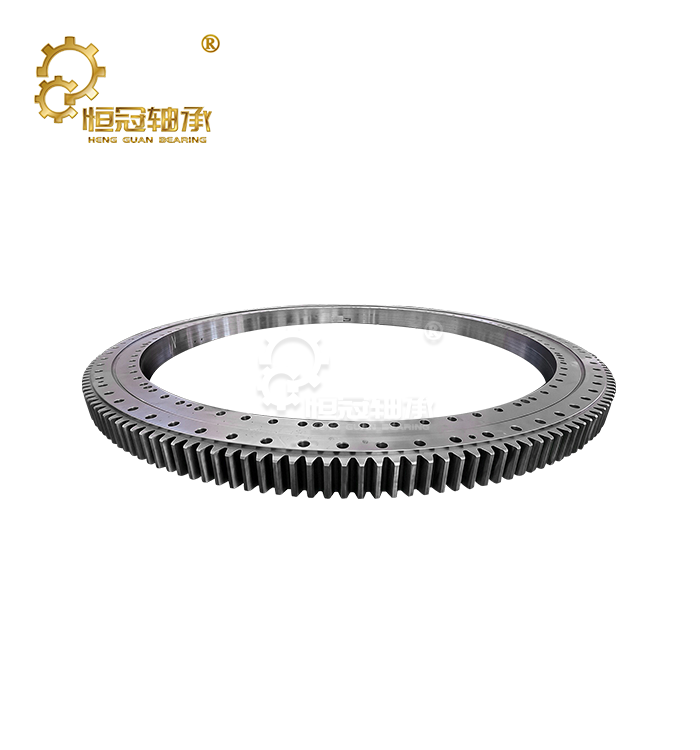
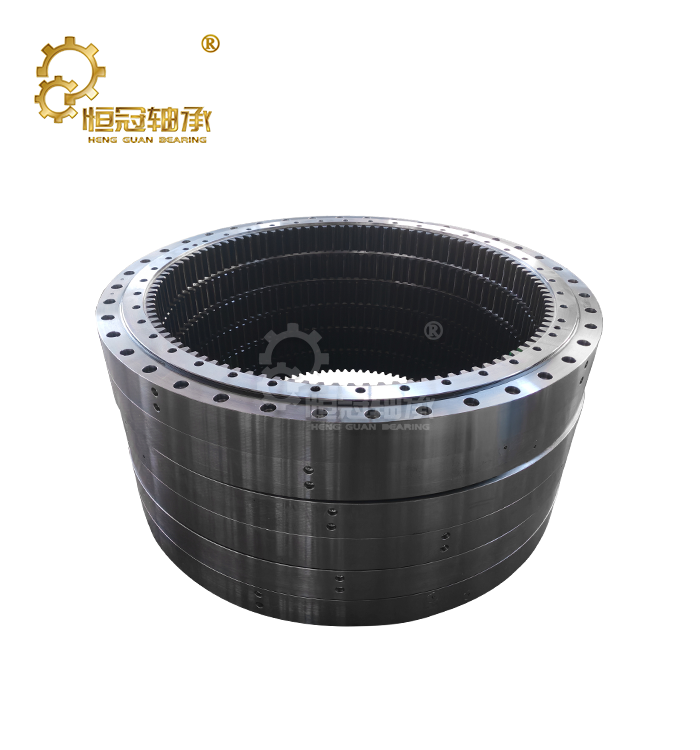
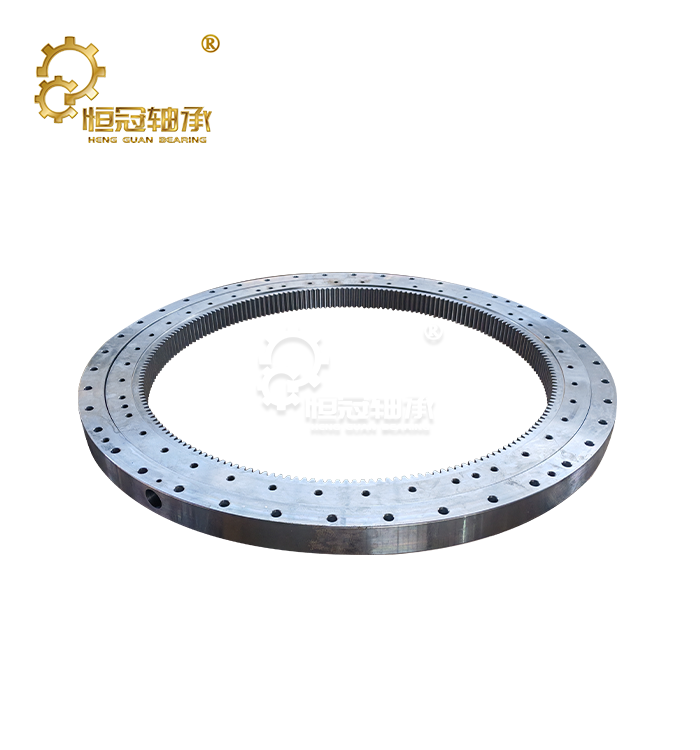
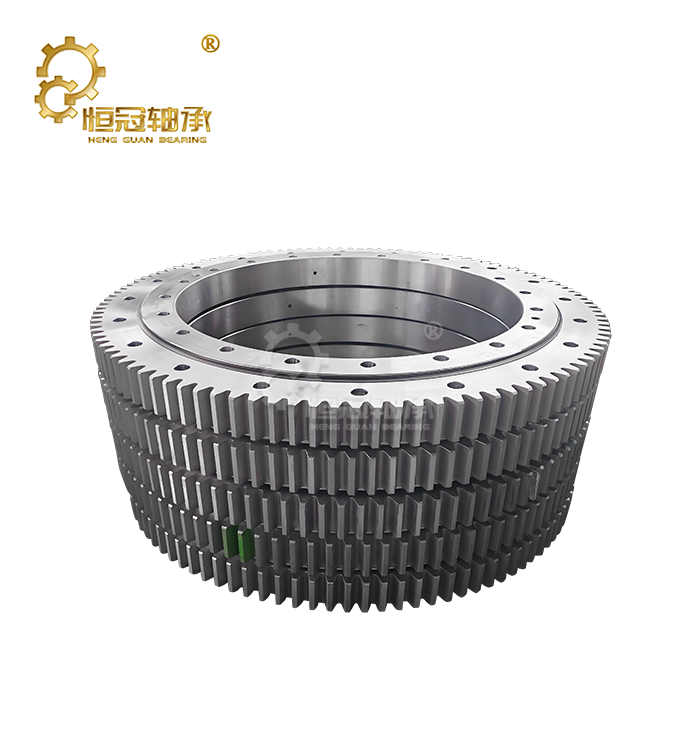
A triple-row roller slewing ring usually comprises an inner ring, an outer ring, three rows of rolling elements, spacers or separators as necessary, seals, and raceways according to the loading conditions envisaged. Depending on the application, cylindrical or other roller configurations can be used for the rolling parts.
The primary engineering benefit in this is that the rolling contacts are divided into several raceway configurations. The rollers have line contact with the raceways rather than concentrating the load through a restricted number of point connections. This can enhance the stiffness and spread the applied forces over a broader effective region of contact.
The three rows do not execute three isolated roles. Their combined geometry allows the bearing to respond to axial force, radial force, and overturning moment as a whole load system. The actual distribution relies on bearing geometry and the quantity and direction of the applied loads. Therefore, engineers should consider the entire load combination and not select a bearing purely on its nominal axial capacity.
Materials and Heat Treatment
Material selection directly affects raceway fatigue resistance, dimensional stability, and overall bearing durability. In general, large slewing rings are made from alloy or medium carbon steels selected according to bearing size, load requirements, heat-treatment procedure, and production standards.
For ring components, 50Mn and 42CrMo are suitable materials; and for rolling elements, bearing steels such as GCr15 can be considered if the characteristics are appropriate for the purpose. The ultimate material specification should be determined by the manufacturer based on the actual bearing design and not based on a broad product category.
Heat treatment is as vital. In the hardening of raceways, a correct balance must be struck between the surface hardness and the core toughness. A too-soft raceway might wear out or distort before its time, while an inadequate depth or method of hardening may lower the resistance to fatigue and fracture. Therefore, the heat-treatment procedure over the entire raceway is an important part of the production quality of large-diameter slewing rings.
Raceway Accuracy and Manufacturing Control
Large slewing rings need accurate control of raceway geometry, gear precision when an integrated gear is employed, mounting surfaces, bolt hole placements, and overall dimensional tolerances. This can be accomplished by combining CNC machining, controlled heat treating, grinding, and dimensional inspection for the desired geometry.
But the correct tolerance must always be related to the bearing design and application. A statement like “0.01 mm accuracy” is meaningless without a precise definition of measurement location, feature, tolerance class, and inspection procedure.
For OEM projects, the buyer should seek dimensional inspection records for important features. This record may help to check that the finished bearing is compatible with the mounting interface and reduce issues during assembly.
Where Triple-Row Roller Slewing Rings Provide the Most Value?
High Capacity and Structural Stiffness
Engineers are drawn to triple-row roller designs for a number of reasons, chief among them the capability to manage difficult combinations of axial, radial, and moment stresses. The line contact between rollers and raceways may provide a higher contact stiffness than a similar point contact configuration; however, the actual capacity relies on bearing design and operating conditions.
High rigidity is especially desirable when too much deflection could damage the precision or stability of the equipment. Cranes, excavators, and huge rotating platforms can encounter large overturning moments because the working load is generally positioned away from the slewing center. In these applications, bearing selection should be based on the vertical load and the distance from the load to the bearing center.
The bearing should consequently be assessed on the full load combination rather than a single maximum value.
Construction and Heavy Equipment
Large slewing bearings are often used in construction machines. Excavators, crawler cranes, drilling equipment, and other rotating machines can impose continuously varying loads on the bearing.
For example, an excavator does not work under a single fixed loading condition. Digging, lifting, swinging, and dumping can produce diverse combinations of axial force, radial force, and overturning moment. Thus, the slewing ring has to be selected according to the actual working cycle of the machine.
For cranes the position of the hoisted load is of special importance. As the working radius expands, a relatively minor lifted mass is capable of producing a significant overturning moment. The correct three-row roller design of roller slewing rings can give the requisite rigidity and load-carrying qualities for these severe working circumstances.
Mining and Material-Handling Machinery
Mining equipment often works under high loads, dust, vibration, and shock continually. For machines such as bucket wheel excavators, huge stackers, reclaimers, and heavy material-handling systems to operate stably under varying loads, large-diameter slewing bearings are required.
In these circumstances sealing and lubrication are as crucial as the base load rating. Fine dust, abrasive particles, and other contaminants can enter the bearing and harm the raceways and rolling elements. Therefore, the design stage should include a proper sealing system, appropriate grease, and a reasonable relubrication schedule.
Port, Marine, and Offshore Equipment
Container cranes, ship loaders, unloaders, and other marine material handling devices impose heavy demands on slewing bearings. These applications may be subject to humidity, salt attack, temperature variations, and limited access for maintenance in addition to mechanical loads.
Corrosion protection should be specified for the real environment. Surface treatments, paint systems, sealing arrangements, choice of grease, and material requirements may need to be changed for maritime or offshore duty.
The bearing should be described as more than just “corrosion resistant.” Instead, the maker and the consumer should describe the environmental conditions and agree on the suitable protective solution.
How Engineers Should Select a Triple-Row Slewing Ring?
Start With the Complete Load Spectrum
The first step in bearing selection is to collect the machine's actual loading information. Important parameters can include:
Maximum axial load
Radial load
Overturning moment
Static and dynamic operating conditions
Shock or impact loads
Rotation speed
Rotation direction and frequency
Duty cycle
Expected service life
Maximum loads alone may not provide enough information. A bearing operating under a moderate load for thousands of repeated cycles may experience a different fatigue condition from one exposed to occasional high-impact loading.
For this reason, engineers should provide the manufacturer with the machine's load spectrum whenever possible. The supplier can then use the information to evaluate bearing capacity, raceway contact conditions, bolt loads, and expected service performance.
Check Mounting and Interface Requirements
A high-capacity bearing cannot perform properly if the supporting structure is insufficient. The mounting flange must have adequate stiffness, flatness, and strength to prevent excessive deformation.
Engineers should check:
Bearing outside and inside diameter
Overall height
Mounting bolt pattern
Bolt diameter and grade
Gear dimensions if applicable
Mounting surface requirements
Clearance requirements
Adjacent structural components
The supporting structure is part of the load path. Excessive deformation in the machine frame can change the raceway loading distribution and negatively affect bearing performance even when the bearing itself has sufficient theoretical capacity.
Consider Operating Environment
Temperature, contamination, moisture, vibration, and corrosion all affect bearing selection.
For dusty mining equipment, sealing and lubrication deserve particular attention. For outdoor machinery, weather exposure and temperature variation may influence grease selection and seal material. For marine equipment, corrosion protection may require additional surface treatment.
NBR seals are common in industrial applications, but seal material and protection level should be specified according to the actual design. An IP rating should not be assigned automatically simply because a particular seal material is used. The complete sealing and housing arrangement must be evaluated if ingress protection is required.
Quality Control Before Delivery
Inspection Documents Buyers Should Request
For a high-value slewing ring, procurement should focus on traceability as well as price. Depending on project requirements, useful quality documents may include:
Material certificates
Heat-treatment records
Hardness inspection results
Dimensional inspection reports
Raceway inspection data
Gear accuracy reports
Non-destructive testing records where applicable
Final assembly inspection records
Product drawings and technical specifications
These documents provide evidence that the delivered roller slewing rings component matches the agreed technical requirements.
For critical applications, buyers should also establish acceptance criteria before production begins. This avoids disputes later about dimensional tolerances, material grades, gear accuracy, or inspection methods.
Manufacturing Capability Matters for Large Diameters
Large slewing rings are not simply scaled-up versions of small bearings. As diameter increases, machining accuracy, heat-treatment control, raceway geometry, handling, and inspection become increasingly important.
A manufacturer supplying large-diameter bearings should be able to explain how it controls these processes. CNC machining capacity, heat-treatment capability, inspection equipment, experienced engineering personnel, and traceable quality procedures are all useful indicators when evaluating a supplier.
For non-standard bearings, buyers should also ask whether the manufacturer can provide engineering support during the design stage instead of only manufacturing from a finished drawing.
Customization Options for OEM Applications
Engineering Changes That May Be Required
OEM equipment often cannot use an off-the-shelf bearing without modification. Depending on the machine, customization may involve:
Non-standard mounting dimensions
Special bolt-hole patterns
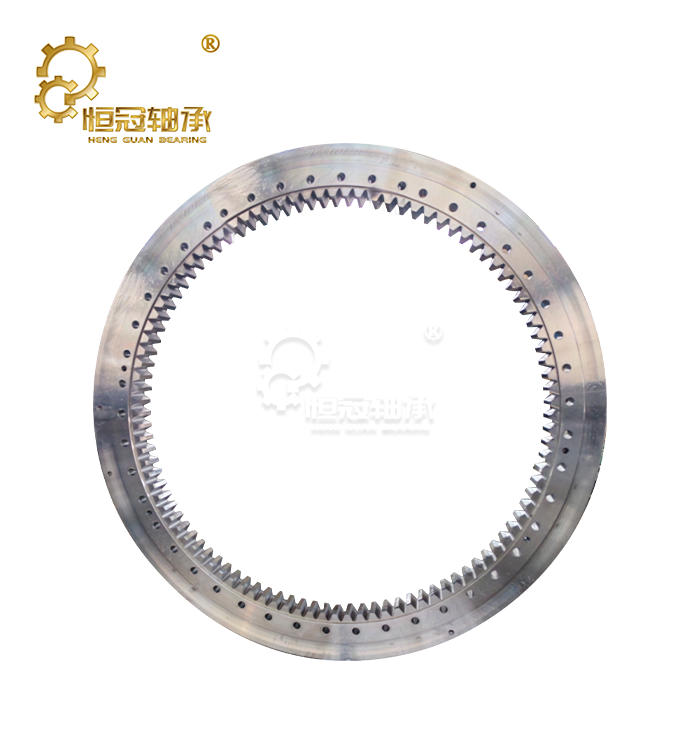
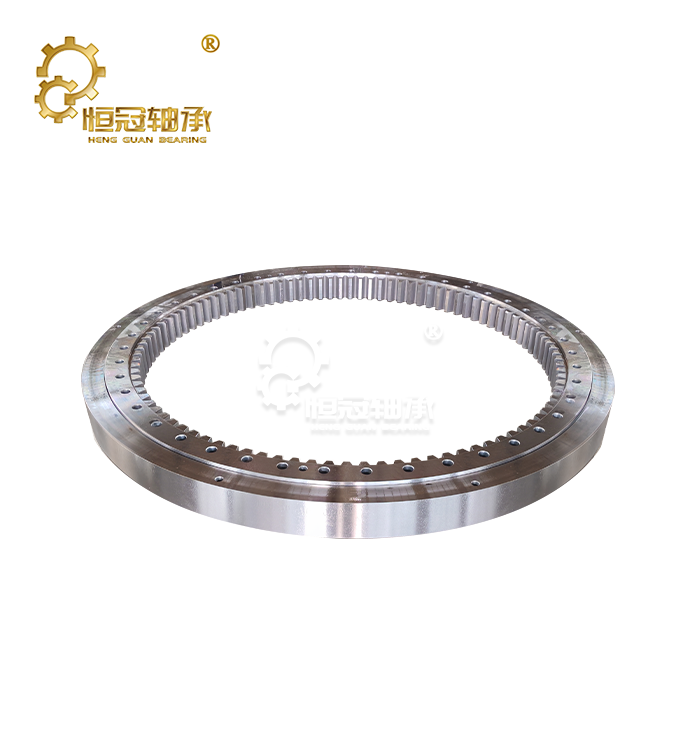
Internal or external gear arrangements
Modified gear modules
Different sealing systems
Alternative lubrication ports
Special surface protection
Customized internal clearances
These changes should be determined from the machine interface and operating conditions rather than added only to make the product appear more customized.
Technical Information to Provide a Supplier
The more complete the engineering information is at the beginning of a project, the easier it is to avoid repeated design revisions.
A useful inquiry package should include the general assembly drawing, mounting dimensions, load cases, rotation speed, operating temperature, environmental conditions, required service life, gear requirements, and applicable standards.
For a new machine, it is particularly helpful to involve the bearing supplier before the surrounding structure is finalized. This gives the engineering team an opportunity to review the bearing-to-structure interface and identify potential problems with bolt placement, flange stiffness, gear engagement, lubrication access, or installation clearance.
Procurement Strategies for Large Slewing Ring Projects
Compare Total Cost Instead of Unit Price Alone
The cheapest bearing is not necessarily the lowest-cost solution. Procurement teams should consider the total cost of ownership, including installation, lubrication, inspection, downtime, replacement, and potential production losses.
For equipment operating continuously, an unexpected slewing bearing failure can have a much greater financial impact than the initial difference between two purchase quotations.
A more useful comparison should therefore include technical specifications, expected service conditions, quality documentation, delivery capability, warranty terms, engineering support, and replacement support.
Plan Lead Times for Customized Designs
Custom slewing rings require more planning than standard products. Engineering review, drawing approval, material preparation, machining, heat treatment, inspection, assembly, and final testing can all affect delivery schedules.
The previously stated fixed lead time of “8 to 16 weeks” should not be presented as a universal promise. Actual lead time depends on diameter, design complexity, production schedule, material availability, inspection requirements, and order quantity.
For large OEM projects, procurement teams should confirm the production schedule with the supplier before placing the order and establish milestone dates for drawing approval, manufacturing, inspection, and shipment.
Evaluate the Supplier as a Long-Term Partner
For large or critical machines, supplier evaluation should go beyond a product catalog. Buyers should look for evidence of engineering competence and process control.
Questions worth asking include:
How are raceways inspected?
What heat-treatment process is used?
How are dimensional tolerances verified?
Can the supplier provide material traceability?
What load information is required for bearing selection?
Can the supplier support non-standard designs?
What inspection documents are included?
How are large bearings packaged for transportation?
What technical support is available after delivery?
Clear answers to these questions provide more useful evidence of supplier capability than generic claims about being “high quality” or “advanced.”
Conclusion
Triple-row roller slewing rings can be a strong solution for machinery that combines high axial loads, radial forces, and substantial overturning moments with demanding requirements for structural stiffness. Their multi-row roller arrangement provides a practical way to distribute loads through several raceway contacts, making them suitable for construction machinery, mining equipment, cranes, port machinery, and other large rotating systems.
However, maximum bearing capacity should never be considered in isolation. Proper selection requires a complete assessment of the machine's load spectrum, mounting structure, operating environment, rotation conditions, lubrication system, and expected service requirements. Material selection, heat treatment, raceway manufacturing, dimensional inspection, sealing, and installation quality all influence the final performance of the bearing.
For OEMs and industrial procurement teams, the most reliable approach is to work with a manufacturer that can support the project from technical specification through production and inspection. Providing accurate load data and interface drawings at an early stage allows the supplier to recommend an appropriate configuration instead of relying on generic bearing ratings. With proper engineering evaluation, quality control, and maintenance planning, triple-row roller slewing rings can provide the load-carrying capability and operational reliability required by demanding heavy-duty rotating equipment.
FAQ
1. What distinguishes triple-row from single-row roller slewing rings?
Triple-row configurations can handle much more weight because the load is spread out over three rows of rollers. This means that axial, radial, and moment loads can all be handled at the same time, which is not possible with single-row setups.
2. How do environmental conditions affect bearing selection?
Extreme temperatures, pollution, and corrosive environments can change the material that needs to be used and how it needs to be sealed. Our NBR seals offer IP65 protection, and special materials can handle temperatures from -40°C to +120°C.
3. What maintenance protocols optimize service life?
Regular lubrication through built-in ducts, tracking of vibrations and temperatures, and monitoring of vibrations all make predictive maintenance possible. If you follow the right upkeep steps, your service will last longer than 100,000 hours of normal use.
4. How do lead times vary for standard versus custom bearings?
Standard setups usually ship between 4 and 8 weeks, while custom options take between 8 and 16 weeks, based on how complicated they are. Early involvement in project planning makes sure that delivery times are in sync with plans for putting together tools.
Partner with Heng Guan for Premium Roller Slewing Ring Solutions
Heng Guan Bearing Technology makes roller slewing rings that are the best on the market. These rings are designed to work well and reliably in the toughest situations. Our manufacturing center in Luoyang has 20 years of specialized knowledge and high-tech production tools, so all of our products, from 500mm to 10,000mm in diameter, are of the highest quality. As a reliable roller slewing rings maker, we offer full customization services, precise technical support, and shipping all over the world, all of which make the buying process easier for you. Email our technical team at mia@hgb-bearing.com to talk about your unique needs and find out how our tried-and-true solutions can improve the performance of your tools while lowering the total cost of ownership.
References
1. Chen, M. (2023). "Advanced Load Distribution Analysis in Multi-Row Slewing Ring Bearings." International Journal of Mechanical Engineering Applications, Vol. 45, pp. 123-137.
2. Rodriguez, A. et al. (2022). "Comparative Performance Study of Roller versus Ball Slewing Bearings in Heavy Construction Equipment." Heavy Machinery Engineering Quarterly, Issue 3, pp. 89-104.
3. Thompson, R. (2023). "Materials Science Innovations in Large-Diameter Bearing Manufacturing." Industrial Bearing Technology Review, Vol. 18, pp. 45-62.
4. Liu, W. and Zhang, H. (2022). "Predictive Maintenance Strategies for Triple-Row Roller Slewing Rings in Wind Energy Applications." Renewable Energy Mechanical Systems, Vol. 12, pp. 78-95.
5. Anderson, K. (2023). "Quality Assurance Protocols in International Bearing Procurement." Global Industrial Supply Chain Management, Vol. 29, pp. 156-171.
6. Park, S. et al. (2022). "Industry 4.0 Integration in Heavy-Duty Bearing Systems: Current Trends and Future Prospects." Smart Manufacturing Technology, Vol. 8, pp. 234-249.

WHAT OUR CUSTOMERS SAY
Here is the customer's evaluation of us