




Slewing Bearing Customization for Cranes: Design and Selection Guide
Cranes rarely fit a one-size-fits-all bearing catalog, which is exactly why slewing bearing customization has become such a common request from crane manufacturers and heavy-lifting equipment builders. At Heng Guan Bearing, we regularly work with engineers who need a rotary support component tailored to a specific boom length, load class, or mounting footprint rather than a generic off-the-shelf part, with bore diameters from 50 mm up to 10,000 mm and cross-section heights from 20 mm up to 600 mm available through our standard scope. If you're exploring how to approach a Slewing Bearing Customization project, this guide walks through load planning, material and gear decisions, dimensional matching, and how to choose a manufacturer you can actually trust with a critical lifting component. Let's break down what matters most at each stage of the process.
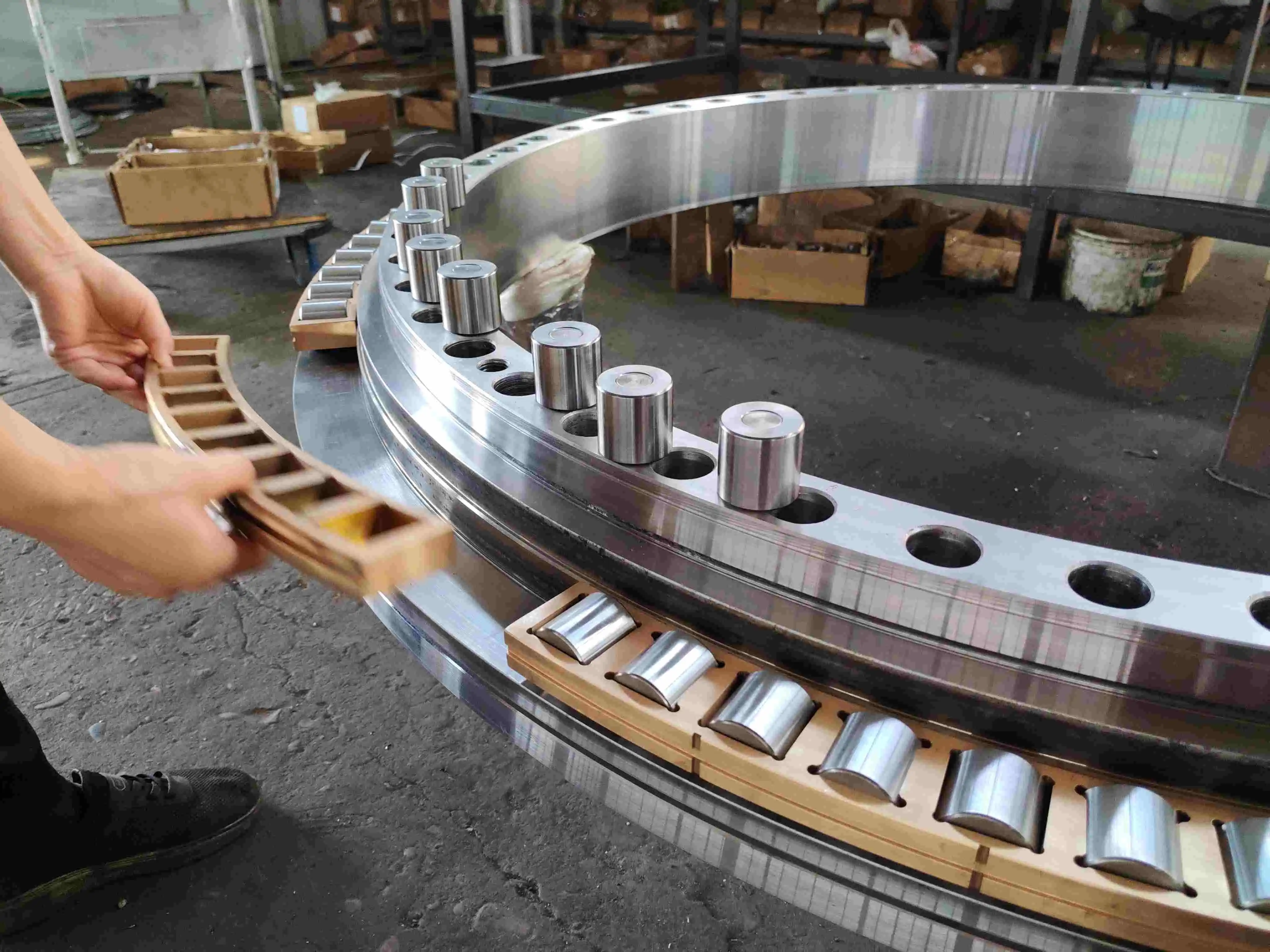
What Load Requirements Should Be Considered for Custom Slewing Bearing Design?
Before any drawing gets finalized, it's worth mapping out the full load case your crane will experience — not just the rated lifting capacity, but wind loading, boom self-weight, dynamic swing forces, and worst-case tipping moments. This is where Slewing Bearing Customize work really earns its value, since a custom slewing bearing engineered around your actual load spectrum performs far more reliably than one selected from a standard size chart.
If you're specifying a custom slewing bearing for a mobile or tower crane, it also helps to think through duty cycle: cranes that swing constantly through a shift need different fatigue margins than ones used occasionally for positioning. Many crane builders find that describing their intended lifting radius and cycle frequency upfront lets engineers narrow down raceway geometry and rolling-element size more accurately, which shortens the design loop considerably.
| Load Factor | Typical Source | Design Implication |
|---|---|---|
| Static axial | Boom self-weight, hoist load | Select Coa ≥ 1.5× envelope |
| Radial | Wind on boom, side pull | Match Cor to mid-cycle duty |
| Tilting moment | Maximum lift at radius | Compute Mt at full extension |
| Dynamic swing | Acceleration / deceleration | Add fatigue margin at ISO 281 |
| Thermal / wind | Outdoor + winter operation | Specify -40 to +80 °C envelope |
Slewing Bearing Customization: Material Selection, Gear Design, and Precision
Once the load needs are known, the choice of material and the design of the gear go hand in hand. For crane service, a custom slewing bearing is usually made of cast ring steel with carefully controlled induction hardening depth on the raceways. This is because the induction hardening depth directly affects how long the bearing lasts against cracking and wear after being lifted many times.
Heng Guan Bearing's standard range uses 50Mn or 42CrMo high-strength alloy steel for the rings and GCr15 precision-ground bearing steel for the rolling elements. NBR seals are used by default, but for outdoor crane applications, high-temperature, high-pressure, or specialty-environment seals can be made to order. The shape of the gear teeth is also very important. The module, the pressure angle (20° is normal), and the way the teeth are hardened must all be matched to the drive motor and gearbox, not picked separately.
You can choose between involute and cycloidal profiles. Our professional custom precision slewing bearing solutions can do just this kind of work. The tolerance grade (usually P0 through P4) is chosen based on how accurate the rotation needs to be for your slewing mechanism. Also, don't think that higher precision is always better; matching the precision grade to the real operating needs keeps costs low without lowering performance where it matters.
| Precision Grade | Typical Crane Use Case |
|---|---|
| P0 | General-purpose mobile cranes |
| P6 | Tower cranes with moderate swing accuracy needs |
| P5 / P4 | High-precision lifting or positioning equipment |
How Can Engineers Match Custom Slewing Bearings to Crane Mounting Dimensions?
Dimensional fit is typically the downfall of bespoke slewing bearing projects if not taken care of immediately. The bolt circle diameter, the number of bolt holes, the height of the ring, and the thickness of the lip must fit the crane's turntable or base construction. Small deviations might result in costly repairs as the assembly proceeds.
Heng Guan Bearing can operate with non-standard bolt patterns, carved fixing shoulders, custom flange profiles, and raceway shapes that can be altered, which may make the Slewing Bearing feasible. Drop-in solutions for existing housings need no adapter plates or frame adjustments. The mounting holes and the form of the seal may be highly different between two very similar-looking designs. You should be giving your bearing engineer comprehensive mounting drawings, not just the diameter.
Projects involving customized slewing bearings sometimes need a modification in the seal configuration to suit outside applications, since construction and port cranes must be able to withstand dust, wetness, and temperature variations not experienced by inside equipment. Reference sheets that compare typical crane bearing sizes may assist in narrowing down the alternatives before the final designs are sent back and forth.
| Crane Type | Typical Outer Diameter Range | Common Mounting Style |
|---|---|---|
| Mobile crane | 800–1,600 mm | Bolted flange, single row |
| Tower crane | 1,200–2,500 mm | Double-row ball, flanged |
| Port / gantry crane | 2,000–4,000 mm | Three-row roller, heavy flange |
| Crawler / ship-to-shore | 1,500–3,500 mm | Double-row ball or three-row roller |
How Do You Choose a Reliable Manufacturer for Slewing Bearing Customization Projects?
Choosing the right manufacturing partner is arguably the most important decision in a slewing bearing customization project, since design accuracy on paper means little without proper forging, heat treatment, and machining behind it. Heng Guan Bearing operates an ISO 9001-certified factory with 20+ years of bearing experience, 50+ dedicated engineers, and in-house equipment including CNC vertical lathes for large diameters, CNC quenching machines, CNC gear-shaping and large gear-hobbing centers, machining centers, precision grinders, CMM dimensional inspection, hardness testing, roughness measurement, and pre-delivery functional test stands — so the entire process from raw forging to final run-out verification stays under one roof.
It's reasonable to ask potential suppliers for material certificates, hardness test reports, and sample lead times before committing to a full production order; our professional custom precision slewing bearing solutions are backed by in-house design review, which tends to catch fit or tolerance issues before they become expensive field problems. If your project timeline is tight, ask early about prototype or trial-batch options rather than committing straight to full-volume production. Our team at mia@hgb-bearing.com regularly supports crane manufacturers through exactly this evaluation process, sharing test documentation and prior project references so buyers can compare suppliers on more than just price.
| Verification Item | Why It Matters for a Custom Slewing Bearing |
|---|---|
| Material certificates (50Mn / 42CrMo) | Confirms alloy and heat-treatment pedigree |
| In-house heat treatment | Ensures raceway hardness consistency |
| CMM dimensional inspection | Validates mounting-fit before shipment |
| Custom flange / bolt-pattern capability | Confirms the bearing fits the existing housing |
| Prototype / trial-batch option | De-risks design before full production commitment |
| Documented export experience | Supports long-term repeat-order partnership across 50+ countries |
Conclusion
Custom slewing bearing design for cranes depends on accurate load analysis, sound material choices, and precise dimensional matching. Heng Guan Bearing is ready to support your next slewing bearing customization project from concept through delivery, with professional custom precision slewing bearing solutions that combine engineering review, in-house manufacturing, and a single point of contact from quotation to commissioning.
FAQ
Q1: Why can't a standard slewing bearing always work for crane applications?
A: Cranes often have unique load, mounting, or precision needs that standard catalog bearings aren't optimized for, especially when boom length or rated capacity falls between standard sizes.
Q2: What information should I provide for a custom slewing bearing quote?
A: Load data (axial, radial, tilting moment), full mounting drawings, duty cycle, working temperature range, and environmental exposure help engineers scope the design accurately.
Q3: Does higher precision grade always mean better performance?
A: Not necessarily — precision should match your rotational accuracy needs (P0 for general mobile cranes, P5/P4 for high-precision positioning) rather than defaulting to the highest grade available.
Q4: How long does slewing bearing customization typically take?
A: Custom development projects typically ship 2–4 weeks after final design approval, with rush service available for tight project timelines and prototype or trial-batch options to shorten the path to full production.
Q5: Can Heng Guan Bearing support outdoor crane applications?
A: Yes — sealing (high-temperature / high-pressure / custom environment), material choices (50Mn / 42CrMo standard, with corrosion-resistant options), and surface treatment can all be adapted for construction, port, or exposed outdoor environments operating from -40 °C up to +80 °C.
Q6: Can Heng Guan Bearing handle projects without complete 3D drawings?
A: Yes — HGB accepts reverse-engineering and on-site measurement assignments, so buyers without original drawings can still get a fully dimensioned custom slewing bearing quote through our One-to-one Customization service.
Ready to Start Your Custom Slewing Bearing Project?
If your crane project needs a tailored rotary solution, Heng Guan Bearing's engineering team is ready to help. Email mia@hgb-bearing.com with your load and mounting details, and let's design a custom Slewing Bearing Customize solution built specifically for your crane.
References
1. International Organization for Standardization. ISO 76:2006 — Rolling Bearings: Static Load Ratings.
2. International Organization for Standardization. ISO 281:2007 — Rolling Bearings: Dynamic Load Ratings and Rating Life.
3. American Bearing Manufacturers Association. ANSI/ABMA STD 26.2-2014 — Load Ratings for Slewing Ring Bearings.
4. International Organization for Standardization. ISO 1328-1:2013 — Cylindrical Gears: ISO System of Flank Tolerance Classification.
5. Deutsches Institut für Normung. DIN 3967 — Cylindrical Gears: Root Diameter and Tooth Thickness Tolerances.
6. Harris, T. A., & Kotzalas, M. N. (2006). Rolling Bearing Analysis (5th ed.). CRC Press.

WHAT OUR CUSTOMERS SAY
Here is the customer's evaluation of us