




How to Select the Right Crossed Roller Internal Gear Bearing for Robotics?
Choosing the right rotational component can make or break a robotic joint's performance, and this is exactly why engineers spend so much time evaluating a crossed roller internal gear bearing before finalizing a design. At Heng Guan Bearing, we work with robotics manufacturers who need compact, rigid, and precise rotary support for articulated arms, rotary tables, and automated platforms. If you're wondering how to narrow down the right bearing for your application, this guide walks through the load considerations, dimensional matching, mounting practices, and supplier verification steps that matter most. Let's take a closer look at what separates a well-chosen bearing from one that causes downtime later on.
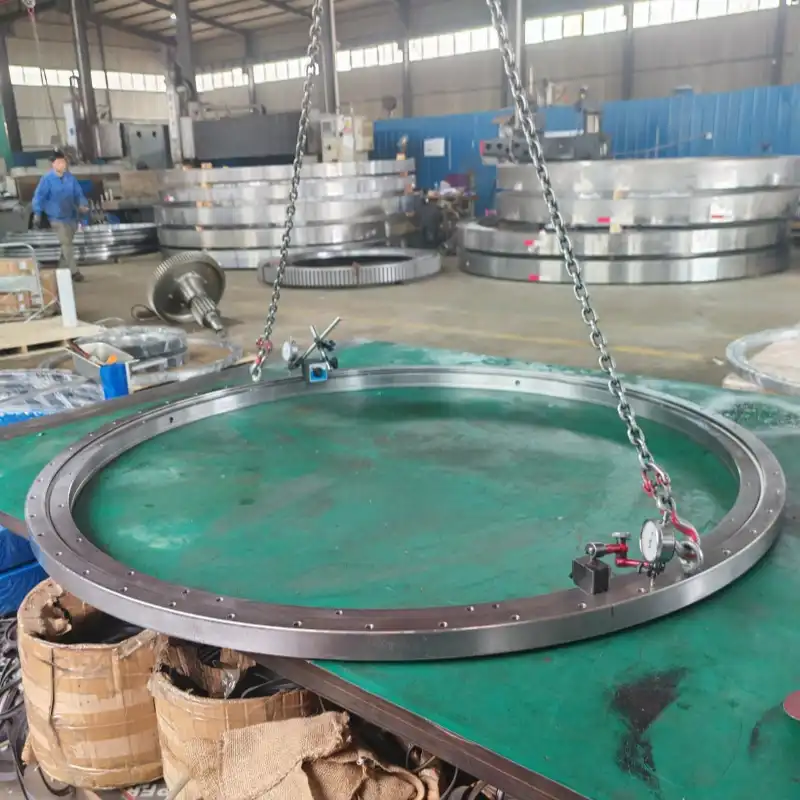
What Load Requirements Matter When Selecting a Crossed Roller Internal Gear Bearing?
What kind of loads will your joint actually be under in service? That's the first thing that should be done. Because the rollers in a crossed roller internal gear bearing sit at different 90-degree angles, it can handle axial loads, rotational loads, and twisting moments all at the same time. This is why robot designers prefer them to stacked bearing setups.
The 07-series single-row crossed cylinder roller design from Heng Guan Bearing is about three to four times stiffer than four-point contact ball slewing rings of the same size. This is because line contact on the roller track spreads stress over a much larger area. If the motion starts and stops a lot or goes in the opposite direction, you should size the bearing for high dynamic loads instead of normal ones.
You should also check your torque and speed needs against standard designs like the Rollix crossed roller slewing ring internal gear class, which has been used for a long time as a standard for medium to heavy robotic and rotary-table tasks. Also, don't forget about shock loading. If the load rating was set too low, sudden impacts during pick-and-place cycles can shorten the life of the bearings.
| Load Factor | Why It Matters for Robotic Joints | Sizing Approach |
|---|---|---|
| Static axial load | Supports cantilevered arm weight | Choose Coa ≥ 1.5× static envelope |
| Radial load | Carries tool or gripper reaction | Match Cor to mid-cycle duty |
| Tilting moment | Most critical for long-reach arms | Use Mt rating, not just axial |
| Dynamic peak | Starts / stops / shock | Rate against peak, not average |
| Cycle frequency | Affects L10 life at ISO 281 | Compute L10h at actual rpm |
How Do You Match Bearing Dimensions and Gear Specifications to Robotic Joints?
After deciding on the load requirements, the next step is to line up the joint's mechanical envelope with the bore diameter, outer diameter, section height, and gear module. It is very common for a crossed roller internal gear bearing to need to be re-sourced in the middle of a project because of this mistake. To avoid this, make sure that the tooth count, module, and pitch circle diameter are correct for your drive motor and reduction stage as soon as possible.
The 07-series from Heng Guan Bearing has raceway center diameters ranging from 500 mm to 2,800 mm, internal gear modules from M5 to M18, involute tooth profiles at a standard 20° pressure angle, and tooth-surface hardness 52–58 HRC after CNC gear shaping. This means that you can choose the geometry that fits your reduction ratio without giving up envelope space. A lot of robotics teams use specifications for pelletizer slewing ring internal gears when moving from light-duty robots to heavier industrial arms.
This is because the rigid-mounting principles and tooth-load relationships work well in all situations. The 07-0673-00 medium-pelletizer configuration is often picked as a link between collaborative robot joints and full-size industrial shoulders because it has already been used to handle continuous duty in plastics processing. Here is a review of three common 07-series sizes that are used in robots, granulators, and naval platforms.
| Model | ID (mm) | OD (mm) | HT (mm) | Typical Application |
|---|---|---|---|---|
| 07-0673-00 | 541 | 771 | 70 | Medium pelletizer / heavy robot shoulder |
| 07-0770-00 | 635 | 872 | 70 | Medium universal heavy-duty platform |
| 07-1075-01 | 962 | 1,176 | 90 | Large marine / ship-crane flagship |
If you're unsure which class fits your torque and precision targets, it's worth asking your supplier to walk through the calculation rather than guessing from a catalog alone.
Crossed Roller Internal Gear Bearing Mounting, Lubrication, and Service Life
How a crossed roller internal gear bearing is mounted has almost as much influence on performance as the bearing selection itself. Flatness of the mating surfaces, correct bolt torque sequencing, and proper preload all affect running accuracy, so it's best to follow the manufacturer's mounting sequence rather than treating it as a generic bolt-on part.
Heng Guan Bearing's 07-series uses zero-clearance negative preload established by precision-ground spacer rings, with integrated double-lip NBR contact seals and grease nipples on the outer ring for on-site regreasing without disassembly — operators can top up through the lubrication points and visually inspect the seal lip without pulling the bearing. Lubrication schedules matter more in robotics than people often expect, since duty cycles tend to be continuous and repetitive rather than intermittent.
Grease intervals used for a pelletizer slewing ring internal gear in a plastics-processing line, for example, can offer a useful starting reference for high-cycle robotic joints, though actual intervals should be adjusted for ambient temperature and rotation speed. For buyers weighing options, our team at mia@hgb-bearing.com regularly helps customers work out realistic lubrication intervals based on their specific duty cycle, which tends to extend service life meaningfully compared with using default catalog values.
| Maintenance Item | Recommended Practice | Interval |
|---|---|---|
| Grease replenishment | Lithium EP2 via outer-ring nipple | Every 250–500 operating hours |
| Bolt torque re-check | Star pattern, 30% / 70% / 100% | After first 50 h, then quarterly |
| Seal inspection | Check NBR lip for damage | Monthly |
| Runout / play check | Indicator on outer ring | Quarterly |
| Full raceway inspection | Visual + hardness spot-check | Annually or every 5,000 h |
How Can Buyers Verify Crossed Roller Internal Gear Bearing Quality and Supplier Support?
With so many suppliers offering seemingly similar specifications on paper, it's worth digging into how a crossed roller internal gear bearing is actually manufactured and tested before committing to an order. Ask about heat treatment records, raceway hardness testing (HRC 55–62 induction hardening is the HGB baseline), and runout inspection reports — these details reveal more about long-term reliability than a spec sheet alone.
It's also reasonable to request sample data or references from prior robotics or automation projects, since a supplier familiar with tight-tolerance work will usually have this on hand. Heng Guan Bearing operates an ISO 9001-certified, RoHS-compliant factory, performs CMM dimensional inspection plus vibration and raceway-hardness verification on every 07-series unit, and can issue a Factory Acceptance Test (FAT) report for critical applications, with gear-shape inspection on CNC shapers to limit tooth-side play.
For buyers comparing against an incumbent Rollix crossed roller slewing ring internal gear reference, Heng Guan Bearing's 07-series is dimensionally interchangeable on the same bore/OD/HT envelope with CNC-shaped internal gearing that matches the involute 20° profile, and is qualified on heavy robot shoulder joints where the Rollix crossed roller slewing ring internal gear class has historically set the benchmark. The table below outlines the verification points most commonly requested during supplier qualification.
| Verification Item | Why It Matters |
|---|---|
| Material certification (42CrMo / 50Mn) | Confirms alloy and heat treatment consistency |
| Raceway hardness report (55–62 HRC) | Validates wear-resistance claim |
| Runout / precision test report | Confirms rotational accuracy vs. spec |
| Tooth-shape inspection (CNC shaper) | Limits gear backlash and side play |
| Sample or trial order availability | Reduces risk before full production commitment |
| FAT report on request | Required for critical robotics / radar applications |
Heng Guan Bearing provides documentation and sample support for exactly these reasons, and our engineers are happy to walk buyers through test reports before an order is placed.
Conclusion
Selecting the right crossed roller internal gear bearing comes down to matching load, dimensions, mounting practice, and supplier transparency. Heng Guan Bearing is ready to help you choose confidently — reach out and let's build your next robotic joint on a solid foundation.
FAQ
Q1: What makes a crossed roller internal gear bearing different from a standard bearing?
A: It combines crossed cylindrical rollers at 90° with internal gearing in one compact unit, supporting multi-directional loads while also transmitting rotary drive, with line-contact rigidity 3–4× higher than ball slewing rings.
Q2: Can these bearings handle heavy industrial robots, not just small ones?
A: Yes — the 07-series covers bore sizes from 541 mm to 962 mm and beyond (up to 2,800+ mm raceway diameter), with internal-gear modules M5–M18 and involute profiles at 20° pressure angle, suitable for heavy joints.
Q3: How often should lubrication be checked in robotic applications?
A: Intervals vary by duty cycle and speed; continuous-use robots typically need more frequent checks than intermittent industrial equipment — HGB typically recommends grease replenishment every 250–500 operating hours with bolt re-torque after the first 50 hours.
Q4: Is a pelletizer slewing ring internal gear relevant to robotics buyers?
A: Yes, it's a useful reference point for high-load, continuous-duty gearing behavior — the 07-0673-00 medium pelletizer model shares the same 70 mm section height and internal-gear design philosophy used in heavy robot shoulders.
Q5: What should I ask a supplier before ordering?
A: Request material certification (42CrMo / 50Mn), precision test reports, gear-shape inspection data, runout reports, and sample availability before committing to full production quantities.
Q6: What is the typical lead time for a crossed roller internal gear bearing?
A: Heng Guan Bearing ships standard 07-series models (such as 07-0673-00 and 07-0770-00) in 15–20 days, while custom configurations with non-standard diameters, modified bolt patterns, or upgraded FKM seals require 35–45 days, including engineering review and FAT.
Ready to Choose the Right Bearing for Your Robotics Project?
Still weighing your options? Heng Guan Bearing's engineering team can review your load and dimension requirements and recommend the right crossed roller internal gear bearing for your build, with 1:1 dimensional compatibility against common imported references so an upgrade can drop into existing housings. Email us at mia@hgb-bearing.com to start the conversation today.
References
1. International Organization for Standardization. ISO 76:2006 — Rolling Bearings: Static Load Ratings.
2. International Organization for Standardization. ISO 281:2007 — Rolling Bearings: Dynamic Load Ratings and Rating Life.
3. International Organization for Standardization. ISO 1328-1:2013 — Cylindrical Gears: ISO System of Flank Tolerance Classification.
4. American Bearing Manufacturers Association. ANSI/ABMA STD 26.2-2014 — Load Ratings for Slewing Ring Bearings.
5. Deutsches Institut für Normung. DIN 3967 — Cylindrical Gears: Root Diameter and Tooth Thickness Tolerances.
6. Harris, T. A., & Kotzalas, M. N. (2006). Rolling Bearing Analysis (5th ed.). CRC Press.

WHAT OUR CUSTOMERS SAY
Here is the customer's evaluation of us