




What Makes Four-Point Contact Ball Slewing Bearings Reliable?
Reliability is the whole point of a slewing bearing, and few designs deliver it as consistently as the four-point contact configuration. At Heng Guan Bearing, we hear this question often from customers in construction, automation, and material handling: why do Four-Point Contact Ball Slewing Bearings hold up so well under mixed loading conditions compared with other bearing types? If you're evaluating this bearing style for your next project, this guide walks through the design features, sealing and lubrication practices, mounting accuracy, and maintenance habits that keep these bearings running smoothly for years. Let's look at what actually drives that reliability.
|
|
How Does Four-Point Contact Ball Slewing Bearing Design Support Combined Loads?
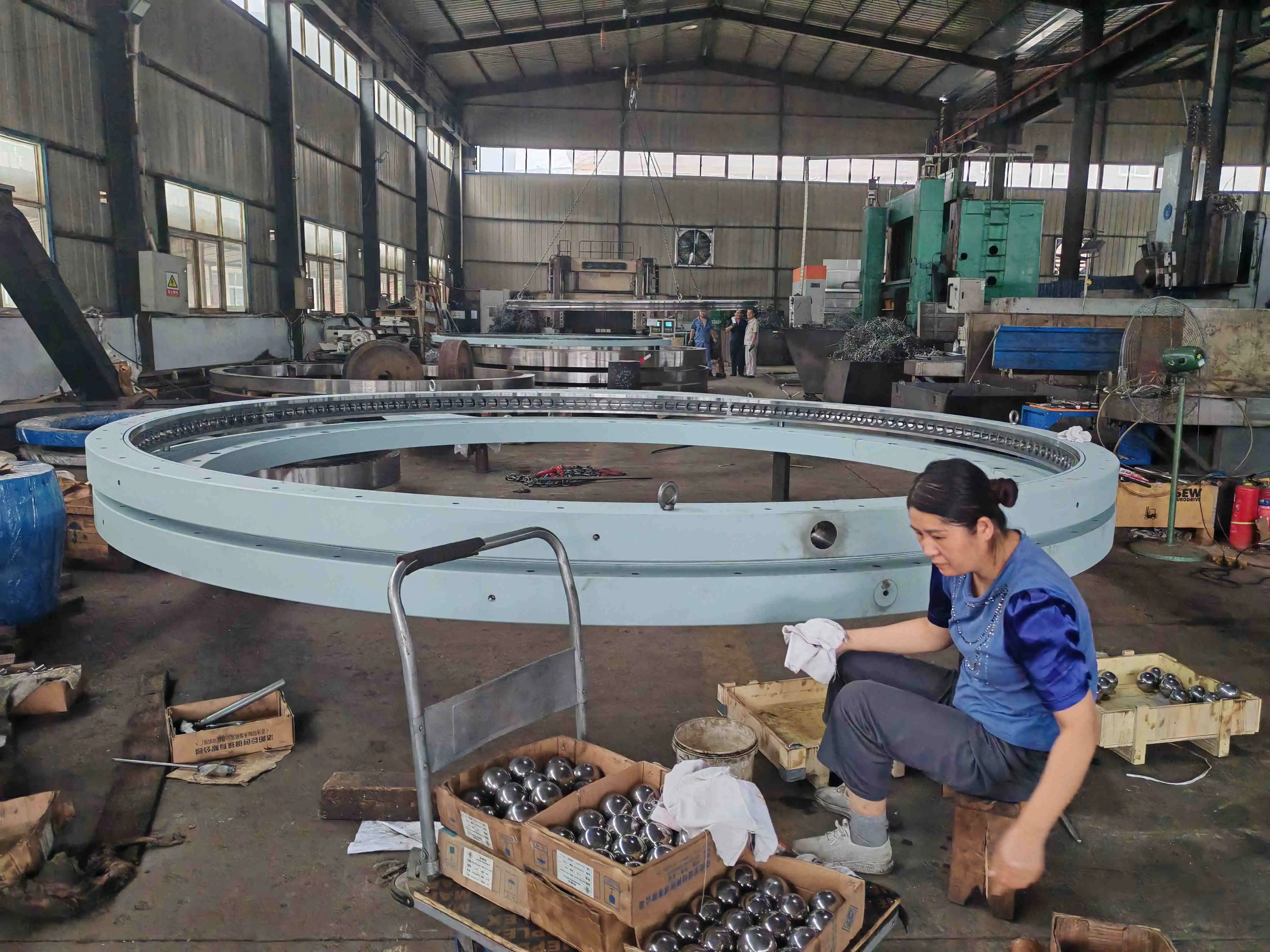
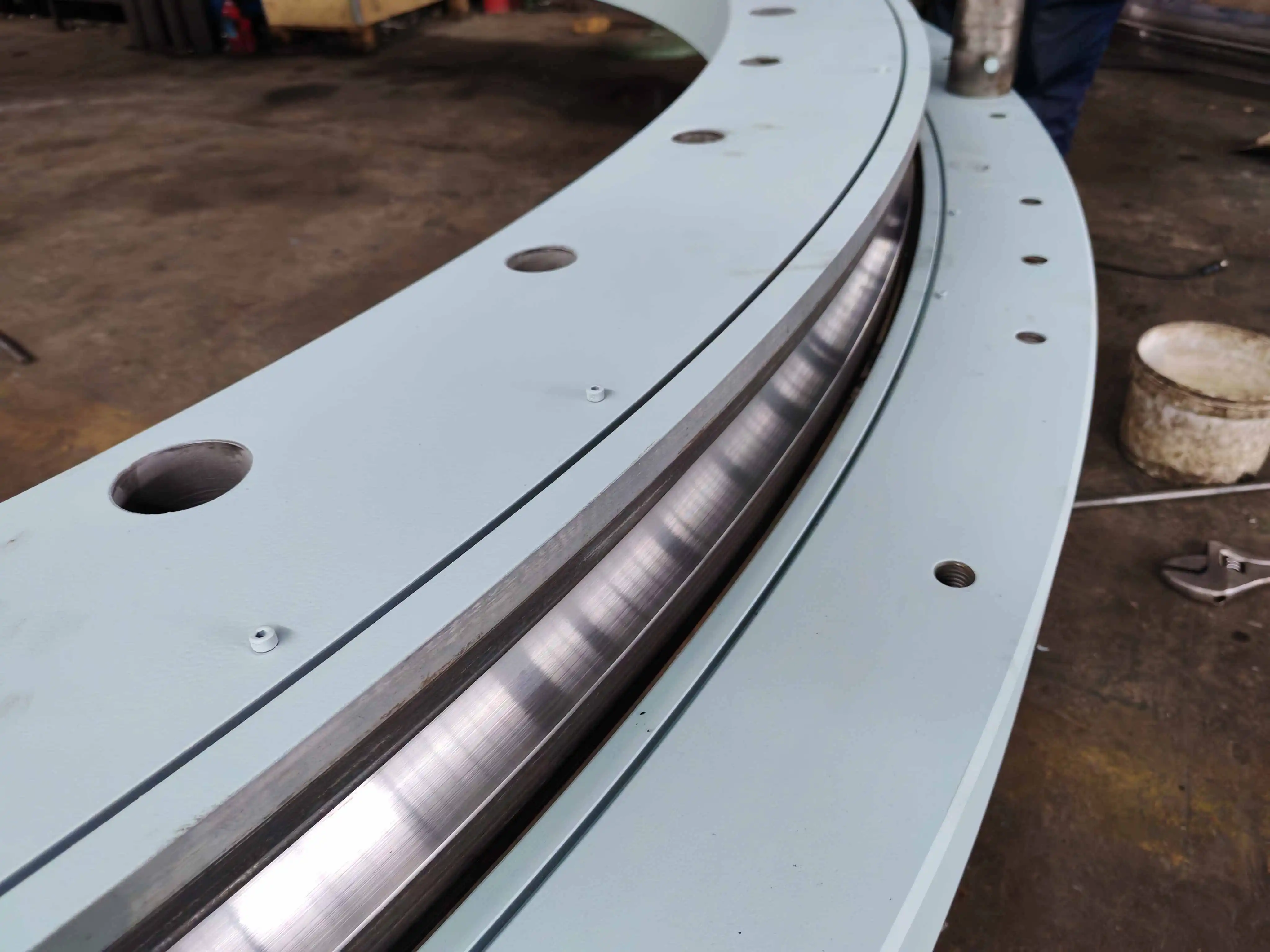
Four-point contact ball slewing bearings are characterized by a special raceway geometry. Instead of two points of contact, each ball is in touch with the raceway at four locations. This means that a single row may take up axial loads, radial loads, and tilting moments at the same time. This is a big reason why engineers turn to this design when space is tight, yet coupled loads must be avoided, such as in slewing platforms, rotating tables, and construction equipment turrets. Heng Guan Bearing’s four-point contact range is available with bore diameters from 100 mm to 4,000 mm, outer diameters from 150 mm to 4,500 mm, and section heights from 25 mm to 200 mm – with special diameters up to 10 meters for specific applications such as ship-to-shore cranes, large wind turbine nacelles, and radar platforms.
The contact angle is set by geometry rather than merely preload; therefore, the bearing tends to be constant in stiffness in different directions of load, which is important when equipment is cycling regularly between lift, rotate, and hold positions. If you are considering other structural options for a new design, note that many Four-point contact ball slewing bearing suppliers offer single-row configurations precisely because they balance load capacity in space-constrained applications against a compact cross-section better than multi-row options, and that experienced Four-point contact ball slewing bearing suppliers will typically have on-hand models that meet common bolt-circle and section-height standards, rather than requiring a fully custom design.
| Load Direction | How the 4-Point Contact Geometry Handles It | Typical Equipment |
|---|---|---|
| Axial load | Two contact points share the vertical force | Crane boom, hoist support |
| Radial load | Two contact points on the opposite sidewall | Side-pull, wind on structure |
| Tilting moment | All four points engage simultaneously | Long-reach arm, radar pedestal |
| Combined cycle | Stiffness remains consistent across load mix | Turret, slewing excavator |
What Role Do Lubrication and Sealing Play in Bearing Reliability?
Even the best raceway design will not operate consistently without adequate lubrication and sealing. It is typically here that field problems really begin, not in the bearing geometry itself. You need to take into consideration the range of working temperatures, the speed of rotation, and the frequency of exposure to dust or moisture when selecting grease. The entry of contaminants is one of the most prevalent reasons for premature wear in slewing applications.
Heng Guan Bearing recommends that greasing be done every 250 operating hours under normal duty, and more frequently under high-pressure or high-stress conditions; new grease should be pumped up to the seal lip, with the bearing rotating slowly; and several standard models feature M10×1 grease-fitting ports for ease of on-site regreasing without dismantling. Sealing lip design and material are more important than people sometimes realize.
A wrong seal might allow grit in even when the lubrication intervals are followed properly. Many customers sourcing overseas ask our staff at mia@hgb-bearing.com about which grease types and seal configurations are suited to certain regions. Matching these parameters to your operational environment tends to add substantial years to service life.
| Operating Environment | Recommended Grease / Seal Configuration |
|---|---|
| Dry, indoor automation | Standard lithium-based grease, single-lip nitrile seal |
| Outdoor construction | Extreme-temperature grease, double-lip nitrile seal |
| Marine / port equipment | Corrosion-resistant grease, reinforced fluororubber (FKM) seal |
Four-Point Contact Ball Slewing Bearings: Mounting Accuracy and Load Distribution
Mounting accuracy plays a bigger role in reliability than many buyers expect, since even a well-manufactured Four-Point Contact Ball Slewing Bearing unit can wear unevenly if the supporting structure isn't flat or rigid enough. Uneven mounting surfaces create localized stress points, which concentrate load on a portion of the raceway rather than distributing it evenly across all the balls, shortening effective service life regardless of how good the bearing itself is.
Heng Guan Bearing's standard catalog of more than 30 ready-to-ship sizes — from 010.20.200 (Da 280, Di 120, H 60, 20 kg) through 010.75.4500 (Da 4,726, Di 4,272, H 174, 4,000 kg) — specifies the outer- and inner-ring bolt-circle diameters, hole counts, and bolt sizes so the mating structure can be machined to a matching flatness tolerance before installation. It's generally recommended to check flatness tolerance on the mating structure before installation and to follow the manufacturer's recommended bolt tightening sequence, since uneven bolt torque can quietly reproduce the same problem a warped surface would cause.
Reputable Four-point contact ball slewing bearing suppliers typically provide mounting torque specifications and flatness tolerances alongside the bearing drawing, and following these closely is one of the simplest ways to protect your investment from day one.
| Mounting Factor | Why It Affects Reliability |
|---|---|
| Surface flatness | Prevents uneven load concentration on raceway |
| Bolt tightening sequence | Maintains uniform preload distribution |
| Correct bolt torque value | Avoids loosening or localized deformation |
| Bolt-hole pattern match | Confirms mounting interface before assembly |
How Can Proper Maintenance Extend Four-Point Contact Ball Slewing Bearing Life?
Maintenance habits ultimately determine whether a well-selected Four-Point Contact Ball Slewing Bearing unit reaches its full expected lifespan or falls short of it. Routine grease replenishment on schedule, periodic inspection of seal condition, and monitoring for unusual noise or rotational resistance are all practical steps that catch developing issues before they become costly failures.
It's also worth tracking operating hours or cycle counts where possible, since this data helps justify adjusting maintenance intervals proactively rather than reactively — for example, shortening the 250-hour baseline interval when the bearing runs in port sandstorms or continuous concrete-pump cycles, and lengthening it for indoor clean-room applications such as radar pedestals or medical imaging tables.
Heng Guan Bearing encourages customers to treat maintenance scheduling as part of the original bearing selection conversation, not an afterthought, since Four-Point Contact Ball Slewing Bearings that receive consistent care routinely outperform their rated service life expectations in real-world use. The table below summarizes practical intervals that align with how these bearings are typically deployed in the field.
| Maintenance Item | Recommended Interval | What to Check |
|---|---|---|
| Grease replenishment | Every 250 h (normal); shorten for harsh duty | Pump fresh grease until it appears at the seal lip |
| Bolt torque re-check | After first 50 h, then quarterly | Use star pattern, restore to spec value |
| Seal lip inspection | Monthly | Look for cracks, hardening, or contamination ingress |
| Operating-noise check | Continuous monitoring | Investigate any new rumble or irregular resistance |
| Full disassembly inspection | Annually or every 5,000 h | Raceway, rolling elements, gear-mesh condition |
Conclusion
Reliability in Four-Point Contact Ball Slewing Bearings comes from sound design, proper sealing, accurate mounting, and consistent maintenance. Heng Guan Bearing is ready to help you get all four right — from the smallest 010.20.200 catalog size through custom-engineered bearings with outer diameters up to 10 metres.
FAQ
Q1: Why are four-point contact bearings good for combined loads?
A: Each ball contacts the raceway at four points, allowing axial, radial, and moment loads to be absorbed simultaneously, with consistent stiffness across varying load directions.
Q2: How often should lubrication be checked?
A: Heng Guan Bearing recommends grease replenishment every 250 operating hours under normal duty, with shorter intervals for dusty, high-pressure, or high-cycle outdoor environments.
Q3: Does mounting surface quality really affect bearing life?
A: Yes — uneven surfaces or incorrect bolt torque can concentrate load on a portion of the raceway and cause premature wear, which is why flatness tolerance and torque sequence should follow the manufacturer's specifications.
Q4: What seal type works best for outdoor equipment?
A: Double-lip nitrile seals are common, and fluororubber (FKM) seals with corrosion-resistant grease are preferred for marine and port environments exposed to salt and abrasive dust.
Q5: Can Heng Guan Bearing recommend a bearing for specific climates?
A: Yes, our engineering team can match lubrication and sealing choices (lithium-based / extreme-temperature / corrosion-resistant grease and nitrile / FKM seals) to your operating environment, and supply models with M10×1 grease-fitting ports for clean on-site regreasing.
Q6: How many standard four-point contact ball sizes are available off-the-shelf?
A: Heng Guan Bearing lists more than 30 standard single-row four-point contact ball models in the catalog — from 010.20.200 (Da 280 mm, 20 kg) through 010.75.4500 (Da 4,726 mm, 4,000 kg) — with custom-engineered sizes available up to 10-metre outer diameter for special applications.
Ready to Find the Right Slewing Bearing for Your Application?
Not sure which configuration fits your load and environment? Heng Guan Bearing's team can help you select the right Four-Point Contact Ball Slewing Bearings for reliable long-term performance, drawing on a 30-model catalog and 20+ years of manufacturing experience. Email mia@hgb-bearing.com to get started today.
References
1. International Organization for Standardization. ISO 76:2006 — Rolling Bearings: Static Load Ratings.
2. International Organization for Standardization. ISO 281:2007 — Rolling Bearings: Dynamic Load Ratings and Rating Life.
3. American Bearing Manufacturers Association. ANSI/ABMA STD 26.2-2014 — Load Ratings for Slewing Ring Bearings.
4. International Organization for Standardization. ISO 15:2017 — Rolling Bearings: Radial Bearings, Boundary Dimensions, General Plan.
5. Deutsches Institut für Normung. DIN 623-1:1991 — Rolling Bearings: General Plans for Radial Bearings.
6. Harris, T. A., & Kotzalas, M. N. (2006). Rolling Bearing Analysis (5th ed.). CRC Press.

WHAT OUR CUSTOMERS SAY
Here is the customer's evaluation of us