




Maintenance schedule for marine crane slew rings
Marine cranes operate under a combination of heavy loads, slow slewing speeds, vibration, saltwater exposure, and changing vessel conditions. The marine crane slewing bearing sits between the crane structure and rotating assembly and transfers axial loads, radial loads, and overturning moments while allowing controlled rotation. Because a failure can affect crane availability and, in some situations, safe lifting operations, its maintenance program should be based on operating conditions rather than on a generic calendar alone. A practical maintenance schedule should combine routine visual inspections, lubrication control, bolt and mounting checks, condition monitoring, and periodic dimensional assessment. Maintenance teams should also keep records of torque, temperature, vibration, lubrication condition, gear wear, seal condition, and bearing clearance so that gradual changes can be identified before they become a major repair issue. The exact inspection frequency should always be confirmed against the crane manufacturer's instructions, slewing-bearing documentation, duty cycle, environmental exposure, and the actual operating history of the equipment. The schedule below provides a practical framework for marine crane owners, maintenance engineers, OEMs, and procurement teams.
How Marine Crane Slewing Bearings Behave in Service?
A slewing bearing is not just a huge rotary bearing. It is also a structural link between important crane components. Bearing condition can be affected by mounting accuracy, bolt preload, structural deformation, lubrication, gear engagement, and operational stresses.
Main Components That Require Inspection
Typical maritime crane slewing bearings may consist of inner and outer rings, raceways, balls or rollers, seals, lubrication points, and a gear system, integral or separately built. The bearing may employ a four-point contact ball configuration, crossing rollers, cylindrical rollers, or any other configuration appropriate for the application's load and speed requirements based on the design.
Each of these regions must be dealt with separately during maintenance. Raceway condition gives information on rolling contact damage, and seal condition gives information on the extent of protection against seawater and contaminants. Gear teeth also require their own check, as gear damage might develop even with appropriate bearing raceways.
How the thing is mounted is important, too. If a bearing is mounted on a deformed or improperly prepared surface, the load may not be evenly distributed. Therefore, the bearing should not be treated as an independent component in a maintenance schedule.
Marine Operating Conditions That Increase Maintenance Risk
Many interior industrial applications do not have the same circumstances as marine cranes. The salt water spray and high humidity can cause corrosion, while vessel motion can bring varying stresses during lifting and slewing.
Lubrication can also be very critical at low speeds. The bearing can sustain large contact loads without the high rotational speeds of some industrial gear. Therefore, contamination, insufficient lubrication, incompatible lubricants, or damaged seals can accelerate raceway and rolling element wear.
Port environments can also be another source of pollution. Dust, cargo residues, abrasive particles, and cleaning chemicals may reach exposed surfaces or enter through defective sealing arrangements. These considerations should be addressed in setting inspection intervals.
Building a Practical Maintenance Schedule
A good maintenance plan should differentiate between routine checks, planned inspections, and condition-based assessments. The aim is not to inspect every component to the same depth each day. Instead, when operational conditions or inspection results indicate a developing problem, effort for maintenance should escalate.
Daily or Pre-Shift Checks
Crane operators or maintenance staff should visually inspect for noticeable changes in bearing condition prior to crane operation. The inspection may include:
Leakage of grease or abnormal discharge of lubricant around seals Corrosion visible on exposed bearing and mounting surfaces Seals damaged or displaced Abnormal condition of gear teeth Fasteners loose or damaged Unusual noise during slewing Sudden changes in slewing resistance Contamination visible around lubrication points
The operator also needs to be aware of variations in crane behavior. If you hear a new grinding sound, notice an uneven movement, or see an unexpected rise in slewing resistance, this is more important than a noise that has been the same for a long time.
Any odd finding should be recorded, not left to memory. Photos, hours of operation, load circumstances, and where the problem is located might greatly simplify diagnosis later on.
Weekly and Monthly Inspections
A weekly inspection might be much more than a simple operator check. Maintenance staff can inspect the sealing arrangement more closely, verify the condition of accessible gear teeth, check lubrication-system performance, and check fastener condition for changes.
Monthly checks may include checking lubrication usage, grease condition, temperature trends, vibration data, and slewing performance. If the crane is equipped with automatic lubrication, inspect the system for clogged lines, empty reservoirs, damaged fittings, and uneven distribution of the grease.
The frequency must be modified if the crane is operated continually, handles large loads, works in harsh marine environments, or has had prior bearing or gear issues.
Quarterly and Annual Assessments
Higher detail inspections should be planned over longer periods of time according to the maintenance documents and operating history of the crane manufacturer.
Depending on the design and accessibility of the bearing, these checks may involve clearance measurements, comprehensive gear inspection, mounting-bolt verification, lubrication assessment, vibration analysis, and investigation of sealing components.
Annual inspection does not have to require disassembly of each and every bearing. Scope should be decided by condition data, manufacturer instructions, hours of operation, and previous inspection findings.
A documented condition check of the marine crane slewing bearing is especially valuable for cranes employed in important lifting operations, before and after periods of unusually heavy service.
Using Condition Monitoring to Detect Developing Problems
Routine inspections paired with condition data make for a more effective maintenance schedule. That allows engineers to see developments rather than just using predetermined maintenance periods.
Vibration and Temperature Trending
Monitoring vibration can help to discover changes related to rolling-element deterioration, raceway faults, looseness, mounting difficulties, or other mechanical situations. Trend analysis under like operating conditions is typically the most useful strategy.
Don’t jump to the conclusion that one vibration reading is a bearing failure. Operating load, speed, temperature, noise, and historical readings should be assessed together.
Temperature monitoring might be another valuable signal. Gradual rise may be caused by changes in lubrication, increase in friction, pollution, or developing damage. Prompt inspection is warranted for a sudden change in temperature, especially when associated with abnormal noise or slewing resistance.
Monitoring Slewing Torque and Operating Behavior
Slewing torque can be effectively used to monitor changes in bearing condition. If the torque is recorded under similar operating conditions, engineers can tell if the resistance is growing or if a certain angular position is continually causing anomalous behavior.
If there is a steady increase across the rotation, this could point to lubrication, preload, or general friction problems. A local rise at a repeatable angular position can be indicative of raceway degradation, mounting distortion, or some other local issue.
The trick is to create a baseline at commissioning (or a time of early healthy operation), then compare all future measurements to the baseline.
Recording Clearance and Wear Data
The procedure and limits for bearing clearance measurement should be as defined for the particular bearing design. The clearance value of the slewing bearing of the maritime crane is not universal. It will not work reliably in all applications.
Maintenance records should include method of measurement, measurement location, operating condition, and prior readings. Trend information is generally more informative than a single measurement, as progressive changes can be detected before the bearing reaches a critical condition.
Diagnosing Common Slewing Bearing Problems
A systematic troubleshooting procedure enables maintenance crews to defer bearing replacement until the true source of the problem is verified.
Excessive Noise or Vibration
First determine if the noise or vibration is new. Compare the present measurement to commissioning or earlier inspection data.
Possible causes are
Insufficient or poor lubrication;
Contaminated grease;
Damaged rolling elements;
Damaged raceway;
Seal failure;
Gear difficulties;
Loose mounting;
Structural deformation.
Never take a bearing out because of increased vibration. First, check if the anomalous signal is related to bearing rotation, gear engagement, crane structure, or any other rotating component.
Increased Slewing Resistance
Lubrication difficulties, bearing failure, gear interference, structural distortion, high preload, or contamination can cause an increase in slewing resistance.
The maintenance technicians should note where the resistance takes place during the rotation. If a certain angular position is always linked with increased resistance, this can be a crucial diagnostic clue.
Whenever feasible, the crane should be tested under controlled settings so that fluctuations in load and operating speed do not mask the results.
Gear Wear and Damage
Gears and pinions For cranes with integral gears, check the gear teeth for abnormal wear, pitting, cracking, or damage to the tooth flanks.
The condition of the gear must be examined combined with pinion alignment, backlash, lubrication, and mounting precision. If you replace a damaged bearing but do not fix a gear or alignment problem, the same failure can happen again.
Deciding Between Repair and Replacement
Repair decisions should be based on engineering inspection rather than on a single visual defect.
When Repair May Be Possible?
Some faults can be repaired if the bearing structure and functional surfaces are within the manufacturer's repair specifications. Examples include specific seal replacements, cleaning after contamination, localized exterior corrosion treatments, or approved refurbishing of chosen components.
Raceway grinding, reconditioning, hardfacing, or other specialized treatments should only be conducted if the bearing manufacturer or an authorized repair organization has determined that the process is appropriate for the particular bearing design.
When Is Replacement More Appropriate?
Replacement is more likely when there is major raceway damage, broken rolling elements, serious damage to gear teeth, structural cracking, unsatisfactory clearance, widespread corrosion, or indications that the bearing can no longer achieve the requisite load and rotation performance.
A damaged bearing should not be assessed solely on whether it is able to spin anymore. Critical are the structural state and the remaining service capability, because one of the load paths goes through a crane bearing.
Procurement teams should examine the original marine crane slewing bearing number, size, mounting-hole pattern, gear specifications, internal design, and seal arrangement and any changes made during earlier modifications before purchasing a replacement.

What Procurement Teams Should Ask a Slewing Bearing Supplier?
Maintenance performance depends partly on the quality of information available when a bearing is purchased. A supplier should be able to review the application rather than simply offering a bearing based on outside diameter.
Application Data for Technical Selection
For a marine crane, the supplier may need information such as
maximum and typical lifted load;
load spectrum and duty cycle;
overturning moment;
axial and radial loads;
slewing speed;
operating temperature;
marine exposure;
gear requirements;
mounting dimensions;
bolt pattern;
required seal arrangement;
expected service life;
available lubrication method.
Providing this information allows the manufacturer to assess whether the proposed bearing configuration is appropriate for the application.
Documentation and Inspection Records
For replacement bearings, procurement teams should request documentation appropriate to the project. Depending on the application, this may include dimensional inspection records, material information, heat-treatment records, hardness results, quality certificates, and product drawings.
If marine classification approval is required, the buyer should confirm the exact approval or project requirement instead of assuming that a general quality certificate covers it.
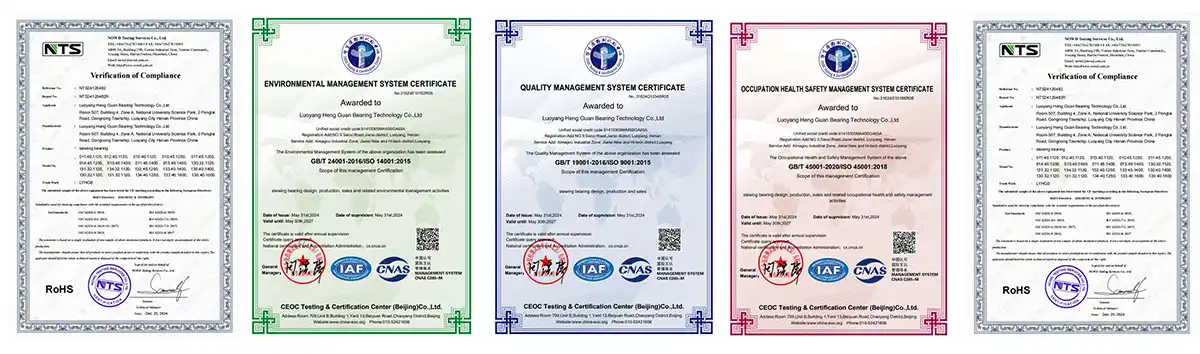
ISO 9001 is a quality management system standard rather than a product-performance certification, so an ISO 9001 certificate should be treated as evidence of the supplier's quality-management system, not as proof that a particular bearing is suitable for a specific crane.
After-Sales Engineering Support
For critical crane applications, supplier support can be valuable during replacement and troubleshooting. Useful services may include drawing review, bearing selection, installation guidance, inspection support, dimensional confirmation, lubrication recommendations, and failure analysis.
A supplier should also be able to explain which parameters are application-specific rather than presenting one generic maintenance value as suitable for every crane.
Conclusion
A reliable maintenance schedule for marine crane slew rings should be built around the actual operating condition of the crane rather than a generic calendar alone. The marine crane slewing bearing should be treated as both a precision rotating component and part of the crane's structural load path.
Routine inspection should cover seals, lubrication, corrosion, fasteners, gear condition, noise, and changes in slewing behavior. Periodic maintenance should add condition measurements such as temperature, vibration, torque, and bearing clearance where appropriate. When abnormal trends appear, engineers should investigate the underlying cause before deciding whether repair or replacement is necessary.
For OEMs and procurement teams, the maintenance strategy should begin before the replacement bearing is ordered. Application data, mounting drawings, load conditions, environmental exposure, and inspection requirements should be shared with the manufacturer so that the selected bearing matches the crane rather than merely matching a catalog dimension.
A qualified slewing-bearing supplier can also support drawing review, dimensional verification, installation guidance, lubrication recommendations, and failure analysis. For marine cranes operating under demanding loads and environmental conditions, this combination of structured maintenance and application-specific engineering support can reduce avoidable downtime and improve the long-term reliability of the rotating system.
|
|

FAQ
1. How often ought I to check my Marine Crane Slewing Bearing?
How often inspections are done relies on how busy the operations are and how bad the surroundings are. Visual checks every day for clear problems like oil leaks or strange noises don't take much time, but can catch problems early. Seals and fastening tools should be checked once a week. Lubricant samples and torque checks are part of detailed inspections that happen once a month. Every three months, Marine Crane Slewing Bearing clearance measurements and thorough status reports are part of the evaluation process. Every year, full overhauls that include some removal check the general health of the bearings and the remaining service life. Cranes that work nonstop in harsh offshore settings might need longer breaks more often, while equipment that is only used sometimes in softer conditions might need slightly longer breaks less often.
2. What are the signs that the Marine Crane Slewing Bearing is about to fail?
Recognizing the signs of failure lets you take action before a major breakdown happens. As the slewing force goes up, it means that the wear or greasing is getting worse. If the wheel is turning and there is an unusual noise or sound, it could mean that the rollers or raceways are damaged. Metal bits, color changes, or water emulsification that can be seen in the lubricant are signs of interior wear or seal failure. If the mounting bolt comes loose even though it is properly torqued, this means that the bearing contact is moving. Temperatures that rise above the average suggest that there is more contact because there isn't enough lubrication or the damage is getting worse. Any of these signs should be looked at carefully right away, and if necessary, the bearing should be replaced to keep operations running smoothly and avoid safety problems.
3. Can you make bearings that fit different types of cranes?
Customization is one of the main things that sets specialized makers apart from catalog sellers. For uses that standard products can't handle, our engineering team creates and makes marine crane slewing bearing units that are exactly what the customer wants, including the mounting dimensions, bolt patterns, gear parameters, and raceway configurations. The diameter range of 50 mm to 10,000 mm allows for options ranging from small wheels for medical equipment to huge offshore crane installations. You can choose the right material, heat treatment, seal design, and precision grade based on the needs of the application. This makes sure that the product works well in all operating and weather situations.
Trust Heng Guan for Your Marine Crane Slewing Bearing Solutions
Luoyang Heng Guan Bearing Technology Co., Ltd. designs marine crane slewing bearing units that are perfect for naval cranes that have to handle a lot of weight. Our P5 precision grade bearings are made from 50Mn/42CrMo alloy steel and have heat-treated raceways (HRC 55–60 surface hardness). They can handle combined loads and saltwater corrosion for longer than regular catalog goods. We have been making marine crane slewing bearing units for a long time and have ISO 9001-certified methods that ensure the quality is always the same. Our Luoyang facility has CNC vertical lathes, hardening machines, and precision cutting tools. We can customize our products to fit non-standard configurations, and our global service network, which includes more than 50 countries, offers quick expert help for installation, commissioning, and upkeep throughout the life of your bearing. Get in touch with our engineering team at mia@hgb-bearing.com to talk about your specific marine crane needs and find out how Heng Guan's 20 years of experience with bearings can help your equipment fleet run more efficiently.
References
1. American Bureau of Shipping (2019). Guide for Certification of Lifting Appliances. Houston: ABS Publications.
2. Hartnett, M. J. & Associates (2018). Slewing Bearing Maintenance for Marine and Offshore Cranes. Marine Engineering Quarterly, Volume 23, pp. 145-168.
3. International Organization for Standardization (2017). ISO 12480-1: Cranes - Safe Use - Part 1: General. Geneva: ISO Standards.
4. Maritime Equipment Manufacturers Association (2020). Technical Guidelines for Rotary Bearing Systems in Marine Applications. London: MEMA Technical Series.
5. Peterson, R. & Williams, K. (2021). Predictive Maintenance Strategies for Heavy-Duty Slewing Bearings in Offshore Environments. Journal of Marine Technology and Engineering, Volume 15, Issue 3, pp. 89-112.
6. Society of Naval Architects and Marine Engineers (2019). Maintenance and Inspection Protocols for Shipboard Crane Systems. Jersey City: SNAME Technical Publications.

WHAT OUR CUSTOMERS SAY
Here is the customer's evaluation of us