




Understanding How a Slewing Cross Roller Bearing Works
When heavy equipment needs to rotate smoothly while carrying combined loads, the bearing system becomes one of the most critical components affecting performance and reliability. A Cross Roller Slewing Bearing is designed to solve this challenge by combining high rotational accuracy, strong moment resistance, and compact structural design in a single bearing unit.
The cross roller design differs from traditional bearing configurations that use several components to handle various load directions. It uses cylindrical rollers aligned at 90° to each other in a V-shaped raceway. The unusual design allows the bearing to sustain radial loads, axial loads, and tilting moments at the same time with good rotational stability.
Cross roller slewing bearings have these advantages and are widely used in industrial robots, precision machinery, medical equipment, wind turbines, construction machinery, and other applications where accuracy and load capacity need to operate together. Understanding the internal structure, working principles, and selection variables of these bearings assists engineers and purchasing teams to identify the right solution for their equipment requirements.
What Makes a Cross Roller Slewing Bearing Different?
A cross roller slewing bearing is a high-precision slewing bearing that uses crossed cylindrical rollers as the rolling elements instead of steel balls or typical roller configurations. The rollers are arranged alternately at right angles to each other so that each roller can take loads from different directions.
The main difference between this design and the usual bearing designs is that the rollers and raceway are in line contact. Line contact has a broader contact area than the point contact of ball bearings and thus better stiffness and load distribution.
There are various practical advantages to this setup:
more resistance to the tilting moments
Higher rotation accuracy
Less space necessary for installation
Increased stability under coupled loading
These properties are particularly advantageous for equipment producers where machine size, precision, and reliability are equally critical.
Internal Structure and Operating Principle
The cross roller design operating principle is based on the interaction between the rollers, raceway, spacer system, and bearing rings.
The cylindrical rollers take turns in their direction within the bearing. One roller takes the loads in one direction, and the next roller takes the loads in the opposite direction. This cross configuration leads to even load sharing all around the circumference.
The inner and outer rings are accurately machined with a V-shaped raceway. During operation the rollers are in stable contact with the bearing surfaces and roll on the raceway. The design reduces uneven loading and maintains the smooth rotation despite the changing of external forces.
Also vital elements of the framework are precision spacers or cages. They provide the correct spacing of the rollers. They prevent rolling elements from coming into direct contact with each other. They provide stable operation throughout a long service life.
For high-precision applications, they commonly regulate things like
Raceway Machining Precision
Uniformity in roller diameter
Internal clearance or pre-load
Regulation of ring deformation
Surface roughness
These parameters directly influence bearing life, rotation precision, and operating reliability.
How do cross roller slewing bearings handle different loads?
One reason engineers specify cross-roller slewing bearings is because they may accommodate multiple sorts of loads in one compact unit.
Radial Load Support
Radial loads act perpendicular to the bearing rotation axis. These forces commonly appear in rotating tables, robotic joints, and industrial positioning systems.
The line contact between cylindrical rollers and raceways allows the bearing to distribute radial forces over a larger area. This reduces localized stress and improves rigidity compared with smaller rolling contact points.
Axial Load Capability
Axial loads act along the rotation axis and are common in applications such as lifting equipment, medical imaging systems, and precision automation machinery.
Because the rollers are arranged in alternating directions, the bearing can support axial forces from both directions without requiring additional bearing assemblies.
Tilting Moment Resistance
Tilting moments are often the most challenging loads for slewing systems. They occur when an external force creates a turning effect around the bearing center.
For example, platforms of excavators, arms of robots, and parts of wind turbines are subjected to considerable moment loads throughout their work.
With the crossing roller configuration, the moment stiffness is increased because the load is shared by more than one roller concurrently all around the raceway. This helps to keep positioning precision and avoid undesired movement during operation.
Key Advantages of Using Cross Roller Slewing Bearings
The engineering features of this bearing design make it suited for applications where traditional slewing bearings may not provide sufficient precision or stiffness.
Compact Design With High Rigidity
Today's machines often require smaller, lighter parts that yet operate well. Cross Roller Slewing Bearing: High load capacity in a relatively compact cross-sectional design.
This is especially crucial for:
Robots with restricted installation space
Semiconductor manufacturing technology
Medical examination system
Very precise positioning stages
The combination of several load functions in one bearing means no extra mechanical components are needed.
Improved Rotational Accuracy
Precision movement is critical in businesses where slight errors in positioning can affect the final product quality.
Cross roller designs often offer stronger rotational stiffness and reduced elastic deformation under load than standard ball slewing bearings. This makes them useful for equipment that needs repetitive and exact movement.
This stability is critical to the consistent functioning of CNC rotary tables and robotic joints across thousands or millions of working cycles.
Reduced Mechanical Complexity
Conventional systems may require different elements for radial, axial, and moment loads. This makes assembly more difficult and creates further alignment problems.
Cross roller slewing bearing combine numerous load capabilities into a single bearing structure. This can reduce machine design complexity, decrease installation needs, and improve system reliability.
Where are cross roller slewing bearings commonly used?
The performance characteristics of a cross roller slewing bearing make it suitable for equipment that requires both high load capacity and precise rotational control. Although different industries have different operating conditions, the common requirement is the same: the bearing must maintain stable movement while dealing with complex forces, limited installation space, or continuous operation.
Industrial Robotics and Automation Equipment
Industrial robots require highly accurate movement because even small positioning errors can affect production quality. The rotating joints of robotic arms must repeatedly perform the same movements while maintaining rigidity and smooth operation.
A cross roller slewing bearing is often selected for robotic applications because its crossed roller structure provides the following:
High rotational stiffness
Low running clearance
Stable positioning accuracy
Compact installation dimensions
In applications such as welding robots, assembly robots, and automated inspection systems, bearing performance directly influences repeatability and machine efficiency.
Precision Machine Tools and Rotary Tables
CNC machine tools place strict requirements on bearing accuracy. Rotary tables, indexing systems, and multi-axis machining centers depend on bearings that can maintain precise positioning under changing loads.
Compared with ordinary bearing solutions, cross roller designs help reduce deformation during machining operations. This is important because excessive bearing movement can affect machining accuracy, surface quality, and production consistency.
For manufacturers of precision equipment, selecting the correct bearing preload and accuracy grade is especially important. A bearing designed for high-precision applications must be matched with the machine structure, operating speed, and expected loading conditions.
Medical Imaging and Precision Instruments
Medical equipment requires a combination of accuracy, smooth movement, and long-term reliability. Systems such as CT scanners, radiation treatment equipment, and diagnostic positioning devices often require rotating components that can move precisely without excessive vibration.
A cross roller slewing bearing helps achieve the following:
Smooth rotation
High positioning accuracy
Low friction operation
Compact mechanical design
Because medical equipment often operates in controlled environments, bearing cleanliness, lubrication selection, and manufacturing quality are important considerations during procurement.
Construction and Heavy Industrial Machinery
Construction equipment creates some of the most demanding conditions for slewing bearings. Excavators, cranes, and drilling equipment experience heavy loads, vibration, impact forces, and exposure to dust or moisture.
In these applications, the bearing must withstand:
Continuous radial and axial loading
Sudden impact forces
Environmental contamination
Long working cycles
Although large heavy-duty machines often use other types of slewing bearings depending on load requirements, cross roller designs can provide advantages where higher precision and compact structure are required.
Renewable Energy Equipment
Wind energy equipment continues to increase in size and complexity. Modern wind turbines require reliable rotation systems that can operate under changing wind conditions and significant mechanical forces.
A cross roller slewing bearing may be used in systems where precise angular positioning and structural rigidity are required, such as yaw adjustment systems or other positioning mechanisms.
For renewable energy applications, bearing selection should consider:
Long-term fatigue resistance
Weather protection
Lubrication performance
Maintenance requirements
Cross Roller Slewing Bearing Compared With Other Bearing Designs
Choosing the right slewing bearing requires understanding how different structures perform under specific operating conditions. A cross roller slewing bearing provides unique advantages, but it is not always the best choice for every application.
The correct selection depends on factors including the following:
Load capacity requirements
Rotation speed
Precision requirements
Installation space
Operating environment
Maintenance expectations
Cross Roller Slewing Bearing vs. Ball Slewing Bearing
Ball slewing bearings use steel balls as rolling elements. They are widely used because of their relatively simple structure and cost advantages.
Compared with ball slewing bearings, cross roller designs generally provide higher rigidity because line contact distributes loads across a larger area.
Advantages of Ball Slewing Bearings
Ball designs may be preferred when:
Cost control is a major consideration.
Extremely high rotational speed is required
Precision requirements are moderate.
Advantages of Cross Roller Designs
Cross roller bearings are often selected when
High positioning accuracy is needed.
Moment stiffness is important.
Installation space is limited.
Combined loads must be supported simultaneously.
Therefore, the choice depends on whether the application prioritizes economy or precision performance.
Cross Roller Slewing Bearing vs. Three-Row Roller Slewing Bearing
Three-row roller slewing bearings are commonly used in very heavy machinery because they provide extremely high load capacity.
They separate different load directions through multiple roller rows, making them suitable for large cranes, mining equipment, and port machinery.
However, their larger structure may require more installation space compared with cross roller designs.
Cross roller bearings offer advantages in applications where
Compact design is required
Higher rotational accuracy is needed.
Moderate-to-high combined loads must be supported.
Three-row designs remain suitable for extreme heavy-load applications where maximum capacity is the primary concern.
How to Choose the Right Cross-Roller Slewing Bearing Supplier?
Purchasing a Cross Roller Slewing Bearing is not only about selecting a product size. The supplier’s engineering capability, manufacturing process, and quality control system directly affect final equipment performance.
Evaluate Manufacturing Capability
A reliable manufacturer should have experience in:
Precision machining
Heat treatment processes
Raceway grinding
Bearing assembly
Accuracy inspection
Important quality factors include dimensional control, material consistency, and testing procedures.
For customized applications, manufacturers should also be able to review technical drawings, analyze operating conditions, and recommend suitable bearing structures.
Confirm Customization and Engineering Support
Many industrial applications require non-standard bearing solutions.
Customization may involve:
Special mounting dimensions
Different preload requirements
Customized sealing solutions
Modified materials
Specific accuracy grades
A supplier with engineering support can help reduce selection risks and improve equipment reliability.
Check Quality Documentation and Testing
Before purchasing, buyers should request relevant technical documents, such as:
Product drawings
Inspection reports
Material certificates
Accuracy records
Performance testing information
Professional documentation helps ensure that the supplied bearing matches project specifications.
Choosing an Experienced Cross Roller Slewing Bearing Manufacturer
For industrial buyers, supplier selection should focus on long-term reliability rather than only initial price.
A manufacturer with strong technical capabilities can provide better support throughout the product lifecycle, including design consultation, production control, quality inspection, and after-sales communication.
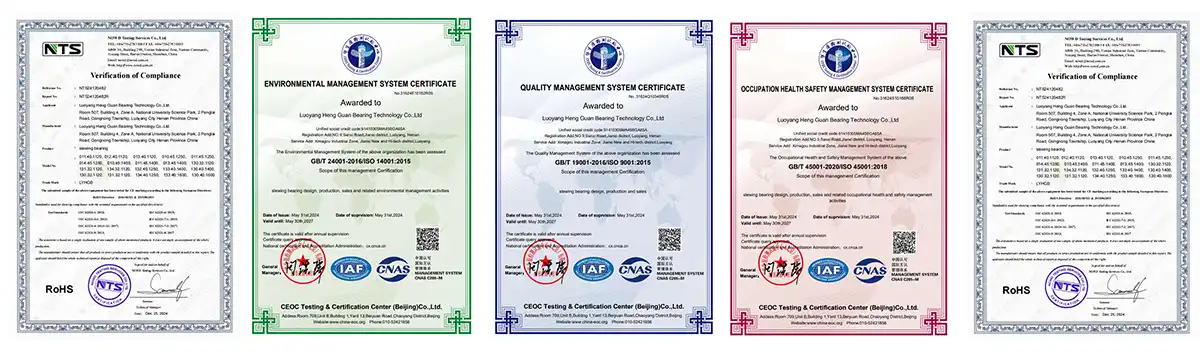
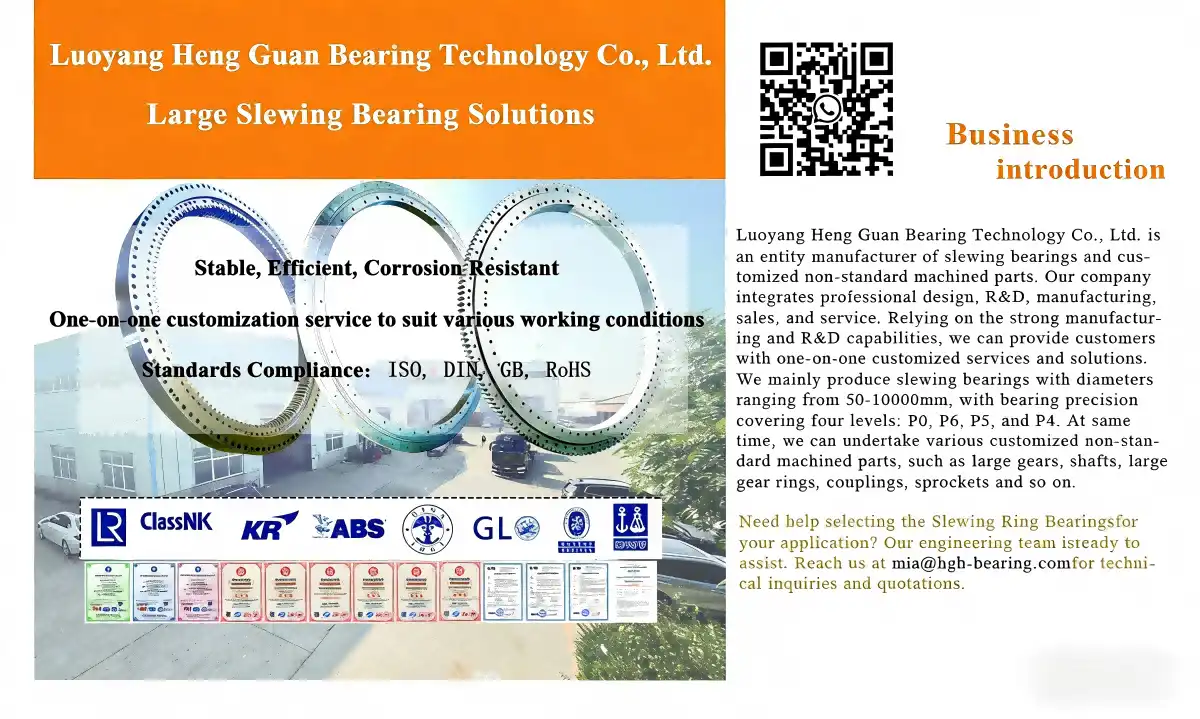
Luoyang Heng Guan Bearing Technology Co., Ltd. is an example of a manufacturer specializing in slewing bearing solutions for industrial applications. The company provides different slewing bearing structures, including cross cylindrical roller designs, four-point contact ball bearings, three-row roller bearings, and customized solutions.
Its production capability covers various bearing sizes and precision requirements, allowing customers to select solutions based on application conditions rather than standard dimensions alone.
For projects requiring customized cross roller slewing bearing solutions, working with a manufacturer that understands load calculation, machining accuracy, and application requirements can help reduce procurement risks and improve equipment reliability.
Looking Beyond Initial Purchase Cost
The lowest purchase price does not always represent the lowest overall cost.
A bearing failure may lead to:
Unexpected equipment downtime
Maintenance expenses
Production delays
Safety concerns
For this reason, professional buyers usually evaluate the complete value of a bearing solution, including:
Product quality
Supplier experience
Delivery reliability
Technical support
Service capability
A properly selected bearing can improve equipment efficiency and reduce long-term operating costs.
Conclusion
Cross roller slewing bearing provide an effective solution for applications that require compact design, high rotational accuracy, and the ability to handle combined loads. Their crossed cylindrical roller arrangement allows radial forces, axial forces, and tilting moments to be supported within a single bearing structure.
From industrial robots and precision machinery to medical equipment and specialized industrial systems, these bearings help engineers achieve reliable and accurate rotational performance.
However, selecting the correct bearing requires more than comparing dimensions or prices. Load conditions, operating environment, precision requirements, maintenance expectations, and supplier capability all influence long-term performance.
For companies purchasing cross roller slewing bearings, partnering with an experienced manufacturer can provide valuable technical support from initial selection through final application. A well-designed and properly manufactured bearing not only improves machine reliability but also helps reduce maintenance costs and improve operational efficiency over the entire equipment lifecycle.
FAQ
1. What is the typical lifespan of a Cross Roller Slewing Bearing?
The service life of a Cross Roller Slewing Bearing depends a lot on how it is used, how much weight it has, and how well it is maintained. Providing they are well taken care of, properly oiled, and used within their stated limits, these bearings can usually last for 20,000 to 30,000 hours or more. Heavy-duty uses that run all the time may need replacement sooner, while fine equipment that runs sometimes under light loads may need replacement much later. Regular inspections and condition tracking help find trends of wear that can be used to plan maintenance instead of waiting for problems to happen.
2. How do I determine the correct bearing size and load capacity?
To choose the right bearings, you need to figure out the predicted loads, which include radial forces, axial forces, and tilting moments, both at normal and peak working conditions. In their technical literature, manufacturers list load rating tables and selection methods. When loads are complicated or application conditions aren't typical, talking to the expert teams at bearing makers makes sure that the right choice is made. By giving engineers specific information about the application, such as loads, speeds, duty cycles, and environmental factors, they can suggest the best bearing configurations and make sure there are enough safety gaps.
3. What maintenance practices extend bearing service life most effectively?
The most important upkeep task is to consistently apply lubricant according to the manufacturer's instructions. Setting up and sticking to lubrication plans that are right for your working conditions will keep your equipment from wearing out too quickly. Checking for contamination, the state of the seal, and the torque on the fixing bolts on a regular basis can help find problems before they break. Keeping an eye on working temperatures and sound levels lets you know right away when problems need to be fixed. In tough conditions, keeping the working area clean and keeping the bearings from getting dirty can greatly increase their service life.
|
|
Partner with Heng Guan for Your Cross Roller Slewing Bearing Needs
Choosing the right Cross Roller Slewing Bearing provider affects how well your equipment works and how much it costs to maintain over the life of your product. Heng Guan brings to every project decades of experience making specialized bearings, advanced production skills, and knowledge in application engineering. Our Cross Roller Slewing Bearings are used in a wide range of difficult uses around the world, from high-precision medical equipment to heavy mining equipment. They always work well and are reliable.
We make bearings with sizes ranging from 20 mm to 10,000 mm in precision grades P0 through P4. For non-standard uses, we can make a lot of changes. Our engineering team works with you from the first planning phase through production, giving you technical help to make sure you choose the right bearings and set them up correctly. We are in Luoyang's specialized bearing production region, and we use both traditional craftsmanship and modern, precise equipment to make sure that the quality and value of our products are the best they can be.
Our team gives each customer the individual care they need, whether they are an OEM creator making new equipment or a repair worker looking for replacement parts. We know that for bearing applications to work well, they need more than just choosing one from a list. They need engineering that is tailored to the application and quick help throughout the product lifecycle.
Get in touch with our expert team right away to talk about your application needs. You can email us at mia@hgb-bearing.com to find out how our precision Cross Roller Slewing Bearing options can help your tools work better. We are a reliable maker and supplier, and we give your projects the technical know-how, high-quality parts, and customer service they need.
References
1. Harris, T.A. and Kotzalas, M.N. (2006). Rolling Bearing Analysis: Essential Concepts of Bearing Technology. CRC Press, Taylor & Francis Group.
2. Schwarz, H. and Ebner, M. (2018). Slewing Bearings: Design, Application, and Maintenance in Heavy Machinery. Springer Technical Publications.
3. Wensing, J.A. (2011). On the Dynamics of Ball Bearings. Ph.D. Thesis, University of Twente, Netherlands.
4. American Bearing Manufacturers Association (2020). Load Ratings and Fatigue Life for Roller Bearings. ABMA Standard 11-1990, Revised Edition.
5. International Organization for Standardization (2014). Rolling Bearings - Slewing Bearings. ISO 12043:2014 Standard.
6. Nisbett, J.K. and Budynas, R.G. (2014). Shigley's Mechanical Engineering Design, 10th Edition. McGraw-Hill Education, Chapter on Rolling-Contact Bearings.

WHAT OUR CUSTOMERS SAY
Here is the customer's evaluation of us