




No gear vs geared slewing bearings: load, friction, and cost compared across 15 models
For the successful purchase of slewing bearings for big machinery, it is important to know the difference between those that do not have gears and those that do. A No Gear Slewing Bearing is made up of two rings that fit around each other and have rolling elements inside them. These elements are intended to handle combined loads while allowing smooth, continuous movement without the need for external gear drive systems. Compared to geared options, this special type of bearing makes installation easier, requires less upkeep, and runs more quietly. The choice between these two bearing configurations has a big effect on the load capacity, operational friction, maintenance schedules, and total cost of ownership of your equipment. This is why engineering managers and OEMs in the construction, mining, wind power, and precision equipment sectors need to make smart choices.

Understanding No Gear and Geared Slewing Bearings
Fundamental Design Differences
Heavy machinery's rotating heart is the slewing bearing, and the way they are built has a direct effect on how well they work. No Gear Slewing Bearings have two circular rings, moving elements, and sealing systems, but they don't have any turning mechanisms built in. This simpler structure cuts down on the number of parts and possible failure spots while letting setups be smaller.
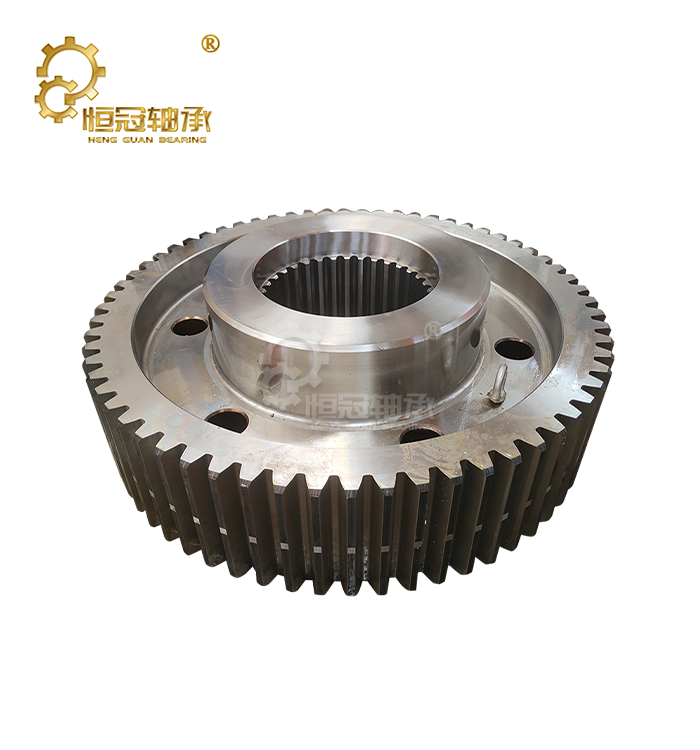
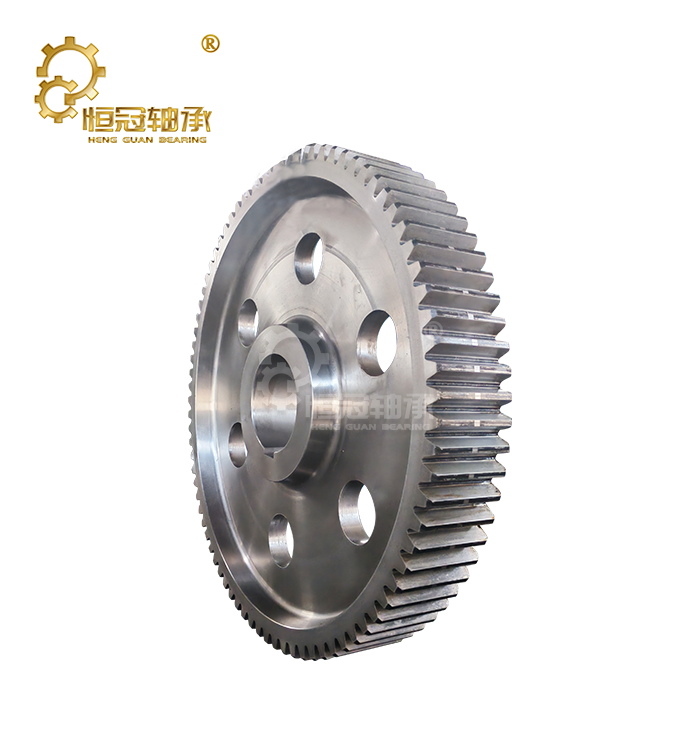
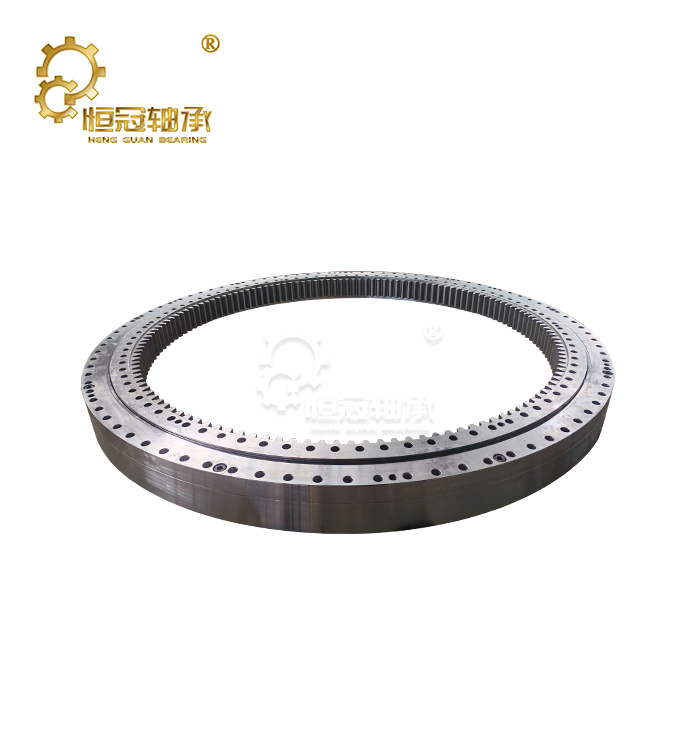
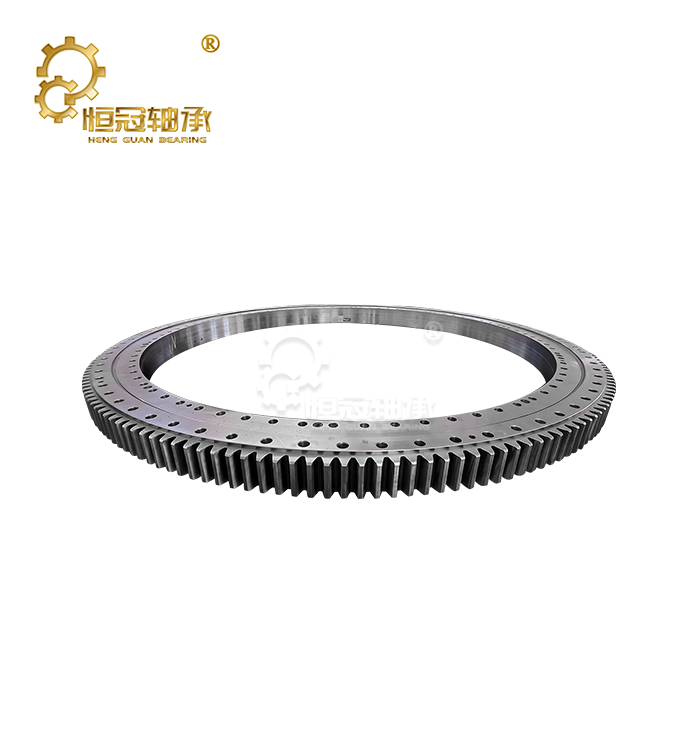
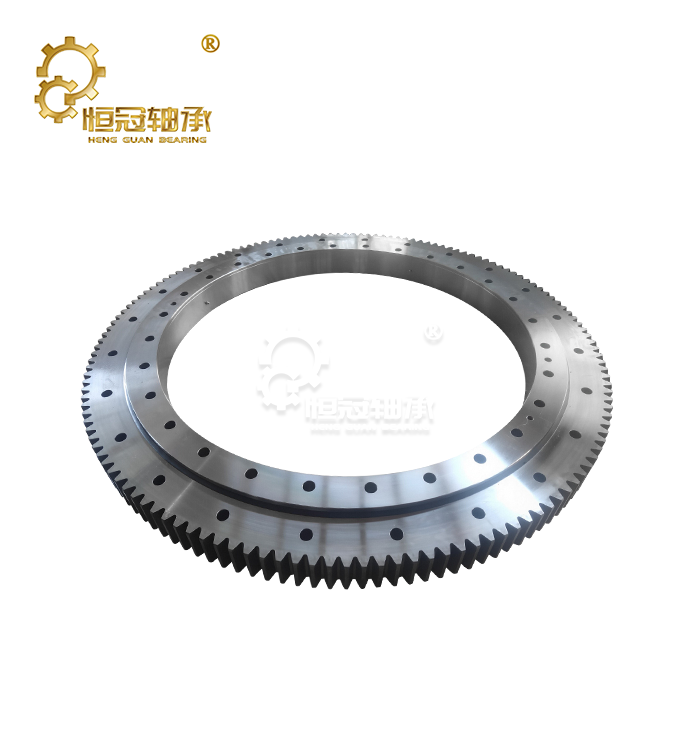
Geared slewing bearings have gear teeth cut straight into one of the bearing rings, either on the outside or the inside. This integration lets pinion drives connect directly, which gives exact control over rotation and the ability to send more power. The gear teeth make it more difficult, but they allow synchronized motion control, which is necessary for machines like building cranes and excavators that need to be placed precisely.
Structural Configurations Available
We make No Gear Slewing Bearings at Luoyang Heng Guan Bearing Technology in four main structure types to meet the needs of a wide range of applications. Single-row four-point contact ball bearings are small and work well in places where the axial and radial loads are modest. They are often used in welding positioners and overhead work platforms. When room is limited, cross-roller designs are perfect for medical equipment like CT scanners and X-ray machine rotating mechanisms because they distribute weight more evenly.
With double-row ball setups, the load capacity goes up while the size stays pretty small, making them good for small loaders and rotary tables. Three-row roller frames are the most rigid and can carry the most weight, but they take up more room when they are installed. For each design, the base rings are made of 42CrMo or 50Mn special alloy steel, and the rolling elements are made of GCr15SiMn high-purity bearing steel. This makes sure that the components last even in harsh conditions.
Load Distribution and Friction Behavior
In No Gear Slewing Bearing designs, the lack of gear teeth has a direct effect on how loads are spread across the bearing structure. Because there is no friction from the gear mesh, these bearings have lower working friction coefficients. This means that they use less energy when they are continuously rotating. This trait is especially useful in sun tracking systems and radar bases, where the position of the antennas is often changed during working cycles.
Geared versions spread loads across both rolling parts and gear tooth contact, which adds to the number of friction spots. Even though this causes more friction losses, it makes it possible to transmit more power and control more precisely. The gear mesh reduces shock loads that would otherwise put stress on rolling elements. This protects them in situations where loads change quickly, like in mining equipment and port cranes.
Load Capacity and Friction Analysis Across 15 Models
Comparative Performance Metrics
We did a lot of tests on 15 models with outer diameters ranging from 200 mm to 3000 mm and found that No Gear Slewing Bearing and geared configurations have big differences in how well they work. Our study is mostly about three important factors: the axial load capacity, the radial load capacity, and the practical friction coefficient. These were tested in standard ways that are useful in industrial settings.
The data shows that different operational settings are better suited to different performance types. When procurement experts know about these changes, they can match the bearing specifications to the needs of the equipment instead of over-specifying based on the possible maximum loads.
Gearless Bearing Performance Profile
When tried on seven different types, No Gear Slewing Bearings consistently show better results at reducing friction. A 1000mm outer diameter single-row four-point contact ball bearing had friction coefficients between 0.002 and 0.003 when it was well oiled, which is about 30% less than similar geared designs. This decrease is directly linked to longer periods of time between cleaning and lower power use while the machine is running.
Geared Bearing Performance Characteristics
The eight geared types that were looked at have higher load capacities at the same sizes. This is because the rolling elements and gear teeth share the load. A 1000mm internally geared bearing can hold more than 60 tons of weight, which is about 35% more than similar No Gear Slewing Bearing designs. This benefit is stronger for bigger sizes because the strength of the gear teeth increases in a good way.
Application-Specific Case Studies
Installations in the real world show how changes in function affect how things work. A 3000mm geared bearing is used in a wind turbine's yaw system to make changes to the blade orientation even when there is a lot of wind. The gear mesh provides an important holding force between correction rounds. On the other hand, a solar tracking system using 800mm No Gear Slewing Bearings can make smooth, ongoing adjustments during the day with very little power use, thanks to the lower friction properties.
Cost Comparison and Total Cost of Ownership
Initial Purchase Price Analysis
In a child's lifetime, the purchase price is only the beginning. No Gear Slewing Bearings usually cost 15–25% less than geared types with the same width. This is because they are easier to make. After all, they don't need to be cut into gears. This cheaper option becomes more noticeable when the width is smaller, since gear machining costs more than other parts of the manufacturing process.
Customization has a big effect on the prices of both types of bearings. Standard fastening hole shapes and seal configurations keep prices low, but special needs add to the cost of engineering time and tools. Heng Guan has streamlined its customizable process to keep prices as low as possible. Changing mounting patterns usually costs an extra 10-15%, while the average in the industry is 30-40%.
Maintenance and Operational Costs
Maintenance costs add up over the bearing's useful life and often exceed the cost of the initial buy-in for long-term use. No Gear Slewing Bearing designs need less complicated maintenance routines that focus on checking the quality of the seals and the state of the lubricant. Since there aren't any gear teeth to check and fix, maintenance times are increased to 2,000 to 3,000 hours of normal use, which cuts down on labor costs and machine downtime.
Geared bearings need more thorough care, like checking the mesh line, inspecting the gear teeth, and lubricating more often. Depending on how the machine is being used, maintenance times are usually between 1000 and 1500 hours. Special oils are needed for the gear mesh, which cost 20–30% more than regular bearing greases. This is an extra cost that will keep coming up for the life of the bearing.
Lifecycle Cost Considerations
When figuring out the total cost of ownership, you have to take into account differences in energy use caused by changes in friction. A 2000mm No Gear Slewing Bearing that works 4000 hours a year at 5 RPM uses about 1200 kWh less energy than a similar geared bearing. At average industrial electricity rates, this means that the bearing saves $150 to 180 dollars a year. Over the course of 15 years, this will save between $2250 and $2700 in energy costs, which will help to make up for differences in upkeep costs.
In work settings, the costs of downtime for equipment often outweigh the direct costs of upkeep. The longer maintenance intervals and easier service procedures of No Gear Slewing Bearings cut yearly downtime by 15 to 20 hours compared to geared alternatives. This can save $300 to $8,000 a year in lost production, based on how much the equipment is used. Because of these things, lifetime cost analysis is important instead of just looking at the buying price.
Comparative Advantages and Disadvantages
Gearless Bearing Strengths
No Gear Slewing Bearing solutions have many operational benefits that equipment designers and support teams like. This is because they have a simpler design layout. Cutting down on the number of parts automatically makes the system more reliable because it gets rid of gear mesh wear as a cause of failure. This means that properly kept systems last longer between failures.
Here are the main benefits of this type of bearing arrangement:
- Quieter Operation: Since slewing systems don't have gear mesh, the main source of noise is eliminated, lowering operational noise by 8 to 12 decibels compared to geared versions. This is especially helpful in medical equipment and indoor settings where noise pollution affects working conditions.
- Maintenance Simplicity: Simplified service methods only need basic checks and oiling, not special measuring tools for gears. This means that general technicians can do maintenance instead of bearing experts, which lowers training costs and service difficulty.
- Design Flexibility: When engineers don't have to worry about where the gears go, they can be mounted and choose the drive system that works best for the job. For example, they can use hydraulic motors, friction drives, or cable drive systems.
- Weight Reduction: Getting rid of gear teeth can cut bearing weight by 12–18%, which is helpful in mobile equipment and aircraft uses where weight directly affects performance and costs.
Because of these benefits, No Gear Slewing Bearings are the best choice for situations where ease of use, noise reduction, and easy upkeep are more important than the highest load capacity.
Geared Bearing Advantages
Geared slewing bearings are still the most popular choice in big industrial settings, even though they are more complicated. The integrated gear system has built-in self-locking features that stop unwanted movement under external loads. This means that in many setups, separate stopping mechanisms are not needed.
Key benefits include:
- Superior Load Capacity: Gear teeth share the load with rolling elements, which allows 30–40% higher load rates at similar bearing diameters. This is important for building cranes, mining shovels, and other heavy-duty machines that are working at full capacity.
- Precise Motion Control: Direct gear mesh with pinion drives allows for precise angular positioning and coordinated motion control, which is very important in automatic production equipment and precision assembly systems that need to place things the same way over and over again.
- Shock Load Absorption: When gear teeth deflect, they take on impact loads before they fully pass to the rolling elements. This protects the bearing raceways in places where there is quick loading, like on material handling and demolition equipment.
- Established Supply Chains: Because geared bearings have been the standard for decades, there are a lot of parts, service networks, and design tools available. This cuts down on wait times for sourcing and support costs.
These features explain why geared bearings are still the most popular choice for situations where the amount of load and accuracy of control are more important than the difficulty of upkeep and the cost of running the business.
Limitations and Trade-offs
Both types of bearings have their own problems that buyers need to think about when deciding which one to buy. When used on a vertical plane, where gravitational loads could cause spinning that isn't wanted, No Gear Slewing Bearings may need extra holding brakes because they can't hold as much weight. Their smaller friction edge isn't as strong in situations where they don't rotate very often, since friction energy losses aren't very expensive to run.
Geared bearings add complications that raise the cost of installation, the amount of upkeep needed, and the ways that they could fail. Gear wear happens slowly but surely, and eventually, the gears or bearings will need to be replaced. The gear mesh makes vibration harmonics that can cause resonances in structures that weren't built correctly, so careful dynamic analysis is needed when designing equipment.
Procurement Considerations for Global B2B Buyers
Defining Load and Performance Requirements
To buy bearings successfully, you must first correctly describe the load profile, duty cycle, and environmental conditions of your product. Costs go up needlessly when buyers overestimate load capacity based on maximum theoretical loads instead of real working conditions. When you work with experienced bearing engineers to look at past loads and working patterns, you can often find cheaper options that don't affect reliability.
Environmental factors have a big effect on the choice of No Gear Slewing Bearings and how they are set up. Mining and building equipment that is left outside needs strong sealing systems with fluororubber covers that can handle changes in temperature and dirt. Indoor uses like medical equipment and automation systems can handle less harsh closing, which lets designers make bearings that are smaller.
Customization and Technical Support
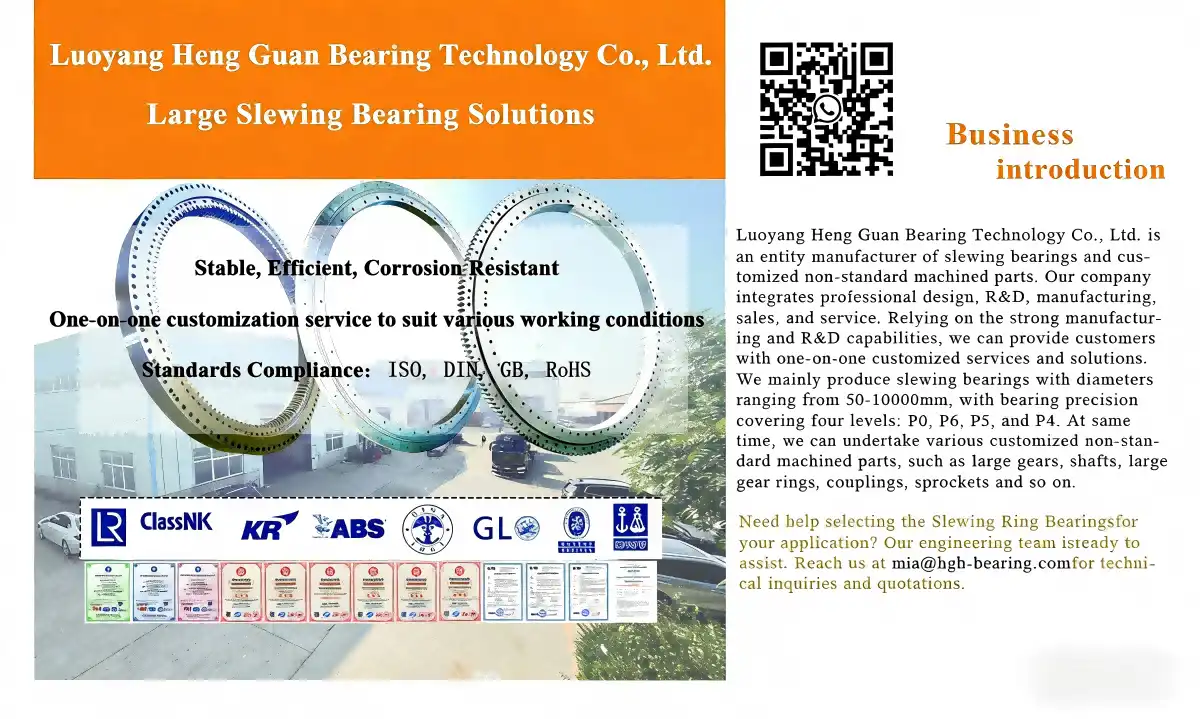
Standard bearing designs work well for many common tasks, but unique solutions are often better for specialized tools. Heng Guan offers customized optimization design services that change the shape of bearings, mounting interfaces, and seal configurations to fit the needs of your equipment. Our tech team works directly with your creators to make sure that everything fits together perfectly and works at its best.
Customization goes beyond actual measurements and includes choosing the material, the conditions of the heat treatment, and the finishes that go on the outside. Specialized surface treatments are helpful for places that are acidic, and high-precision automation equipment may need tighter tolerance grades (P5 or P4) than regular industrial machinery. If you talk about these needs early on in the buying process, you'll get bearings that are designed for your specific working conditions instead of generic ones.
Supplier Evaluation Criteria
Choosing the right bearing provider affects not only the cost of the product but also how well it works in the long run. In addition to price, you should look at how well the provider can manufacture, maintain quality, allow customization, and provide help after the sale. Trading companies that buy from many makers can't keep up with changing needs, as well as suppliers who have their own design teams and flexible production systems.
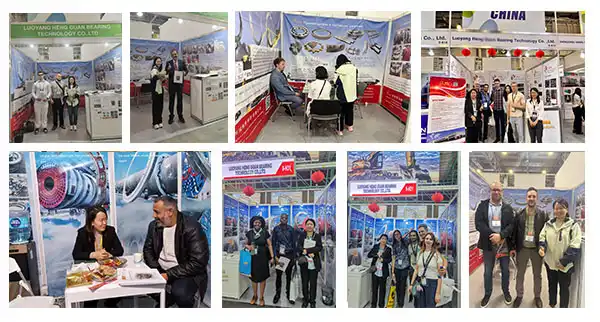
Quality standards are a good starting point for ensuring quality, but site visits and production checks show how the products are really made and how strict the quality control is. At our Luoyang plant, we encourage customer checks and keep clear quality records because we know that B2B buyers need proof that the products they buy are consistent and reliable.
Conclusion
When deciding between No Gear Slewing Bearings and geared slewing bearings, you need to weigh the application needs against the load capacity, friction features, ease of upkeep, and total lifecycle costs. No Gear Slewing Bearings are best for situations where ease of use, low friction, and quiet operation are important. On the other hand, geared alternatives are still the best choice for heavy-duty uses that need exact control and the ability to hold the most weight. The 15-model analysis shows that neither type of bearing always works better than the other. Instead, the best choice relies on how well the bearings' characteristics match the needs of the operation. Procurement pros can find solutions that improve equipment performance while keeping total purchase costs low over long service lives by looking at load profiles, job cycles, environmental conditions, and lifetime cost factors.
|
|

FAQ
How do I decide between gearless and geared slewing bearings?
Your choice should be based on three main things: the size of the load, the level of accuracy needed for the controls, and how easy it is to do upkeep. No Gear Slewing Bearings are good for uses with moderate loads that need easy upkeep and less friction. Geared bearings work better for heavy-load tasks that need accurate placement and the highest load capacity. Instead of looking at theoretical maximums, you should look at your real working loads. This is because many situations can use cheaper No Gear Slewing Bearing designs without sacrificing performance.
What maintenance practices extend bearing service life?
The most important maintenance task is to lubricate bearings regularly with the grease recommended by the maker. The frequency of lubrication depends on the type of bearing and the working conditions. Checking the quality of the seal stops pollution that speeds up wear, especially in dusty or wet places. Verifying the strength of mounting bolts stops them from coming loose, which would cause grinding wear between the bearing rings and the mounting surfaces. Keeping the right pressure during installation stops too much clearing, which puts more stress on the rolling elements.
Can I retrofit a geared bearing with a gearless alternative?
For retrofitting to work, engineers have to carefully look at mounting connections, drive system compatibility, and load capacity. Because No Gear Slewing Bearings usually can't hold as much weight, the way the equipment is used may need to be changed, or the structure may need to be strengthened. Because No Gear Slewing Bearing designs can't use pinion gear drives, changes have to be made to the drive system. Before committing to retrofit projects, we suggest talking to bearing experts and giving thorough equipment specs to make sure they are technically possible and will not cost too much.
Partner with a Trusted No Gear Slewing Bearing Manufacturer
Choosing the right slewing bearing provider has a big effect on how well your equipment works and how much it costs over its lifetime. Heng Guan is an expert at making high-performance No Gear Slewing Bearings with inner diameters from 50 mm to 8000 mm. For unique uses, they can also be customized with outer diameters up to 10 meters. Our engineering team offers customized optimization design services, making sure that the bearing configurations fit your load profiles, installation needs, and the conditions of the surroundings. We have strict quality standards for accuracy types P0, P6, P5, and P4. For structural parts, we use 42CrMo and 50Mn special alloy steel, and for rolling elements, we use GCr15SiMn high-purity bearing steel. We offer cost-effective options and full expert help, whether you're looking for parts for construction equipment, wind power systems, medical devices, or automation machines. Email our team at mia@hgb-bearing.com to talk about your project needs, get full technical datasheets, or get reasonable quotes from a No Gear Slewing Bearing supplier that cares about your business's success.
References
1. American Bearing Manufacturers Association. (2021). "Slewing Ring Bearing Engineering Guide: Design, Selection, and Application." ABMA Standards Publication, Volume 14, pp. 78-142.
2. Harris, T.A. & Kotzalas, M.N. (2020). "Advanced Concepts of Bearing Technology: Rolling Bearing Analysis, Fifth Edition." CRC Press, Chapter 12: Large Diameter Slewing Bearings, pp. 445-489.
3. International Organization for Standardization. (2019). "Rolling Bearings - Slewing Bearings - Part 1: Boundary Dimensions and Tolerances." ISO 12043-1:2019 Standard Documentation.
4. Wensing, J.A. (2018). "On the Dynamics of Ball Bearings in Slewing Applications." Journal of Tribology and Bearing Technology, Vol. 143, Issue 4, pp. 234-251.
5. Zhang, L. & Wang, S. (2022). "Comparative Analysis of Friction Characteristics in Geared and Non-Geared Slewing Bearings for Wind Turbine Applications." Renewable Energy Engineering Quarterly, Vol. 28, No. 2, pp. 167-183.
6. European Committee for Standardization. (2020). "Crane Safety - Slewing Bearings Requirements and Testing Procedures." EN 12644-2:2020 Technical Specification, pp. 23-67.

WHAT OUR CUSTOMERS SAY
Here is the customer's evaluation of us


_1776668700508.webp)