



Excavator Slewing Bearing Applications in Cranes and Wind Turbines
A failure of a crawler crane unable to keep its boom angle, a wind turbine whose yaw system seizes after five years of operation, an excavator with play developing in its upper frame mid-dig – all three failures can be traced to the same component family, and all three may be prevented with the appropriate specification. An Excavator Slewing Bearing is one of the most widely adopted bearing types in heavy industry, turning up in cranes, wind turbines, and more, although the name may indicate a single machine. At Heng Guan Bearing, we make this bearing family just for these kinds of applications, and this article goes through how it helps heavy-duty cranes, what the load and tilting-moment requirements are like in different applications, why it’s as important for wind turbine yaw and pitch systems, and how to choose the right one. If you are comparing an excavator slewing bearing supplier for a crane or renewable energy project, this should assist explain what you need to look for.
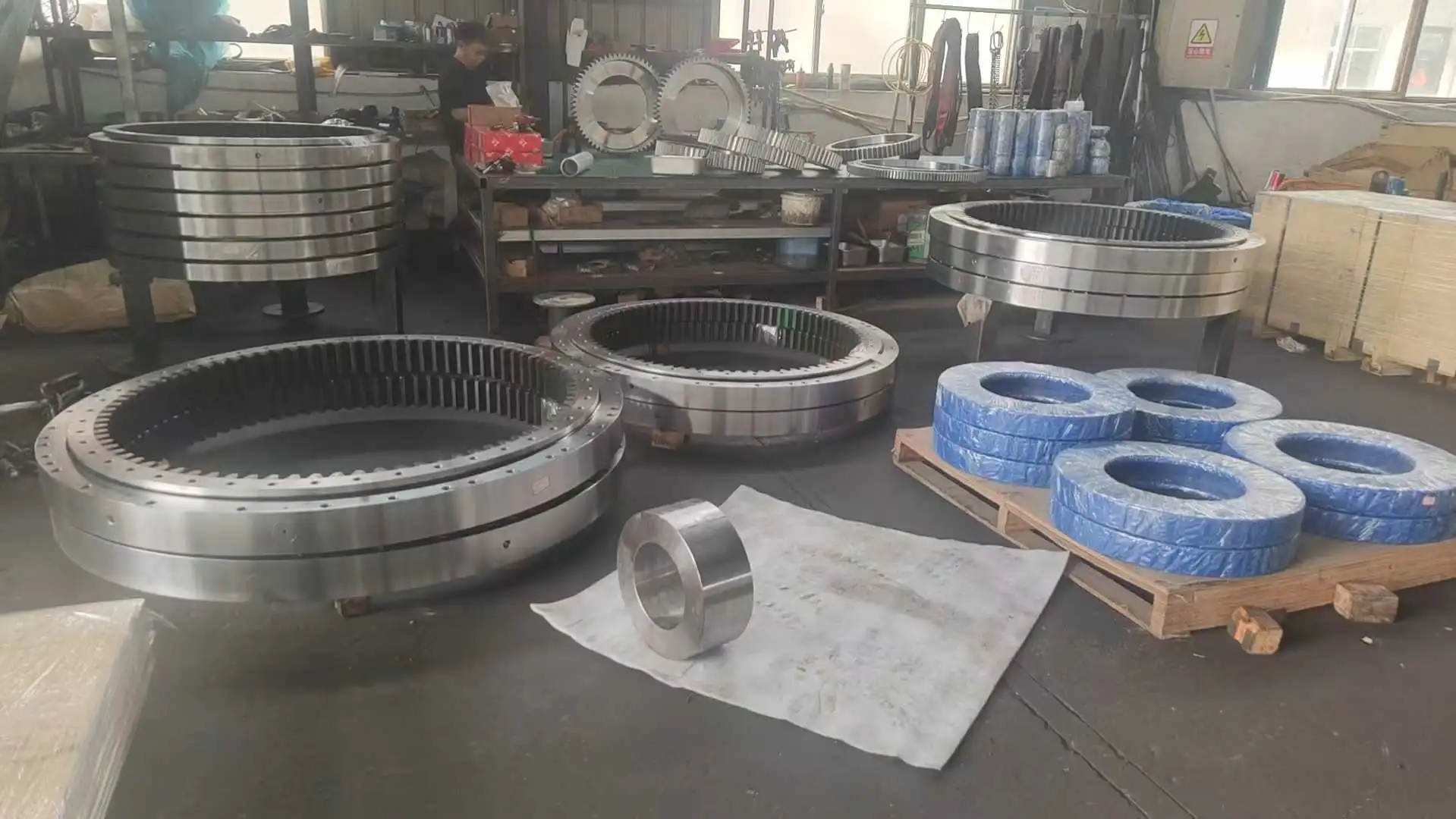
How Does an Excavator Slewing Bearing Support Heavy-Duty Cranes?
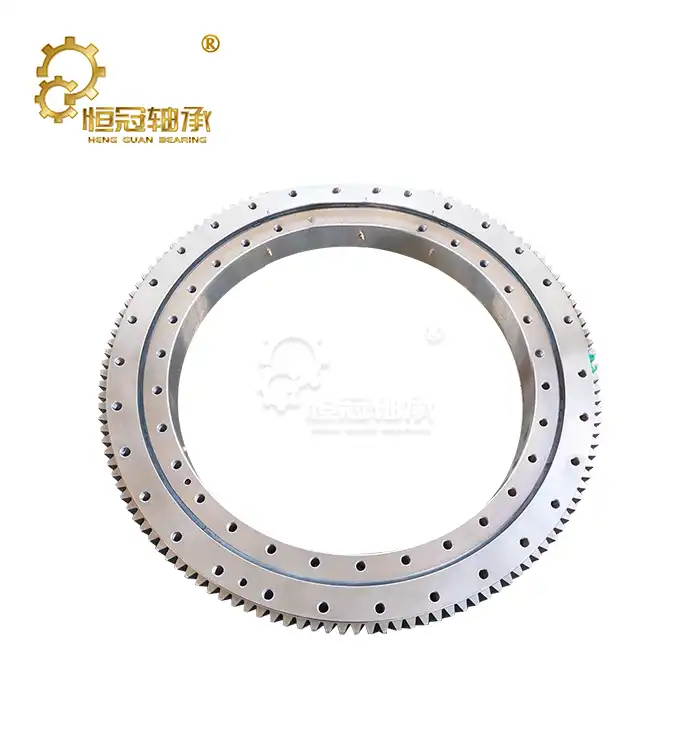
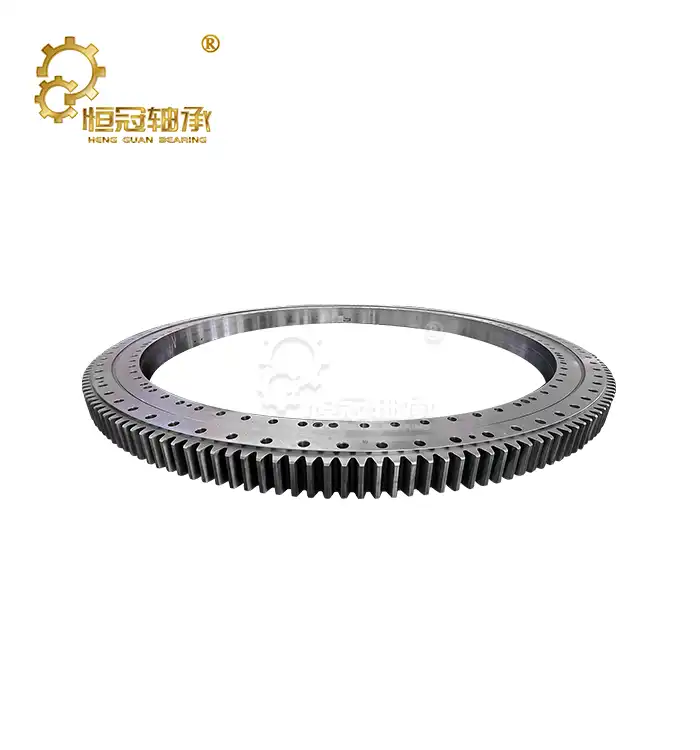
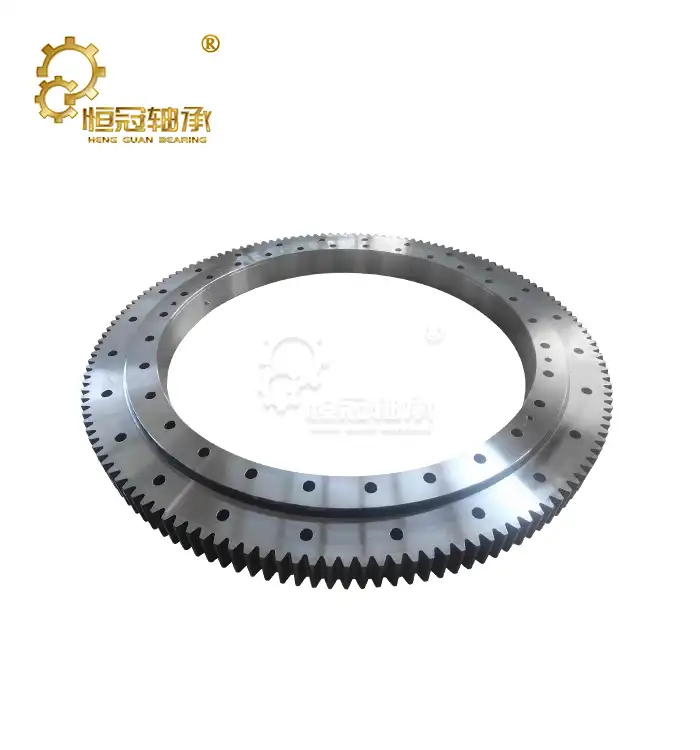
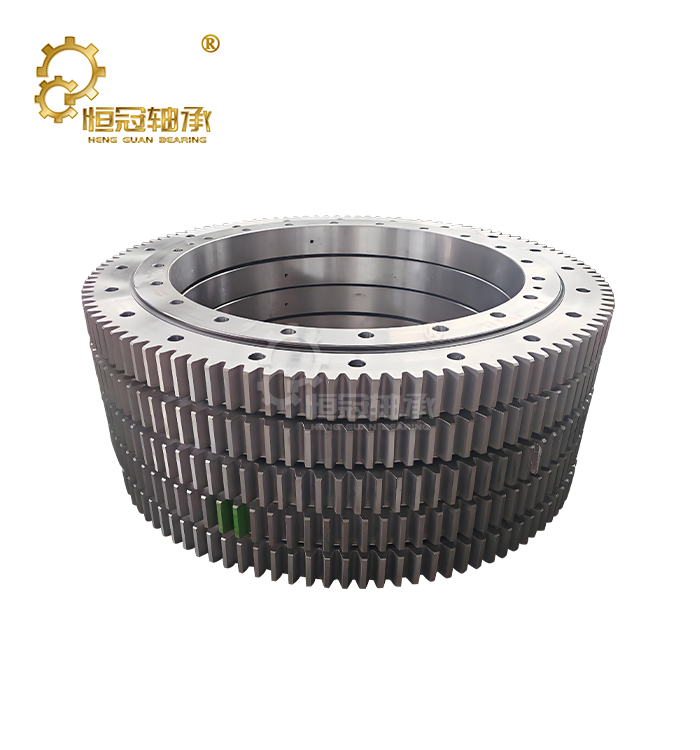
An excavator slewing bearing is fitted between the undercarriage and the top structure, allowing the cab and boom to turn independently of the tracks, and the same mechanical concept applies directly to cranes. The bearing is the structural attachment in both machines that allows the operator to swing a laden arm through a complete 360 degrees while the base remains stationary. A sturdy slewing bearing is essential for a crane to slew its jib and counterweight smoothly and securely under load.
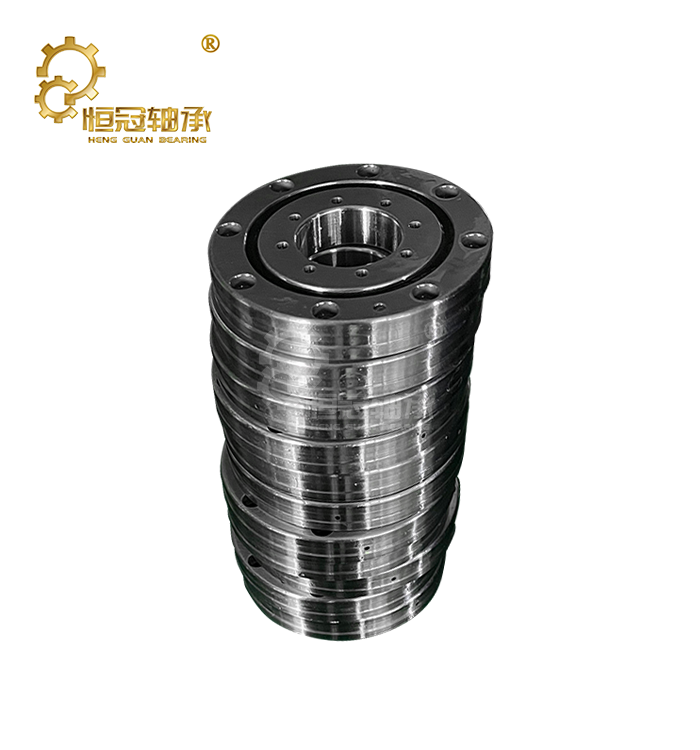
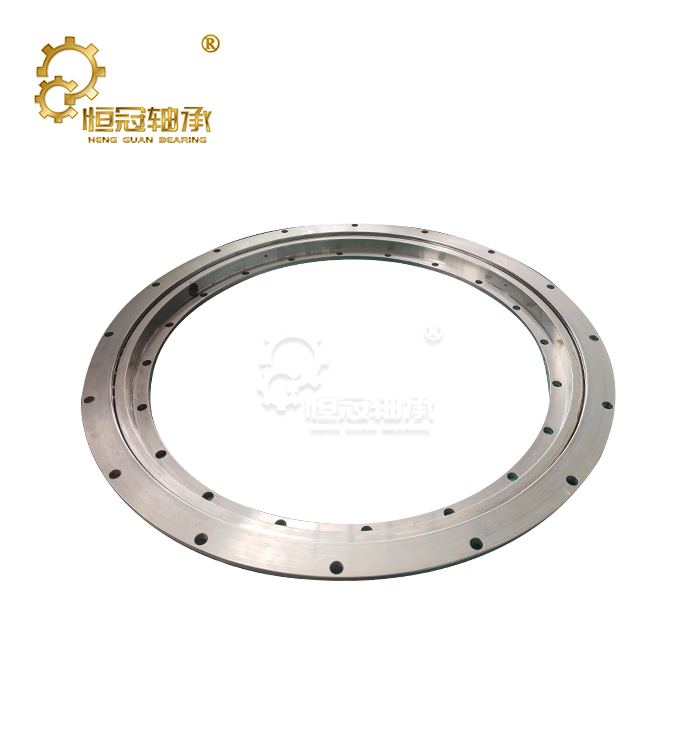
Heng Guan Bearing manufactures excavator slew bearing units with single-row four-point contact ball, cross-cylindrical roller, and three-row cylindrical roller designs, all of which are popular options for heavy-duty cranes that need to balance a high load capacity with impact resistance from frequent swing cycles. As a reliable excavator slewing bearing supplier, we find the same bearing families are chosen across mobile cranes, tower cranes, and excavators, since all three machines have the same essential requirement: continuous, exact rotation under rigorous and frequently uneven loads.
| Specification | Excavator Slewing Bearing Range |
|---|---|
| Bore / outer diameter | 500 – 5,000 mm / 600 – 5,500 mm (production up to 10,000 mm) |
| Height | 100 – 500 mm |
| Structures | Single-row four-point contact ball, double-row ball, three-row roller |
| Raceway hardness | HRC 55–60, hardened depth 2.5–5 mm |
| Gear teeth hardness | HRC 45–50 (internal or external gear) |
| Rolling elements | GCr15SiMn steel, Ø10–60 mm; brass/steel/nylon cages |
| Sealing | Double-lip, imported NBR or FKM |
| Temperature range | -30°C to +60°C (standard seals) |
| Precision grades | P0, P6, P5, P4 (ABEC 3/5/7/9) |
Because the same raceway hardness of HRC 55–60 with a 2.5–5 mm case depth carries over from compact excavators to port cranes, the design rules engineers already trust transfer directly between machine types.
Load Capacity and Tilting Moment Requirements Across Applications
Every application that uses an Excavator slewing bearing provider must account for three load types acting together: radial load, axial load, and tilting moment. Tilting moment is usually the governing factor in bearing selection, since it grows with both the weight of the load and the distance from the bearing's center — a crane holding a heavy load at a long boom radius creates a substantial tilting moment that the bearing must resist without excessive deflection. Excavators add a further complication: digging, swinging, and dumping cycles introduce repeated shock loading that a bearing built only for steady rotation would struggle to survive.
Naturally, this is why manufacturers rely on high-strength forged alloy steels and hardened raceways to give the excavator slewing bearing the fatigue resistance these duty cycles demand. The table below compares typical load characteristics across the applications this bearing family serves.
| Application | Dominant Load Type | Duty Cycle |
|---|---|---|
| Excavator | Shock + tilting moment | Continuous, impact-heavy |
| Mobile/tower crane | Tilting moment | Continuous, variable load radius |
| Wind turbine yaw | Overturning moment | Intermittent, long service life |
| Wind turbine pitch | Moment + oscillation | Frequent, small-angle adjustment |
Buyers sourcing an excavator slewing bearing made in China should always confirm the load rating against their specific duty cycle rather than assuming a standard catalog size will cover a demanding application by default — the same bearing family that handles a 6-tonne mini excavator is not automatically right for a 90-tonne mining machine.
| Excavator Class | Typical Structure | Design Priority |
|---|---|---|
| Mini (1–6 t) | Compact single-row four-point contact | Space and cost |
| Small to medium (6–30 t) | Standard four-point contact ball | Balanced capacity |
| Large (30–90 t) | Double-row different-diameter ball | Higher safety factor |
| Ultra-large (90 t+) | Three-row cylindrical roller | Maximum load capacity |
Why Are Slewing Bearings Critical to Wind Turbine Yaw and Pitch Systems?
Wind turbines depend on the same fundamental bearing technology found in excavators and cranes, adapted for a very different service environment. Yaw bearings sit between the tower and the nacelle, rotating the entire housing so it faces the wind directly, while pitch bearings sit at the root of each blade, adjusting blade angle to optimize power capture and protect the structure during high winds. These bearings must support enormous overturning moments generated by rotor thrust, all while operating reliably for twenty years or more in a maintenance-constrained environment where an unscheduled replacement can cost far more than the bearing itself.
It's worth noting that single-row four-point contact ball structures are common in yaw systems for their compact footprint, while double-row or cross-roller designs often serve pitch systems where tighter rotational accuracy is required. Feel free to reach out to mia@hgb-bearing.com if you're specifying an Excavator slewing bearing provider for a wind energy project — cross-application experience with tilting moment and fatigue life calculations transfers directly from heavy equipment to turbine yaw and pitch design.
| Wind Turbine System | Common Bearing Structure | Primary Function |
|---|---|---|
| Yaw system | Single-row four-point contact ball | Rotate the nacelle to face the wind |
| Pitch system | Double-row ball / cross roller | Adjust blade angle precisely |
The service-life discipline that guides excavator bearings — lubrication every 250–500 operating hours in normal conditions, tightened to every 100–250 hours in dust or moisture, with bolt torque rechecked at 1,000 hours or annually — maps cleanly onto the condition-based maintenance programs used at wind farms, where a scheduled service beats a crane-lifted replacement every time.
How to Select the Right Excavator Slewing Bearing for Cranes and Wind Turbines?
Choosing the right excavator slewing bearing starts with an honest assessment of the load case, not just the bearing's headline diameter. Calculate radial load, axial load, and — most importantly — tilting moment at worst-case operating conditions, then compare that against the candidate bearing's rated capacity with an appropriate safety margin for the duty cycle involved. Gear configuration matters too: external gears are easiest to machine and are the most common choice for excavators, while internal gears offer a more compact, debris-protected option favored in tower cranes and space-constrained turbine hubs.
Precision grade should match the application's positioning requirements, and Heng Guan Bearing's excavator slewing bearing line covers P0 through P4 grades to fit everything from general construction machinery to tighter-tolerance turbine pitch systems. As an established excavator slewing bearing provider offering customized, flexible production, we work directly with customers to translate their drawings and load calculations into a finished bearing rather than forcing every project into a fixed catalog size.
| Selection Step | What to Define | Notes |
|---|---|---|
| Load case | Peak radial/axial/tilting moment | Worst-case, not average |
| Safety margin | Duty cycle factor | Impact-heavy duty demands more |
| Gear type | Internal vs. external | Space, debris, and drive layout |
| Precision grade | P0–P4 requirement | Match positioning tolerance |
| Installation | Diagonal torque 30% → 70% → 100% | Retorque after the first 100 hours |
Heng Guan Bearing's 50-person R&D team supports reverse engineering from worn parts when original drawings are unavailable, and remote installation guidance is included with every order — both of which reduce the risk that a well-selected bearing is compromised by a poorly executed swap.
| Reference Model | Outer Ø (mm) | Inner Ø (mm) | Height (mm) | Teeth | Weight (kg) |
|---|---|---|---|---|---|
| CAT 320D | 1316 | 1081 | 105 | 110 | 235 |
| PC200-8 | 1323 | 1084 | 100 | 96 | 240 |
| PC400-6 | 1563 | 1240 | 152 | 84 | 516 |
| PC600-8 | 1794 | 1380 | 190 | 100 | 900 |
Conclusion
An Excavator Slewing Bearing's combined radial, axial, and moment-load capability makes it equally vital to cranes and wind turbines. Heng Guan Bearing engineers each one for the duty cycle it will actually face.
FAQ
Q: Why is the same bearing used in excavators, cranes, and wind turbines?
A: All three applications need a component that supports combined radial, axial, and moment loads while enabling controlled rotation.
Q: What load type usually governs excavator slewing bearing selection?
A: Tilting moment is typically the governing load case, especially at long boom or blade radii.
Q: What precision grades does Heng Guan Bearing offer?
A: We manufacture across P0, P6, P5, and P4 accuracy grades, plus ABEC 3–9 equivalents, to match different application requirements.
Q: Is an excavator slewing bearing suitable for wind turbine pitch systems?
A: Yes, the same underlying bearing technology, often in double-row or cross-roller form, is commonly used in pitch applications.
Q: What materials are used for demanding, shock-loaded applications?
A: High-strength alloy steels such as 42CrMo and 50Mn with hardened raceways (HRC 55–60) are typically used to withstand impact and fatigue from repeated cycles.
Q: What is the expected service life of an excavator slewing bearing?
A: Under normal conditions, 8,000–15,000 operating hours, depending on load severity, lubrication discipline, and the operating environment.
Ready to Source Your Excavator Slewing Bearing?
Whether you need an Excavator Slewing Bearing for a crane, an excavator, or a wind turbine yaw or pitch system, Heng Guan Bearing can engineer the right solution. Email mia@hgb-bearing.com today to discuss your load case and specifications.
References
1. Harris, T. A., & Kotzalas, M. N. (2006). Rolling Bearing Analysis: Advanced Concepts of Bearing Technology (5th ed., Vol. 2). CRC Press/Taylor & Francis.
2. International Organization for Standardization. (2007). ISO 281:2007: Rolling bearings — Dynamic load ratings and rating life (2nd ed.). ISO.
3. International Organization for Standardization. (2006). ISO 76:2006: Rolling bearings — Static load ratings (3rd ed.). ISO. [Including Amendment 1:2017.]
4. International Electrotechnical Commission. (2019). IEC 61400-1:2019: Wind energy generation systems — Part 1: Design requirements (4th ed.). IEC.
5. Brändlein, J., Eschmann, P., Hasbargen, L., & Weigand, K. (1999). Ball and Roller Bearings: Theory, Design and Application (3rd ed.). John Wiley & Sons.
6. International Organization for Standardization. (2015). ISO 9001:2015: Quality management systems — Requirements (5th ed.). ISO. [Including Amendment 1:2024.]

WHAT OUR CUSTOMERS SAY
Here is the customer's evaluation of us