



Why PC1250 Excavator Bearings Fail: Causes and Fixes
Operators using a Komatsu PC1250 know precisely how costly downtime becomes when the swing structure begins feeling loose or loud, and more often than not, it all comes down to the slewing bearing. One unexpected halt on a machine of this kind may cost tens of thousands of dollars in lost output before the first wrench is turned, and the replacement cycle itself extends into weeks when the incorrect unit is purchased. At Heng Guan Bearing, we work with fleet owners and repair shops sourcing PC1250 Excavator Bearings after failure, so this article walks through what typically causes premature failure, how lubrication and contamination play a role, how overload and misalignment do their damage, and what inspection routine actually prevents these problems. If you are diagnosing a PC1250 or shopping around PC1250 Excavator Bearing Manufacturers for a replacement, this should provide you with a viable diagnostic framework based on the same load-classification logic utilised in the crane industry’s downtime-prevention playbooks.
What Causes PC1250 Excavator Bearings to Fail Prematurely?
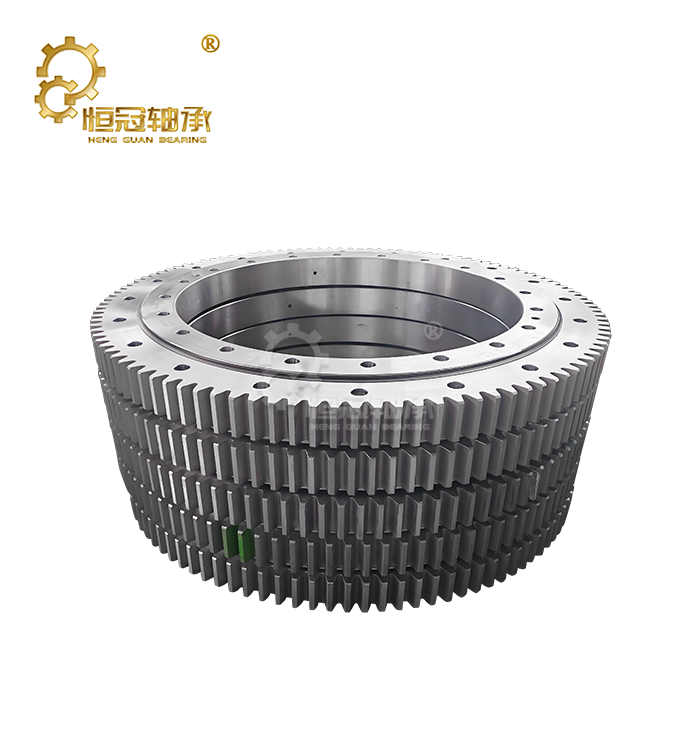
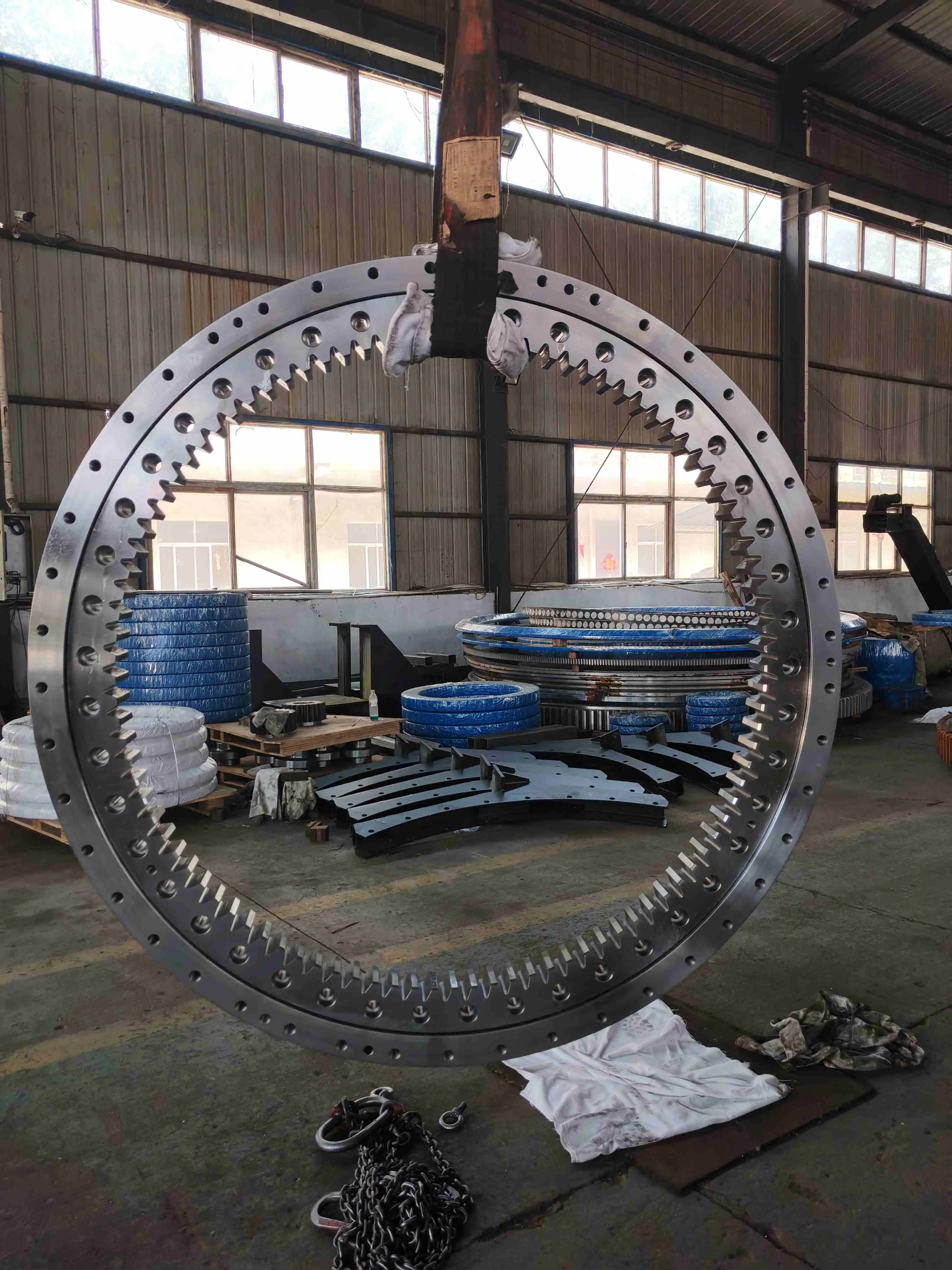
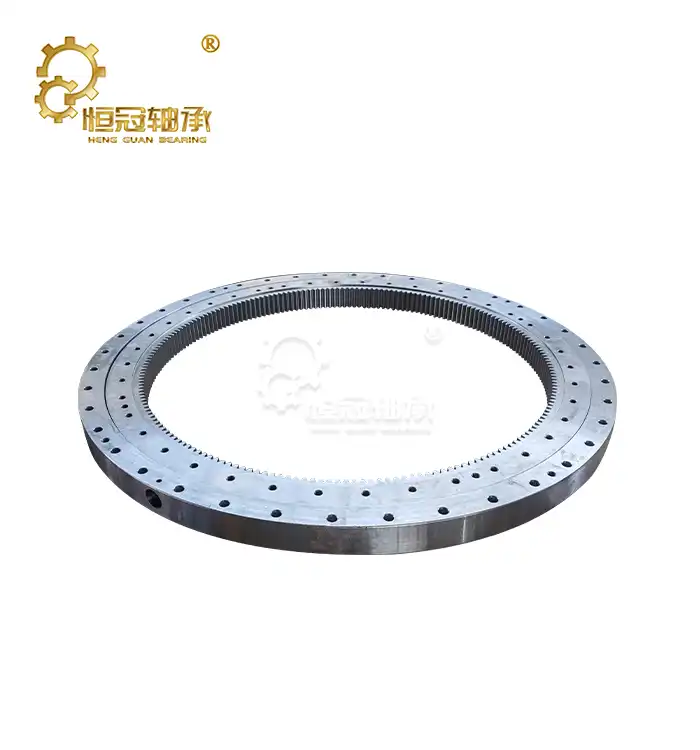
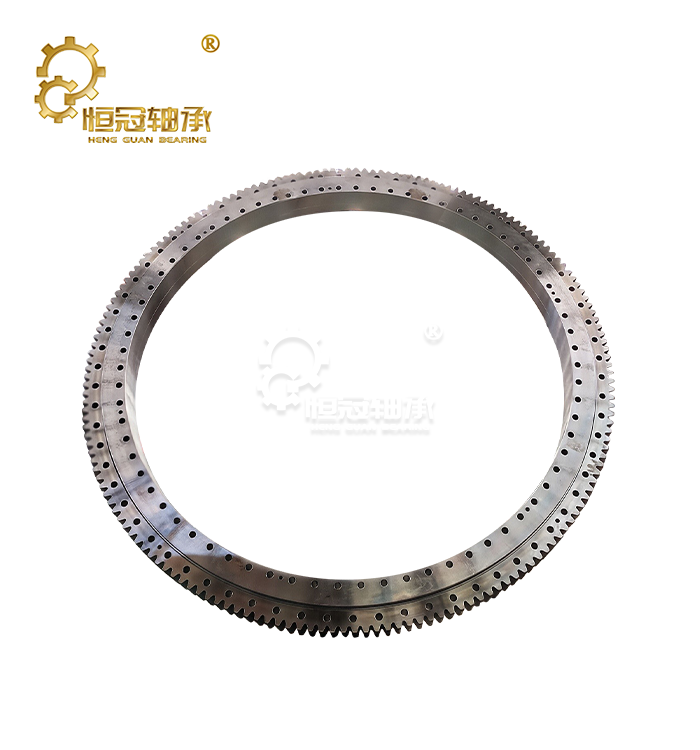
The PC1250 excavator bearing is located between the undercarriage and the top structure. It is subjected to axial load, radial load, and tilting moment at the same time, as the cab and boom move through repeated digging and dumping cycles. A three-row roller slewing bearing is the OEM solution on machines of this size: two horizontal rows of rollers carrying axial load and overturning moment, and a vertical row handling radial load. Stress is distributed over three separate raceways, rather than being concentrated on a single contact path.
Premature failure is not generally due to one reason but a mixture of contaminants, lack of lubrication, overload, and installation mistakes that compound over time. Grinding or clicking sounds during rotation, noticeable looseness between the cab and chassis, and finding metal particles in the grease during regular inspections are early warning symptoms. The PC1250 class bearing has a large dimensional envelope, generally 2,200 to 3,200 mm outer diameter and 150 to 300 mm cross-section height, which requires the reinforced raceways to withstand shock loads in the thousands of kilonewtons.
Heng Guan Bearing makes replacement PC1250 Excavator Bearings using high-strength forged alloy steel and reinforced raceways designed particularly to tolerate the repetitive stress loading generated by this kind of equipment. We are one of the established PC1250 Excavator Bearing Suppliers working with mining and heavy construction fleets, and we always see the same handful of failure modes repeating themselves across different operating environments. That is why it matters to understand them in advance rather than react after the fact.
| PC1250 Bearing Design Feature | Typical Specification | Why It Matters in Service |
|---|---|---|
| Bearing configuration | Three-row roller (2 axial rows + 1 radial row) | Splits axial load, radial load, and tilting moment across dedicated raceways |
| Outer diameter range | 2,200 – 3,200 mm | Matches the structural envelope of PC1250 / 6090 / EX1200-class machines |
| Inner bore range | 1,800 – 2,800 mm | Governs fit-up with the swing pinion and undercarriage interface |
| Cross-section height | 150 – 300 mm | Determines stiffness against overturning deflection under bucket load |
| Rolling element material | GCr18Mo bearing steel, vacuum heat-treated | P4-grade geometry keeps contact stress uniform across the raceway |
Lubrication, Contamination, and Seal Damage: Common Failure Causes
The most typical causes for early PC1250 Excavator Bearing Manufacturers failure are by far lubrication difficulties and pollution. Soil, water, and abrasive grit are the enemies of any slewing bearing raceway. When these particles combine with the grease, they operate like a grinding paste, eroding away carefully machined surfaces with each turn. Seal ageing only makes the situation worse: rubber sealing strips break or harden with time, allowing oil to seep out while dust and moisture find their way in, creating a vicious cycle that accelerates from there. Lack of lubrication or blocked lubrication channels results in metal-to-metal contact between the rolling elements and the raceways, which causes localised heat and quick wear before contamination is even an issue.
The PC1250-class unit’s recommended practice is lithium-based EP2 grease with molybdenum disulfide, re-lubricated every 100 operating hours in clean environments and every 50 hours in dusty mining conditions — intervals that many fleets extend well beyond, which is exactly when failure rates soar. Table 16 summarises the most common lubrication-related failure patterns seen on PC1250-class devices.
| Failure Mode | Root Cause | Typical Symptom | Preventive Countermeasure |
|---|---|---|---|
| Abrasive wear | Contaminated grease (dirt, water, grit) | Metal flakes in grease sample | Shorten re-grease interval to 50 h in dusty mines; check seal condition |
| Lubrication starvation | Missed greasing intervals, clogged channels | Grinding noise, overheating | Stick to EP2 + MoS₂ schedule; verify grease lines are clear |
| Seal degradation | NBR rubber aging, cracking, improper reinstallation | Visible grease leakage, water ingress | Inspect seals every 200 h; replace before hardening cracks form |
How Do Overload and Improper Alignment Damage PC1250 Excavator Bearings?
Apart from lubrication problems, overload and misalignment are two of the most harmful circumstances that a PC1250 excavator bearing may undergo. Each slewing bearing has certain load limitations for axial force, radial force, and overturning moment. If these limits are exceeded, as when a load is swung sideways rather than lifted straight up, the stress concentration is much greater than the raceway is intended to take. This recurrent stress, over time, leads to irreversible deformation of the steel, cracking of the raceway, and, in extreme situations, fracture of the ring gear.
A related but different problem is misalignment. If the mounting surface is not flat, or if bolts are not torqued to specification, the bearing rings distort unevenly when tightened. This creates localised high-stress contact points and accelerates fatigue in specific areas of the raceway, rather than distributing wear evenly. Installation regulations for PC1250-class replacements are exacting: the mounting surface must be level to 0.5 mm across the whole diameter, M30 mounting bolts require 800 – 1,200 N·m of torque, and each mounting bolt must be retorqued after the first 8 hours of operation.
Of course, these two failure mechanisms often go hand in hand on machines that have been stressed without the corresponding attention to installation quality. This is why reputable PC1250 Excavator Bearing Manufacturers always specify exact bolt torque and mounting flatness tolerances along with the bearing itself.
| Condition | Effect on Bearing | Long-Term Consequence | Specification That Prevents It |
|---|---|---|---|
| Overload / lateral swing force | Stress concentration beyond rated capacity | Raceway cracking, ring gear failure | Stay within rated tilting moment; avoid side-swinging loads |
| Uneven mounting surface | Ring distortion under bolt tension | Localized fatigue, accelerated wear | Mounting flatness ≤ 0.5 mm across full diameter |
| Bolt loosening / under-torque | Ring fretting, progressive misalignment | Premature spalling, structural play | M30 bolts at 800 – 1,200 N·m; retorque after first 8 h |
| Impact from excavator bucket teeth strikes | Localized raceway brinelling | Noisy rotation, vibration | Depth-hardened raceway (HRC 58 – 62, 8 – 12 mm case) absorbs shock |
How Can Proper Inspection and Maintenance Prevent Bearing Failure?
Most PC1250 Excavator Bearing Suppliers' failures give warning signs well before catastrophic damage occurs, which is exactly why a disciplined inspection routine pays for itself many times over. Listening for unusual grinding or clicking sounds during rotation, checking grease samples for metal particles or discoloration, and periodically performing a wobble test with the arm extended and bucket resting on the ground are all straightforward diagnostic steps that catch problems early. Bolt torque should be checked at regular service intervals, since loosening bolts are a leading contributor to the misalignment issues discussed above.
A workable PC1250 schedule looks like this: visual checks of seals, leaks, and gear teeth every 200 hours, bolt torque verification every 500 hours, and axial-plus-radial clearance measurement every 1,000 hours. If you're unsure whether your current bearing condition warrants replacement or if you need help sourcing a compatible unit, our team is reachable at mia@hgb-bearing.com and can walk through dimensional specifications or inspection findings with you directly. Heng Guan Bearing supports customers with both routine maintenance guidance and full replacement PC1250 Excavator Bearings, manufactured to match OEM dimensions so downtime stays as short as possible.
| Maintenance Task | Interval (PC1250-class) | What to Look For |
|---|---|---|
| Re-lubrication with EP2 + MoS₂ grease | 50 h (dusty mine) / 100 h (clean) | Consistent grease purge at seals; no darkening or grit |
| Visual inspection of seals and gear teeth | 200 h | Cracks, hardening, leakage, tooth pitting or chipping |
| Bolt torque re-check | 500 h | M30 bolts at 800 – 1,200 N·m; mark bolts after torquing |
| Axial + radial clearance measurement | 1,000 h | Compare against baseline; rising clearance signals raceway wear |
Conclusion
Most PC1250 Excavator bearing failures trace back to contamination, poor lubrication, overload, or misalignment. The three-row roller design of the PC1250-class bearing handles axial load, radial load, and tilting moment through dedicated raceways, but that engineered robustness only holds if greasing intervals are respected, mounting flatness and bolt torque are enforced, and seals are inspected before they fail. Heng Guan Bearing supplies durable replacements engineered to resist exactly these conditions — forged alloy steel, deep-hardened raceways, and CNC-ground gearing in the same dimensional envelope as the OEM unit.
FAQ
Q1: What are the earliest warning signs of PC1250 excavator bearing failure?
A: Grinding or clicking noises during rotation, visible play between the cab and chassis, and metal fragments in the grease are the most common early signs. Rising axial or radial clearance measured at the 1,000-hour check is a leading quantitative indicator.
Q2: How often should the slewing bearing on a PC1250 be greased?
A: Industry practice typically recommends greasing every 250 to 500 operating hours for standard machines, but PC1250-class units in mining duty run tighter: every 100 operating hours in clean environments and every 50 hours in dusty or wet conditions, using lithium-based EP2 grease with molybdenum disulfide.
Q3: Can an overloaded bearing be repaired instead of replaced?
A: Once raceway cracking or significant deformation occurs from overload, repair is generally impractical, and replacement is recommended. Partial raceway spalling might be reconditioned in some bearing shops, but for a bearing carrying this machine's tilting moment, replacement restores full rated capacity at a known cost.
Q4: Does mounting surface flatness really affect bearing life?
A: Yes, an uneven mounting surface distorts the bearing rings under bolt tension, creating localized stress points that accelerate fatigue. On PC1250-class replacements, flatness should hold within 0.5 mm across the full diameter, and M30 bolts should be torqued to 800 – 1,200 N·m, then retorqued after the first 8 hours of operation.
Q5: Why does a PC1250 use a three-row roller bearing instead of a single-row ball bearing?
A: Because the machine combines high axial load with a large overturning moment and radial reaction. Two horizontal roller rows absorb axial load and tilting moment, while one vertical row carries radial load, distributing stress across three raceways and providing far higher stiffness and shock resistance than a single-row design.
Ready to Replace Your PC1250 Excavator Bearing?
Don't let a worn slewing bearing put your PC1250 Excavator Bearings out of service longer than necessary. Heng Guan Bearing can supply a durable, correctly specified replacement fast — forged alloy steel rings, deep-hardened raceways, and precision-ground gearing in OEM dimensions. Email mia@hgb-bearing.com today to get started.
References
1. Harris, T. A., & Kotzalas, M. N. (2006). Advanced Concepts of Bearing Technology: Rolling Bearing Analysis, Fifth Edition. CRC Press.
2. International Organization for Standardization. (2007). ISO 281:2007: Rolling bearings — Dynamic load ratings and rating life. ISO.
3. International Organization for Standardization. (2006). ISO 76:2006: Rolling bearings — Static load ratings. ISO. [See also Amendment 1:2017.]
4. International Organization for Standardization. (2023). ISO 683-17:2023: Heat-treated steels, alloy steels and free-cutting steels — Part 17: Ball and roller bearing steels. ISO.
5. American Society of Mechanical Engineers. (2018). ASME SRB-1-2018 (R2023): Design, Installation, Maintenance, and Application of Ball Slewing Ring Bearings. ASME.
6. Ministry of Industry and Information Technology of the People's Republic of China. (2018). JB/T 2300-2018: Slewing bearings. Machinery Industry Standard of the People's Republic of China.

WHAT OUR CUSTOMERS SAY
Here is the customer's evaluation of us
_1767784942887.webp)
_1776668700508.webp)