



Can a Small Slewing Bearing Handle High Loads Efficiently?
When engineers design compact equipment that still needs to withstand high axial, radial, and overturning moment loads, a natural question arises: can a small slewing bearing really deliver industrial-level load capacity in such a limited space? At Luoyang Heng Guan Bearing Technology, we design compact slewing solutions that combine high load capability with space efficiency, enabling stable performance in robotics, precision machinery, and industrial automation systems. In this article, we will break down how a small slewing bearing handles loads efficiently, what determines its capacity, and how to choose the right configuration for demanding applications.
What Load Capacity Can a Small Slewing Bearing Actually Support?
A small slewing bearing is engineered to handle combined loads simultaneously, rather than distributing them across multiple separate components. This includes:
- Axial load (vertical force)
- Radial load (horizontal force)
- Overturning moment (tilting force)
Instead of limiting performance due to compact size, the internal raceway geometry is optimized to distribute stress evenly across rolling elements.
Typical dimensional ranges include:
- Outer diameter: 80mm – 500mm
- Inner diameter: 60mm – 400mm
- Height: 8mm – 40mm
This range allows engineers to select a configuration precisely matched to load conditions instead of oversizing the system, which is especially important in:
- Robotics
- Precision turntables
- Medical equipment
- Aerospace mechanisms
- Automation systems
Structural Designs That Enable High Load Performance
The load capacity of a small slewing bearing largely depends on its internal structural design. Two main configurations are used:
| Structure Type | Load Handling Characteristics |
|---|---|
| Four-point contact ball | Efficient handling of combined axial and radial loads |
| Crossed roller | Higher rigidity and superior moment load capacity |
The crossed roller structure is particularly effective in high-load precision systems because the cylindrical rollers provide a larger contact area, improving stiffness and reducing deformation under moment loads.
Meanwhile, the four-point contact design offers a more balanced solution for applications requiring smooth rotation and moderate load capacity.
Key Material Systems That Support Load Durability
Load performance is not only structural—it depends heavily on material selection and heat treatment.
Common materials include:
- GCr15 bearing steel – high hardness and wear resistance
- 50Mn alloy steel – strong fatigue resistance under cyclic loads
- 42CrMo alloy steel – excellent toughness and impact resistance
- SUS440C stainless steel – corrosion-resistant environments
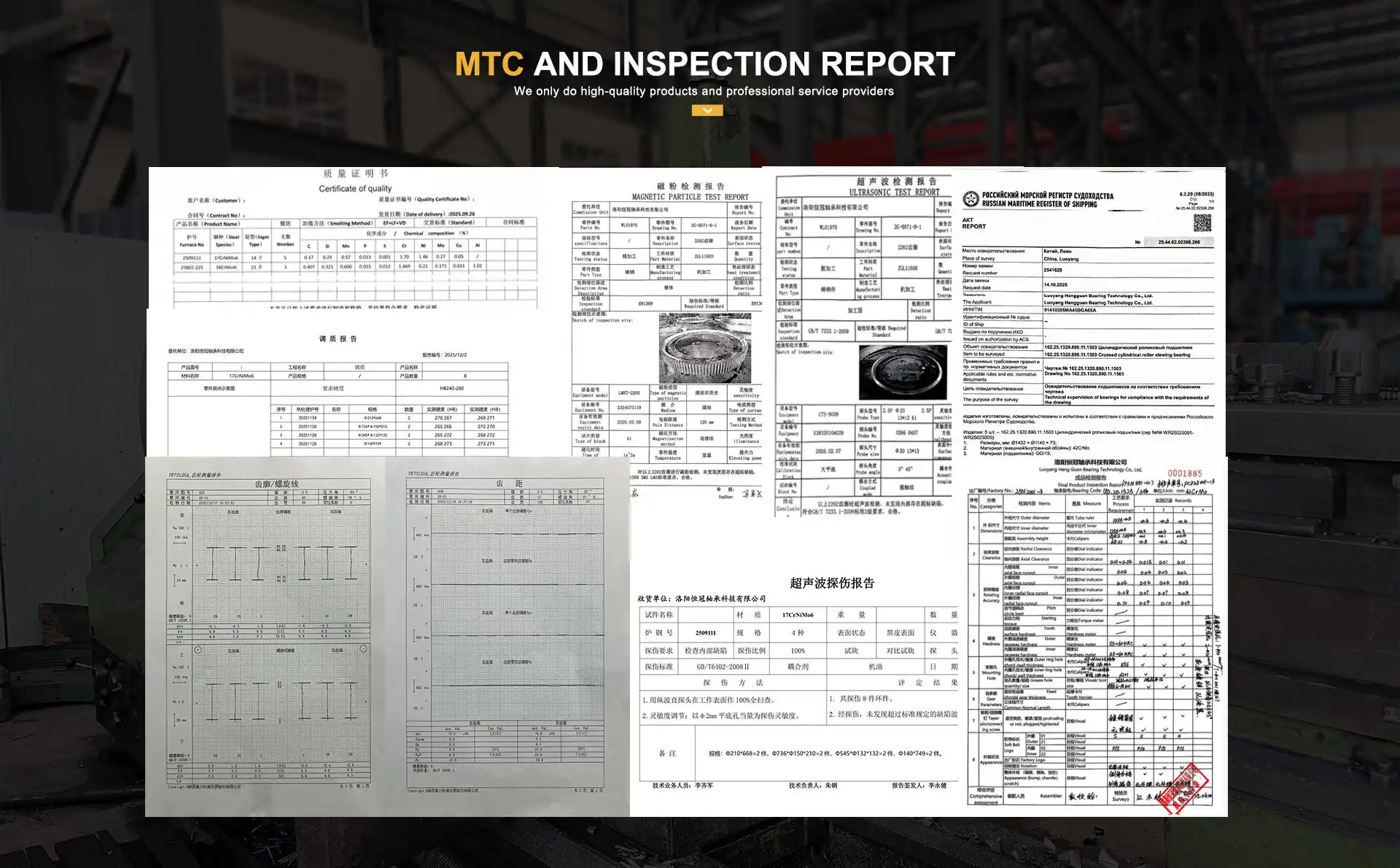
Raceways are precision ground and heat-treated to ensure stable hardness and dimensional integrity during long-term operation. This ensures that even under repeated load cycles, the bearing maintains its structural geometry and load distribution performance.
Integrated Design Advantages Under High Load Conditions
One of the most important advantages of a small slewing bearing is its integrated structure, which combines:
- Radial bearing function
- Axial thrust bearing function
- Structural support function
This integration eliminates assembly gaps and misalignment risks commonly found in multi-component systems.
As a result:
- Load is distributed more evenly
- Stress concentration is reduced
- Structural deformation is minimized
- Service life is extended
Optional sealing systems further improve durability by preventing dust and moisture ingress, which is especially important in industrial automation and outdoor applications.
How to Select a High-Load Small Slewing Bearing
Selecting the correct bearing requires evaluating more than just size. Key factors include:
| Selection Factor | Why It Matters |
|---|---|
| Structural type | Determines rigidity and moment capacity |
| Material grade | Impacts fatigue life and wear resistance |
| Heat treatment quality | Ensures hardness stability under load |
| Precision class | Affects smoothness and load distribution |
| Sealing design | Protects against contamination |
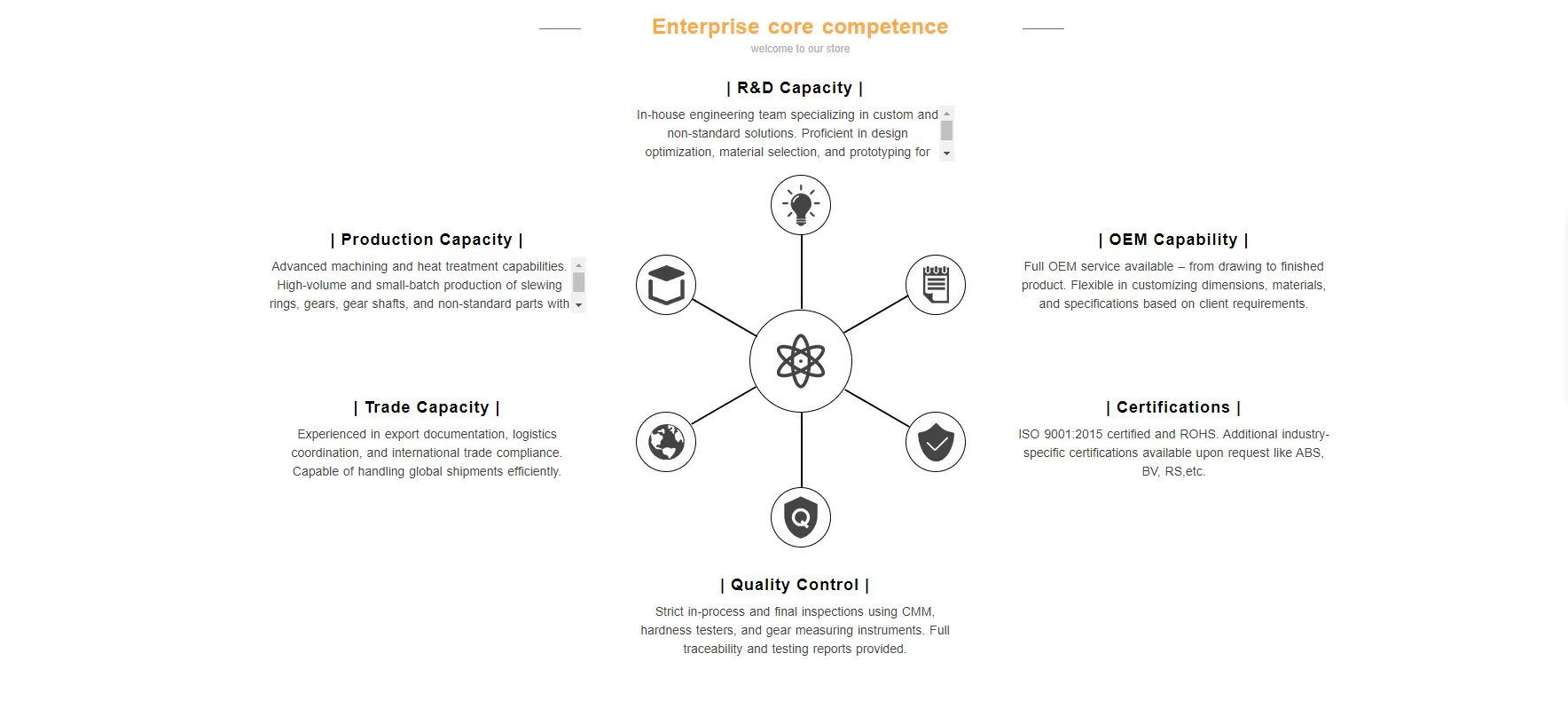
Manufacturing capability is equally important. CNC machining, precision grinding, and gear processing directly influence how accurately loads are distributed across the raceway system. Luoyang Heng Guan Bearing Technology Co., Ltd. provides full-range customization services for small slewing bearings, including structural optimization, non-standard design, and reverse engineering based on samples without drawings.
Our engineering team evaluates load conditions, application environments, and precision requirements to ensure each solution is properly matched for high-load performance. For technical selection support, you may contact our engineers at mia@hgb-bearing.com.
Typical Applications in High-Load Compact Systems
Despite their compact size, small slewing bearings are widely used in systems where high load + limited space must coexist:
- Industrial robotic arms (high moment load joints)
- Precision inspection turntables
- Medical imaging equipment (CT/MRI rotation platforms)
- Aerospace compact actuation systems
- Automated production and assembly systems
In all these cases, the bearing must maintain stable load distribution while ensuring precise rotation over long operating cycles.
Conclusion
A small slewing bearing from Luoyang Heng Guan Bearing Technology is not limited by its size—it is engineered to efficiently handle combined axial, radial, and moment loads through optimized structure, material selection, and precision manufacturing.
This makes it a reliable solution for compact yet high-load-demand applications across robotics, automation, and precision engineering industries.
FAQ
Q1: Can a small slewing bearing handle high loads despite its size?
A: Yes. It is designed to handle axial, radial, and overturning moment loads simultaneously through optimized raceway geometry.
Q2: Which structure is better for high-load applications?
A: Crossed roller structures provide higher rigidity and better moment load capacity than four-point contact designs.
Q3: What materials are used for high-load performance?
A: GCr15, 50Mn, and 42CrMo alloy steels are commonly used for strength and fatigue resistance.
Q4: What is the typical size range?
A: Outer diameters range from 80 mm to 500 mm, with heights from 8 mm to 40 mm.
Q5: Where are small slewing bearings commonly used?
A: Robotics, medical systems, aerospace equipment, precision turntables, and automation systems.
Need a Compact Bearing for High Load Applications?
If your equipment requires compact structure, high load capacity, and long-term rotational stability, Luoyang Heng Guan Bearing Technology Co., Ltd. can provide engineered slewing bearing solutions tailored to your load conditions and working environment. From standard small slewing bearings to fully customized high-load designs, we offer end-to-end technical support including selection, structural optimization, manufacturing, testing, and reverse engineering. Whether your application is in robotics, heavy automation systems, aerospace mechanisms, or precision industrial equipment, our engineering team can help you achieve reliable performance under demanding load conditions. Contact our engineers: mia@hgb-bearing.com. Send your requirements or drawings today to receive a customized technical solution and quotation.
|
|
References
1. Load Capacity Analysis of Compact Slewing Bearings, Journal of Mechanical Design and Automation
2. Crossed Roller vs Ball Bearing Performance Comparison, International Journal of Precision Engineering
3. Fatigue Behavior of Bearing Steels Under Cyclic Loading, Materials Science Reports
4. Structural Optimization in Compact Rotary Systems, Aerospace Engineering Journal
5. Manufacturing Standards for Slewing Bearings in China, China Bearing Industry Yearbook
6. Industrial Applications of Compact Load-Bearing Systems, Journal of Automation Engineering

WHAT OUR CUSTOMERS SAY
Here is the customer's evaluation of us