



Why Use a 130.40.1600 slewing bearing in Wind Turbines?
Every hour that a wind turbine is not moving results in a financial loss. The yaw and pitch positions are among the most difficult parts of the machine to maintain. This is due to the fact that changing a damaged slewing bearing frequently requires the use of heavy cranes, weather windows, and a significant amount of time lost in production. In most cases, the same concerns are shared by both operators and original equipment manufacturers (OEMs): bearings that wear out prematurely, units that do not fit the mounting interface and need to be returned, and suppliers that are unable to match drawings or produce test data. By selecting the appropriate 130.40.1600 slewing bearing and the appropriate supplier, the majority of that risk is eliminated. We at Heng Guan Bearing are responsible for the design and production of slewing bearings, which are used to maintain the stability, accuracy, and dependability of rotating constructions. In the following paragraphs, we will discuss the ability of the 130.40.1600 slewing bearing to manage enormous loads, the benefits that it offers, how to choose it, and how to extend its lifespan.
How Does a 130.40.1600 Slewing Bearing Handle Combined Loads in Wind Turbines?
Rarely does a wind turbine encounter a single clean load. An axial force is produced by the wind pressure exerted on the blades, radial force is added by the weight of the rotor and gusts, and the tower must be able to withstand a continual overturning moment. It is necessary for a slewing bearing to handle all three at some point. The slewing bearing with the model number 130.40.1600 is constructed with a three-row cylindrical roller structure. This means that different roller rows are responsible for separately carrying axial load, reverse axial load, and radial load. The contact load is distributed across a large area due to the fact that each row has its own raceway.
This reduces the amount of local tension and maintains a smooth rotation. That’s why the model number 130.40.1600 slewing bearing is suitable for yaw and pitch systems, which need strength and precision to function properly. Heng Guan Bearing optimizes the raceway geometry and CNC quenching to ensure the designed performance of each roller row.
| Roller Row | Load Carried | Role in a Wind Turbine |
|---|---|---|
| Axial roller row | Main axial load | Resists wind thrust acting on the rotor and nacelle |
| Reverse axial roller row | Reverse axial load and overturning moment | Keeps the ring seated under gusts and tilting moments |
| Radial roller row | Radial load | Carries rotor weight and lateral wind force |
Key Performance Advantages of 130.40.1600 Slewing Bearing in Wind Turbine Applications
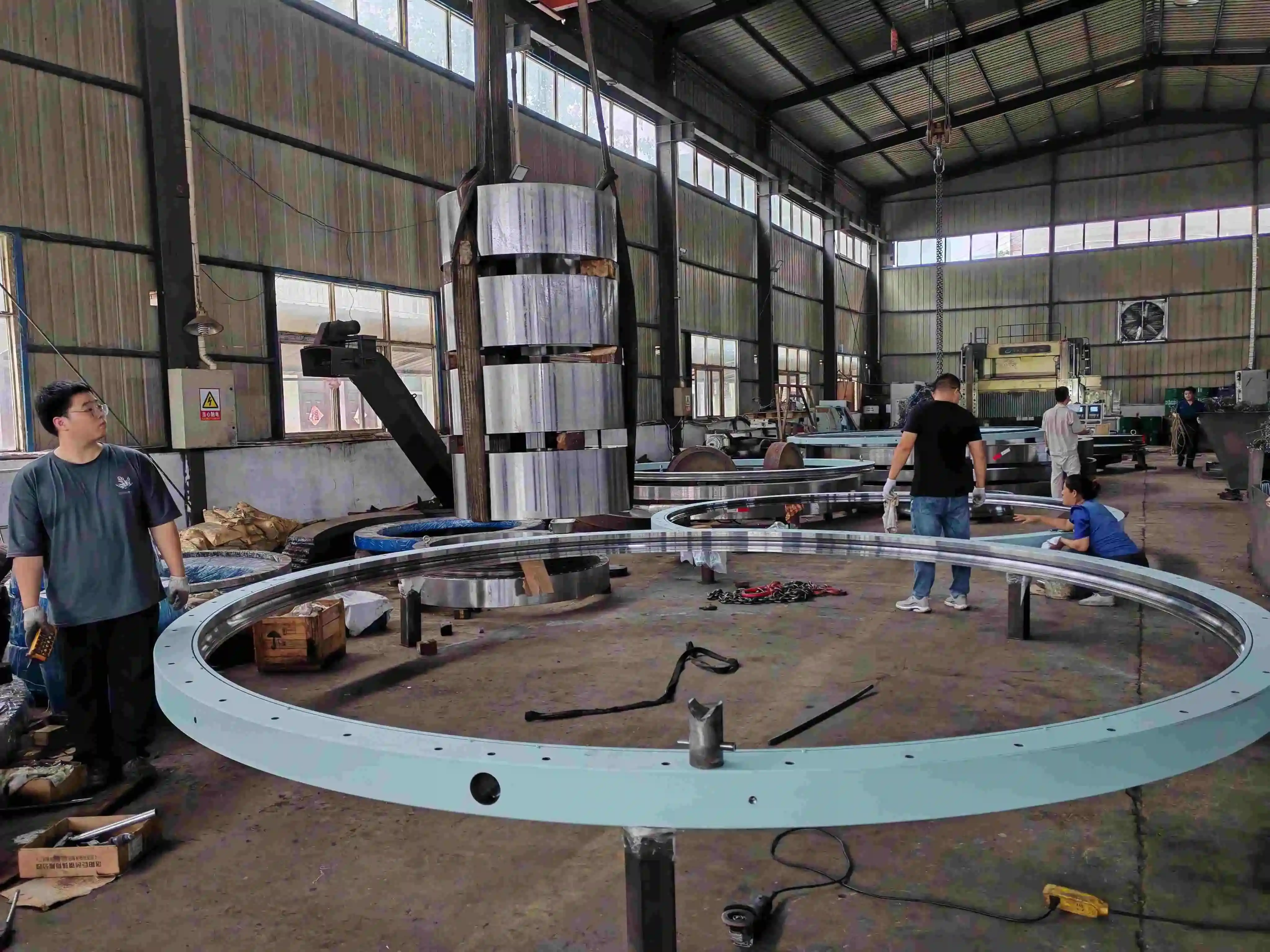
The 130.40.1600 slewing bearing has a number of practical benefits, which are of great significance in the long working life of a turbine. These benefits are not just about load capacity. Its compact and integrated design allows it to replace several individual bearings with a single unit, simplifying installation and saving space within the hub or nacelle. The three-row roller slewing bearing has high stiffness, which helps to keep the meshing with the drive pinions stable and to keep the blade or nacelle pointing in the right direction. This will result in a smoother motion and fewer adjustments for the operators. Moreover, Heng Guan Bearing engineers customize each slewing bearing according to the customer’s drawings and working conditions. This includes the use of reverse engineering in situations where the original blueprints are unknown. Here is a table that provides a summary of the primary advantages.
| Feature | Practical Benefit |
|---|---|
| Three-row roller structure | High axial, radial, and moment capacity |
| Integrated single unit | Faster installation, less space used |
| High rigidity | Stable positioning and smooth rotation |
| Custom design options | Better match to turbine requirements |
In the field, the durability of these benefits is determined by the quality of the manufacturing process. Our rings are made from 42CrMo or 50Mn alloy steel and GCr15SiMn rolling elements. During CNC quenching, the hardness level along the raceway is the same, so the wear is the same. The normal operating range is -30 degrees Celsius to +80 degrees Celsius.
| Parameter | Value |
|---|---|
| Structure | Three-row cylindrical roller |
| Precision Grades | P0, P6, P5, P4 |
| Base Material | 42CrMo, 50Mn alloy steel |
| Rolling Elements | GCr15SiMn bearing steel |
| Operating Temperature | -30°C to +80°C (standard) |
| Gear Options | No gear (130 series), external gear (131 series), internal gear (133 series) |
| Load Capacity | Calculated per application; load curve available on request |
What Should Buyers Check When Selecting a 130.40.1600 Slewing Bearing?
The first step in selecting the appropriate slewing bearing is to have a thorough comprehension of the function of your turbine. Confirm the maximum axial load, radial load, and overturning moment, and then compare these values to the rated capacity of the slewing bearing with the model number 130.40.1600. After that, conduct a thorough examination of the mounting dimensions, bolt patterns, gear requirements, and accuracy grade, given that our goods encompass P0, P6, P5, and P4. Listed below are the primary dimensions of the slewing bearing with the model number 130.40.1600.
| Parameter | Value |
|---|---|
| Outer Diameter | 1795 mm |
| Inner Diameter | 1405 mm |
| Height | 220 mm |
| Mounting Bolt Circle (outer ring) | 1743 mm |
| Mounting Bolt Circle (inner ring) | 1457 mm |
| Mounting Holes | 48 × Ø26 mm |
Material, heat treatment, and test records also deserve attention. If you are unsure about any parameter, our team is glad to help; simply email mia@hgb-bearing.com with your drawings and operating data. Heng Guan Bearing will review them and suggest a suitable solution. The checklist below can guide your inquiry.
| Check Item | What to Confirm |
|---|---|
| Load data | Axial, radial, and moment values |
| Dimensions | Mounting size and bolt holes |
| Gear requirement | No gear, external gear, or internal gear |
| Accuracy grade | P0, P6, P5 or P4 |
| Material and treatment | Steel grade, raceway hardening |
| Documentation | Inspection and test reports |
How Do Lubrication, Sealing, and Maintenance Improve Slewing Bearing Service Life?
Even a well-built 130.40.1600 slewing bearing benefits from good care. A film of suitable grease is applied at regular intervals to the rollers and raceways to protect them. This lowers friction and wear. Reliable seals prevent dust, moisture, and salt spray ingress, which is particularly valuable in coastal and offshore wind sites. Teams can inspect bolt preload, raceway condition, and rotation torque on a set schedule to catch small changes early and schedule work on their own terms. Keeping your records clean and following the recommended relubrication interval will help your slewing bearing deliver consistent performance for many years.
| Interval | Action Required |
|---|---|
| After initial run-in | Re-check bolt preload. Early bedding-in can relax bolts, which may lead to fretting at the mounting surface if left uncorrected. |
| Monthly | Listen for unusual noise or vibration during yaw or pitch movement. These often signal lubrication depletion or early raceway wear. |
| Quarterly | Inspect seals for cracking, deformation, or grease leakage. Contamination is a leading cause of premature failure. |
| Annual | Check rotation torque and clearance against the baseline recorded at installation. |
| Based on operating hours | Re-grease through all lubrication points. Offshore and high-duty sites need shorter intervals. |
Heng Guan Bearing provides maintenance guidance with every project, and our technical team can prepare a checklist matched to your turbine model, so your team can build a simple routine with confidence.
Conclusion
The 130.40.1600 slewing bearing combines three-row roller strength, compact design, and dependable rotation, making it a strong fit for wind turbines. Choosing it is not only a technical decision. It is a practical way to protect uptime and control lifecycle cost. With correct selection and regular care, it supports a long service life. Heng Guan Bearing is ready to supply and customize it for your project.
FAQ
What type of bearing is the 130.40.1600?
It is a three-row cylindrical roller slewing bearing in the no-gear version. External-gear (131 series) and internal-gear (133 series) versions are also available.
Can it carry combined loads?
Yes. Separate roller rows support axial, radial, and overturning moment loads together.
Which accuracy grades are available?
Heng Guan Bearing offers P0, P6, P5, and P4.
Can it be customized?
Yes. We adapt designs to your drawings and working conditions, including non-standard dimensions and gear configurations.
How can I extend its service life?
Use proper lubrication, effective sealing, correct bolt torque, and regular inspections.
Ready to Upgrade Your Wind Turbine Bearings? Contact Us Today!
Choose Heng Guan Bearing for reliable, customized slewing bearing solutions:
- Slewing bearings from 50 mm up to 10,000 mm, P0 to P4 precision
- ISO 9001 certified production with custom sizing and material options
- Engineering team available for load analysis, selection, and installation guidance
Send your requirements to mia@hgb-bearing.com, and our team will reply with a clear proposal quickly. Let us help your turbines run smoothly for years.
References
1. Harris, T. A., & Kotzalas, M. N. (2006). Essential Concepts of Bearing Technology. CRC Press.
2. Hau, E. (2013). Wind Turbines: Fundamentals, Technologies, Application, Economics. Springer.
3. Burton, T., Jenkins, N., Sharpe, D., & Bossanyi, E. (2011). Wind Energy Handbook. Wiley.
4. Manwell, J. F., McGowan, J. G., & Rogers, A. L. (2009). Wind Energy Explained. Wiley.
5. Harris, T. A. (2001). Rolling Bearing Analysis. Wiley.
6. ISO 281:2007. Rolling Bearings: Dynamic Load Ratings and Rating Life. International Organization for Standardization.

WHAT OUR CUSTOMERS SAY
Here is the customer's evaluation of us