




How Does a Case Excavator slewing bearing Improve Jobsite Uptime?
Every hour a Case excavator stands idle costs you money, and the slewing bearing is often where trouble starts. Under constant impact loads, abrasive dust and mud, and the strain of heavy bucket work at full reach, a worn bearing leads to premature raceway wear, gear tooth failure, and rotational instability that eat into productive hours. If this sounds familiar, a well-chosen and well-maintained Case Excavator slewing bearing is the most effective way to keep the upper structure turning smoothly, with fewer interruptions and more productive hours on site. In this guide, Heng Guan Bearing explains what the bearing does, how to inspect it, how to lubricate it, and how to pick the right replacement, so your team can plan maintenance with confidence and keep every machine working.
What Role Does a Case Excavator slewing bearing Play in Machine Performance?
A slewing bearing, also called a swing circle or turntable bearing, is the basic link between the excavator's upper structure and its undercarriage. Every time the operator digs, lifts, or swings, the Case Excavator slewing bearing carries axial loads, radial forces, and tilting moments while allowing smooth 360-degree rotation. When it performs well, the cab responds precisely, the bucket lands where the operator intends, and the swing motor works without extra effort.
Heng Guan Bearing supplies a complete range for Case machines from 5 to 80 tons, covering models from the compact CX55 to the heavy-duty CX800, including the CX75, CX130, CX210, CX240, CX290, CX350 and CX470 series as well as the legacy WX series. Each bearing uses finite element analysis and a reinforced raceway design, giving your machine the load capacity and stability it needs for demanding daily work. Two structural families cover most applications.
| Structure | Primary Load Characteristic | Typical Application |
|---|---|---|
| Single-row four-point contact ball | Handles axial, radial, and moment loads at once; low friction and quiet operation | Standard excavation, material handling, urban utility work, compact installation space |
| Single-row cross-roller and three-row roller | Maximum load capacity in minimal axial height; superior rigidity and tilting-moment resistance | Heavy demolition, mining and quarry work, high-frequency duty cycles with extreme shock loads |
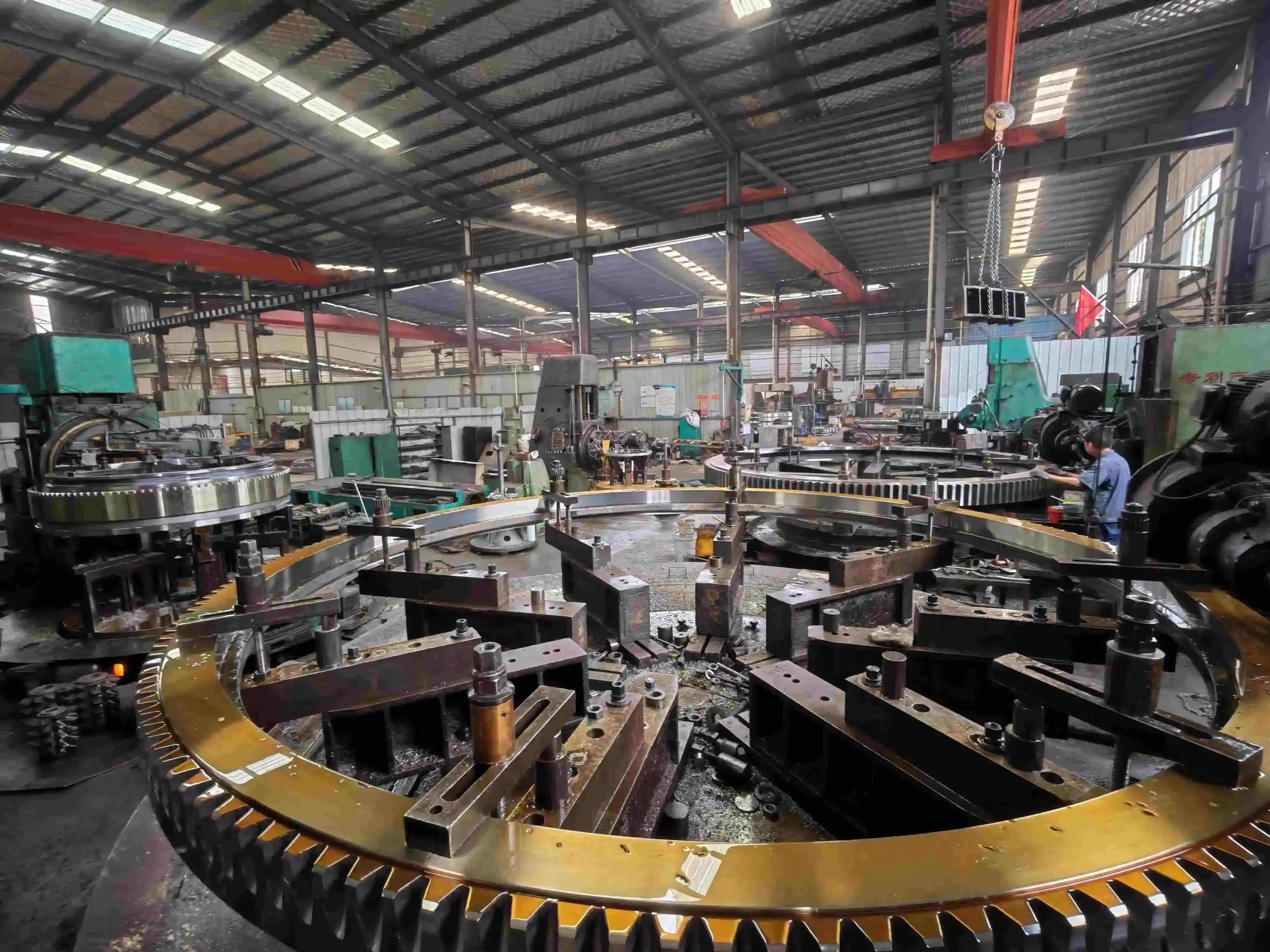
Material and heat treatment decide how long a Case Excavator slewing bearing lasts. Our rings are forged from 50Mn or 42CrMo alloy steel, and medium-frequency induction hardening gives the raceways a surface hardness of HRC 55–62 with a case depth of 2.5–5 mm, while the tough core resists brittle failure. Gear surfaces are induction hardened to HRC 45–50 to balance wear resistance with impact toughness, and multi-lip seals with labyrinth features keep abrasive particles and moisture out.
Key Technical Specifications
| Parameter | Specification Range |
|---|---|
| Diameter coverage | 50 mm – 10,000 mm |
| Precision grades | P0, P6, P5, P4 |
| Raceway hardness | HRC 55–62 |
| Gear hardness | HRC 45–50 |
| Base materials | 50Mn, 42CrMo alloy steel |
| Sealing type | Multi-lip NBR/FKM with labyrinth |
| Standards compliance | ISO, DIN, GB |
How Can Regular Inspection Prevent Unexpected Excavator Downtime?
Planned inspection turns surprises into scheduled maintenance. Walk around the machine at regular intervals and check the mounting bolts, seals, and grease condition around the Case Excavator slewing bearing. Listen during a full swing for unusual sounds, and watch for any hesitation, gear backlash, or play in the upper structure. Recording your findings each time helps your team spot trends early and book service before the next busy period. Heavy-duty applications may need more frequent checks. The table below offers a simple routine you can adapt to your own fleet.
| Check | Frequency | What to Look For |
|---|---|---|
| Bolt tightness | Every 250 hours | Secure, evenly torqued fasteners |
| Seal condition | Every service | Intact seals, clean surroundings |
| Swing sound | Daily | Smooth, quiet rotation |
| Grease appearance | Every service | Clean, consistent grease |
| Re-lubrication | Every 100–200 operating hours | Fresh grease at all lubrication points |
Essential Lubrication and Maintenance Practices for Longer Bearing Service Life
Applying enough oil is the most straightforward method for extending the lifespan of a slewing bearing on a Case Excavator. Before beginning operation, the grease channels should be filled with the lubricant that has been prescribed, and the bearing should be rotated many times to ensure that the grease is distributed uniformly over the raceways. Replace the lubricant every one hundred to two hundred hours of operation, and the gear teeth should also be gently lubricated. Before adding new grease, you should remove any old oil and debris from the gear teeth. The seals protect the internal components from filth; therefore, it is important to maintain them clean and in position. Additionally, during regular maintenance, check the tension of the bolts, the gear backlash, and the rotation smoothness. In order for the bearing to provide smooth rotation year after year, it is necessary to adhere to a routine that is consistent.
If you would like a lubrication plan matched to your working conditions, share your machine model and site details with our engineers at mia@hgb-bearing.com, and we will gladly help.
How to Select the Right Replacement Slewing Bearing for Case Excavators?
When replacement time comes for a Case Excavator slewing bearing, begin with your machine model and serial number, or the part number on your existing bearing, then confirm the key dimensions: outer and inner diameter, height, bolt hole layout, and number of gear teeth. Check that the gear type matches your swing pinion. Our structural dimensions and mounting interfaces are compatible with industry-standard specifications for plug-and-play installation, and we keep a large inventory of common models. The table below shows a selection of Case models and their key dimensions (all in mm).
| Case Model | Part Number | Outer Diameter | Inside Diameter | Total Height | Outer / Inner Holes | Teeth |
|---|---|---|---|---|---|---|
| CX130 | KNB10130 | 1172 | 972 | 88 | 28 / 36 | 98 |
| CX210 | KRB10160 | 1330 | 1093 | 102 | 31-φ22 / 36-M20 | 92 |
| CX210B | KRB11710 | 1330 | 1093 | 102 | 31-φ22 / 36-M20 | 92 |
| CNH E215 | 72203516 | 1312 | 1082 | 110 | 33 / 36 | 110 |
| CX240 | KBB10080 | 1376 | 1093 | 125 | 27 / 36 | 92 |
| CX240B | KBB11350 | 1377 | 1094 | 124 | 28-26 / 36-M24 | 92 |
| CX290 | KBB10100 | 1615 | 1274 | 122 | 41 / 46 | 92 |
| CX460 | KTB10010 | 1615 | 1275 | 145 | 41-Φ26 / 46-M24 | 92 |
Heng Guan Bearing manufactures slewing bearings from 50 to 10,000 mm with P0, P6, P5, and P4 accuracy, and we can customize designs to your drawings or working conditions, including non-standard hole patterns, gear modifications, and special sealing. For older machines, we offer technical support for measuring and reverse-engineering your existing bearing. Our quality checks include coordinate measuring machine verification, gear tooth profile analysis, hardness depth testing, seal integrity validation, and assembly runout measurement, so the bearing arrives ready to install. Heng Guan Bearing is ISO9001 certified and RoHS compliant. Use the table below as a quick selection guide.
| Selection Point | What to Confirm |
|---|---|
| Machine model | CX series model and serial number |
| Dimensions | Diameters, height, hole layout |
| Gear design | Internal or external teeth, tooth count |
| Precision grade | P0, P6, P5 or P4 |
| Support | Installation guidance and technical advice |
Conclusion
A dependable Case Excavator slewing bearing supports smooth rotation, and regular inspection, correct lubrication, and careful replacement selection keep it working longer. Together, these habits reduce stoppages, protect productivity, and prevent small signs of wear from turning into costly failures on site. Checking bolt tightness, seal condition, and swing sound at scheduled intervals, re-greasing every 100–200 operating hours, and matching dimensions, gear teeth, and precision grade to your machine model all help avoid premature raceway wear and gear tooth failure. Heng Guan Bearing is ready to help you keep every machine running, with plug-and-play replacements for CX and legacy WX series excavators, forged 50Mn and 42CrMo rings, ISO9001-certified production and engineering support from selection through installation.
FAQ
Which Case models do you cover?
We cover Case excavators from 5 to 80 tons, from the CX55 to the CX800, plus the legacy WX series.
How often should I inspect the bearing?
Check the sound and seals daily, and review bolts and grease at every service. Heavy-duty applications may need more frequent checks.
How do I lubricate a new bearing?
Fill the grease channels with the specified lubricant, then rotate the bearing several times. Re-lubricate every 100–200 operating hours.
What details do I need for a replacement?
Provide your machine model, serial number, working conditions, and, if possible, the part number or dimensions of your existing bearing.
Can you customize a bearing?
Yes, we design and produce to your drawings or application needs, and we can measure and reverse-engineer an existing bearing.
What is your lead time?
In-stock products ship within 7–15 days. Custom configurations take 4–6 weeks depending on complexity.
Keep Your Case Excavator Working
Ready to improve your jobsite uptime? Heng Guan Bearing combines engineering expertise and manufacturing capability to deliver a Case Excavator slewing bearing that keeps your fleet productive:
- Plug-and-play replacements for Case CX and legacy WX series, from 5 to 80 tons
- Forged 50Mn / 42CrMo rings with HRC 55–62 hardened raceways
- ISO9001-certified production with full inspection and RoHS compliance
- Large stock inventory, custom designs and reverse engineering for older machines
Contact Heng Guan Bearing today for expert advice, fast quotations, and reliable replacement bearings. Email our team at mia@hgb-bearing.com with your machine model and requirements, and let us deliver the right solution for your fleet.
References
1. Harris, T. A., & Kotzalas, M. N. (2006). Essential Concepts of Bearing Technology (5th ed.). CRC Press.
2. International Organization for Standardization. (2007). ISO 281: Rolling bearings – Dynamic load ratings and rating life. ISO.
3. International Organization for Standardization. (2017). ISO 15243: Rolling bearings – Damage and failures – Terms, characteristics and causes. ISO.
4. Khonsari, M. M., & Booser, E. R. (2017). Applied Tribology: Bearing Design and Lubrication (3rd ed.). Wiley.
5. SKF Group. (2011). SKF Bearing Maintenance Handbook. SKF.
6. International Organization for Standardization. (2015). ISO 9001: Quality management systems – Requirements. ISO.

WHAT OUR CUSTOMERS SAY
Here is the customer's evaluation of us