




Where Are RKS.161.14.0544 Slewing Bearings Commonly Used?
Selecting the incorrect rotating joint is a costly error to make with your money. Engineers who specify RKS.161.14.0544 slewing bearings frequently confront the same concerns: bearings that are too bulky for the area that is available, units that wear out prematurely under tilting loads, and vendors who are unable to match a drawing or answer technical queries. The answer to the question of where RKS.161.14.0544 slewing bearings fit best is applicable to a wide variety of pieces of machinery. Engineers also ask this question. As a result of its compact size, rigidity, and precision, this crossed roller slewing bearing with an external gear is utilized in lifting machinery, automation systems, and specialty rotating platforms. The slewing bearings that we design and produce at Heng Guan Bearing are designed to assist machines in rotating smoothly even when subjected to rigorous loads. This article examines the various industries that rely on RKS.161.14.0544 Slewing Bearings, ranging from robotics to cranes, and explains why the crossed roller design is so effective in meeting the needs of these businesses.
Which Industrial Machines Commonly Use RKS.161.14.0544 Slewing Bearings?
RKS.161.14.0544 slewing bearings are a practical choice for machines that need a compact rotating joint capable of carrying axial force, radial force, and tilting moment together. The crossed roller structure places rollers at alternating angles between two rings, so one slewing bearing can handle several load directions without extra support. The external gear lets the bearing connect directly with a drive pinion, which simplifies the rotation mechanism. Because of this, RKS.161.14.0544 slewing bearings are commonly found in lifting equipment, packaging and automation lines, medical devices, and testing platforms. Heng Guan Bearing supplies slewing bearings for fields such as new energy, mining, port machinery, and aerospace, so we can match this model to many working conditions.
| Machine Type | Role of the Slewing Bearing |
|---|---|
| Lifting equipment | Supports rotating boom or platform |
| Automation lines | Enables precise indexing |
| Medical equipment | Provides smooth, stable rotation |
| Test platforms | Carries load with accurate positioning |
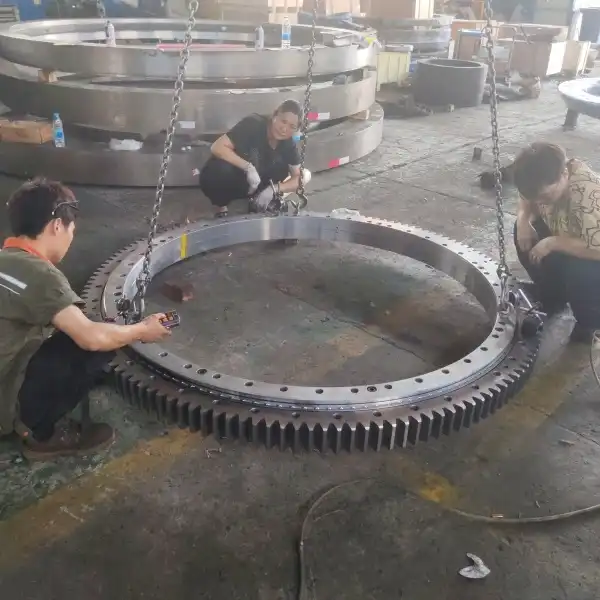
The main technical data of the RKS.161.14.0544 slewing bearing are listed below in a clear, well-organized table, so that you can quickly and easily determine whether its overall dimensions, inner and outer diameters, mounting hole layout, gear module and tooth count, basic dynamic and static load ratings, and total mass are suitable for your available installation space and the requirements of your particular application before you make your final choice of bearing.
| Parameter | Value |
|---|---|
| Structure | Single-row crossed cylindrical roller, external gear |
| Outer Diameter | 640.8 mm |
| Inner Diameter | 474 mm |
| Height | 56 mm |
| Raceway Diameter | 544 mm |
| Outer Ring Mounting | 28 × M12 holes on Ø585 mm circle |
| Inner Ring Mounting | 32 × Ø14 mm holes on Ø498 mm circle |
| Gear Module / Teeth | m = 6 / z = 105 |
| Basic Load Ratings | Dynamic Cr 194 kN, Static C0r 784 kN |
| Mass | 44 kg |
Applications in Cranes, Construction Machinery, and Heavy Material Handling
In cranes and construction machinery, the slewing bearing connects the fixed base with the rotating upper structure. It must carry the weight of the load, resist side forces, and remain stable as the boom swings. RKS.161.14.0544 slewing bearings suit small and medium lifting units, truck-mounted equipment, port handling devices, and similar material handling machines where installation space is limited. Their crossed roller design spreads contact pressure across the raceways, which supports steady rotation during frequent starts and stops. The gear teeth also make power transmission simple and direct.
Heng Guan Bearing can adjust dimensions, mounting holes, and gear details to your drawings, and can reverse engineer from a sample when drawings are unavailable, so your RKS.161.14.0544 slewing bearing arrives ready to fit your machine and keep work moving efficiently.
| Application | Why This Bearing Fits |
|---|---|
| Small and medium lifting units | 56 mm height saves installation space |
| Truck-mounted equipment | Gear teeth connect directly to the drive pinion |
| Port handling devices | Crossed rollers carry combined loads in one bearing |
| Material handling machines | Stable rotation during frequent starts and stops |
Why Are Crossed Roller Slewing Bearings Suitable for Precision Equipment?
Precision equipment values rigidity, low friction, and accurate positioning, and this is where a crossed roller slewing bearing performs especially well. In RKS.161.14.0544 slewing bearings, the rollers are arranged so that neighboring rollers cross at right angles, giving the bearing strong stiffness in a thin cross section. This helps maintain stable alignment, reduces tilting under moment loads, and supports repeatable movement.
Our accuracy grades of P0, P6, P5, and P4 allow customers to choose the level that suits their application, and CNC quenching gives uniform raceway hardness for consistent wear. If you are unsure which grade or structure to select, email mia@hgb-bearing.com, and Heng Guan Bearing will help you compare options. The table below summarizes the main benefits for precision machinery.
| Feature | Benefit for Precision Equipment |
|---|---|
| Crossed roller arrangement | High rigidity and moment capacity |
| Compact cross section | Saves installation space |
| Multiple accuracy grades | Fits different precision needs |
| External gear | Direct and simple drive connection |
RKS.161.14.0544 Slewing Bearings in Robotics, Turntables, and Specialized Machinery
Robotics and automation demand compact joints that rotate cycle after cycle accurately. RKS.161.14.0544 slewing bearings fulfill this requirement, combining a small footprint with strong load support. They can be used in robot bases, rotary tables, positioning turntables, and indexing devices. They rotate smoothly to hold the equipment in place, and the external gear connects easily to servo or motor drives. The slewing bearing quietly and reliably carries the rotating structure in special machines such as inspection platforms, medical scanners, and display turntables.
Heng Guan Bearing supplies non-standard customized designs and flexible production, such as special materials 42CrMo, 50Mn alloy steel, and so on. Every project is different. Tell us about how your machine spins, and we will assist you in picking the correct slewing bearing.
| Equipment | Typical Requirement |
|---|---|
| Robot bases | Compact joint, repeatable positioning |
| Rotary tables | Rigidity under tilting moment |
| Indexing devices | Smooth rotation, direct gear drive |
| Inspection and scanner platforms | Quiet, stable rotation |
Conclusion
RKS.161.14.0544 slewing bearings are used in cranes, material handling equipment, robotics, and precision platforms. They are designed with a strong cross-roller structure and outer gear that provide compact load bearing and simple, direct power transmission. If you choose the right slewing bearing, it is possible to safeguard your machine from unanticipated downtime, premature wear, and expensive rework, all while ensuring that the rotation remains smooth and dependable throughout the course of many years of performance. Heng Guan Bearing provides you with high-quality goods, the ability to customize them in a flexible manner, and reliable engineering assistance for your next rotating application. This includes everything from the initial selection to the examination of drawings and ideas for installation.
FAQ
What type of bearing is the RKS.161.14.0544?
It is a slewing bearing with an outer gear of the crossed roller type. The crossed roller configuration allows a single bearing to carry combined loads and provides a compact and rigid design for demanding rotation applications.
Which loads can it carry?
It handles axial, radial, and tilting moment loads together. This combined load capacity makes it well suited to applications where space is limited and a single bearing must support complex forces in multiple directions.
Is it suitable for precision equipment?
Yes. Its rigid structure supports accurate, smooth rotation. The crossed roller design minimizes deflection and backlash, helping maintain positioning accuracy in equipment that demands repeatable, precise motion control.
Can it be customized?
Yes. Heng Guan Bearing can adjust dimensions, gears, and accuracy grades to your drawings. Our engineering team reviews each request and confirms a feasible specification, including gear type, precision grade, and surface treatment, before production begins.
Which industries use it?
Lifting, automation, medical, robotics, and material handling. Its combined load capacity, rigid structure, and precise rotation make it a practical choice wherever reliable slewing motion is required under demanding operating conditions.
Need RKS.161.14.0544 Slewing Bearings?
Select Heng Guan Bearing for expert service and high-quality, personalized slewing bearing solutions:
- P0 to P4 precision slewing bearings ranging from 50 mm to 10,000 mm. You may choose a single bearing or a complete project set from a single verified provider thanks to our selection, which includes both standard and custom designs.
- Custom sizing and material options are available in ISO 9001 certified manufacture. Purchasing and engineering teams have confidence throughout the entire process since each order is backed by traceable materials, recorded heat treatment, and inspection reports.
- The engineering team is ready for installation advice, drawing reviews, and selection.
Send your drawings and requirements to mia@hgb-bearing.com, and our team will reply with a clear proposal. Let us help your equipment rotate with confidence.
References
1. Harris, T. A., & Kotzalas, M. N. (2006). Essential Concepts of Bearing Technology. CRC Press.
2. Harris, T. A. (2001). Rolling Bearing Analysis. Wiley.
3. Hamrock, B. J., Schmid, S. R., & Jacobson, B. O. (2004). Fundamentals of Machine Elements. McGraw-Hill.
4. ISO 281:2007. Rolling Bearings: Dynamic Load Ratings and Rating Life. International Organization for Standardization.
5. Budynas, R. G., & Nisbett, J. K. (2020). Shigley’s Mechanical Engineering Design. McGraw-Hill.
6. Norton, R. L. (2013). Machine Design: An Integrated Approach. Pearson.

WHAT OUR CUSTOMERS SAY
Here is the customer's evaluation of us