




Why Choose Precision Slewing Ring Bearings?
When a machine needs controlled rotation while carrying axial loads, radial loads, and overturning moments, the bearing becomes more than a simple rotating component. It becomes part of the machine's load-carrying and positioning system. This is where a precision slewing ring can make a significant difference. Precision slewing ring bearings are designed for applications where rotational accuracy, controlled clearance, reliable load transmission, and consistent movement are important. They are widely used in cranes, excavators, industrial positioning equipment, wind turbine systems, machine tools, robotics, and other heavy-duty machinery. However, choosing a precision Slewing Ring should not be based on the word “precision” alone. The correct bearing must match the actual load spectrum, operating speed, slewing angle, mounting structure, environmental conditions, and service requirements of the equipment. A technically suitable design can improve positioning stability and operating consistency, while an incorrectly selected bearing may create excessive play, uneven loading, premature wear, or installation problems.
What Defines a Precision Slewing Ring Bearing?
How the Bearing Transfers Combined Loads
A slewing ring bearing generally consists of an inner ring, outer ring, rolling elements, raceways, seals, and mounting features. Depending on the design, the rolling elements may be balls or rollers. Some configurations also incorporate an integral gear for transmitting drive torque.
The main advantage of this construction is that a single large-diameter bearing can support multiple types of loads. Instead of using separate bearings for axial, radial, and moment loads, the slewing bearing can be designed around the combined loading conditions of the machine.
For example, a crane slewing bearing may experience a large axial load from the suspended payload while simultaneously being subjected to radial forces and an overturning moment generated by the boom position. An excavator bearing faces a different load spectrum because digging forces, machine weight, and intermittent rotation create changing load combinations.
Precision therefore does not simply mean making every component smaller in tolerance. It means controlling the dimensional, geometrical, and functional characteristics that influence the bearing's performance in its intended application.
Why Raceway and Rolling-Element Accuracy Matters?
The raceway geometry has a direct effect on how loads are distributed through the rolling elements. Manufacturing accuracy, raceway profile, hardness, surface finish, internal clearance, and assembly quality all influence the resulting contact conditions.
For applications requiring higher rotational accuracy, the bearing design may need tighter control of running accuracy, clearance, mounting dimensions, gear accuracy, or other characteristics. Importantly, the appropriate accuracy level should be defined by the application rather than assumed from a generic “precision bearing” label.
Standard bearing accuracy classes such as P5 and P4 are established concepts for rolling-bearing tolerances, but they should not automatically be treated as universal classifications for every large-diameter slewing ring. The required accuracy should be confirmed against the manufacturer's technical specifications and the machine's performance requirements.
Where Precision Slewing Rings Belong and Deliver the Most Value?
Improved Positioning and Controlled Rotation
One of the clearest reasons to use a precision slewing ring is the need for predictable rotational movement.
In equipment such as robotic positioning systems, inspection machines, antenna platforms, and industrial rotary tables, excessive clearance can make the output position less predictable. When the machine changes direction, mechanical play can appear as a small movement before the load-bearing components fully engage.
Reducing unnecessary play can help improve repeatability, particularly when the bearing is integrated into a servo-driven positioning system. The actual result depends on the complete mechanical system, including the drive, mounting structure, gear mesh, control system, and bearing characteristics.
For cranes and excavators, the objective may be different. Extremely high positioning accuracy may not be required, but stable rotation and predictable mechanical behavior are still important. A suitable bearing helps the upper structure rotate smoothly while maintaining the required load-carrying capability.
Better Control of Mechanical Runout and Vibration
Rotational accuracy can also influence vibration and mechanical noise. Uneven raceway geometry, inappropriate clearance, poor mounting surfaces, or gear errors can introduce unwanted variations during operation.
A precision bearing cannot eliminate every source of vibration because the complete machine contains many other components. However, controlling bearing-related dimensional and geometrical errors can help create a more stable mechanical interface.
This becomes particularly relevant when the slewing ring is connected to a precision gear drive. Gear accuracy, bearing runout, mounting stiffness, and drive alignment all need to be considered together. Treating the bearing as an isolated component can result in an inaccurate assessment of the final machine performance.
More Consistent Performance Under Repeated Duty Cycles
Industrial machinery rarely operates under one constant load. A crane may alternate between lifting, slewing, positioning, and unloading. An excavator may experience repeated digging cycles with changing loads and rotation angles. Wind turbine systems operate under changing wind conditions and load directions.
For this reason, bearing selection should consider the complete duty cycle rather than a single maximum load.
A manufacturer may evaluate load spectra, operating speed, slewing angle, frequency of movement, and other operating conditions before recommending a bearing. Thyssenkrupp Rothe Erde, for example, identifies loads, load spectra, speed or number of slewing movements, slewing angles, gear forces, diameter, and operating conditions as important information for bearing selection.
How to Select a Precision Slewing Ring for Your Equipment?
Start With the Actual Load Spectrum
The first step is to collect the loads acting on the bearing.
At minimum, the engineering team should determine:
- Maximum axial load
- Radial load
- Tilting or overturning moment
- Operating speed
- Slewing or oscillation angle
- Frequency of movement
- Duty cycle
- External shock or impact loads
- Gear torque, where applicable
- Required operating life or service target
These values should be considered together. A bearing that appears suitable when only the axial load is considered may not be suitable once the overturning moment and radial load are included.
For crane applications, for example, the position of the payload can substantially change the overturning moment. Bearing selection therefore needs to consider realistic load cases rather than relying only on the nominal lifting capacity.
Consider Static Capacity and Operating Life Separately
Static capacity and service life answer different engineering questions.
Static assessment considers whether the bearing can withstand a specified load without unacceptable permanent deformation or damage. This is particularly important when the machine experiences high loads while stationary or during slow movement.
Service-life assessment considers repeated operation under the expected duty cycle. For conventional rolling bearings, nominal rating life can be an important design parameter. For large slewing bearings operating at low speeds or through limited oscillation angles, however, service-life evaluation can require a more application-specific approach.
The manufacturer may use load curves, load factors, duty cycles, and actual movement conditions rather than simply converting a target number of hours into an L10 value. This distinction is important because a slewing bearing that moves only through a small angle is subjected to different contact conditions from a bearing operating continuously through full rotations.
Match the Bearing to the Operating Environment
The environment can be just as important as the mechanical load.
Outdoor cranes may be exposed to rain, dust, temperature changes, and corrosive atmospheres. Mining equipment may operate with abrasive contamination and shock loading. Marine equipment may require enhanced corrosion protection. Wind turbine applications can involve low temperatures, changing loads, and limited accessibility for maintenance.
Seal design, lubricant selection, material treatment, internal clearance, and corrosion protection should therefore be evaluated according to the actual environment.
For low-temperature applications, the engineering team should confirm that the steel, lubricant, seals, and other relevant components remain suitable at the expected operating temperature. For contaminated environments, sealing and lubrication arrangements deserve particular attention.
What Buyers Should Check Before Ordering?
Review the Drawing and Technical Specification
A purchasing department should not select a precision Slewing Ring only from an outside diameter and mounting-hole dimension.
The technical review should cover:
- Bearing type and internal configuration
- Inner and outer diameter
- Mounting-hole pattern
- Raceway design
- Rolling-element type
- Internal clearance or preload requirements
- Gear configuration, if applicable
- Gear accuracy requirements
- Material specification
- Heat-treatment requirements
- Seal arrangement
- Lubrication requirements
- Mounting orientation
- Required inspection criteria
The mounting interface is especially important. A high-accuracy bearing cannot compensate for a distorted or inadequately machined supporting structure.
The bearing manufacturer should therefore review the mating structure and mounting requirements when precision and load capacity are critical.
Ask for Evidence of Manufacturing and Quality Control
E-E-A-T is particularly important when evaluating industrial bearing suppliers because product quality cannot be judged from photographs alone.
Buyers should ask suppliers about their manufacturing process and quality-control system. Depending on the application, useful documentation may include material certificates, heat-treatment records, dimensional inspection reports, hardness results, gear inspection data, and final inspection records.
For critical applications, buyers can also ask how raceway geometry, gear accuracy, mounting dimensions, and other important characteristics are inspected.
A supplier that can clearly explain its manufacturing route and inspection process provides more useful evidence than a supplier that simply claims to offer “high precision” products.
Evaluate Engineering Support, Not Only Unit Price
The lowest purchase price is not always the lowest total cost.
A slewing bearing is difficult and expensive to replace once it has been installed in a large machine. If the wrong bearing is selected, the resulting costs may include redesign, machining, transportation, installation, downtime, and field service.
A technically capable supplier should be able to discuss the application before recommending a product. The conversation should include actual loads, movement patterns, mounting conditions, gear requirements, environmental conditions, and expected duty cycle.
This is especially important for customized slewing ring designs. A custom bearing may require modifications to the raceway, gear, mounting-hole pattern, material, heat treatment, sealing system, or internal configuration.
Installation Factors That Affect Precision
Prepare the Mounting Structure Carefully
Bearing accuracy depends partly on the structure to which the bearing is mounted.
Before installation, the mounting surfaces should be cleaned and inspected. Paint, burrs, corrosion, welding spatter, and other irregularities can prevent the bearing from sitting correctly.
Flatness, stiffness, parallelism, and mounting-hole position should be checked against the bearing manufacturer's requirements. There should not be an assumption that one universal flatness value applies to every slewing bearing. Large-diameter bearing designs differ considerably, so the manufacturer's installation specification should be treated as the controlling requirement.
The supporting structure must also be sufficiently rigid. Even a high-quality bearing can experience uneven loading if the surrounding structure deforms significantly under operating loads.
Follow the Correct Bolt Installation Procedure
The mounting bolts are part of the complete bearing connection and must be considered during bearing selection and installation.
Bolt grade, diameter, tightening method, preload, tightening sequence, and thread engagement should follow the engineering design and manufacturer's instructions. It is not sufficient to assume that Grade 8.8 or Grade 10.9 is universally appropriate for every application.
For large slewing bearings, bolt failure can have serious consequences because the bolts transfer the bearing loads into the supporting structure. The connection therefore needs to be designed as a complete system rather than treated as an installation detail.
Maintenance Practices for Long-Term Reliability
Monitor Lubrication and Sealing
Lubrication is one of the most important maintenance factors for a Slewing Ring.
The correct grease, quantity, lubrication interval, and replenishment method depend on the bearing design and operating conditions. Over-lubrication can be undesirable because excessive grease may increase internal resistance and affect seals, while insufficient lubrication can accelerate wear.
Seals also need regular inspection. Damage, hardening, displacement, or contamination around the sealing area can indicate that the bearing needs attention.
Maintenance personnel should follow the bearing manufacturer's lubrication instructions instead of applying a generic greasing interval to every application.
Track Changes in Rotation, Noise, and Clearance
Routine monitoring can help identify changes before they become major failures.
Useful indicators may include:
- Increased rotational resistance
- Unusual noise
- Changes in vibration
- Abnormal temperature rise
- Lubricant contamination
- Seal damage
- Gear wear
- Increasing backlash or clearance
- Mounting-bolt condition
For critical equipment, condition monitoring can be combined with scheduled inspection. However, the monitoring limits should be established for the specific bearing and machine rather than using a universal alarm value.
Increasing clearance, unusual vibration, or changes in operating torque do not automatically identify one specific failure mode. They should be treated as signals requiring further inspection.
When Should You Choose a Precision Slewing Ring?
A precision Slewing Ring is particularly worth considering when the equipment requires controlled rotation, repeatable positioning, stable load transmission, or tighter control of mechanical play.
Typical applications include:
Cranes and lifting equipment: where axial load, radial load, and overturning moment occur simultaneously.
Excavators and construction machinery: where repeated digging and slewing cycles create changing load conditions.
Wind energy equipment: where controlled yaw movement and long-term outdoor operation are important.
Industrial automation: where repeatable rotary positioning can influence production accuracy.
Robotic and positioning systems: where mechanical play and runout can affect the final position of the tool or workpiece.
Machine tools and inspection equipment: where rotational accuracy and structural stiffness are important.
The key point is that precision should be specified according to the machine's actual performance requirements. A higher-accuracy bearing is not automatically better if the rest of the system cannot use that additional accuracy.
Conclusion
Choosing a precision slewing ring is not simply a matter of selecting a bearing with tighter tolerances. The right solution must match the complete operating conditions of the equipment, including axial and radial loads, overturning moments, movement patterns, speed, duty cycle, mounting structure, environment, lubrication, and gear requirements.
Precision can provide meaningful advantages when rotational accuracy, controlled clearance, and repeatable movement are important. However, those advantages depend on correct engineering, manufacturing quality, installation, and maintenance.
For buyers, the most reliable approach is to provide the supplier with complete application data and evaluate the proposed bearing against actual operating conditions. A capable manufacturer should be able to explain how its Slewing Ring design addresses the load spectrum, mounting interface, gear requirements, environmental conditions, and maintenance needs.
When the bearing is selected as part of the complete machine system rather than as an isolated component, precision becomes a practical engineering advantage rather than simply a marketing term.
FAQ
1. How do I calculate the load capacity requirements for my application?
To figure out the load capacity, you need to know three types of force: the axial load that is parallel to the bearing plane, the radial load that is in the bearing plane, and the bending moment that makes the load distribution uneven. Find or measure the highest values that happen during operation, such as shock loads from quick moves. Compare these to the values in the bearing catalog, making sure to use the right safety factors (usually 1.5 for static capacity and L10 life estimates for dynamic capacity). If you give Slewing Ring makers detailed information about your application, their engineering teams can check your numbers and suggest the right models to make sure you have enough capacity with enough safety margins.
2. Can precision slewing rings operate in harsh environmental conditions?
When properly defined, precision bearings are often used in harsh conditions. When there is corrosion, you need parts made of stainless steel or protective coatings like zinc-nickel plating. Dust and water can't get into mine and building sites with improved seal systems that use labyrinth designs with multiple barriers. By choosing the right materials and lubricants, temperature ranges from -40°C to +80°C can be easily handled. Talk to the makers about the details of environmental exposure when making your choice. Specialized configurations can handle almost any environmental problem while still keeping precise performance characteristics.
3. What are typical lead times for custom precision slewing ring orders?
Standard stock setups usually ship 4 to 8 weeks after the order is confirmed. Custom designs that need technical input and specialized production add 8–12 weeks to lead times, making the total lead time 12–20 weeks. Projects that are very complicated and need a lot of tailoring may take 20 to 24 weeks. With extra fees, rush production choices can cut down on wait times by 20 to 30 percent. Project delays can be avoided by planning buying processes around these dates. Keeping in touch with the manufacturers throughout the process lets you control the plan proactively and spot possible delivery problems early on.
Partner With a Trusted Slewing Ring Manufacturer
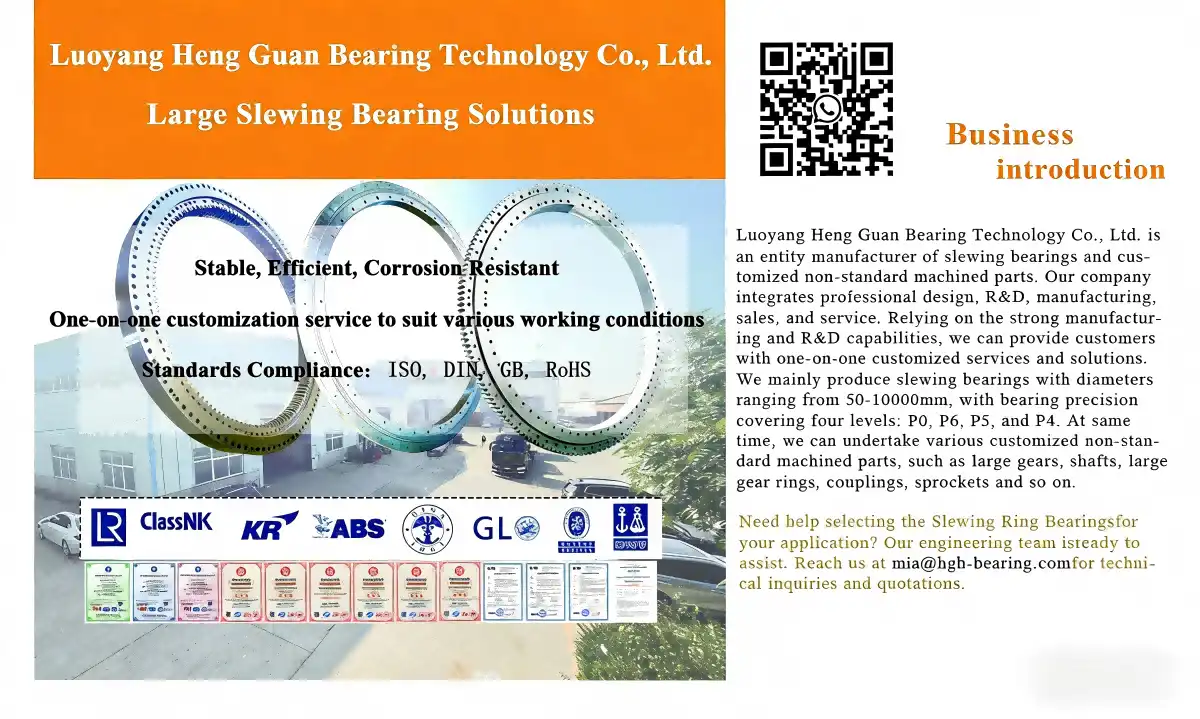
Heng Guan Bearing Technology offers precision Slewing Ring options that are designed to meet the needs of your business. Our Luoyang factory makes bearings with diameters from 20 to 10000mm and accuracy levels from P0 to P4. These bearings come in single-row four-point contact, crossed roller, and three-row configurations. We know what problems makers of heavy equipment, developers of green energy, and integrators of precision machinery face all over North America. Together with your technical staff, our engineering team works closely to provide customization options that improve performance for your specific application needs while keeping costs low. With a wide range of quality certifications and strict testing methods, we provide parts that meet international standards and offer quick expert help for the whole lifecycle of your product.
Reach out to our applications engineering team at mia@hgb-bearing.com to discuss your specific precision bearing requirements. Our goal is to become your trusted source for slewing ring solutions, whether you need quick quotes for standard setups or teamwork for unique solutions.
References
1. Harris, T.A., and Kotzalas, M.N. (2006). Advanced Concepts of Bearing Technology: Rolling Bearing Analysis. CRC Press, Boca Raton, Florida.
2. Budynas, R.G., and Nisbett, J.K. (2015). Shigley's Mechanical Engineering Design, 10th Edition. McGraw-Hill Education, New York.
3. American Gear Manufacturers Association. (2013). AGMA 6123-B06: Design Manual for Enclosed Epicyclic Gear Drives. Alexandria, Virginia.
4. ISO 76:2006. Rolling bearings — Static load ratings. International Organization for Standardization, Geneva, Switzerland.
5. Glover, D.R. (1988). Slewing Ring Bearing Design and Application. Journal of Mechanical Design, Transactions of the ASME, Vol. 110, pp. 378-383.
6. Wensing, J.A. (1998). On the Dynamics of Ball Bearings. PhD Dissertation, University of Twente, Enschede, Netherlands.

WHAT OUR CUSTOMERS SAY
Here is the customer's evaluation of us