




Where Are rotary table bearings Used in Automation Systems?
That’s why you’ll find rotary table bearings on so many contemporary production lines. They provide smooth, precise rotation for automated equipment in a small size. Luoyang Heng Guan Bearing Technology Co., Ltd produces these bearings for automation equipment, machine tools, and industrial machinery. This guide outlines where they are used and what to look for in selecting them. Keep reading to see which is the best option for your system.
Which Automation Systems Commonly Use Rotary Table Bearings?
Rotary table bearings transmit axial load, radial load, and moment load in one small unit to fit equipment that requires precision rotation without a large bearing system. This design integration decreases the number of parts needed to assemble the machine. It makes it simpler and requires less maintenance.
Typical Systems
Common examples include CNC machine tools, indexing tables, robotic arms, rotary assembly stations, injection molding equipment, extruders, and powdering machine tables.
| System | Typical Use | Benefit |
|---|---|---|
| CNC machine tools | Rotary positioning | Rigid, accurate rotation |
| Indexing tables | Station changes | Repeatable movement |
| Robotic arms | Joint and base rotation | Compact design |
Compact Design and Sealing
Heng Guan Bearing also provides compact designs, with one standard dimension of 540 × 360 × 60 mm, to save space in narrow machine frames. Oil and wear-resistant nitrile seals serve to safeguard the raceways under workshop conditions. When designing a new line, compare which kind of rotary table bearings suit your load and positioning demands.
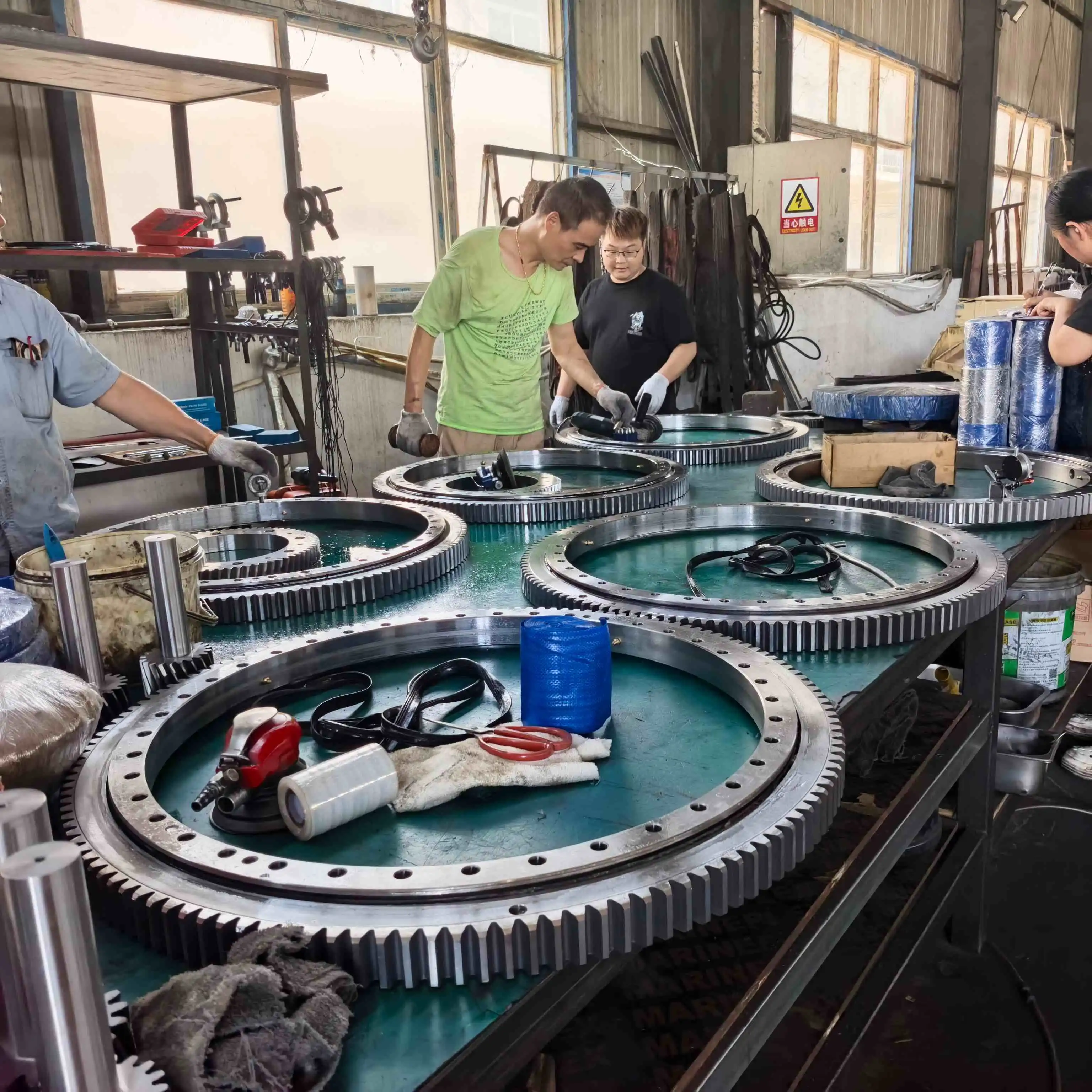
How Do Rotary Table Bearings Improve Robotic Assembly and Automated Handling?
In robotic assembly, every degree of turn matters for positioning parts. Rotary table bearings make sure that the arm base or turntable remains stable as it travels. This allows the robot to repeat the same action thousands of times.
Rigidity and Repeatability
High stiffness results in little deflection under load, and the small construction enables designers to mount the bearing directly in the machine. Ground gear surfaces and close manufacturing tolerances provide constant positioning precision even on long production runs.
Service Life and Handling
Heng Guan Bearing uses innovative heat treatment to make raceways strong and the core robust, which means lengthy service intervals and reduced downtime. Bearings on rotating tables also provide a smooth transfer between conveyor stations in automated handling.
If you want advice on sizing, email mia@hgb-bearing.com, and our engineers will help you select the right model.
Applications in Semiconductor Manufacturing, Inspection, and Packaging Automation
Precision equipment such as inspection stations, wafer-handling tools, and packaging machines depends on steady, accurate rotation.
Where Position Repeatability Matters
In these systems, turntables, rotary stages, and indexing devices are supported by rotary table bearings, where position repeatability is important. In packaging lines, rotating plates are used to convey items between the filling, sealing, and labeling stations.
| Application | Requirement | Bearing Feature |
|---|---|---|
| Inspection stations | Position accuracy | Higher precision grades |
| Packaging lines | Continuous indexing | Durable raceways |
| Rotary stages | Stable rotation | High rigidity |
Precision Grades, Testing and Customization
Heng Guan Bearing offers these applications with P0, P6, P5, and P4 precision grades so that you may match accuracy to your process. Each bearing is verified on coordinate measurement equipment and vibration analysis before shipping. We can also alter mounting holes and dimensions for a variety of machine designs and duplicate an existing bearing from the previous part when there are no blueprints available. Tell us your application, and we will provide a suitable solution.
What Bearing Performance Factors Matter for High-Precision Automation Systems?
Many things influence bearing performance. Rigidity is how much the table moves under load; precision grade is rotation accuracy. Dimensions, mounting technique, and preload are also important; thus, rotary table bearings should be selected to fit the machine’s spindle or Shaft. Quality seals and the right greases will enhance service life.
Reference Technical Parameters
The table below summarizes the specifications of our standard rotary table bearing. Custom sizes are available for special applications.
| Parameter | Specification | Performance Advantage |
|---|---|---|
| Dimensions | 540 × 360 × 60 mm | Compact structure, space-saving |
| Manufacturing range | 50 – 10,000 mm | Supports custom requirements |
| Axial / radial clearance | 0.03 – 0.04 mm | High-precision positioning |
| Gear surface hardness | HRC 45 – 55 | Excellent wear resistance |
| Gear precision | Class 6 (ground gear) | Smooth, reliable transmission |
| Ring material | 50Mn / 42CrMo alloy steel | High strength and stability |
| Rolling elements | GCr15SiMn bearing steel | Long service life |
| Seals | Oil-resistant, wear-resistant nitrile rubber | Contamination protection |
| Precision grades | P0, P6, P5, P4 | Meets varied accuracy needs |
Installation and Verification
After installation, spin the bearing through a few complete revolutions and verify that your measurement equipment reads within the desired accuracy. Torque the mounting bolts to the prescribed value in a cross pattern. Use oil suitable with nitrile seals, but do not over-lubricate. Heng Guan Bearing guarantees every item with dimension verification, quality testing, and safe packing in hardwood boxes with iron frames. Our crew can also help with installation and maintenance to ensure your automation system runs efficiently.
Conclusion
Rotary table bearings provide accurate and compact rotation for robots, machine tools, inspection stations, and packing lines. Heng Guan Bearing gives automation builders stable, precise motion, P0-P4 accuracy, robust testing, and bespoke design.
FAQ
1. What do rotary table bearings support?
Axial, radial, and moment loads together.
2. Which automation equipment uses them?
CNC machines, indexing tables, robots, and packaging lines.
3. What precision grades are available?
P0, P6, P5, and P4.
4. Can sizes be customized?
Yes, based on your drawings and machine needs.
5. How are the bearings tested?
By coordinate measuring and vibration analysis.
Request Your Rotary Table Bearing Quote
Need dependable rotary table bearings for your automation project? Email your drawings or requirements to mia@hgb-bearing.com. Heng Guan Bearing will send a tailored recommendation and fast quotation. Let’s make your machines run precisely.
References
1. Harris, T. A., & Kotzalas, M. N. (2006). Rolling Bearing Analysis, 5th ed. CRC Press.
2. ISO 281:2007. Rolling Bearings – Dynamic Load Ratings and Rating Life. International Organization for Standardization.
3. ISO 9001:2015. Quality Management Systems – Requirements. International Organization for Standardization.
4. Brändlein, J., Eschmann, P., Hasbargen, L., & Weigand, K. (1999). Ball and Roller Bearings: Theory, Design and Application, 3rd ed. Wiley.
5. Budynas, R. G., & Nisbett, J. K. (2006). Shigley’s Mechanical Engineering Design, 10th ed. McGraw-Hill.
6. Potočnik, R., Göncz, P., Flašker, J., & Glodež, S. (2010). Fatigue life of double row slewing ball bearing with irregular geometry. Procedia Engineering, 2(1), 1877–1886.

WHAT OUR CUSTOMERS SAY
Here is the customer's evaluation of us