




How to Choose an Aerial Work Platform Slewing Bearing?
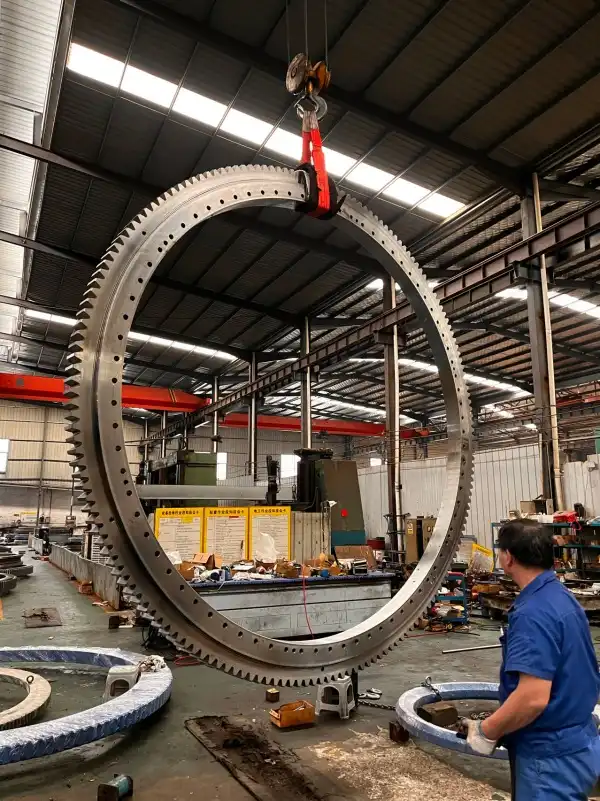
The selection of the proper slewing bearing is one of the most critical considerations in the construction of a safe and dependable aerial work platform. The bearing attaches the turntable to the chassis, bears the weight of the boom and basket, and regulates every revolution made by the operator at height. We at Heng Guan Bearing make slewing bearings for lifting, construction, and port equipment, and we assist purchasers in matching every bearing to the machine. In this tutorial, we’ll cover the load conditions, size and material considerations, bearing types, and safety regulations you should examine before ordering an aerial work platform slewing bearing.
What Load Conditions Should an Aerial Work Platform Slewing Bearing Withstand?
An aerial work platform slewing bearing works under combined loads that change as the boom lifts, extends, and rotates.
The Three Load Types
The weight of the boom, basket, tools, and operators provides axial force. Wind and unexpected pauses contribute radial force. The long boom causes a significant moment of tilt. A well-designed slewing bearing takes all three in one go, yet allows smooth and controlled turning.
| Load Type | Typical Source | Effect on the Bearing |
|---|---|---|
| Axial force | Boom, basket, tools, operators | Presses on the raceways |
| Radial force | Wind, sudden stops | Pushes the rings sideways |
| Tilting moment | Extended boom | Loads one side of the raceway most |
| Shock load | Starting and stopping | Causes fatigue if raceways are soft |
Margin and Fatigue
Starting and halting are short shock loads; hence the raceways must be hardened to resist fatigue. Before purchasing, ask the vendor to guarantee that the bearing exceeds your machine’s maximum operating load and greatest overturning moment with a safe margin. Heng Guan Bearing can examine your load data and provide a proper design.
Technical Specifications
| Parameter | Specification |
|---|---|
| Bearing structures | Single-row four-point contact ball, double-row ball, cross roller, three-row roller |
| Gear options | External gear, internal gear, gearless |
| Ring material | 42CrMo or 50Mn special alloy steel |
| Rolling elements | GCr15SiMn high-purity bearing steel |
| Cage material | Brass, steel or engineering plastic |
| Seal type | Nitrile rubber (NBR) or fluororubber |
| Raceway hardness | 55 – 62 HRC, induction hardened |
| Precision grades | P0, P6, P5, P4 |
| Overall manufacturing range | 50 mm to 10,000 mm diameter |
| Mounting holes and gear data | Made to your drawing |
Key Factors in Slewing Bearing Size, Material, and Structural Design
Size, material, and structure work together to determine how well a slewing bearing performs on a lift platform.
Size and Fit
Start with the installation space, including the outer diameter, inner diameter, and section height, so the aerial work platform slewing bearing fits the turntable without extra modifications.
Material and Heat Treatment
The rings are usually forged from alloy steel such as 42CrMo or 50Mn and hardened on the raceways, which provides strength and long fatigue life.
Structure
Single-row four-point contact ball designs suit compact platforms, while larger machines may need a cross roller or three-row roller structure. Heng Guan Bearing produces diameters from 50 mm to 10,000 mm, so there is a size for almost every platform. The table below summarizes the main factors.
| Factor | What to Consider |
|---|---|
| Size | Diameter and height to fit the turntable |
| Material | Forged alloy steel such as 42CrMo or 50Mn |
| Raceway treatment | Induction hardening for fatigue life |
| Structure | Ball, cross roller, or roller design |
How Do You Choose the Right Bearing Type for Different Aerial Work Platforms?
Different platforms place different demands on the slewing bearing, so the bearing type should follow the machine.
Scissor Lifts and Small Booms
Scissor-type and small boom lifts often use a single-row four-point contact ball slewing bearing because it is compact, light, and easy to install.
Telescopic and Articulated Booms
Booms with higher moments may call for a double-row ball or cross roller structure, which offers extra rigidity.
Heavy-Duty Long Reach
Heavy-duty platforms with long reach can benefit from a three-row roller design, which carries the largest loads.
A reliable aerial work platform slewing bearing also needs the right gear option, either external or internal, to match the drive. Share your platform model with us at mia@hgb-bearing.com, and Heng Guan Bearing will suggest the most suitable bearing type. The table below gives a quick guide.
| Platform Type | Suitable Bearing Structure |
|---|---|
| Scissor lift, small boom | Single row four-point contact ball |
| Telescopic or articulated boom | Double row ball or cross roller |
| Heavy-duty long reach | Three-row roller |
Gear Accuracy, Mounting Dimensions, and Safety Performance Requirements
The safety of an aerial work platform relies on the right gears, the right installation, and a bearing made to reliable standards.
Gears
Make that the gear module, tooth count and accuracy match your drive. Accurate teeth provide smooth, silent rotation and soft starts.
Mounting
Check the mounting hole design and flatness criteria since an equally supported slewing bearing maintains the bolts uniformly loaded. Use high-strength bolts fastened in a cross pattern. Expect frequent lubrication and inspection.
Documents and Accuracy
Request material certifications, hardness reports, and inspection records. Ensure the precision grade, from P0 to P4 at Heng Guan Bearing, is appropriate for your demands. Combined, these actions enable your aerial work platform slewing bearing to function safely and steadily for years to come.
| Check Item | What to Ask For |
|---|---|
| Material | Steel certificate |
| Raceway hardness | Hardness report (55 – 62 HRC) |
| Dimensions | Measured inspection record |
| Gear data | Module, tooth count, and accuracy confirmation |
Conclusion
When you are choosing an aerial work platform slewing bearing, you must match the load, size, material, construction, and gear precision to your machine. Platforms remain safe and productive with careful selection and frequent maintenance. Heng Guan Bearing is ready for your next project.
FAQ
Q: Which loads does an aerial work platform slewing bearing carry?
A: Axial force, radial force, and tilting moment together.
Q: Which material is common for the rings?
A: Alloy steel such as 42CrMo or 50Mn, with hardened raceways.
Q: Which bearing type suits small scissor lifts?
A: A single-row four-point contact ball slewing bearing.
Q: Can the gear be customized?
A: Yes, module, tooth count, and gear position can be adapted.
Q: What should I check before ordering?
A: Dimensions, mounting holes, gear data, and inspection records.
Ready to Choose Your Slewing Bearing? Contact Heng Guan Bearing Today
Looking for a dependable aerial work platform slewing bearing? Contact Heng Guan Bearing for a tailored solution:
- Slewing bearings from 50 mm to 10,000 mm, P0–P4 precision
- ISO 9001-certified production, custom sizing and gear options
- Engineering support for load analysis, bearing selection, and installation guidance
- Inspection records and material certificates available with every order
Send your drawings and working conditions to Heng Guan Bearing at mia@hgb-bearing.com, and our engineers will recommend the best solution and provide a clear quotation. Contact Us today and lift your project higher.
References
1. International Organization for Standardization. (2006). ISO 76:2006. Rolling Bearings: Static Load Ratings.
2. International Organization for Standardization. (2007). ISO 281:2007. Rolling Bearings: Dynamic Load Ratings and Rating Life.
3. International Organization for Standardization. (2010). ISO 16368:2010. Mobile Elevating Work Platforms: Design, Calculations, Safety Requirements and Test Methods.
4. European Committee for Standardization. (2013). EN 280:2013. Mobile Elevating Work Platforms: Design Calculations, Stability Criteria, Construction, Safety, Examinations and Tests.
5. Harris, T. A., & Kotzalas, M. N. (2006). Rolling Bearing Analysis: Essential Concepts of Bearing Technology (5th ed.). CRC Press.
6. Budynas, R. G., & Nisbett, J. K. Shigley’s Mechanical Engineering Design. McGraw-Hill.

WHAT OUR CUSTOMERS SAY
Here is the customer's evaluation of us