




Cross Roller Slewing Bearing Applications in Robotics and Automation
Today’s robots and other automated devices rely on rotary joints that can rotate smoothly, keep a position, and transport loads from many directions at once. A cross roller slewing bearing meets these demands in a compact, rigid package, which is why it appears in so many automation designs. At Heng Guan Bearing, we provide slewing bearings used in automation, medical, lifting, and other precision sectors. This tutorial will show how these bearings increase positioning accuracy, where they are utilized, why stiffness is important, and how to pick the proper bearing for your system.
How Do Cross Roller Slewing Bearings Improve Robotic Positioning Accuracy?
The quality of the rotary support is the starting point for positioning precision. A cross roller slewing bearing is designed to do just that. The cylindrical rollers are organized one-to-one in a cross pattern between V-shaped raceways, so the contact is a line and not a point, and this makes movement steady and predictable.
The construction is small, light, and made to high accuracy. This fits robotic joints that must stop precisely where the program states. The limited assembly clearance of a transverse cylindrical roller slewing ring also decreases play, so the robot repeats the same course again and again. Heng Guan Bearing provides slewing bearing products in P0, P6, P5, and P4 precision grades to meet your application requirements.
| Accuracy Grade | Typical Use |
|---|---|
| P0 | General applications |
| P6 / P5 | Higher precision requirements |
| P4 | High-precision spindles needing minimal runout |
Key Applications in Industrial Robots, Robotic Arms, and Rotary Joints
The cross roller slewing bearing is used when a small rotary joint must take combined stresses. It supports the base, shoulder, and wrist axes in industrial robots where space is tight, and precision is critical. Robotic arms utilize it for holding the tool stable in pick-and-place and assembly activities, while rotary tables use it for smooth indexing.
Cross cylindrical roller slewing ring is also widespread in medical equipment, packing lines, inspection machines, and welding positioners. Heng Guan Bearing is a supplier of slewing bearing products for automation, medical, lifting, port, and wind power industries with customizable constructions for various equipment. The following table highlights typical usage.
| Application | Typical Role of the Bearing |
|---|---|
| Industrial robot base | Supports rotation and load |
| Robotic arm joint | Keeps the tool steady |
| Rotary indexing table | Provides smooth, precise indexing |
| Medical equipment | Enables compact, quiet rotation |
| Measuring instruments | Gives repeatable positioning |
Why Are High Rigidity and Multi-Directional Load Capacity Essential for Automation Equipment?
Rarely can automation equipment handle just one basic load.
Cross roller slewing bearing fits this demand, with its crossed roller arrangement providing high stiffness and carrying axial load, overturning moment, and significant radial load combined. A stiff slewing bearing prevents the joint from deflecting, so the tool remains precise as the load varies. The machine also runs silently and with minimal vibration.
Thus, a cross cylindrical roller slewing ring is a good option for tiny machines where one bearing has to take the place of many. Heng Guan Bearing develops each product to take into account these combined loads.
How to Select the Right Cross Roller Slewing Bearing for Robotics and Automation Systems?
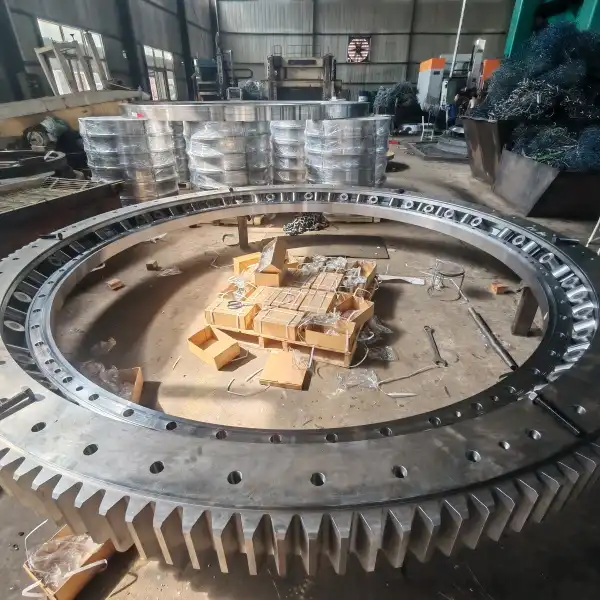
The selection starts with your machine's needs. The axial load, radial load, tilting moment, speed, and precision needed should be collected and compared with the bearing capacity. Check the installation area, the configuration of the mounting holes, and whether you require a gear – a cross roller slewing bearing may be delivered without a gear, with external teeth, or with internal teeth. Also check the accuracy grade, sealing, and lubrication procedure.
Heng Guan Bearing can develop and produce customized products; therefore, the cross cylindrical roller slewing ring may be made according to your designs. For helping to choose, email your data to mia@hgb-bearing.com and our engineers will recommend a suitable slewing bearing. The table below lists the key inputs.
| Selection Input | Why It Matters |
|---|---|
| Axial, radial, and moment loads | Determines bearing size |
| Required accuracy grade | Sets positioning precision |
| Installation space | Defines diameter and height |
| Gear type | Matches the drive method |
Technical Specifications
| Parameter | Specification |
|---|---|
| Outer ring diameter | 80 – 2000 mm |
| Inner ring diameter | 60 – 1850 mm |
| Height range | 10 – 80 mm |
| Precision grades | P0, P6, P5, P4 |
| Base material | 42CrMo, 50Mn special alloy steel |
| Rolling elements | GCr15SiMn high-purity bearing steel |
| Cage material | Brass, steel or engineering plastic |
| Seal type | Nitrile rubber or fluororubber |
| Operating temperature | −30 °C to +120 °C (standard seals) |
| Load capacity | Combined axial, radial and moment loads |
| Mounting method | Clamping rings or bolt-on flange |
| Construction | Split outer ring with retaining rings for easier installation |
Every bearing is checked before shipment, including dimensional verification on coordinate measuring machines, vibration and noise testing, and hardness testing. Custom bearings typically take 4–6 weeks, depending on complexity.
Conclusion
Cross roller slewing bearings provide robots and automation equipment with precise, sturdy, and compact rotational support. Stable and repeatable performance matched to load, precision, and installation requirements. Heng Guan Bearing is ready to help you with your next automation project.
FAQ
Q: What is a cross roller slewing bearing?
A: It is a slewing bearing with cylindrical rollers arranged in a one-to-one cross pattern.
Q: Why is it popular in robotics?
A: It offers high rigidity, accuracy, and a compact structure.
Q: Which loads can it carry?
A: Axial force, radial force, and tilting moment together.
Q: What accuracy grades are available?
A: Heng Guan Bearing offers P0, P6, P5, and P4.
Q: Can it be customized?
A: Yes, gear type, size, and mounting layout can be adapted.
Q: What is the typical lead time?
A: Custom bearings typically take about 4–6 weeks, depending on complexity.
Ready to Upgrade Your Automation Equipment? Contact Heng Guan Bearing Today
Looking for a precise and reliable cross roller slewing bearing? Contact Heng Guan Bearing for a tailored solution:
- Slewing bearings from 50 mm to 10,000 mm, P0–P4 precision
- ISO 9001-certified production, custom sizing and gear options
- Engineering support for load analysis, bearing selection, and installation guidance
- Proven solutions for robots, medical equipment, machine tools, and automation systems
Send your drawings and working conditions to Heng Guan Bearing at mia@hgb-bearing.com, and our engineers will recommend the right solution and provide a clear quotation. Contact Us today and move your automation forward.
References
1. International Organization for Standardization. (2006). ISO 76:2006. Rolling Bearings: Static Load Ratings.
2. International Organization for Standardization. (2007). ISO 281:2007. Rolling Bearings: Dynamic Load Ratings and Rating Life.
3. International Organization for Standardization. (1998). ISO 9283:1998. Manipulating Industrial Robots: Performance Criteria and Related Test Methods.
4. Harris, T. A., & Kotzalas, M. N. (2006). Rolling Bearing Analysis: Essential Concepts of Bearing Technology (5th ed.). CRC Press.
5. Craig, J. J. (2017). Introduction to Robotics: Mechanics and Control (4th ed.). Pearson.
6. Slocum, A. H. (1992). Precision Machine Design. Prentice Hall.

WHAT OUR CUSTOMERS SAY
Here is the customer's evaluation of us