




Can RKS.21.0841 Slewing Bearings Reduce Maintenance Costs?
There is a strong correlation between the maintenance costs and the profitability of a piece of rotating machinery. When considering buying RKS.21.0841 Slewing Bearings, buyers usually have similar concerns: bearings that fail too soon, unexpected breakdowns that delay projects, and suppliers who can't provide maintenance advice when problems arise. Many buyers ask whether RKS.21.0841 Slewing Bearings can help. Intelligent design, good quality production, and simple routine maintenance are the key to success. At Heng Guan Bearing, we manufacture slewing bearings that rotate smoothly and jerk-free, that are wear-resistant, and keep their reliability even after long periods of use. In this post, we’ll look at the advantages of RKS.21.0841 slewing bearings, including the reduction of wear, what characteristics increase service life, and which maintenance steps protect your investment.
How Does the RKS.21.0841 Slewing Bearings Design Minimize Wear and Tear?
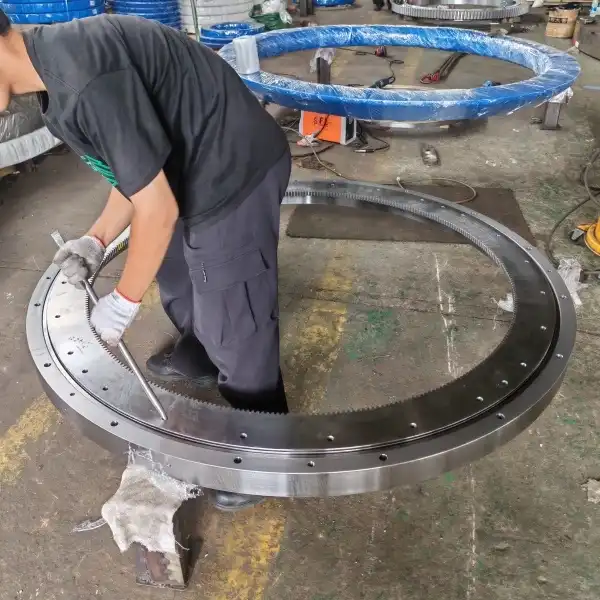
Wear in a slewing bearing usually starts at locations where contact stress is uneven, or where friction is uncontrolled. RKS.21.0841 slewing bearings are single-row, four-point-contact ball-type with external gear. They are designed for distributing working load over hardened raceways, making rolling elements move evenly and local stress low. Smooth raceway surfaces and tight machining help to keep the friction constant, reducing heat and retarding surface fatigue.
A correctly fitted rolling element set also allows quiet, stable rotation, even with frequent starts and stops. Heng Guan Bearing controls each stage, from forging and heat treatment to grinding and inspection, so every RKS.21.0841 slewing bearing leaves the factory with consistent quality. When a bearing runs evenly from the first day, it needs fewer corrections and fewer unplanned stoppages.
| Parameter | Value |
|---|---|
| Structure | Single-row four-point contact ball, external gear (light series) |
| Outer Diameter | 950 mm |
| Inner Diameter | 734 mm |
| Height | 56 mm |
| Raceway Diameter | 841 mm |
| Ball Diameter | 20 mm |
| Outer Ring Mounting | 18 × M12 holes on Ø885 mm circle |
| Inner Ring Mounting | 18 × Ø18 mm holes on Ø762 mm circle |
| Gear Module / Teeth | m = 8 / z = 117 |
| Basic Load Ratings | Dynamic Cr 222 kN, Static C0r 580 kN |
| Mass | 68 kg |
Key Features That Extend Bearing Service Life and Reduce Replacement Frequency
Service life depends on material, structure, and manufacturing precision working together. RKS.21.0841 slewing bearings benefit from quality steel, hardened raceways, and carefully processed rings, which help them resist fatigue under repeated loading. Our rings are made from 42CrMo or 50Mn alloy steel, and CNC quenching gives uniform raceway hardness for consistent wear. Our accuracy grades of P0, P6, P5, and P4 let customers choose the level of precision that matches their equipment.
| Feature | Maintenance Benefit |
|---|---|
| Hardened raceways | Slower surface wear |
| Precision machining | Even load distribution |
| Selectable accuracy grade | Better fit for the application |
| Customized design | Fewer adjustments after installation |
Because Heng Guan Bearing offers customized design and flexible production, we can fine-tune dimensions, mounting holes, and sealing arrangements for each application, and we can reverse-engineer from a sample when drawings are unavailable. Longer-lasting parts mean fewer replacement orders, fewer crane or machine stoppages, and lower labor expense. The table below shows how these features connect to cost savings.
| Parameter | Value |
|---|---|
| Ring Material | 42CrMo, 50Mn alloy steel |
| Raceway Hardness | 55–62 HRC |
| Precision Grades | P0, P6, P5, P4 |
| Operating Temperature | -30°C to +80°C (standard) |
| Gear Options | Internal / external / no gear |
What Maintenance Practices Help Prevent Premature Slewing Bearing Failure?
Even the most skilled slewing bearing can be protected by good practices. First, ensure that the installation is done correctly by cleaning the mounting surfaces, ensuring that they are flat, and tightening the bolts in the order that is advised. During operation, it is important to pay attention to any strange noises, keep an eye out for rising temperatures, and take note of any changes in rotation torque. This is because early warning indications make it easier to perform minor repairs. Maintaining a straightforward inspection log enables teams to compare readings over a period of time and plan maintenance during scheduled downtime rather than doing emergency pauses. If you want a maintenance checklist tailored to your RKS.21.0841 slewing bearings, email mia@hgb-bearing.com, and Heng Guan Bearing will share practical guidance for your working conditions. Consistent attention turns routine checks into real savings.
| Interval | Action Required |
|---|---|
| First 100 hours | Re-torque all mounting bolts to the specified values. Initial bedding-in can relax bolts, which may lead to fretting at the mounting surface if left uncorrected. |
| Monthly | Listen for unusual vibration or noise during slewing. These often signal lubrication depletion or early raceway wear. |
| Quarterly | Inspect seals for cracking, deformation, or grease leakage. |
| Annual | Measure clearance and rotation torque against the baseline recorded at installation. |
| Based on hours | Re-grease through all lubrication points. Heavy-duty or continuous work needs shorter intervals. |
Lubrication, Seal Protection, and Bolt Inspection for Lower Operating Costs
Lubrication, sealing, and bolt inspection are the three straightforward activities that have the greatest impact on reducing operational expenses. Keeping a protective coating between the rolling elements and the raceways by applying fresh grease at the specified intervals helps to reduce the amount of friction and wear that occurs. It is also useful in mining, ports, and outdoor construction environments to have the seals intact, as it prevents dust, water, and different pollutants from entering. Routine bolt inspections are critical to confirm that the preload is correct and that the slewing bearing is stable under load. The table below provides a simple reference for planning different activities.
Heng Guan Bearing is glad to offer advice on schedules for RKS.21.0841 slewing bearings to help your team maintain a predictable level of service and control their budgets.
| Task | Purpose | Suggested Habit |
|---|---|---|
| Lubrication | Reduce friction and wear | Follow the recommended interval |
| Seal inspection | Block dust and moisture | Check during routine rounds |
| Bolt inspection | Maintain correct preload | Verify at scheduled stops |
Conclusion
RKS.21.0841 slewing bearings can help cut down on the amount of money spent on maintenance by spreading loads evenly and by using materials that last for a long time and need little maintenance. Properly lubricated, sealed, and inspected equipment lasts longer and reduces unscheduled downtime. Lower replacement and labor costs also contribute to the predictability of the budget during the entire service life. Addressing noise, temperature, and rotating torque from the outset can result in substantial cost savings even during minor inspections.” In addition, a simple inspection log enables teams to plan maintenance during scheduled downtime rather than focusing on emergency repairs. The Heng Guan Bearing team is prepared to help you with your next project, with advice on selection, custom design, and practical maintenance tips. This will ensure that your machinery continues to turn over smoothly and that your running expenses remain firmly under control.
FAQ
How can RKS.21.0841 slewing bearings reduce costs?
Durable design means less wear and fewer replacements. Hardened raceways, precision machining, and even load distribution slow surface fatigue, so bearings last longer, downtime falls, and maintenance budgets stay predictable over the full service life.
What accuracy grades are available?
Heng Guan Bearing offers P0, P6, P5, and P4. The P5 and P4 grades are for tighter tolerance applications with smoother rotation. The P0 and P6 grades cover most standard heavy-duty slewing bearing applications.
How often should I lubricate?
Follow the recommended interval for your working conditions. Heavy-duty or continuous operation needs shorter intervals. Regular greasing keeps a protective film between rolling elements and raceways, reducing friction, heat, and wear.
Why inspect bolts regularly?
Correct preload keeps the bearing stable under load. Initial bedding-in can relax bolts, so re-torque at the first 100 hours and verify at scheduled stops to prevent fretting at the mounting surface.
Can the bearing be customized?
Yes. We adapt dimensions, gears, and sealing details to your drawings. If drawings are unavailable, our engineering team can reverse engineer from a sample, establishing an achievable specification prior to production.
Want Lower Maintenance Costs? Contact Us Today!
Choose Heng Guan Bearing for reliable, customized slewing bearing solutions and professional support:
- Slewing bearings from 50 mm to 10,000 mm, P0 to P4 precision. Our range covers standard and custom designs, so you can source a single bearing or a complete project set from one certified supplier with consistent quality
- ISO 9001 certified production with custom sizing and material options. Every order is backed by traceable materials, documented heat treatment and inspection reports, giving purchasing and engineering teams confidence from quotation through delivery
- Engineering team available for selection, drawing review, and maintenance guidance. Share your requirements with our team, and we will reply with a clear proposal, helping keep your equipment running smoothly for years
Send your requirements to mia@hgb-bearing.com, and our team will reply with a clear proposal. Let us help you keep your equipment running smoothly for years.
References
1. Harris, T. A., & Kotzalas, M. N. (2006). Essential Concepts of Bearing Technology. CRC Press.
2. Harris, T. A. (2001). Rolling Bearing Analysis. Wiley.
3. Hamrock, B. J., Schmid, S. R., & Jacobson, B. O. (2004). Fundamentals of Machine Elements. McGraw-Hill.
4. ISO 281:2007. Rolling Bearings: Dynamic Load Ratings and Rating Life. International Organization for Standardization.
5. Stachowiak, G. W., & Batchelor, A. W. (2013). Engineering Tribology. Butterworth-Heinemann.
6. Mobley, R. K. (2002). An Introduction to Predictive Maintenance. Butterworth-Heinemann.

WHAT OUR CUSTOMERS SAY
Here is the customer's evaluation of us