



What's A Cross Roller Ring Bearing And How Does It Work?
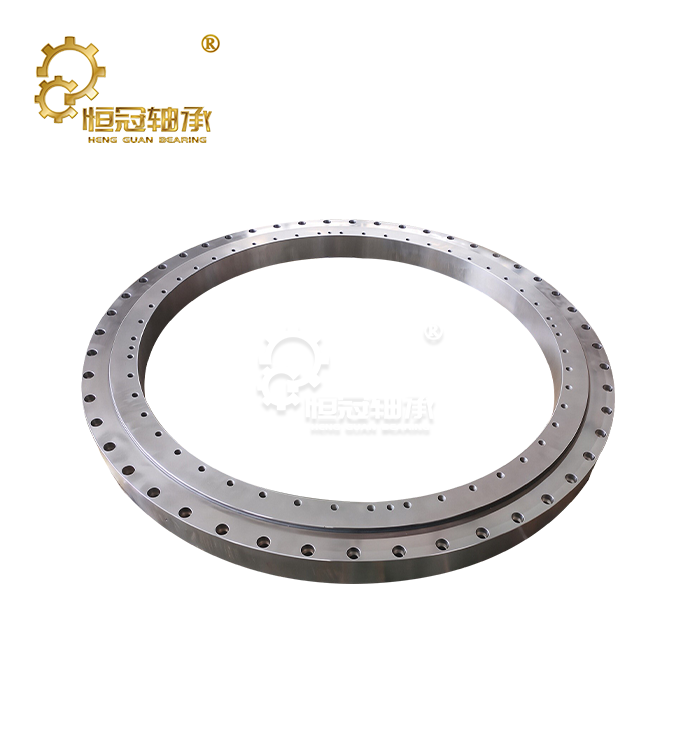
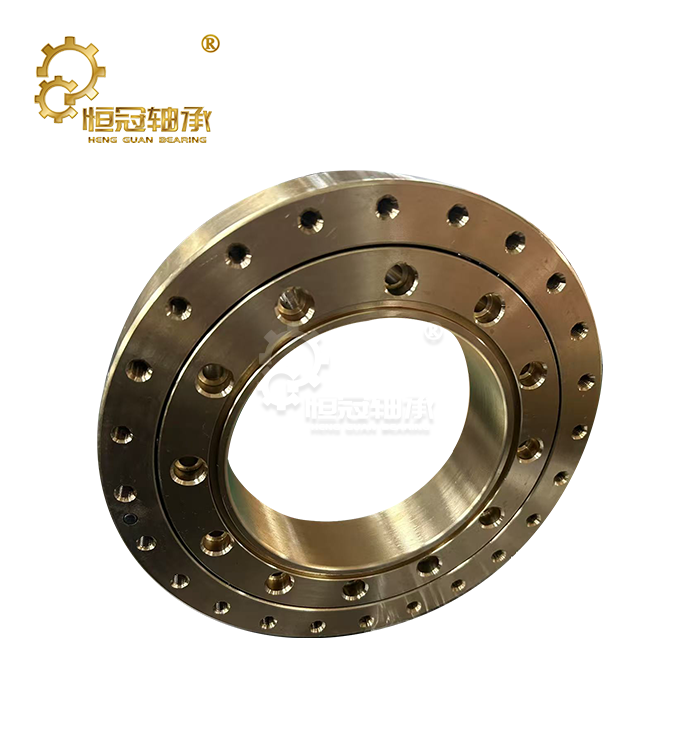
When a robotic arm requires extremely accurate positioning or a CNC rotary table needs stable movement under heavy cutting forces, bearing selection directly affects equipment performance. A Cross Roller Ring Bearing, is intended for these severe applications and combines high rigidity, compact structure and multi-directional load capability in one bearing unit.
Traditional ball bearings rely significantly on the point contact between the rolling elements and raceways. Cross roller ring bearing designs utilise cylindrical rollers set at 90-degree angles to each other. This unusual roller arrangement provides line contact with the raceways, enabling the bearing to concurrently handle radial, axial and moment stresses.
By substituting numerous standard bearing arrangements with a single bearing, cross-roller ring solutions enable the design of more compact machines and offer improved rotational accuracy and structural stability. They are frequently utilised in industrial robots, semiconductor equipment, precision machine tools, medical imaging systems and other applications where space efficiency and positioning accuracy are critical.
Understanding Cross Roller Ring Bearing Structure and Operating Principle
How Does the Cross Roller Design Work?
A cross roller ring bearing operates by using a particular arrangement of cylindrical rollers in the bearing raceways. The rollers are placed alternately at right angles to each other, i.e., the neighbouring rollers carry loads coming from various directions.
The crossed roller configuration has several significant advantages:
Rollers running on the raceways carry the radial forces.
Axial forces are distributed through rollers in various orientations.
The rollers have a larger area of contact, which helps resist tilting moments.
The contact line design distributes loads more uniformly than standard point contact ball bearings. Consequently, the bearing is more rigid and more resistant to deformation during service.
The inner ring, outer ring, rollers, spacers and sealing components are assembled with precision. The roller separators keep the rolling parts evenly spaced out. This prevents friction due to rollers rubbing directly against each other and allows the rollers to roll smoothly.
Why Line Contact Improves Bearing Performance?
The basic distinction between cross roller ring bearing technology and traditional bearing designs is how they make contact.
Point contact is produced by ball bearings. This means that the load is concentrated on a very small region. In the case of cross-roller designs, the force is spread over the length of the cylindrical roller by means of a line contact.
The design yields:
Greater efficiency of load sharing
Enhanced rotational accuracy
Higher resistance to moment loads
Reduced elastic stretch
Even with precision equipment, minor amounts of deviation might affect the quality of the final result. In applications such as robotic joints or CNC positioning tables, a higher bearing rigidity provides accurate movement through repeated operations.
Key Design Features That Improve Bearing Performance
Precision Manufacturing and Material Selection
The great performance of a cross roller ring bearing is not only based on the structural design, but also the manufacturing accuracy and material quality.
Usually bearing rings are made of high-strength alloy steels such as 42CrMo or 50Mn, which have good mechanical strength and fatigue resistance. The rolling elements are usually made of high-grade bearing steel such as GCr15SiMn, which has good hardness, wear resistance and dimensional stability.
During production the bearing components are frequently subjected to several processes, including:
Heat treatment for hardness and toughness
Precision grinding for correct raceway geometry
Surface finish to reduce friction
Dimensional inspection for maintaining manufacturing tolerance
Proper heat treatment is a balance between surface hardness and interior toughness. So, the bearing can tolerate repeat loading cycles without early fatigue damage.
In addition, for demanding industrial applications, manufacturers are able to offer surface treatments, including black oxide coating or anti-corrosion protection, in an effort to increase resistance to moisture and contamination.
Compact Structure With High Rigidity
One of the primary reasons engineers choose Cross Roller Ring Bearing solutions is their ability to deliver great performance in a short installation space.
In the traditional bearing arrangements, several bearings are used to carry up combined loads. This makes the assembly more complex and demands additional housing space.
The cross-roller structure incorporates several load-supporting functions in one compact component. This permits equipment designers to lower the overall size of the machine, retaining mechanical stability.
For instance:
Smaller joints and higher positioning precision help robotic arms.
Rotary tables provide greater stiffness without increasing the size of the machine.
The tiny mechanical structures keep the precision of the inspection equipment.
The combination of compact size and excellent stiffness makes the cross roller ring bearing very important in current automation systems.
Different Types and Specifications of Cross Roller Ring Bearings
Selecting the Right Precision Grade
Precision requirements vary depending on the application. Choosing the correct accuracy grade helps prevent unnecessary cost while ensuring reliable performance.
Common precision classifications include:
Standard precision grades
These are suitable for general industrial applications where stable rotation and reliable load support are required but ultra-high positioning accuracy is unnecessary.
Higher precision grades
Precision-grade cross roller ring bearing models are commonly used in:
Semiconductor manufacturing equipment
Optical inspection systems
High-speed indexing platforms
Precision robotic mechanisms
Higher accuracy levels typically require tighter manufacturing tolerances, more advanced grinding processes, and stricter quality inspection procedures.
Before selecting a precision grade, engineers should consider:
Required positioning accuracy
Operating speed
Load conditions
Machine structure
Expected service life
Size Range and Load Capacity Considerations
Cross roller bearings are available in various sizes to meet different industrial requirements. Small-diameter models are often used in compact robotic joints and automation equipment, while larger designs are applied in heavy-duty machinery.
As an experienced China cross roller ring bearing manufacturer, suppliers can provide customized solutions covering different outer diameters, mounting dimensions, and load requirements.
When selecting a suitable bearing size, engineers should evaluate the following:
Radial load capacity
Axial load capacity
Moment load requirements
Rotation speed
Installation space
Moment loads are particularly important because improper selection can lead to uneven raceway stress and accelerated wear.
For example, a robotic arm lifting an offset load generates not only radial force but also a tilting moment. A properly selected cross roller ring bearing helps maintain stability and positioning accuracy under these combined forces.
Industrial Applications of Cross Roller Ring Bearings Deliver Value
Robotics and Automation Equipment
Industrial robots require bearings that can provide accurate movement while handling repeated acceleration, deceleration, and positioning cycles. A cross roller ring bearing is widely used in robotic joints because it combines compact dimensions with excellent rigidity.
Robot manufacturers often face challenges such as limited installation space and the need for precise positioning. Traditional bearing combinations may increase the size and weight of robotic joints, while cross roller designs allow engineers to achieve a smaller structure without sacrificing load capacity.
In robotic applications, bearing performance directly influences:
Repeat positioning accuracy
Mechanical stability
Energy efficiency
Service life
For collaborative robots, assembly robots, and automated production lines, smooth rotation and low operational vibration are essential for maintaining consistent manufacturing quality.
CNC Machine Tools and Rotary Tables
Precision machine tools require bearings that can withstand cutting forces while maintaining accurate positioning. A cross roller ring bearing is often selected for CNC rotary tables, indexing mechanisms, and multi-axis machining centers because of its high stiffness and resistance to deformation.
During machining operations, cutting forces create complex loads that include radial forces, axial forces, and tilting moments. A conventional bearing system may experience greater deflection under these conditions.
The crossed roller structure helps minimize movement errors by distributing loads across multiple rollers. This improves:
Machining accuracy
Surface finish quality
Positioning repeatability
Equipment stability
For five-axis machining centers, where the rotary axis must maintain precise angles during complex processing, bearing rigidity becomes especially important.
Medical Imaging and Precision Inspection Equipment
Medical and inspection equipment requires extremely stable rotation because even small mechanical errors can affect measurement or imaging accuracy.
Applications such as CT scanners, optical inspection machines, and precision measurement systems often use Cross Roller Ring Bearing solutions because they provide the following:
Smooth rotation
Low vibration
High positioning accuracy
Long-term operational stability
In medical imaging systems, the rotating gantry must maintain accurate alignment between components during continuous movement. Any excessive runout or vibration may reduce image quality.
Similarly, optical inspection equipment relies on precise angular positioning to detect small defects during manufacturing inspection processes.
How to Select the Right Cross-Roller Ring Bearing Supplier?
Evaluate Technical Capability and Customization Support
Choosing the correct cross roller ring bearing supplier involves more than comparing product prices. The manufacturer’s engineering capability, production experience, and quality control system directly influence bearing reliability.
A professional supplier should be able to support customers with:
Bearing selection according to load conditions
Customized dimensions
Technical drawings
Installation recommendations
Inspection documentation
For special applications, standard models may not always provide the best solution. Customized bearing designs may be required when equipment has unique space limitations, unusual loads, or special environmental requirements.
Before purchasing, buyers should provide key technical information, including:
Operating speed
Applied loads
Mounting dimensions
Working temperature
Environmental conditions
Required precision level
This allows engineers to recommend a suitable bearing configuration instead of selecting a product based only on size.
Quality Control and Manufacturing Standards
A reliable bearing manufacturer should have strict quality management procedures throughout production.
Important manufacturing checkpoints include:
Material inspection
Raw materials should be tested to confirm chemical composition and mechanical properties.
Heat treatment control
Proper heat treatment ensures the required hardness and structural stability of bearing components.
Precision machining inspection
Raceway dimensions, roundness, and surface finish directly influence bearing accuracy and operating life.
Final performance testing
Finished bearings should undergo inspection before shipment to confirm that they meet technical requirements.
For industrial customers, inspection reports, quality certificates, and product traceability provide additional confidence when selecting a long-term supplier.
Cost Factors and Procurement Planning
The cost of a cross roller ring bearing depends on several factors, including:
Bearing size
Precision grade
Material requirements
Production volume
Customization level
Higher precision bearings generally require more advanced machining and inspection processes, which increases manufacturing costs.
However, selecting the lowest-priced option is not always economical. A bearing failure can result in:
Equipment downtime
Production delays
Maintenance expenses
Replacement costs
A properly selected bearing with suitable quality standards often provides a lower total ownership cost over the equipment lifecycle.
For large-volume purchasing, cooperation with manufacturers through planned orders can improve supply stability and reduce procurement risks.
Installation and Maintenance Practices for Long-Term Performance
Proper Installation Preparation
Correct installation plays an important role in achieving the expected performance of a cross roller ring bearing.
Before installation, technicians should check:
Mounting surface accuracy
Housing dimensions
Shaft alignment
Surface cleanliness
Contaminants such as dust, metal particles, or installation debris can create uneven stress between the bearing and mounting surface. Even small particles may affect rotational accuracy and shorten service life.
The bearing should remain in protective packaging until installation to prevent contamination and corrosion.
Recommended Mounting Procedures
During installation, uneven tightening forces can deform the bearing rings and reduce performance.
For mounting bolts, a gradual tightening process is recommended:
Position the bearing correctly.
Tighten bolts gradually in a diagonal sequence.
Apply the specified torque value.
Verify rotational smoothness after installation.
Using calibrated torque tools helps maintain consistent clamping force.
For precision applications, technicians may also check the following:
Radial runout
Axial runout
Rotation resistance
Alignment accuracy
Correct installation ensures that the bearing operates under designed load conditions.
Lubrication and Maintenance Management
Proper lubrication reduces friction, prevents wear, and protects internal components from corrosion.
The lubrication method depends on operating conditions, including:
Rotation speed
Temperature
Load level
Environmental contamination
Grease lubrication is commonly used because it provides simple maintenance and good protection against external contaminants. In higher-speed applications, oil lubrication may be preferred because it provides better cooling performance.
Maintenance schedules should consider:
Operating hours
Machine conditions
Lubricant condition
Environmental exposure
Regular inspections can help identify early signs of problems, such as:
Increased vibration
Abnormal noise
Higher operating temperature
Reduced positioning accuracy
Detecting these issues early helps prevent unexpected equipment failure.
Conclusion
Cross roller ring bearing technology provides an effective solution for applications requiring compact design, high rigidity, and accurate rotational performance. Through its unique crossed cylindrical roller arrangement, this bearing type can support radial, axial, and moment loads within a single compact structure.
Compared with traditional bearing arrangements, cross roller ring bearing designs simplify mechanical systems while improving stiffness, positioning accuracy, and reliability. Their advantages make them suitable for industries including robotics, CNC machine tools, medical equipment, automation systems, and precision inspection technologies.
Selecting the correct bearing requires careful consideration of load conditions, operating speed, accuracy requirements, and environmental factors. Working with an experienced manufacturer can help ensure the bearing design matches the actual application requirements.
In addition to product quality, professional technical support, customization capability, and strict manufacturing control are important factors when choosing a long-term bearing partner. With proper selection, installation, and maintenance, a cross roller ring bearing can provide stable performance and extended service life for demanding industrial applications.
|
|

FAQ
1. How do crossed roller bearings differ from standard ball bearings?
The main difference is in the shape of the contact and how much weight it can hold. When you use a ball bearing, the rolling elements and raceways touch at a point, which limits the load capacity and stiffness. Cross Roller Ring Bearing designs use line contact across cylindrical rollers to spread loads over larger areas and make the structure three to four times more rigid. When used at high speeds, ball bearings work best because centrifugal forces favor lighter rolling elements. On the other hand, crossed roller types work best when combined loads are present at moderate speeds, where stiffness and accuracy are more important.
2. What precision grade do I need for my application?
Your requirements for positioning accuracy and the conditions of operation will affect the precision grade you choose. With a standard grade of P0, most industrial rotating platforms work fine. P6 grade is good for moderately precise machine tools and automated assembly equipment. P5 or P4 grades are needed for applications that need to position things down to the micron level, like semiconductor equipment, coordinate measuring machines, and precision optical systems. Keep in mind that higher levels of precision cost more, so figure out what level of accuracy your application really needs to get the most out of your component budget.
Partner with Heng Guan Bearing for Your Precision Motion Solutions
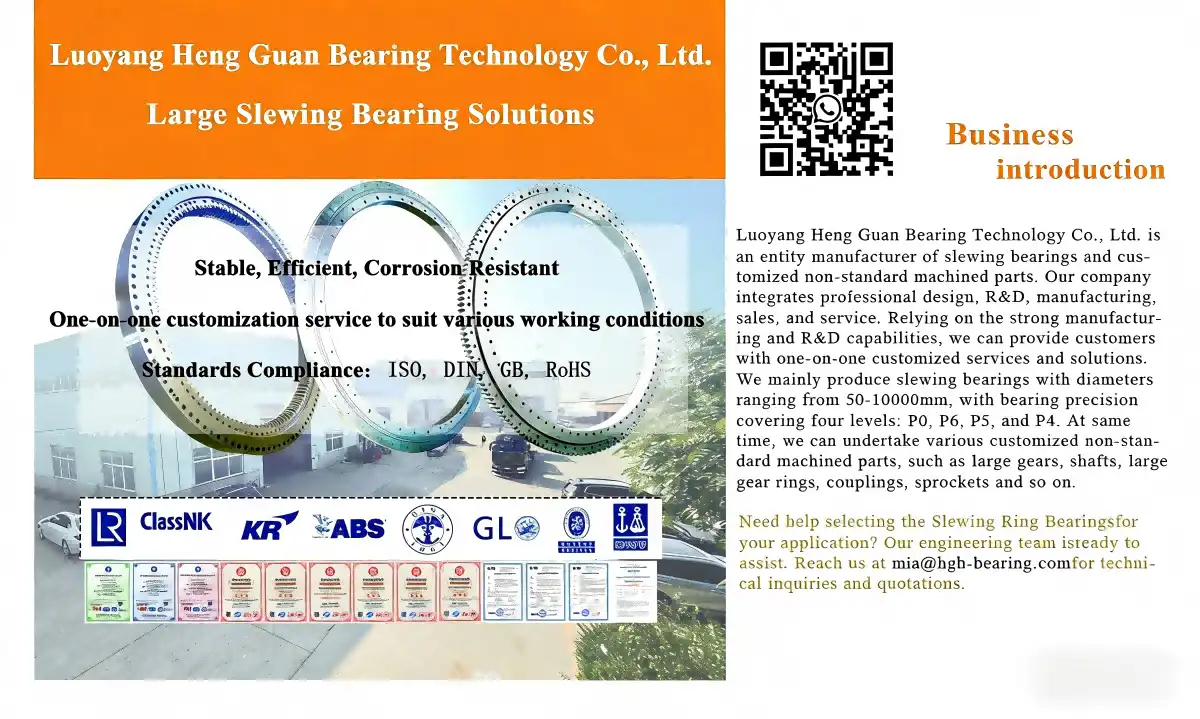
Heng Guan Bearing has everything that engineering teams and procurement professionals need when they are looking for reliable Cross Roller Ring Bearing suppliers. Our factory in Luoyang makes bearings with diameters ranging from 50mm to 10,000mm in all four precision grades (P0 through P4). These bearings are used in a wide range of applications, from small robots to heavy industrial turrets. We can work with non-standard designs by using reverse engineering techniques that don't need 3D models. Instead, we use samples or application parameters to create custom solutions. Our quality systems are backed by ISO 9001 certification, and our products are shipped to more than fifty countries. We have the technical know-how and manufacturing capacity that your projects need. Email our engineering team at mia@hgb-bearing.com to talk about your specific needs and find out how our low-cost, high-precision bearings can improve the performance of your machinery.
References
1. Harris, T.A., & Kotzalas, M.N. (2006). Advanced Concepts of Bearing Technology: Rolling Bearing Analysis, Fifth Edition. CRC Press.
2. Weck, M., & Brecher, C. (2006). Werkzeugmaschinen 2: Konstruktion und Berechnung [Machine Tools Volume 2: Design and Calculation]. Springer-Verlag.
3. Hiwin Technologies Corp. (2018). Cross Roller Bearing Technical Design Guide. Hiwin Precision Machinery Research and Development Department.
4. ISO 199:2014. Rolling bearings — Thrust bearings — Geometrical product specifications (GPS) and tolerance values. International Organization for Standardization.
5. Eschmann, P., Hasbargen, L., & Weigand, K. (1985). Ball and Roller Bearings: Theory, Design and Application, Third Edition. John Wiley & Sons.
6. Nook Industries Inc. (2020). Precision Crossed Roller Bearing Engineering Manual: Selection, Installation, and Maintenance Guidelines. Nook Technical Publications.

WHAT OUR CUSTOMERS SAY
Here is the customer's evaluation of us