




What Is a Heavy-Duty Slewing Bearing and How Does It Work?
A heavy-duty slewing bearing is a large diameter bearing that can withstand combined axial loads, radial loads and overturning moments while allowing one machine structure to rotate relative to another machine structure. A slewing bearing is a complete, highly compact combination of an inner ring, an outer ring, rolling elements, raceways, seals and mounting characteristics. A typical bearing design may have multiple parts to deal with different load directions. The design makes slewing bearings particularly useful in excavators, cranes, mining equipment, wind turbines, material handling equipment and other devices where a massive structure must rotate under tremendous loads. Depending on the application, the bearing can be supplied with balls or rollers. It may also consist of an integral gear for transmitting the drive torque. OEM engineers and purchasing teams need to understand how a heavy duty slewing bearing functions. The selection of bearing affects the stability, life, maintenance and reliability of rotational systems.
How Does a Heavy-Duty Slewing Bearing Work?
The fundamental principle of operation is simple. Typically, one bearing ring is mounted on the fixed structure and the other ring on the rotating structure. The two rings are machined to precise tolerances for the raceways. The rolling elements run on the raceways. The rolling elements transmit the loads generated by the machine while enabling relative rotation.
The fundamental difference is that the bearing is not just supporting a vertical load. In many heavy machines the load is at a distance from the bearing center. This causes an overturning moment, which may be significant even when the direct vertical load seems to be tolerable.
If the bearing is appropriately designed, they are transmitted through the rolling elements and raceways. The internal geometry, rolling-element diameter, number of rolling elements, raceway curvature, contact angle, ring size, and preload or clearance all affect the way the bearing responds under load.
For example, a slewing bearing for an excavator supports the top structure, so it can rotate relative to the undercarriage. As the bucket digs, it creates forces that are transmitted via the boom and top structure to the bearing. The bearing is therefore subjected to a mixture of axial force, radial force, and overturning moment rather than a single load.
Therefore, it is not enough to choose a slewing bearing merely by its outside diameter. Real load spectrum and operational conditions have to be taken into account as well.
Key Components That Determine Bearing Performance
The general shape of the overall bearing looks like a relatively simple ring assembly, but it has multiple parts that cooperate to determine its performance.
Inner and Outer Rings
The bearing consists of rings, which are the main structural elements. They house the raceways and offer the mounting interfaces utilized to affix the bearing to the machine.
Depending on the design, a gear tooth may also be built into one of the rings. In excavators and cranes, a pinion can interact with an external or internal gear to convey the rotation created by the drive system.
Ring rigidity is especially critical for big slewing bearings. Even if the bearing is produced appropriately, excessive distortion of the mounting structure will affect the load distribution throughout the raceway.
Rolling Elements and Raceways
The operating loads are carried between the two rings by balls or rollers. Balls are often utilized in applications where a small cross section and ability to carry combined loads are important. The roller designs offer a higher load-carrying capability for demanding applications owing to the wider contact area created by the rollers.
The shape of the raceway needs to be built with high accuracy since slight differences can influence contact stress and load distribution. The heat treatment is also a factor since the surface of the raceway must have appropriate hardness and fatigue resistance and the material below must have sufficient toughness.
Seals and Lubrication System
The raceway is kept free from water, dust, metal particles, and other impurities via seals. They also hold the lubrication for the bearing.
Lubrication minimizes friction and wear between the rolling elements and the raceways. But more grease doesn’t necessarily guarantee more protection. Excess grease could increase resistance to churning, and too little lubrication might cause wear and contact temperatures.
The correct lubrication and replenishment cycle should therefore be determined according to the bearing manufacturer’s advice and the actual operating conditions.
Which Slewing Bearing Configuration Is Suitable for Heavy Equipment?
There is no unique heavy-duty slewing bearing configuration for any heavy machine. The design shall be selected according to load combination, available installation space, necessary stiffness, rotation characteristics, environmental conditions and predicted service life.
Single-Row Four-Point Contact Ball Bearings
The single-row four-point contact design is commonly utilised for carrying combined axial and radial loads in a reasonably compact section.
The shape of their raceways allows the balls to take loads in diverse directions. This makes them useful for various cranes, excavators, aerial platforms and other rotating gear.
It is not only a question of load capacity. Their comparatively small form may also aid in minimising total machine weight and installation complexity.
Double-Row Ball Slewing Bearings
Some single-row arrangements are not as stable and have less load capacity than double-row ball designs. The two rows of rolling parts can be designed for high combined loads.
They are suitable for applications where a higher moment capacity is required but not the full structural arrangement of a multi-row roller bearing.
Three-Row Roller Slewing Bearings
Three-row roller bearings are used in applications where very high load capacity and rigidity are the primary considerations. Roller arrangements are independent for more efficient handling of axial and radial loads.
You’ll often find these bearings in heavy-duty applications such as huge mining equipment, heavy material handling equipment and some cranes.
But increasing load capacity typically means more size, weight, manufacturing complexity and cost. Thus, engineers shouldn't go for a three-row design simply because it looks tougher. The bearing should be selected according to the actual machine loadings required.
What Materials Are Used in Heavy-Duty Slewing Bearings?
The material selected influences the bearing’s fatigue resistance, hardness, toughness, machinability, and its ability to tolerate shock and cyclic stress.
Depending on the manufacturer’s design and application requirements, huge structural rings can be manufactured of steels such as 42CrMo and 50Mn. The final choice of material must be determined on the mechanical qualities required, the heat-treatment procedure, the bearing size and the operating loads and customer demands.
For rolling elements and raceway applications, rolling element bearing steels with proper cleanliness and hardenability may be utilised. Don’t presume the exact grade from the bearing size, as different manufacturers and designs will have varied material specifications.
Why Heat Treatment Matters?
Heat treatment is one of the most significant production processes of a heavy-duty slewing bearing.
The raceway surface must be strong and wear-resistant to endure repetitive contact stress. At the same time, the base material should be robust enough to prevent brittle failure.
Depending on the bearing design and material, induction hardening or carburising may be applied. The hardness profile and effective hardened depth needed should be managed as per engineering requirements and not as universal values.
The crucial question for procurement teams is not merely if a supplier says it uses heat treatment. Buyers should enquire how the procedure is monitored and what inspection records are available.
What Should Buyers Check Before Ordering a Large Slewing Bearing?
For OEM procurement, the most important step is to provide the supplier with enough technical information to make a correct selection.
A useful inquiry package should include the bearing dimensions, mounting-hole arrangement, gear requirements, load conditions, rotation speed, operating temperature, expected service life, and installation environment.
Where possible, buyers should provide the following information:
- Maximum axial load: The highest thrust load expected during operation.
- Radial load: The horizontal or radial force acting on the bearing.
- Overturning moment: The moment generated by loads acting away from the bearing center.
- Rotation characteristics: Continuous rotation, oscillating motion, intermittent operation, and expected rotational speed can produce different bearing requirements.
- Operating environment: Dust, water, salt spray, chemicals, temperature extremes, and outdoor exposure can affect seal and lubrication requirements.
- Mounting conditions: The stiffness and flatness of the supporting structures are important because bearing performance depends partly on how the load is transferred into the machine frame.
- Gear requirements: If the bearing includes a gear, the supplier needs information such as gear type, module or pitch requirements, tooth dimensions, pinion arrangement, and drive torque.
- Providing this information at the beginning can reduce engineering revisions and help the supplier recommend a more appropriate bearing configuration.
Installation Practices That Affect Bearing Service Life
Even a well-manufactured bearing can experience premature problems if the mounting structure is unsuitable.
The supporting surfaces should meet the flatness, stiffness, and dimensional requirements specified by the bearing manufacturer. Uneven mounting surfaces can deform the rings and cause uneven raceway loading.
Fasteners should also be selected according to the engineering specification. Installation normally requires a controlled tightening sequence so that clamping forces are distributed evenly around the ring.
The bearing should not be forced into position with excessive impact or misalignment. If locating features, guide pins, or other positioning components are specified, they should be used as intended.
For gear-driven slewing bearings, gear backlash and alignment also require attention. Incorrect gear engagement can produce abnormal noise, localized tooth loading, accelerated wear, and excessive drive torque.
Because installation requirements vary by design, the manufacturer's installation drawing and maintenance instructions should take priority over a generic torque or clearance value.
Maintenance Practices for Long-Term Reliability
Routine maintenance should focus on lubrication, sealing, fasteners, gear condition, temperature, noise, and abnormal movement.
Lubrication intervals should follow the manufacturer's instructions and be adjusted when operating conditions change. A bearing operating in a dusty mining environment may require a different maintenance approach from one operating inside a relatively clean industrial facility.
During inspections, technicians should look for:
- lubricant leakage or contamination;
- damaged or displaced seals;
- unusual operating noise;
- abnormal temperature increases;
- excessive rotational resistance;
- loose mounting bolts;
- gear tooth wear;
- abnormal backlash;
- unexpected vibration;
- changes in operating clearance.
Trend monitoring is often more useful than relying on one measurement. If temperature, vibration, or operating torque gradually changes from its normal baseline, maintenance personnel can investigate the cause before the problem develops into a major failure.
This approach is especially valuable for heavy-duty slewing bearing applications in cranes, excavators, mining equipment, and other machines where replacing a large bearing requires significant downtime and lifting resources.
How to Select the Right Slewing Bearing Supplier?
Supplier selection should go beyond comparing unit prices.
A capable manufacturer should be able to discuss the application in engineering terms and explain why a particular bearing configuration is appropriate. Buyers should also evaluate whether the supplier can manufacture the required diameter, raceway configuration, gear arrangement, mounting pattern, and tolerance requirements.
It is useful to ask for:
technical drawings;
material specifications;
heat-treatment records;
dimensional inspection reports;
quality certificates;
product test reports;
load or service calculations where applicable;
packaging information;
installation instructions;
lubrication recommendations;
previous application experience.
For custom bearings, production capacity also matters. A supplier may have experience with standard slewing bearings but lack the machining, heat treatment, inspection, or assembly capability required for very large custom rings.
Communication during engineering is another practical consideration. When dimensions or load conditions change during equipment development, a supplier that can respond quickly with revised drawings and technical recommendations can help reduce project delays.
How Heng Guan Supports Custom Slewing Bearing Projects?
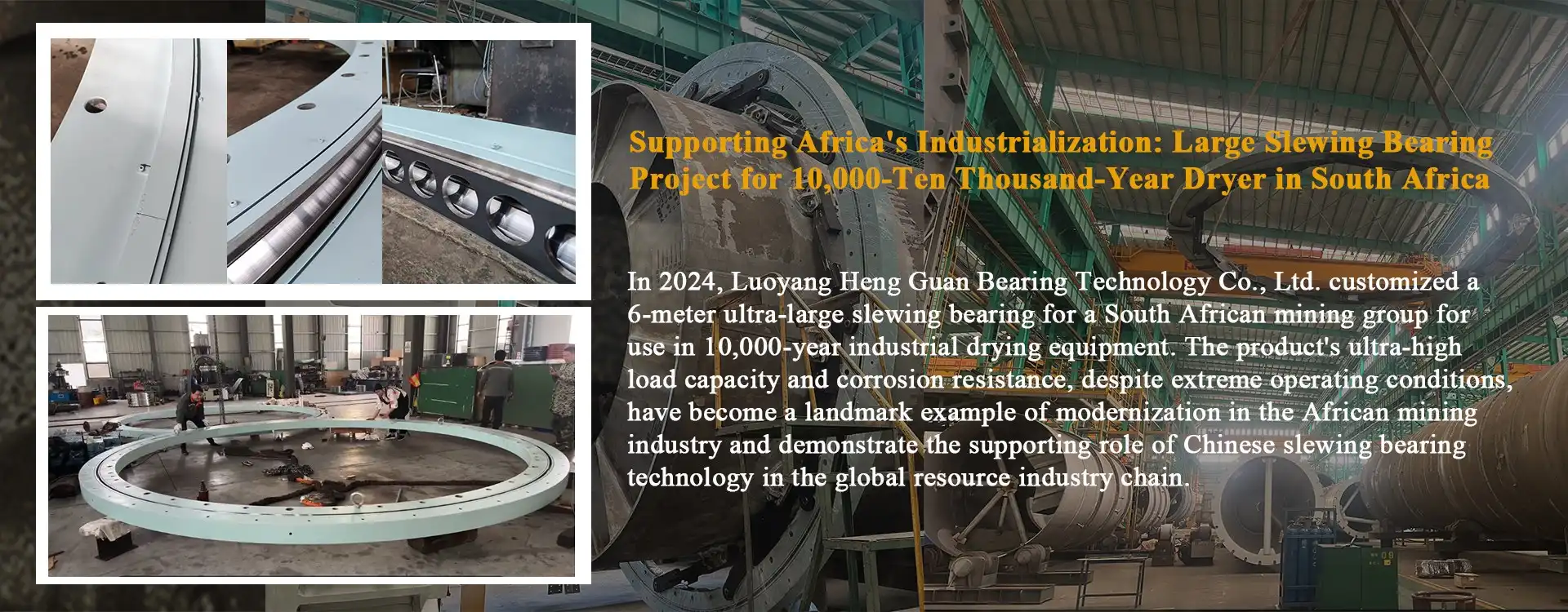
Luoyang Heng Guan Bearing Technology focuses on the design and manufacture of large-diameter bearing products for industrial applications. For OEM customers, the value of a specialized manufacturer is not limited to supplying a finished bearing. Engineering support can also help determine the appropriate structure, dimensions, gear arrangement, sealing method, and manufacturing requirements for a specific machine.
For a custom project, the engineering process should begin with the customer's actual operating conditions rather than selecting a bearing solely from a dimensional catalog. Load combinations, mounting limitations, rotation characteristics, environmental exposure, and expected operating life can all influence the final design.
Heng Guan's production and inspection capabilities can support projects requiring large bearing dimensions and customized interfaces. For procurement teams, this can simplify communication because design, manufacturing, inspection, and technical support can be coordinated with the same supplier.
The most useful approach is to provide the supplier with the machine drawing and operating data at the quotation stage. This gives the engineering team enough information to review the application and identify potential issues before production begins.
For projects involving cranes, excavators, mining machinery, wind equipment, port machinery, or other large rotating structures, early engineering communication is particularly valuable because bearing dimensions and mounting conditions are closely connected to the overall machine design.
Conclusion
To select the optimal heavy-duty slewing bearing solution, the load requirements, environment, and the capabilities of the provider all need to be carefully considered. The manufacturing skills required for these big-diameter rotating assemblies exceed basic machining due to the technological complexity of these components. These abilities include metallurgy, heat treatment, precision grinding, and thorough quality assurance. Procurement specialists working with experienced manufacturers can get engineering advice to make sure the specifications are right and the material is not damaged and to pick the optimum bearings for each application. The quality of these structural parts is of great importance for the work of significant heavy equipment. That is why the selection of a supplier is one of the most critical considerations in equipment development and maintenance programs.
|
|

FAQ
1. What load capacities can slewing ring bearings handle?
Load capacity changes a lot depending on the shape and diameter of the structure. Single-row four-point contact designs with an outer diameter of up to 1,200 mm can usually handle axial loads of up to 800 kN and radial loads of up to 600 kN. Larger three-row roller configurations can have an axial capacity of more than 20,000 kN. The capacity to handle turning moments increases dramatically with diameter. For example, a 5,000 mm bearing can handle tilting moments of more than 50,000 kN·m. To get accurate capacity ratings, engineers need to look at your specific load profile and safety factor needs.
2. How do I specify the correct precision grade?
Precise selection is needed for certain applications. The P0 standard grade is good for general construction equipment that only needs moderate positioning accuracy. P6 precision is used for things like material handling cranes that need to be very precise. For automation systems that need to position things over and over, the P5 grade is used. The P4 specification covers the toughest uses, like medical imaging systems and aerospace ground support equipment, where the accuracy of rotation has a direct effect on how well the system works. Higher precision grades cost more and have tighter manufacturing tolerances.
3. What maintenance intervals do these bearings require?
How often you need to lubricate depends on how hard you work and how much you are exposed to the environment. Equipment that only works sometimes in clean areas may need to be oiled every 300 to 400 hours. In dirty environments, continuous-duty applications may need to be oiled every 100 hours. Every three months, the seal should be visually checked, and if any damage is found, it should be replaced right away. It is suggested that the torque on the mounting bolts be checked every year after the first 50 hours of use. During regular inspections of equipment, temperature and vibration should be checked to find problems before they become major ones.
Partner with a Trusted Heavy-Duty Slewing Bearing Manufacturer
Heng Guan Bearing Technology is ready to meet your most difficult needs for rotating parts. Our rigorous testing procedures and ISO 9001-certified production methods make sure that every bearing meets the exact requirements of your equipment. We can help you with engineered solutions that are made to fit your specific application and heavy-duty slewing bearing needs. These solutions range from single-row four-point contact ball bearings to three-row roller configurations with a diameter of up to 10,000 mm. Our customers all over the world trust us to give them reliable parts that keep equipment running as long as possible in the mining, construction, energy, and industrial sectors. Get in touch with our engineering team at mia@hgb-bearing.com to talk about how our technical support and ability to customize can help you meet your procurement needs and improve your operational success.
References
1. Harris, T.A. and Kotzalas, M.N., "Advanced Concepts of Bearing Technology: Rolling Bearing Analysis, Fifth Edition," CRC Press, 2006.
2. Glover, D.P., "Design and Application of Large Diameter Slewing Ring Bearings for Heavy Equipment," Journal of Mechanical Engineering Science, Vol. 228, No. 4, 2014.
3. American Gear Manufacturers Association, "AGMA 6123-B06: Design Manual for Enclosed Epicyclic Gear Drives with Slewing Bearings," 2006.
4. ISO 76:2006, "Rolling Bearings – Static Load Ratings," International Organization for Standardization, 2006.
5. Wensing, J.A., "On the Dynamics of Ball Bearings," PhD Dissertation, University of Twente, Netherlands, 1998.
6. Zhou, R.S. and Hoeprich, M.R., "Torque of Tapered Roller Bearings Under Combined Loads," Journal of Tribology, Vol. 113, No. 3, American Society of Mechanical Engineers, 1991.

WHAT OUR CUSTOMERS SAY
Here is the customer's evaluation of us