




What Factors Affect Deck Crane Slewing Bearing Performance?
A reliable deck crane slewing bearing must do more than only permit the rotation of the crane upper structure. During the cargo handling operation the bearing is subjected to combined axial and radial loads and overturning moments due to the boom, the raised cargo and the crane structure. Ship motion, wind, salt water, exposure, many starts and stops and change of lifting load can increase the bearing load demands. So for owners, crane builders and maintenance workers, the functioning of the bearing is more than just the bearing itself. The reliability of the service depends on the quality of the materials, the design of the raceways, the load distribution, the precision of the mounting, the bolt connections, the lubrication, the sealing, the corrosion protection and the working conditions. Understanding these characteristics prior to purchasing or repairing a Deck Crane Slewing Bearing will help engineers pick the optimum configuration and avoid premature wear, excessive backlash, abnormal operating torque and unexpected crane downtime.
How Do Deck Crane Slewing Bearings Carry Crane Loads?
A deck crane slewing bearing is the revolving connection between the upper structure of the crane and the supporting base. Unlike a basic pivot, it has to go through multiple different kinds of loads through a reasonably small assembly and allow for controlled rotation.
Combined Loads Make Bearing Selection Critical
The loading condition of a deck crane is a variable condition. If the crane is lifting goods close to the vessel, the bearing may be under a different load combination than when the boom is over the side of the ship.
When selecting a bearing, the main loads usually taken into account are:
Axial load: The vertical force of the hoisted load and the crane structure.
Radial load Horizontal forces through the crane structure.
Overturning Moment: The moment caused by load position, boom geometry and other external pressures.
Dynamic loads: Extra forces generated by acceleration, deceleration, beginning, stopping and ship movement.
These loads should not be considered to be independent. The bearing manufacturer typically requires the worst operating condition full load combination for raceway and rolling-element capacity evaluation.
Performance Should Be Measured Under Real Operating Conditions
A bearing that rotates freely without load may respond differently while the crane is being operated at its maximum rated capacity. Hence, the performance evaluation has to incorporate mechanical features and operating conditions.
Rotational resistance, temperature rise, backlash or clearance, raceway condition, gear engagement when applicable and mounting bolt condition and signs of wear or corrosion are important indicators.
The bearing life should likewise be evaluated carefully. L10 bearing life is a statistical fatigue-life notion, not a guaranteed replacement interval. For big crane slewing bearings, engineering examination should include static load capacity, rigidity of the mounting structure, bolt preload, shock loading, lubrication and environment exposure.
Material and Heat Treatment Determine Long-Term Durability
The bearing material is the foundation of resistance to rolling contact fatigue, deformation and cracking. But material grade is not the only factor that determines service life. Heat treatment, raceway hardness, effective hardened depth, dimensional stability and manufacturing quality are of the same importance.
Raceways Need a Balance of Hardness and Toughness
The large slewing bearings are produced from alloy or medium-carbon steels, which are chosen according to the load capacity, the bearing size and the heat treatment method. The materials such as 42CrMo, 50Mn, etc. are used in diverse applications of slewing bearings, but the correct material should be selected according to the design of the manufacturer and relevant material parameters.
Raceway hardness and hardening depth should be adequate to resist rolling contact fatigue and wear. The supporting material below the hardened layer should have sufficient toughness to withstand shock and cyclic loading.
If the raceway is not firm enough, frequent contact stress might cause early pitting, spalling or plastic deformation. Other failure hazards are excessive residual stress or lack of toughness with poor control of the heat-treatment process.
Therefore, for procurement, purchasers should demand material certificates and appropriate heat-treatment inspection records rather than evaluate a bearing only by its nominal steel grade.
Rolling Elements and Surface Finish Affect Contact Reliability
The rolling elements ought to be geometrically and qualitatively homogeneous because minor imperfections may increase the contact stress. For example, cylindrical rollers are usually made to the dimensional accuracy and surface polish required for the bearing design.
Raceway geometry matters a lot too. Manufacturing faults, excessive roughness or wrong profile shape may influence load distribution among rolling elements. The irregularities of contact may be very modest, yet under severe crane loads the same portions of the raceway may be subjected to numerous stress cycles.
Therefore, grinding, heat treatment and final dimensional inspection are the critical steps in the manufacturing process of slewing bearings.

Installation Accuracy Can Determine Actual Bearing Life
Even a good bearing might be destroyed prematurely if it is placed incorrectly. Uneven support or deformation at the mounting interface may modify the internal load distribution, as a slewing bearing is directly attached to the crane frame.
Mounting Surface Flatness Must Match the Bearing Requirement
Mounting surfaces should be clean, correctly machined, and devoid of burrs, excessive paint accumulation, or other problems that will inhibit full contact.
The required flatness and permissible structural deflections should be determined by the installation paperwork from the bearing manufacturer and the specific crane design. 0.05 mm is a universal number and should not be applied to every bearing just because it is in a general installation guideline.
If there are high places on the mounting surface, the bearing ring could be deformed locally after mounting. However, insufficient support can lead to increased ring deformation and unequal loading of the raceway.
Bolt Tightening Is Part of the Bearing System
The mounting bolts are not just fasteners to hold the bearing in place. They form part of the load-bearing system.
The bearing ring and supporting structure may shift relative to each other with improper bolt preload. Unequal or over-tightening can also cause unwanted deformation.
Therefore, installation should follow the bolt grade, tightening sequence, torque or tension method, and inspection standards provided by the bearing manufacturer. A controlled cross or star tightening sequence is often employed, but the technique must be carried out as per the manufacturer’s recommendations.
Critical crane applications can benefit from controlled tensioning equipment or calibrated torque equipment to help enhance installation consistency. Bolt condition should also be checked during subsequent inspections.
Lubrication and Sealing Protect the Bearing From Premature Wear
Lubrication is one of the most critical maintenance elements influencing the performance of the slewing bearings. It lowers friction, limits direct metal-to-metal contact, and helps protect raceway and rolling element surfaces.
Grease Selection Should Match the Marine Duty
The right grease depends on bearing design, operating temperature, load, rotation speed, and exposure to the environment.
Typically, marine crane applications focus on water resistance and corrosion protection. Saltwater contamination can affect the performance of the lubricant and steel surfaces.
Don't mix greases just because they look alike or are general-purpose greases. Thicker systems or additive packages may not be compatible. The bearing manufacturer shall specify the type of lubricant to be used and the compatibility thereof by maintenance professionals.
Relubrication Frequency Depends on Operating Conditions
There is not a single relubrication interval for all deck cranes.
A crane operating regularly in a salt-laden sea environment will likely require a different maintenance regime than one operating intermittently in sheltered conditions. High operating frequency, numerous slewing cycles, water infiltration, and pollution can all increase lubrication needs, as well as heavy loads.
Grease must be applied at the specified lubrication spots according to the manufacturer's instructions. The technician should also verify during maintenance that fresh grease is reaching the designated locations of the raceways and the old grease for evidence of water contamination or atypical particles.
Seals Are the First Defense Against Contamination
The sealing mechanism keeps seawater, dust, and cargo particles out of the raceways and oil in the bearing.
Contamination can enter the bearing if the seals are cracked, toughened, displaced, or broken. If abrasive particles get into the rolling contact area, they can damage the raceway and cause rapid wear.
Hence, for deck crane slewing bearing operating in bulk cargo ports or dusty surroundings, seal inspection should be a part of routine maintenance, rather than waiting for abnormal bearing noise or torque to arise.
Marine Environmental Conditions Accelerate Bearing Degradation
A deck crane operates in an environment that is considerably more demanding than many indoor industrial machines. Saltwater, humidity, temperature changes, airborne contaminants, and corrosion can all affect bearing performance.
Saltwater Exposure Increases Corrosion Risk
Chloride-containing marine environments are particularly aggressive toward exposed steel surfaces. Damage to coatings or seals can create pathways for moisture to reach the bearing components.
Corrosion pits are not merely cosmetic. A damaged surface can act as a stress concentration and may eventually affect the raceway or other load-bearing surfaces.
Protective coatings, suitable sealing arrangements, drainage provisions, and regular inspection should therefore be considered together.
Temperature Changes Can Affect Lubrication and Clearance
Large temperature variations can influence lubricant viscosity, material dimensions, and internal operating conditions. Cold temperatures can increase grease resistance, while high temperatures may accelerate lubricant degradation.
The bearing should be specified for the actual operating temperature range rather than relying on a generic environmental rating.
Cargo Dust and Foreign Particles Cause Abrasive Wear
Deck cranes handling bulk materials may operate around dust, mineral particles, or other contaminants. If these particles pass through damaged seals, they can enter the lubricant and rolling contact area.
Contamination can cause abrasive wear, surface indentations, and accelerated lubricant degradation. For this reason, seal condition and lubrication cleanliness are important indicators of long-term bearing health.
Maintenance Practices Have a Direct Effect on Bearing Performance
Preventive maintenance is generally more effective than waiting for a crane to develop excessive backlash, abnormal noise, or increased rotational resistance.
Monitor Torque, Temperature, and Backlash
Changes in operating behavior can provide useful early warnings.
An increase in rotational torque may indicate lubrication problems, contamination, raceway damage, seal interference, or other mechanical issues. Increasing temperature can also indicate excessive friction or lubricant deterioration.
Backlash and clearance should be monitored according to the crane and bearing manufacturer's specified inspection method. A gradual change may indicate wear or structural changes that require further investigation.
These measurements become more useful when they are recorded over time. A single measurement provides limited information, while a trend can show whether the condition is stable or deteriorating.
Inspect Raceways, Seals, Gears, and Mounting Bolts Together
A slewing bearing should not be inspected in isolation.
If the bearing incorporates an external or internal gear, gear teeth should be checked for abnormal wear, cracking, pitting, and incorrect tooth contact. Mounting bolts should be inspected for loosening or other signs of abnormal loading. Seals should be examined for damage, and lubrication points should be checked for proper operation.
A systematic inspection of the deck crane slewing bearing helps distinguish between bearing problems and problems originating in the crane structure, drive system, or installation.

Choosing the Right Bearing Requires More Than Comparing Prices
For procurement teams, the lowest initial quotation does not necessarily represent the lowest total cost. A bearing that requires premature replacement can create crane downtime, cargo-handling delays, labor costs, and emergency transportation expenses.
Provide Complete Crane Data Before Requesting a Quotation
A supplier can make a much more reliable recommendation when the buyer provides complete operating information.
Important information can include:
Maximum and rated lifting loads
Maximum working radius
Axial and radial loads
Maximum overturning moment
Slewing speed
Duty cycle and expected operating hours
Crane type and application
Bearing outside diameter, inside diameter, and height
Mounting-hole dimensions
Bolt quantity and arrangement
Gear specifications if an integrated gear is required
Operating temperature
Marine corrosion exposure
Lubrication requirements
Existing bearing drawings or dimensional data
Applicable inspection and documentation requirements
Providing this information allows the manufacturer to assess whether a standard configuration is appropriate or whether a customized design is required.
Evaluate Manufacturing and Quality-Control Capability
A capable slewing bearing supplier should be able to explain how the product is manufactured and inspected.
For a large deck crane slewing bearing, useful supplier evaluation points include material traceability, heat-treatment control, raceway machining, dimensional inspection, gear inspection, seal installation, and final quality checks.
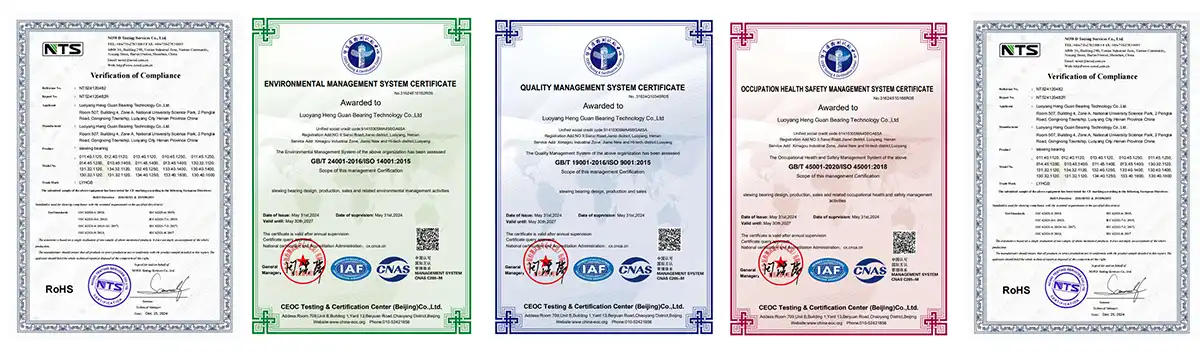
Buyers should also request relevant inspection documentation, such as material certificates, dimensional reports, and other test records applicable to the project.
An ISO 9001 certification can demonstrate that a quality management system is in place, but it should not be treated as proof that every bearing will automatically meet a specific technical requirement. Product drawings, inspection criteria, and acceptance requirements still need to be clearly defined.
Compare Lifecycle Cost Instead of Purchase Price Alone.
A meaningful cost comparison should consider the entire operating period.
The calculation can include:
Purchase price + installation cost + maintenance cost + expected replacement cost + downtime cost
This approach is particularly important for deck cranes because bearing replacement can require substantial preparation, lifting equipment, labor, and operational downtime.
A slightly higher initial price may be justified if the bearing provides the required load capacity, manufacturing quality, corrosion resistance, service support, and expected operating reliability.
How to Improve Deck Crane Slewing Bearing Reliability
Reliable performance starts before the bearing reaches the vessel. Engineering, procurement, installation, and maintenance teams should work from the same technical requirements.
Confirm the Design Before Manufacturing
Before production begins, buyers should verify the bearing drawing, mounting dimensions, load requirements, gear arrangement, and lubrication configuration.
For a replacement bearing, comparing the new design against the original bearing is particularly important. Changes in ring dimensions, bolt patterns, gear geometry, or internal configuration may affect compatibility with the existing crane.
Establish Inspection Records From the First Installation
Installation records should include mounting-surface inspection, bolt-tightening information, lubrication details, and initial operating measurements where applicable.
Once baseline data has been established, future inspections can be compared against the original condition. This makes it easier to identify gradual changes before they develop into major failures.
Conclusion
The performance of a deck crane slewing bearing is determined by the interaction of bearing design, material quality, heat treatment, load distribution, installation accuracy, lubrication, sealing, maintenance, and marine environmental conditions. No single specification can guarantee long service life if the other parts of the system are poorly controlled.
For heavy-duty deck cranes, the selection process should begin with the actual load spectrum and mounting conditions rather than simply choosing a bearing by diameter or purchase price. Material certificates, heat-treatment control, raceway quality, bolt installation, lubrication practices, and corrosion protection should then be considered as part of the same reliability strategy.
For procurement teams, providing complete crane data to the manufacturer is one of the most effective ways to improve bearing selection. Load information, operating cycles, dimensions, gear requirements, and environmental conditions allow the supplier to recommend a configuration based on the real application.
Choosing an experienced manufacturer that can provide engineering support, manufacturing traceability, inspection documentation, and customized solutions can further reduce the risk of premature bearing failure. With the right design and a structured maintenance program, a deck crane slewing bearing can provide stable rotation and dependable load transmission throughout demanding marine service.
|
|
FAQ
1. What is the typical service life for marine crane slewing bearings?
Operational lifespan depends heavily on load intensity, maintenance quality, and environmental severity. Quality Deck Crane Slewing Bearings often last longer than 25,000 operational hours under normal conditions, such as when they are properly oiled and used for moderate amounts of time. Heavy-duty applications in corrosive environments may need to be replaced after 15,000 hours. On the other hand, light-duty cranes that are well taken care of can last for 40,000 hours or more. Keeping an eye on vibration patterns and sticking to lubrication schedules can make something last a lot longer.
2. How do I know when my bearing requires maintenance or replacement?
Some warning signs are strange noises during rotation, more resistance to rotation, corrosion that can be seen on the outside, grease leaks that mean the seal is failing, and high operating temperatures. Vibration monitoring finds damage in the ground before it shows up as obvious symptoms. Any sudden change in how something works needs to be looked at right away to make sure it doesn't break down during cargo operations.
3. Should I choose a standard catalog bearing or commission custom engineering?
Standard products work with standard crane configurations and loading patterns. They have shorter lead times and lower initial costs. Custom solutions improve performance when there are unusual mounting restrictions, unusual load conditions, or unique environmental problems. When existing equipment has non-standard dimensions or needs to perform better than what is listed in a catalog, custom engineering is the best option in the long run, even though it costs more up front.
Partner with Leading Deck Crane Slewing Bearing Specialists
Heng Guan knows that your marine operations can't handle failures that stop moving cargo and cost you money. Our three-row roller deck crane slewing bearing are made from 42CrMo alloy steel that has been fully heat-treated. They can handle heavy loads and won't rust in harsh offshore environments. Precision-grade bearings with diameters from 50 mm to 10,000 mm can be made just the way you want them, even if you don't have full drawings. As a well-known company that makes slewing bearings and ships them to more than 50 countries, we offer full support, from helping with the design phase to installing the bearings and planning preventative maintenance. Contact our engineering team at mia@hgb-bearing.com to talk about how our marine-grade rotational solutions can improve the performance of your deck crane while lowering the total cost of ownership by extending its service life and reducing downtime.
References
1. American Bureau of Shipping. "Rules for Building and Classing Steel Vessels: Machinery and Piping Systems." ABS Technical Publications, 2022.
2. Det Norske Veritas. "Certification of Lifting Appliances: Design Requirements for Crane Slewing Mechanisms." DNV-GL Standards for Maritime Equipment, 2021.
3. International Organization for Standardization. "Rolling Bearings - Slewing Bearings: ISO 8100 Parts 1 and 2 Performance Parameters and Testing Methods." ISO Technical Committee 4, 2020.
4. Shigley, Richard, and Mischke, Charles. "Mechanical Engineering Design: Rolling-Contact Bearings for Heavy Industrial Applications." McGraw-Hill Engineering Series, Eighth Edition, 2019.
5. Harris, Tedric A. and Kotzalas, Michael N. "Advanced Concepts of Bearing Technology: Rolling Bearing Analysis, Fifth Edition - Material Science and Failure Modes." CRC Press Taylor & Francis Group, 2021.
6. Society of Naval Architects and Marine Engineers. "Marine Machinery Systems: Auxiliary Equipment Design Standards for Deck Cranes and Cargo Handling Apparatus." SNAME Technical Research Bulletin, 2023.

WHAT OUR CUSTOMERS SAY
Here is the customer's evaluation of us