



What are the differences between cross roller bearings and slewing ring bearings?
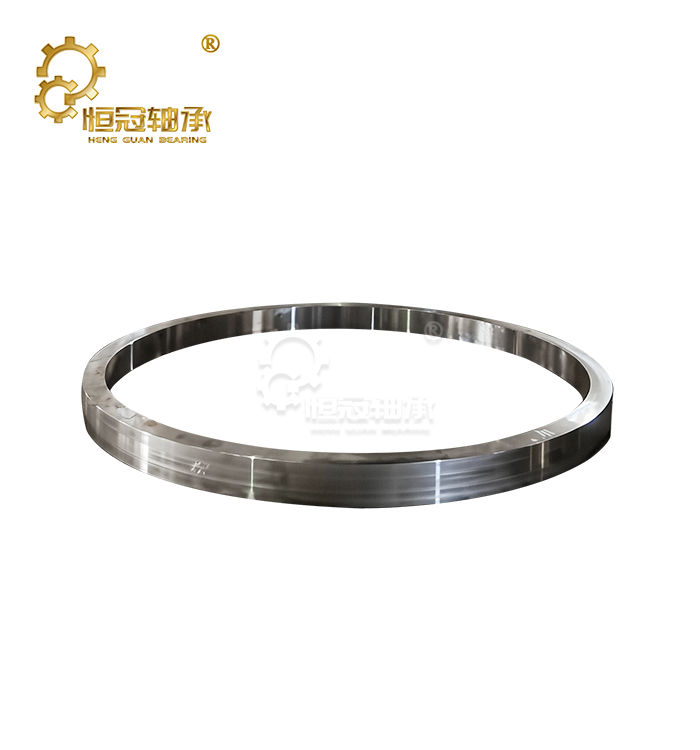
Selecting the right rotary bearing is an important decision for equipment designers, OEM manufacturers, and maintenance engineers. Although cross roller bearings and slewing ring bearings both support rotational movement, they are designed for very different working conditions. The choice between them depends on several factors, including load requirements, rotational accuracy, installation space, operating environment, and maintenance expectations. A Cross Roller Slewing Bearing suited for applications requiring high stiffness, small dimensions and excellent rotational accuracy. The crossed cylindrical rollers are positioned alternately at 90 degrees to the inner and outer raceways. The bearing may simultaneously carry radial, axial and moment loads. That is why it is often utilised in robotics, precise machine tools, semiconductor equipment and medical imaging systems. Slewing ring bearings are mainly created for large scale industrial applications where high load carrying capability and dependable performance under severe conditions are required. They are found in cranes, excavators, wind turbines and port gear where the need for massive loads and continuous rotation outweigh the need for ultrahigh precision. This realisation enables engineers to select a bearing system that will fulfilll the actual needs of the application, not just size or cost.
How are cross roller bearings and slewing ring bearings designed differently?
The primary difference between these two types of bearings is in their internal construction. The design of the rolling elements directly influences the load distribution, precision, and operational performance.
Cross Roller Bearing Structure and Working Principle
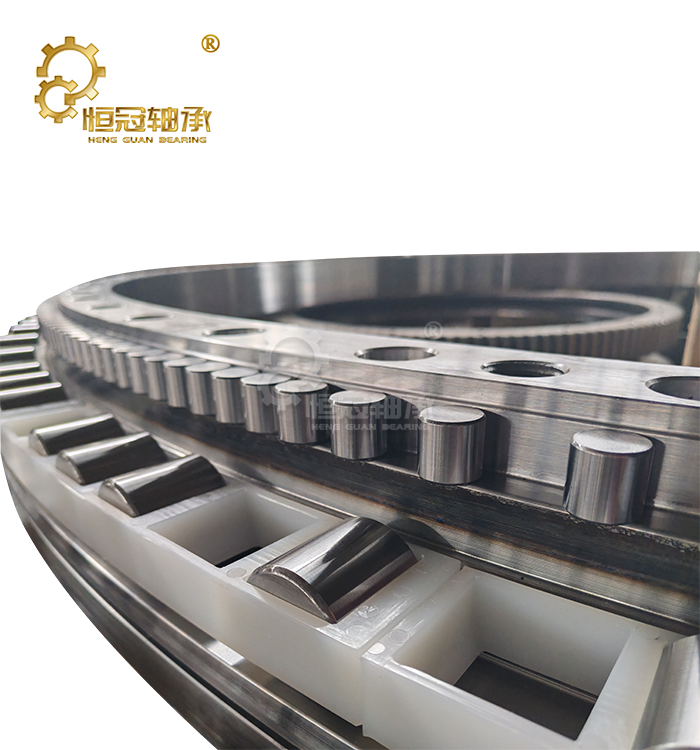
Crossed roller bearings are made with cylindrical rollers that are arranged in a cross pattern between specifically engineered V-shaped raceways. The rollers are perpendicular to each other. So one roller is facing one way, the next is facing a different way, the next is facing a different way, etc.
There are a number of benefits to this form:
- Rotational stiffness increase.
- Increased resistance to overturning moments;
- Lower internal clearance;
- Better positioning accuracy.
Many types of loads can be carried simultaneously by a single cross roller bearing unit. This means that cross roller bearings can often replace the need for many conventional bearings together. This enables a reduced installation space and a simplified mechanical design.
A cross roller slewing bearing is particularly suited to applications where the equipment has to revolve smoothly and yet still maintain accurate alignment. For instance, robotic arms or rotary tables frequently need repetitive motion with little variance. In these circumstances the accuracy of the bearing directly influences the final performance of the machine.
Materials also have an essential effect on performance. The typically used high-grade bearing steels, such as GCr15 (SUJ2), have good wear resistance and fatigue strength. Alloy steels such as 42CrMo can also be explored for specific applications where additional mechanical strength is required.
Slewing Ring Bearing Design Features
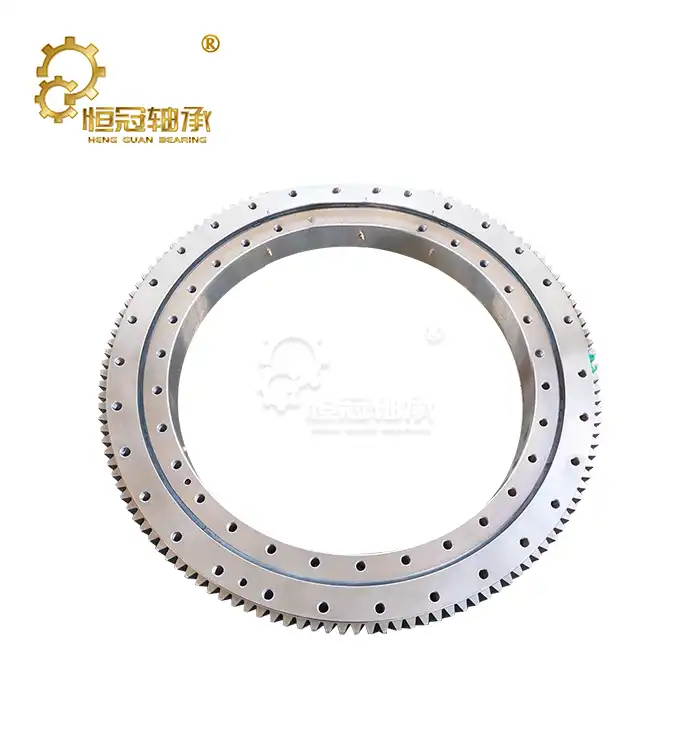
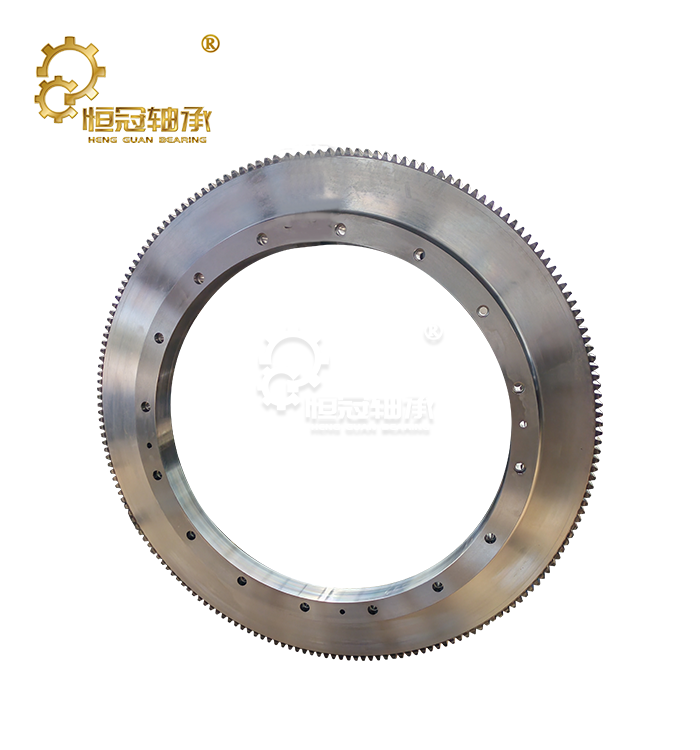
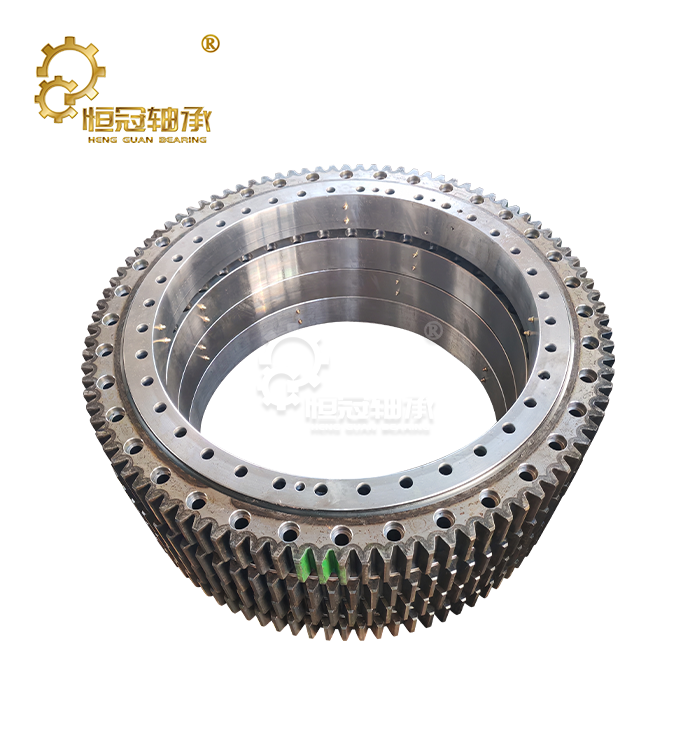
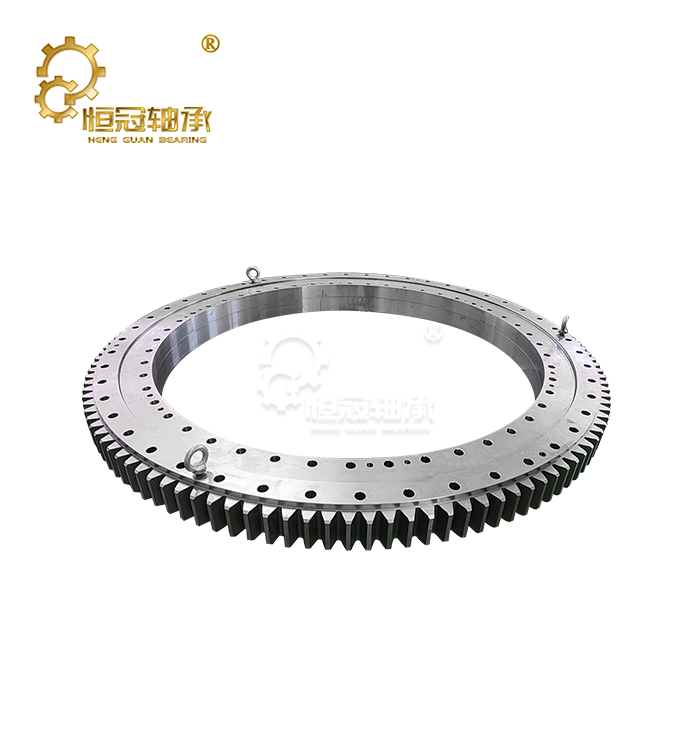
Slewing ring bearings are generally produced in bigger diameters and heavier constructions than cross roller bearings. Depending on the load capacity required, the single-row ball, double-row ball, or multi-row roller arrangement is selected.
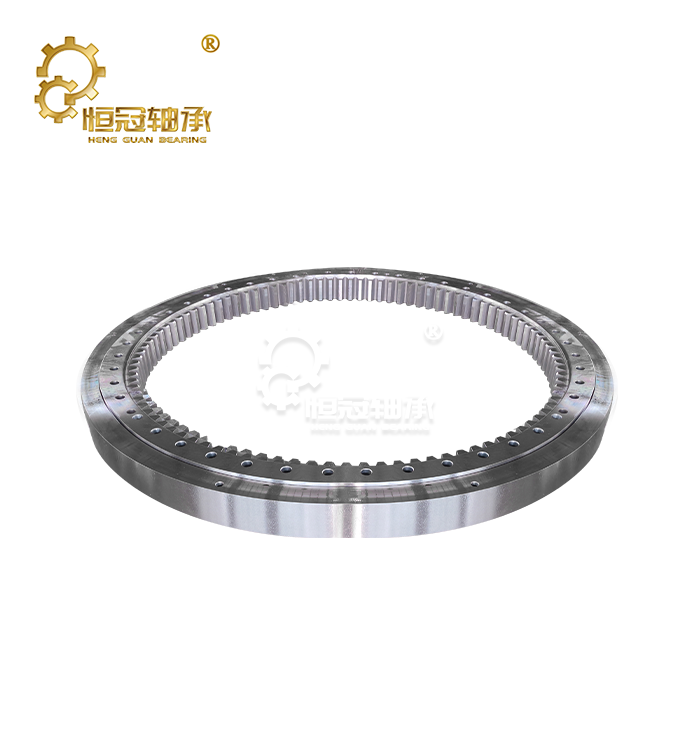
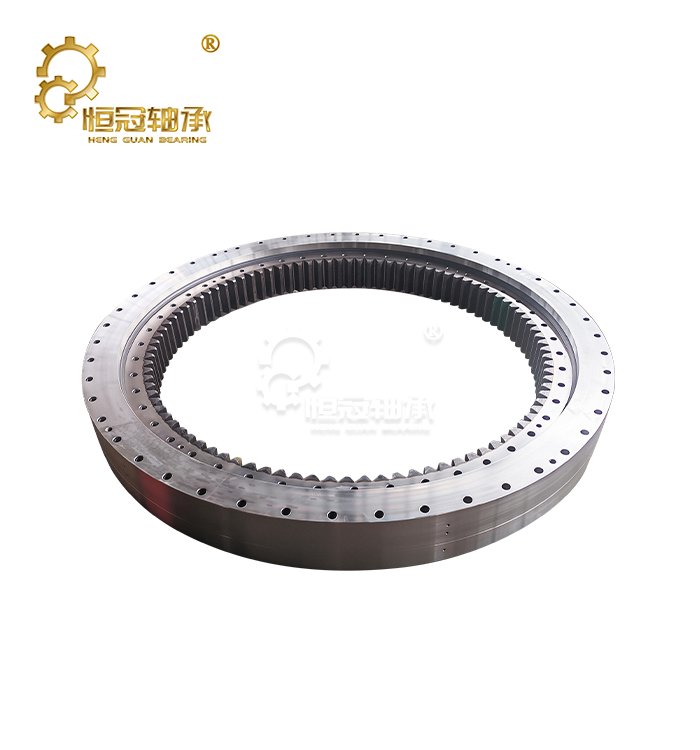
Many slewing ring bearings also feature integrated external or internal gears. Such an arrangement allows the bearing to be connected directly to a drive system, decreasing the amount of additional components necessary.
Typical applications are:
- Slew devices for excavator;
- Cranes, towers;
- Yaw systems for wind turbines;
- Marine hoisting appliances.
The biggest advantage of slewing ring bearings is their capacity to support extremely enormous loads. They have a bigger raceway diameter and a higher number of rolling elements; thus, they can carry heavy axial stresses, radial loads, and overturning moments.
However, the increased size of such designs typically means that they cannot be as precise in rotation as cross roller designs.
Performance Comparison Between Cross Roller Bearings and Slewing Ring Bearings
Both types of bearings give rotating motion, but they work differently. When making a final selection, engineers must consider the following factors.
Load Capacity and Operating Conditions
The advantage of slewing ring bearings is usually when high load capacity is the main consideration.
Heavy equipment such as cranes and extractive machinery regularly breaks down:
- sudden shock loads;
- Changing work directions;
- Extended operation cycles;
- Contamination, external.
- In such cases, slewing ring bearings are reliable support with their sturdy design.
Cross roller bearings, however, are designed for applications where load capacity needs to be matched with precision. The crossed roller design provides a compact profile with effective load distribution.
For example, an industrial robot does not have to lift several hundred tons, but it has to move accurately thousands of times a day. Excess bearing clearance can reduce positioning precision; hence, a cross roller arrangement is frequently more appropriate.
Rotational Accuracy and Rigidity
One of the biggest distinctions between the two designs is rotational precision.
Cross roller bearings are well known for their excellent accuracy because:
- The crossed roller setup minimizes internal movement;
- preloading increases stiffness;
- The contact design reduces the deviation of rotation.
This means that they are useful for:
- CNC rotary tables;
- Optical apparatus;
- Inspection systems
- Medical devices.
Slewing ring bearings are more about strength and durability. They are designed to keep rotating smoothly under enormous loads, not to be accurate to microns in their location.
In construction machinery, a little bit of play is usually acceptable, because the key goals are lifting capability and reliability.
Space Requirements and Installation Considerations
Performance and accessible installation space are a trade-off commonly required by machine designers.
The cross roller bearing has a compact structure that can lower the size of the entire equipment. By using a single bearing unit, several typical bearing arrangements can be replaced, allowing manufacturers to build lighter and more compact machines.
This benefit is especially useful in:
- Joints,
- robotic;
- Automatic equipment.
- Compact machining centers.
Slewing ring bearings are designed for big mechanical systems and hence require greater room to install. But the circular form of the mounts and the built-in gear choices allow for feasible installation of large equipment.
For example, a crane manufacturer may prefer a slewing ring bearing because it combines the support for rotation and the drive gearbox in a single piece.
Choosing the Right Bearing Based on Application Requirements
The accurate selection of a bearing should always originate from actual operating conditions, rather than the selection based on the product specifications.
When Are Cross Roller Bearings the Better Choice?
Cross roller bearings are generally recommended when the application requires the following:
- High accuracy of placement;
- Smooth turning;
- Compact design,
- Low rotation error.
A typical example is:
Robotic systems
Robots for electronics production or precision assembly have to move in a repeatable manner. The precision of the bearings is very crucial since small positioning errors may influence the product quality.
Machine Tool
CNC equipment requires stable rotary motion with a cross roller slewing bearing to keep machining accuracy. The stiffness of the bearings effects the surface quality and the uniformity of output.
Medical devices
Imaging devices (e.g., CT scanners) have to be rotated in a controlled manner. Too much vibration or movement can impact image quality.
In such applications, the investment in a high-precision bearing typically leads to a reduction of long-term difficulties of adjustment and maintenance of the equipment.
Cost Considerations and Long-Term Value of Different Bearing Solutions
When comparing cross roller bearings and slewing ring bearings, the purchase price is not the only thing you should look at. The real cost of a bearing solution is the cost of installation, maintenance, risk of downtime, and service life.
Cross roller bearings are more expensive initially due to the need for precision machining, controlled preload settings, and tight manufacturing tolerances. But this investment can pay off in the long run for precision equipment.
A high-accuracy rotary bearing may aid in the reduction of:
- Positioning errors while the machine is in operation;
- faults in the product caused by vibration;
- Time for adjustment of equipment during commissioning;
- Maintenance caused by too much play.
For producers of automation equipment, a more precise bearing solution can help to enhance production consistency and minimize the need for frequent calibration.
Slewing ring bearings are frequently a superior economic value for heavy-duty applications, as they are built for extensive working cycles under harsh conditions. Their high load capacity and integrated gear options can simplify equipment design and minimize the amount of mechanical components.
However, opting for an undersized slewing ring drive in an effort to cut initial expenses can generate significant problems down the line. Lack of load capacity may cause premature wear and tear, unplanned downtime, and expensive replacement work.
Therefore, engineers should be looking at the overall cost of ownership, not just the original price quote.
What Engineers Should Consider When Purchasing Rotary Bearings?
understanding of the application environment. The professional bearing supplier should allow customers to assess technical factors before manufacture.
Reviewing Load, Speed, and Operating Environment
Before selecting a bearing, engineers should consider:
- Static and dynamic loads;
- Moment loads caused by overhanging structures;
- Rotation speed;
- Operating temperature;
- Dust, moisture, or corrosive conditions.
A precision machine working in a clean factory environment has completely different requirements from a construction machine operating outdoors.
For example, a robotic arm may prioritize low friction and repeatability, while an excavator requires maximum strength and impact resistance.
Considering Customization and Manufacturing Capability
Many industrial applications require customized bearing solutions instead of standard products.
A reliable manufacturer should be able to provide the following:
- Customized dimensions;
- Special mounting designs;
- Different gear configurations;
- Material selection advice;
- Technical drawings and engineering support.
For large rotary equipment, even small dimensional differences can affect installation accuracy. Professional suppliers usually perform detailed reviews of mounting conditions, load calculations, and operating requirements before production.
Manufacturing capability is also important. Precision grinding, heat treatment, dimensional inspection, and quality control processes directly influence bearing reliability.
For example, raceway hardness, surface finish, and internal clearance must be carefully controlled to achieve stable performance.
Checking Quality Control and Documentation
Industrial buyers should pay attention to quality assurance systems when selecting bearing suppliers.
Important documents may include:
- Material certificates;
- Inspection reports;
- Dimensional measurement records;
- Heat treatment records;
- Quality management certifications.
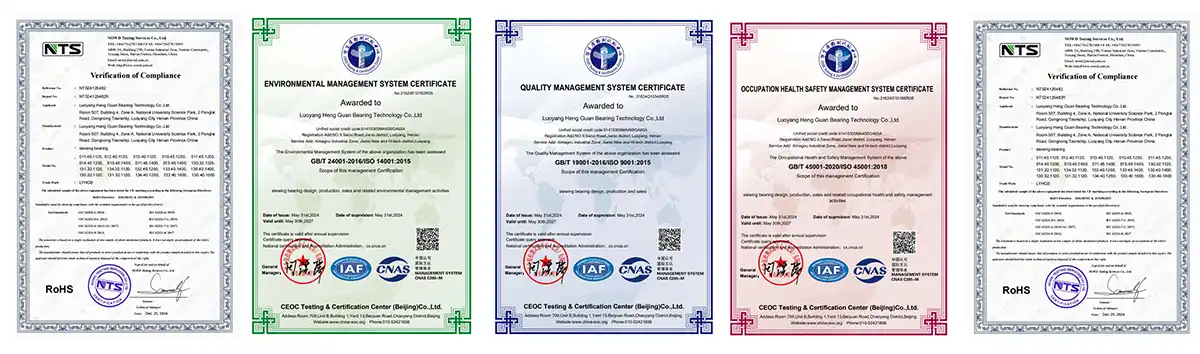
These documents provide confidence that the bearing meets the required specifications and can be traced throughout the manufacturing process.
For industries such as robotics, renewable energy, and heavy equipment manufacturing, consistent quality is essential because bearing failure can affect the entire system.
Maintenance Recommendations for Extending Bearing Service Life
Even a high-quality bearing requires proper maintenance to achieve its expected service life. Incorrect installation, insufficient lubrication, or contamination can significantly reduce performance.
Regular Inspection and Condition Monitoring
Preventive inspection helps identify early problems before they become major failures.
Engineers should regularly check:
- Abnormal vibration;
- Unusual operating noise;
- Temperature increases;
- Lubricant contamination;
- Changes in rotational resistance.
For precision applications using a Cross Roller Slewing Bearingcross roller slewing bearing, monitoring rotational smoothness is especially important. Any increase in friction or unexpected movement may indicate lubrication problems, contamination, or internal wear.
For heavy machinery using slewing ring bearings, inspection should also include checking gear condition, bolt tightening, and seal performance.
Proper Lubrication Practices
Lubrication plays a major role in reducing friction and preventing wear.
The correct lubricant depends on the following:
- Bearing design;
- Operating speed;
- Temperature range.
- Environmental conditions.
Cross roller bearings used in clean environments often require carefully controlled grease lubrication to maintain smooth movement.Slewing ring bearings used outdoors may require lubricants with better water resistance and contamination protection.Over-lubrication should also be avoided because excessive grease can increase operating resistance and generate additional heat.A maintenance schedule should be developed according to actual operating conditions rather than following a fixed interval only.
Correct Installation Methods
Proper installation is one of the most important factors affecting bearing performance.
Before installation, engineers should confirm:
- Mounting surface flatness;
- Correct alignment;
- Proper bolt tightening sequence.
- Clean assembly conditions.
For cross roller bearings, uneven mounting surfaces can affect preload and reduce rotational accuracy.
For slewing ring bearings, incorrect bolt tightening or improper gear alignment may create uneven loads and accelerate wear.
Following manufacturer installation guidelines helps prevent early failures and ensures stable operation.
Working With an Experienced Bearing Manufacturer
The differences between cross roller bearings and slewing ring bearings are not only related to product structure. The manufacturing experience and technical support provided by the supplier also influence the final performance of the equipment.
An experienced bearing manufacturer can help customers:
- Select suitable bearing types;
- Review application requirements;
- Provide customized solutions;
- Improve equipment reliability;
- Reduce unnecessary maintenance costs.
For companies developing precision machinery, automation systems, or heavy industrial equipment, choosing the right supplier is as important as choosing the right bearing.
A professional manufacturer should not only provide products but also offer engineering support throughout the entire process, from initial design review to after-sales service.
Conclusion
Understanding the differences between cross roller bearings and slewing ring bearings helps engineers and purchasing teams select the most suitable rotary bearing solution for their applications.
Cross roller bearings are ideal for precision-focused equipment that requires high rigidity, compact dimensions, and accurate rotation. They are commonly used in robotics, CNC machinery, semiconductor equipment, and medical systems where positioning performance is critical.
Slewing ring bearings are designed for heavy-duty applications where large load capacity, durability, and reliable operation are the main priorities. They play an important role in cranes, excavators, wind turbines, and other large industrial machines.
When selecting between these two bearing types, buyers should consider more than basic specifications. Factors such as load conditions, installation space, operating environment, maintenance requirements, and supplier expertise all influence the final decision.
A properly selected Cross Roller Slewing Bearing or slewing ring bearing can improve equipment performance, reduce maintenance risks, and provide long-term value. By working with an experienced bearing manufacturer that offers technical support, quality control, and customization capability, companies can ensure their rotary systems achieve reliable and efficient operation throughout their service life.
|
|

FAQ
1. Can cross roller bearings and slewing ring bearings be used interchangeably in heavy machinery?
Interchangeability depends on the needs of the application. Cross roller bearings work well in places where accuracy is important, and space is limited, but loads aren't too heavy, like in robotic arms or medical equipment. Slewing ring bearings work best in outdoor heavy machinery like cranes and loaders, where resistance to the elements and high loads are more important than accuracy down to the micron level. To directly replace one with another, engineers usually have to look at the load profiles, available room, and precise needs.
2. How does integrated gearing affect slewing ring bearing performance and maintenance?
The design of a drive system is made easier by integrated gearing, which combines the functions of a bearing and a transmission into a single assembly. This cuts down on the number of parts and possible failure spots. This integration makes the load distribution better at the gear-raceway contact and lets small slewing devices work. Monitoring the health of both the moving elements and the gear teeth makes maintenance a little more difficult, and greasing systems have to take into account the needs of both the gear mesh and the raceways. Integrated gear slewing rings that are well taken care of tend to last longer than separate bearing-and-gear setups because they don't have alignment problems between their parts.
3. What certifications should I require from bearing suppliers to ensure quality and compliance?
Quality security needs ISO 9001 approval, which shows that the manufacturing process is controlled in a planned way and can be tracked. Material certificates that show the composition of the steel and the results of the heat treatment process make sure that the bearings work as expected. Industry-specific approvals, such as CE marking for European markets or ATEX clearance for use in dangerous environments, show that rules are being followed. With every shipment, we include full material tracking, dimensional inspection reports, and certifications to help you with your quality paperwork needs and equipment approval processes.
Partner with Heng Guan for Superior Bearing Solutions
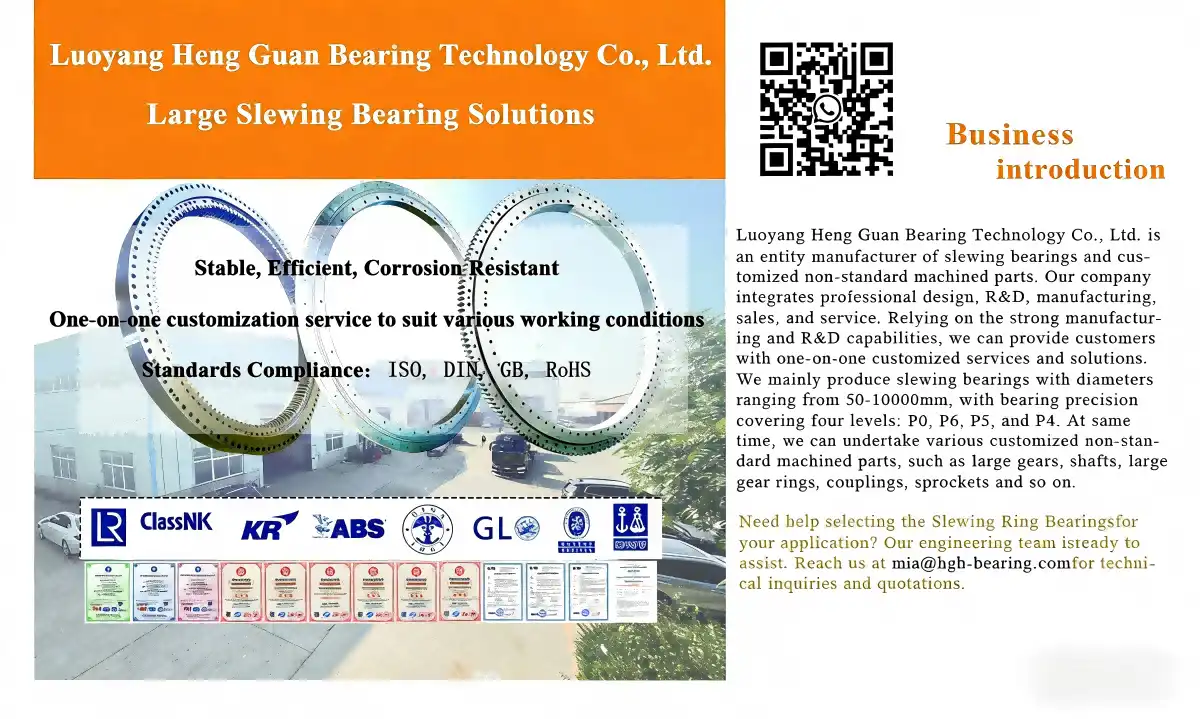
To choose the best bearing technology, you need to know more than just the specifications in a book. You also need to know how to apply those specs in the real world. Heng Guan is in Luoyang, which is known as a hub for making bearings. They have decades of experience making rotor bearings and can also make modern 20-10,000 mm diameter Cross Roller Slewing Bearing production. If you need P4-grade accuracy for medical equipment or ruggedized slewing rings for mining equipment, our engineering team can make a plan that works best for your needs. We use high-quality GCr15 (SUJ2) bearing steel and alloy steels like 42CrMo to make our products, and we keep accurate grades from P0 to P4 to make sure they meet your exact needs. We offer low prices on high-quality Cross Roller Slewing Bearings to customers around the world in the automation, aircraft, wind power, and heavy building industries. Get in touch with our technical experts at mia@hgb-bearing.com to get advice on the right bearings for your needs, help with custom engineering, and prices on both standard and custom-shaped bearings that will solve your specific spinning problems.
References
1. Harris, T.A. & Kotzalas, M.N. (2006). Rolling Bearing Analysis: Essential Concepts of Bearing Technology. CRC Press, Boca Raton.
2. Schaeffler Technologies AG & Co. KG (2019). Large Size Rolling Bearings and Slewing Bearings: Technical Product Information. Schweinfurt, Germany.
3. ISO 199:2014. Rolling Bearings - Thrust Bearings - Geometrical Product Specifications (GPS) and Tolerance Values. International Organization for Standardization.
4. Xu, H. & Zhang, W. (2018). "Comparative Analysis of Load Distribution in Cross Roller and Four-Point Contact Slewing Bearings." Journal of Mechanical Engineering Science, 232(14), 2547-2559.
5. American Gear Manufacturers Association (2020). AGMA 6123-B06: Design Manual for Enclosed Epicyclic Metric Module Gear Drives. Alexandria, VA.
6. Brändlein, J., Eschmann, P., Hasbargen, L., & Weigand, K. (1999). Ball and Roller Bearings: Theory, Design and Application. John Wiley & Sons, New York.

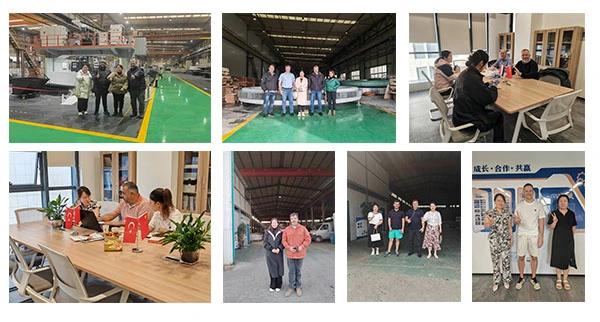
WHAT OUR CUSTOMERS SAY
Here is the customer's evaluation of us