



What are common signs of a failing excavator swing gear?
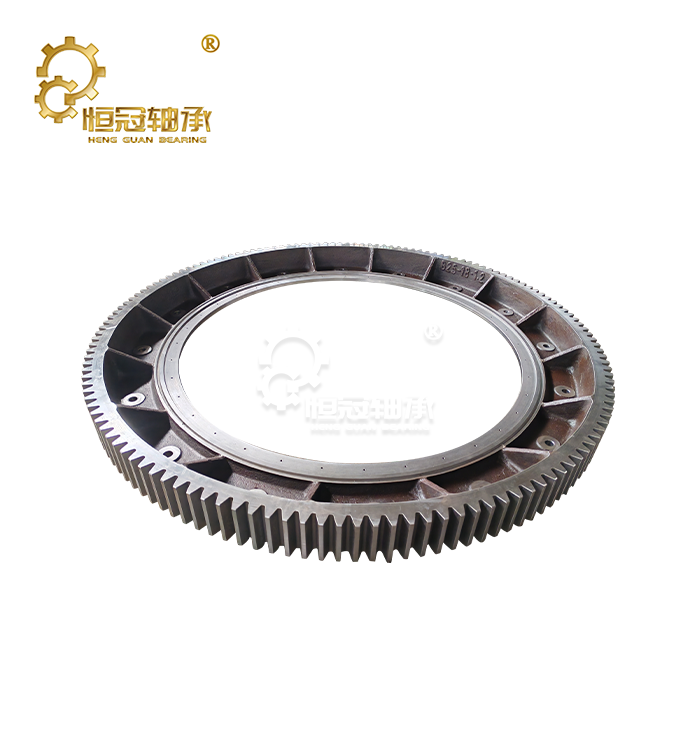
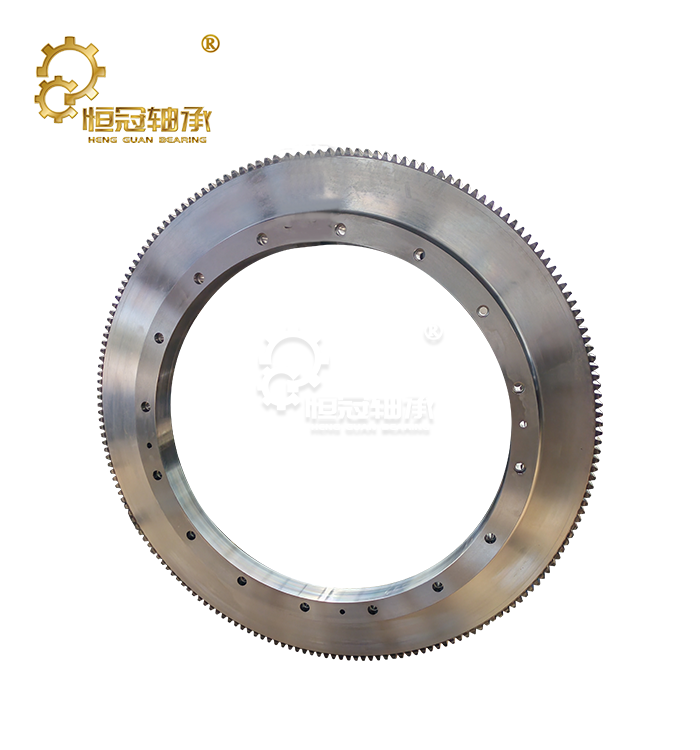
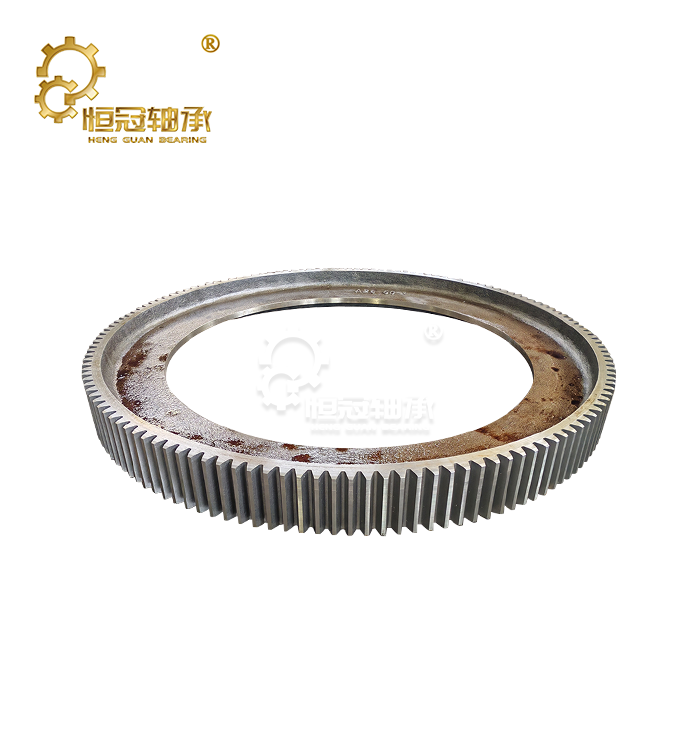
When an excavator begins to develop problems while rotating, the cause may be more than a hydraulic issue. The excavator ring gear works with the swing pinion and slewing bearing to transfer drive from the swing motor and rotate the upper structure around the undercarriage. Because these components operate under repeated loads, poor lubrication, incorrect gear meshing, mounting problems, shock loading, and normal wear can gradually affect swing performance. Common warning signs include unusual grinding or knocking noises, jerky rotation, increased backlash, visible tooth damage, uneven tooth wear, and changes in swing resistance. However, these symptoms do not automatically mean that the ring gear has failed. A damaged pinion, worn slewing bearing, inadequate lubrication, loose mounting bolts, hydraulic problems, or a malfunctioning swing brake can produce similar symptoms. For this reason, an effective diagnosis should examine the complete swing system rather than replacing the excavator ring gear based on one symptom alone.

How the Excavator Swing Gear Works in the Rotation System?
The Relationship Between the Swing Motor, Pinion, and Ring Gear
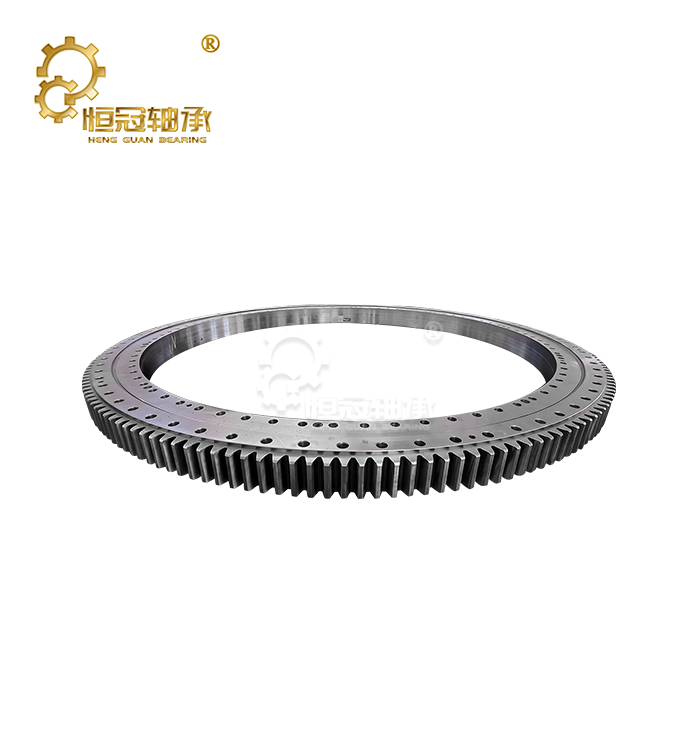
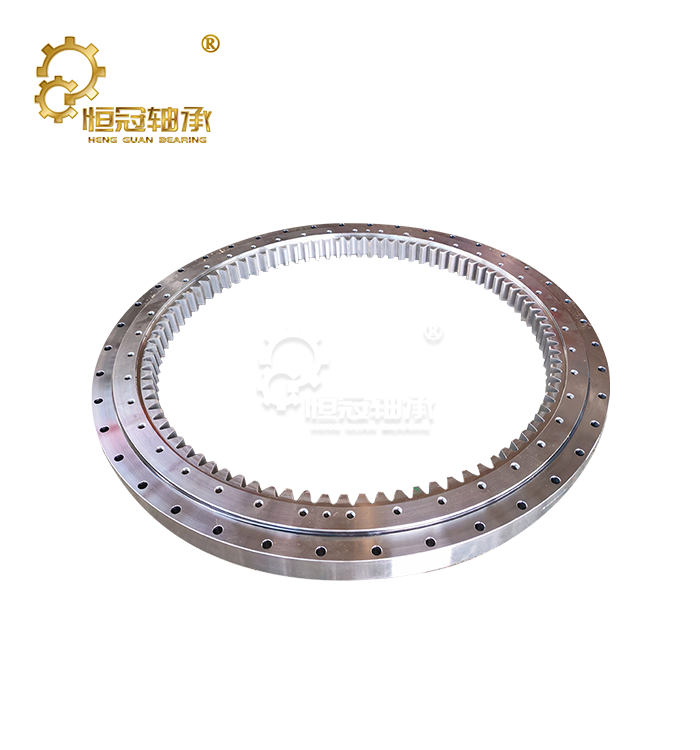
The excavator swing system is the hydraulic system that rotates the upper framework. The swing motor is driven by hydraulic oil and, through a reduction gear, applies torque to a pinion. The pinion is engaged with the internal or external gear tooth of the slewing bearing assembly or ring gear, depending on the configuration of the machine.
The teeth mesh properly, and the rotational force is transferred from the pinion to the ring gear progressively. This permits the upper structure to rotate in both directions, and the motion is regulated.
The excavator ring gear must consequently bear repetitive tooth contact, shifting loads, vibration and shock stresses. Excavation, lifting, demolition and heavy-duty material handling can place significantly different demands on the swing system. Machines that are often utilised at high loads or that have frequent starts and stops may be subject to more severe gear contact conditions than machines used for lesser duty.
Why Gear and Bearing Problems Can Look Similar?
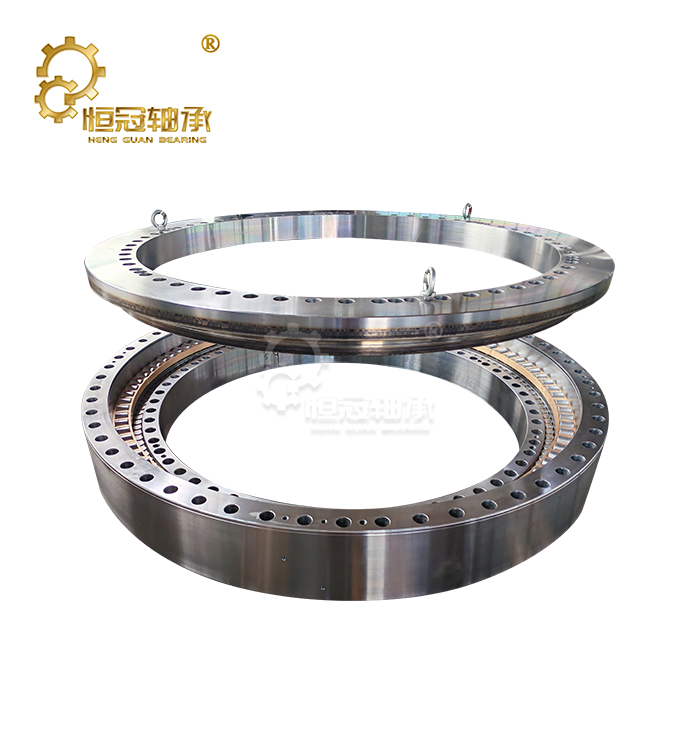
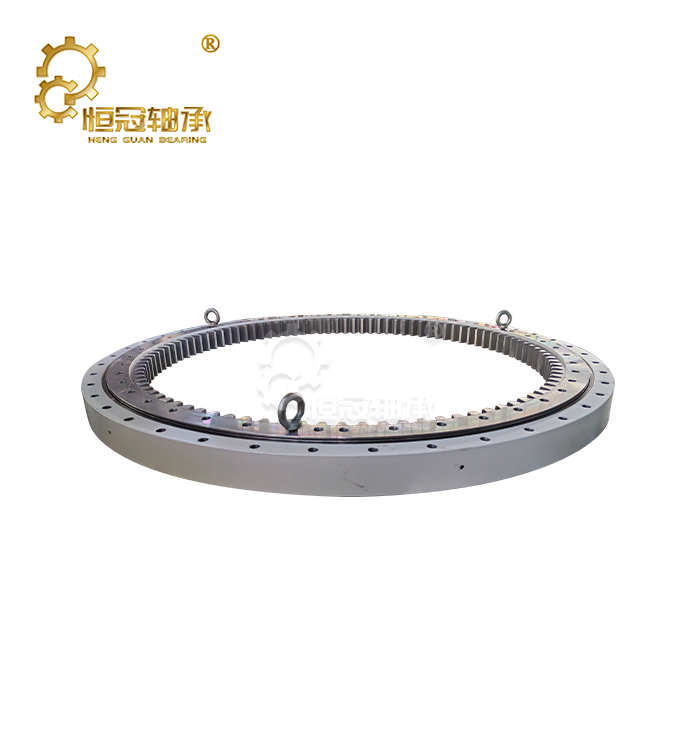
The ring gear should not be viewed in isolation of the slewing bearing. The bearing provides support for the upper structure and allows it to spin. The gear teeth provide the driving interface for the swing mechanism.
This is a critical distinction to remember when you are troubleshooting. For example, bearing failure or lack of lubrication could cause too much swing resistance rather than broken gear teeth. Abnormal backlash can also involve the gear and pinion, but excessive movement may also indicate wear in other areas of the slewing assembly or mounting structure.
So, a good examination starts with the whole system and narrows down the diagnosis based on the data.
Warning Signs That the Swing Gear May Be Failing
Grinding, Knocking, or Repetitive Gear Noise
One of the easiest indications for an operator to notice is unusual loudness. A healthy swing system should operate with a fairly uniform sound pattern. New grinding, rumbling, clicking or knocking noises should be investigated, especially if they only occur during rotation.
Grinding can be caused by insufficient lubrication, broken tooth surfaces, improper gear contact or excessive wear. Constant banging could be aberrant tooth engagement. It could be too much backlash. It could be a loose bearing or a loose pinion nut or mounting bolt. It could be a broken tooth on the ring gear or pinion.
The location of the noise and the operational state are essential. If there is noise all the way around the 360-degree rotation, you have a different challenge to deal with than if the noise is only present in a portion of the swing path. Localised tooth or bearing damage should be suspected if the sound is focused in one spot.
Operators should not expect that greasing would fix all anomalous noises. A chipped or broken gear tooth cannot be repaired by extra lubrication, which will not restore the damaged profile.
Jerky or Uneven Swing Movement
A change in the smoothness of rotation is the second warning indication. The upper structure may shake while starting up, move unevenly or have a significant disparity between clockwise and anticlockwise movement.
There are various causes for jerky movements. The swing performance can be affected by gear tooth damage, wrong tooth contact, excess backlash, wear of the slewing bearing, dirty grease, hydraulic control difficulties, and mechanical misalignment.
For this reason, the general movement location should be noted. If resistance rises at a specific point in rotation, the technician can compare that position with the contact condition of the gear and bearing. This may also help differentiate between localised mechanical damage and a hydraulic fault that affects the entire swing cycle.
Increased Backlash Between the Gear and Pinion
Backlash is the clearance between the teeth of meshing gears. The gears need working clearance. Some backlash is necessary for proper functioning. The difficulty is when the clearance is too much or it’s not close to the original specification.
If you change the direction of the swing, a lot of backlash can generate a significant lag or effect. Also, a banging noise can be produced because the pinion can move through too much space before the load is transmitted to the opposite tooth flank.
Backlash shouldn't be a feeling of only judgement. The suitable inspection method and acceptable value are based on the model of the excavator and the manufacturer’s specifications. When a quantitative measurement is necessary, technicians should consult the appropriate service documentation.
Of particular concern is a sudden increase in backlash, which can be an indication of increased wear or broken teeth or an issue with the supporting components.
Visible Pitting, Chipping, or Cracking on Gear Teeth
Physical tooth damage is a considerably more reliable indication of a mechanical problem than a general change in operating noise.
During an inspection, technicians should check for:
Pitting or tiny holes in the surface of the tooth
Scoring or odd wear markings
Edges of chipped teeth
Chipped teeth
Fissures
Over-rounding of the tooth profile
Uneven wear over the tooth face
Areas of anomalous contact or discolouration
Minor marks on surfaces do not automatically necessitate quick replacement, but gradual degradation should be recorded and compared at following examinations.
Special consideration should be taken for cracks and fractured teeth since they might easily propagate into a more serious failure under cyclic loads. The choice of an acceptable non-destructive testing method for crack identification (e.g., magnetic particle inspection for compatible ferromagnetic materials) shall be in accordance with the material and inspection procedure.
Uneven Wear Around the Rotation Path
A ring gear may not necessarily wear uniformly throughout its entire diameter. Excavators are usually operating with repetitive duties at a small working angle. This means that certain areas of the gear may face much more loading than others.
During the inspection, professionals may notice that one region of the tooth circumference has more polishing, pitting, scoring or profile wear than another.
Uneven wear can also be caused by the alignment, mounting conditions, pinion condition or bearing wear. The conclusion is that a localised wear pattern gives diagnostic information. And it should be documented, not just said “normal wear and tear".
This is especially valuable for comparing wear on an excavator ring gear at different inspection intervals. A consistent minor wear pattern is not the same as fast-developing deterioration.
What Can Cause Excavator Ring Gear Failure?
Poor or Contaminated Lubrication
Lubrication is one of the most important factors affecting gear and bearing service life. Gear teeth require suitable lubrication to reduce friction and control surface contact during operation. The slewing bearing itself also requires the lubricant specified for its raceways and operating conditions.
Contamination can be equally problematic. Dirt, metal particles, water, or other contaminants can reduce the effectiveness of the lubricant and accelerate surface damage.
However, the gear and slewing bearing should not automatically receive the same lubricant simply because they are part of the same swing system. Maintenance personnel should follow the excavator manufacturer's lubrication requirements and use products suitable for the specific application.
Incorrect Gear Mesh or Mechanical Alignment
The pinion and ring gear must maintain appropriate alignment and tooth contact. If the components are not positioned correctly, contact may become concentrated on a small portion of the tooth face rather than being distributed as intended.
Misalignment can result from installation errors, mounting surface problems, structural deformation, worn supporting components, or previous repair work.
The resulting contact pattern can provide useful evidence. If one edge of the tooth shows significantly greater wear than the rest of the contact area, alignment or loading should be investigated before the gear is simply replaced.
Excessive Shock and Repeated Heavy Loading
Excavator swing mechanisms are exposed to repeated acceleration, deceleration, reversing, and load changes. Heavy lifting and demolition work can create particularly demanding operating conditions.
Shock loads can increase the stress on gear teeth and supporting components. Repeated operation under loads beyond the equipment's intended working range can accelerate wear even when lubrication and alignment are correct.
This is why the application should be considered when evaluating ring gear life. A replacement gear selected for an excavator should match the machine's actual operating requirements rather than being selected only by approximate dimensions.
Worn or Damaged Pinion
A ring gear and pinion operate as a matched gear interface. Replacing one component without checking the other can leave the original problem unresolved.
A worn pinion can produce abnormal tooth contact and accelerate wear on a replacement excavator ring gear. Conversely, installing a new pinion against a severely worn ring gear may also produce poor contact.
When abnormal tooth wear is discovered, both components should therefore be inspected. The technician should compare tooth profiles, contact patterns, backlash, and the manufacturer's service limits before deciding which components need replacement.
A Practical Inspection Process for Swing Gear Problems
Start With the Operator's Symptoms
The operator's observations provide useful information before the machine is disassembled.
Record:
When the noise occurs
Whether the noise appears in both directions
Whether the problem occurs across the entire rotation range
Whether swing speed has changed
Whether the machine hesitates when starting
Whether the problem becomes worse under load
Whether the symptoms appeared suddenly or developed gradually
This information can help technicians determine whether the problem is likely to be mechanical, hydraulic, or a combination of both.
Inspect the Gear, Pinion, and Mounting Area
After making the machine safe for inspection, accessible components should be examined for contamination, lubricant condition, tooth damage, abnormal contact marks, and loose or damaged mounting hardware.
The mounting bolts should be checked according to the excavator manufacturer's specified inspection and torque procedure. Torque values should not be generalized across different excavator models because bolt size, grade, joint design, and manufacturer requirements can vary.
The pinion should be inspected at the same time. Looking only at the ring gear can miss the actual source of the problem.
Check the slewing bearing and other swing components.
If the swing remains rough after the gear teeth have been inspected, the slewing bearing should also be evaluated. Excessive bearing clearance, raceway damage, inadequate lubrication, or roller problems can influence swing resistance and stability.
Hydraulic components should also be considered. A weak swing motor, pressure-control problem, contaminated hydraulic oil, or faulty valve can cause slow or inconsistent rotation without any serious damage to the ring gear.
The swing brake is another component that should not be overlooked. Problems with brake release or adjustment can create resistance that may initially be mistaken for a mechanical gear problem.
When Should an Excavator Ring Gear Be Replaced?
Replace Based on Measured Condition, Not Operating Hours Alone
There is no universal operating-hour figure that guarantees an excavator ring gear will need replacement. Service life depends on machine size, duty cycle, load conditions, lubrication, maintenance, alignment, contamination, and operating technique.
Instead of replacing a gear simply because it has reached a certain number of hours, maintenance teams should evaluate its actual condition.
Replacement may become necessary when inspection shows severe tooth damage, progressive cracking, broken teeth, unacceptable wear, excessive backlash, or contact conditions that cannot be corrected through proper adjustment or repair.
The excavator manufacturer's service limits should take priority whenever they are available.
Consider the condition of the mating pinion.
When replacing a ring gear, the pinion condition should be evaluated at the same time. A heavily worn pinion can reduce the service life of a new gear.
This is particularly important for machines that have operated for long periods with poor lubrication or incorrect gear contact. Replacing only the most visibly damaged component may result in repeated wear and additional downtime.
How to Select a Replacement Excavator Ring Gear?
Confirm the Complete Technical Specification
Buying a ring gear based only on outside diameter is risky. Buyers should provide as much technical information as possible, including:
Excavator make and model
Original part number
Outside and inside dimensions
Number of teeth
Gear module
Tooth geometry
Mounting dimensions
Bolt-hole pattern
Material specification
Heat-treatment requirements
Applicable drawings
Pinion information
Slewing bearing configuration
An OEM drawing or the original component information is particularly useful for custom replacement work.
Ask About Manufacturing and Quality Control
For heavy-duty components, buyers should also ask how the gear is manufactured and inspected. Important questions include how dimensional accuracy is controlled, how tooth geometry is verified, what heat-treatment process is used, and what inspection records are available.
Depending on the application and material, dimensional inspection, hardness testing, visual inspection, gear profile checks, and appropriate non-destructive testing may be part of the quality-control process.
A reliable manufacturer should be able to explain which inspections apply to the specific excavator ring gear rather than offering generic claims about “high quality.”
Match the Replacement to the Actual Application
A replacement for a compact excavator does not necessarily have the same requirements as a ring gear for a heavy-duty mining machine. Load characteristics, operating environment, swing frequency, shock loading, and expected service conditions should all be considered.
The correct material and heat-treatment specification should be determined from the engineering requirements rather than selected only because a particular alloy is commonly used.
Conclusion
Knowing the usual signs that an excavator ring gear is breaking down lets maintenance workers and fleet managers fix issues before they get worse and cost a lot to fix. Grinding noises, jerky rotation, obvious tooth wear, and operating resistance are all signs of a part that needs to be fixed because its state is getting worse. Root causes like misalignment, material wear, or lubrication failure can be found through systematic review using the right tools and methods. Structured preventative maintenance greatly increases the life of parts and lowers the chance of unexpected breakdowns. When it's time to replace something, making smart buying choices that balance quality, cost, and source dependability will ensure the best long-term value. Knowing these rules helps people who own tools keep them running efficiently in industrial, mining, and building settings.

FAQ
1. What causes excavator ring gears to fail prematurely?
Early Excavator Ring Gear failure is caused by a number of things. One of the most common reasons is not enough grease. When there isn't enough grease, metals touch each other and wear down gear teeth and bearing surfaces quickly. When parts are used beyond their original load capacity, they are overstressed, which leads to material fatigue and eventually breakage. Environmental pollutants, such as rough dust or water getting in, make lubricants less effective and speed up rust. If you don't place the pinion and gear correctly, the contact pressure will be concentrated on the tooth edges instead of being spread across the whole face width. Regular repair that follows the manufacturer's instructions greatly increases the life of a component.
2. How often should I inspect my excavator's swing gear system?
The number of inspections should be in line with the level of operation and the factors of the surroundings. Daily checks before surgery, such as looking at things and listening for strange sounds, find problems early on. High-use equipment should be serviced once a week so that techs can check the level of lubrication and look for loose mounting pins. Inspections that happen once a month to measure backlash and look at exposed Excavator Ring Gear surfaces show how wear is progressing. Every year, full checks are a good reason to take off the protected covers and look at the whole system, including checking for cracks with magnetic particles. Machines that work in harsh mine or demolition settings should be inspected more often than machines that do normal building work.
3. Can I replace just the ring gear without changing the entire slewing bearing?
Replacement of a part depends on how badly it is damaged and how it wears. If the check shows that the Excavator Ring Gear teeth are worn past their service limits but the bearing races and rolling elements are still in good shape, it may be possible to just replace the gear. However, swing systems usually wear out as a whole. If the ring gear is worn out, it's likely that the bearing races and rollers have also gotten a lot of wear. If you only replace one part, you might have another failure soon after. Replacement choices are based on a full check that measures all parts of the system. When several parts are getting close to the end of their useful lives at the same time, replacing the slewing bearings all at once is cheaper than fixing them one at a time.
4. What's the typical lifespan of a quality excavator ring gear?
Service life depends a lot on how it's used, how well it's maintained, and the specifics of each part. When used for normal building work and properly maintained, equipment usually lasts between 8,000 and 12,000 hours before the Excavator Ring Gear needs to be replaced. Heavy-duty mining tractors that are used for long periods of time and heavy loads may need to be replaced every 5,000 to 7,000 hours. On the other hand, tools that are used occasionally for light tasks could last longer than 15,000 hours. Material quality and manufacturing accuracy have a big effect on how long something lasts. For example, precision-machined gears made from high-grade bearing steel last a lot longer than cheaper parts. Keeping track of the performance of your specific equipment helps you set realistic goals for your working profile and make the most of your maintenance funds.
Partner With Heng Guan for Reliable Excavator Ring Gear Solutions
To keep an excavator working well, its parts need to be designed to work in harsh environments and be made to precise standards. As a well-known company that has been making excavator ring gears for more than 20 years, Heng Guan uses cutting-edge CNC technology and strict quality control to make spinning parts that meet the tough needs of mining and building projects. Our wide range of sizes, from 800mm to 2500mm in diameter, fits machines ranging from very small ones to very big mine excavators.
We know the problems that OEM makers, engineering firms, and servicing companies that take care of fleets of heavy equipment have with buying things. Custom production lets us meet unique needs that catalog parts can't, and our experience exporting around the world makes sure that we can reliably send Excavator Ring Gear units to customers in all countries. Our dedication to consistent quality is shown by our ISO9001 certification, and the fact that we send parts to more than 50 countries shows that they work reliably in real life.
Whether you need to repair a key machine right away or are looking for a strategic supplier partnership for ongoing fleet maintenance, our engineering team can help you make sure you get the right parts for the job. Email us at mia@hgb-bearing.com to talk about your excavator ring gear needs, get technical specs, or find out how our customization options can help your equipment deal with problems that are unique to it.
References
1. Smith, J.R. & Anderson, M.K. (2021). "Heavy Equipment Maintenance: Principles and Practices for Construction Machinery." Industrial Press Technical Manual, 4th Edition.
2. Thompson, D.L. (2020). "Gear Failure Analysis in Mining Equipment: Root Causes and Prevention Strategies." Journal of Mining Equipment Engineering, Vol. 15, Issue 3, pp. 127-145.
3. International Organization for Standardization (2019). "ISO 8579: Acceptance Code for Gears - Part 2: Determination of Mechanical Vibrations of Gear Units During Acceptance Testing." Geneva: ISO Standards Publication.
4. Martinez, C.E. & Wong, H.P. (2022). "Metallurgical Analysis of Heat-Treated Alloy Steels in Rotating Machinery Components." Materials Science and Engineering Research, Vol. 28, pp. 89-104.
5. Henderson, R.B. (2018). "Predictive Maintenance Strategies for Heavy Construction Equipment: Reducing Downtime Through Systematic Inspection Protocols." Construction Equipment Management Quarterly, Vol. 42, No. 2, pp. 34-58.
6. National Fluid Power Association (2020). "Hydraulic System Troubleshooting Guide for Mobile Equipment: Identifying Performance Degradation in Swing Mechanisms and Rotating Assemblies." NFPA Technical Handbook Series.

WHAT OUR CUSTOMERS SAY
Here is the customer's evaluation of us