



Port Crane Slewing Bearing Load Ratings and Specifications
When selecting critical components for heavy-duty port operations, understanding port crane slewing bearing load ratings becomes essential for ensuring operational safety and efficiency. When choosing important parts for heavy-duty port operations, it's important to know the port crane slewing bearing load ratings and technical specifications to make sure the crane works safely and effectively. These big spinning parts link the stable structure to the rolling crane platform. This lets the equipment handle axial loads, radial loads, and moments of tipping while it's lifting. In contrast to normal bearings found in other machines, port crane slewing bearings have to work in harsh sea conditions that include heavy loads, shaking, wind forces, salt exposure, and constant spinning. Checking basic load rates is not enough to choose the right bearings. For long-term reliability, OEM engineers and buying teams must look at the construction of the bearing, the quality of the materials, how well the seals work, how accurately the parts are made, and how well the provider can do their job.
How Port Crane Slewing Bearings Handle Heavy Loads
The Essential Function of Slewing Bearings in Port Equipment
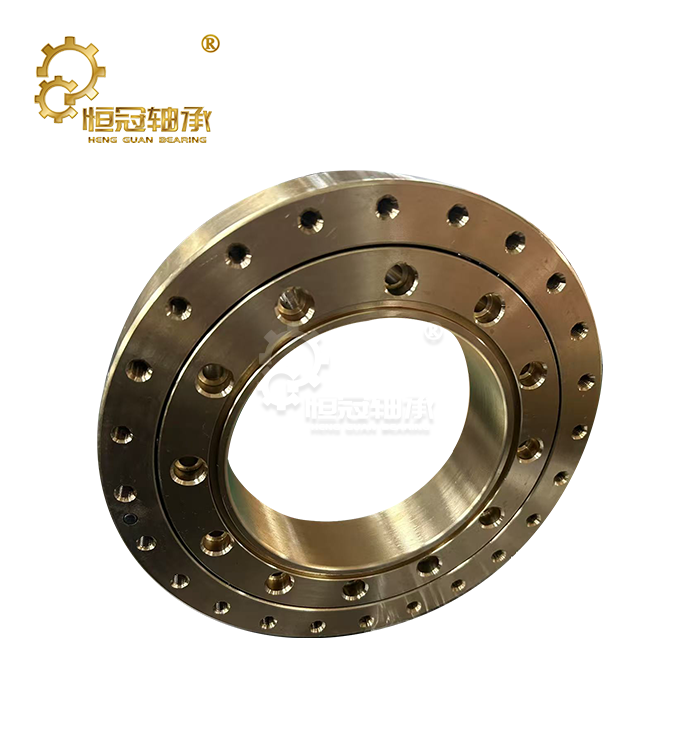
A port crane slewing bearing acts as the primary rotational connection between the crane foundation and the rotating upper structure. It supports the weight of the crane boom, counterweights, lifting mechanisms, and transported loads while allowing controlled rotation during operation.
During crane movement, the bearing is exposed to several forces simultaneously:
Axial loads generated by vertical lifting forces
Radial loads caused by horizontal movement, wind pressure, and structural forces
Moment loads created by extended booms and offset lifting positions
These combined loads create complex stress conditions inside the bearing raceway. Therefore, selecting a bearing based only on one load value can result in insufficient performance or premature failure. For port applications, load analysis should consider the complete operating cycle rather than only maximum lifting conditions. Acceleration, braking, wind influence, and frequent rotation changes can significantly affect actual bearing requirements.
Understanding Static and Dynamic Load Ratings
Load ratings are among the most important technical parameters when evaluating slewing bearings. Static load rating refers to the maximum load a bearing can withstand while stationary or operating at very low speed without permanent deformation of raceways or rolling elements.
Dynamic load rating evaluates bearing performance during continuous rotation and considers factors such as:
Operating speed
Load variation
Contact stress
Fatigue life requirements
Working frequency
For port cranes that operate many hours per day, dynamic performance is especially important. A bearing that meets static requirements may still experience reduced service life if it cannot handle repeated loading cycles.OEM buyers should evaluate both ratings together with actual operating conditions to ensure the selected bearing matches the crane duty level.
Main Load Types Affecting Port Crane Slewing Bearing Selection
Axial Load Capacity Requirements
Axial loads act vertically along the bearing axis and are mainly generated by:
Lifted cargo weight
Crane structural weight
Vertical impact forces during operation
High axial load capacity is particularly important for container cranes and heavy lifting equipment, where large suspended loads create continuous downward forces. The internal raceway design, rolling element arrangement, and contact angle directly influence how efficiently axial forces are transferred through the bearing.
Radial Load Considerations
Radial loads occur perpendicular to the bearing axis and are commonly caused by:
Wind forces acting on the crane structure
Horizontal movement during operation
Offset loading conditions
Although radial loads are often lower than lifting loads, they can become significant in coastal environments where strong wind conditions create additional horizontal forces. Proper radial load evaluation helps prevent uneven raceway stress and excessive wear.
Moment Load Resistance
Moment loads represent overturning forces generated when loads act away from the bearing center.
For port cranes, moment capacity is often one of the most important selection factors because:
Boom extension increases the lever arm effect
Heavy containers create uneven loading conditions
Wind forces can increase overturning moments
Large-diameter slewing bearings provide improved moment resistance because the greater distance between load contact points creates a stronger structural support system.
Selecting the Right Slewing Bearing Type for Port Crane Applications
Single-Row Four-Point Contact Ball Slewing Bearings
Single-row four-point contact ball bearings are commonly used in applications requiring a compact structure with balanced load handling capability.
Their advantages include:
Lower friction during rotation
Compact cross-sectional design
Good axial and moment load capability
Easier maintenance requirements
These bearings are suitable for medium-duty port equipment where space limitations and operational flexibility are important considerations.
Double-Row Ball Slewing Bearings for Higher Load Capacity
Double-row ball configurations increase the number of rolling contact points and improve load distribution.
Compared with single-row designs, they provide:
Higher radial load capability
Improved stability under combined forces
Better performance under heavier working conditions
They are often selected for equipment requiring greater structural support while maintaining relatively compact installation dimensions.
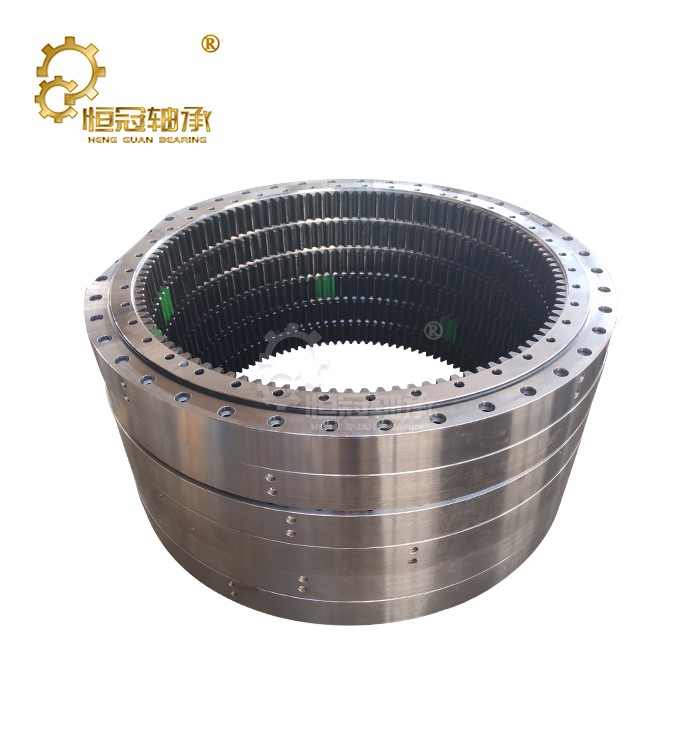
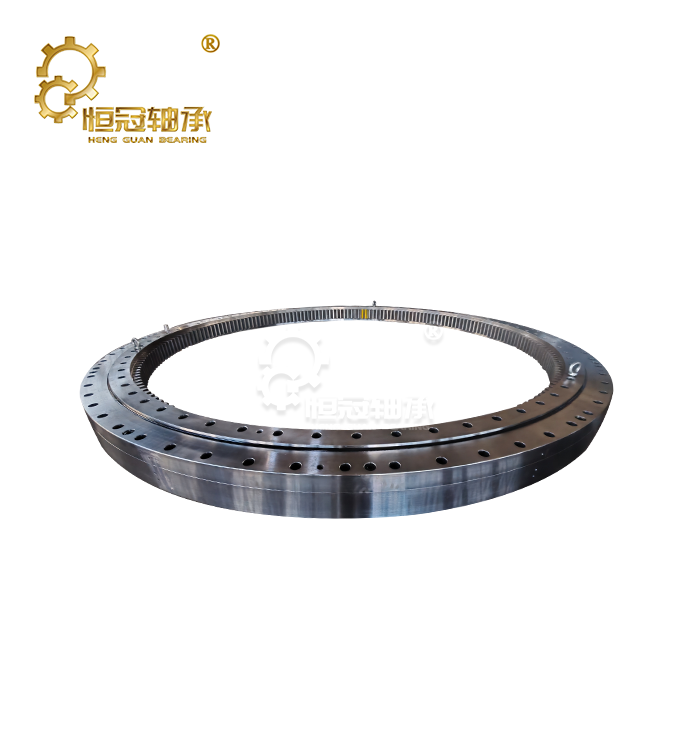
Three-Row Roller Slewing Bearings for Heavy-Duty Port Equipment
Three-row roller slewing bearings are designed for applications requiring maximum load capacity and structural rigidity.
Their separate raceway systems allow different rolling elements to handle:
Axial forces
Radial forces
Moment loads
This configuration is commonly used in large port cranes, ship loaders, and other heavy-duty lifting equipment where bearing failure could lead to significant operational downtime.For demanding marine applications, manufacturers such as Heng Guan develop customized bearing solutions based on crane specifications, operating conditions, and required service life.
Key Design Factors That Determine Bearing Performance
Material Selection for Marine Operating Conditions
The strength, resistance to wear, and service life of a port crane slewing bearing are all directly affected by the material that is used. Because port equipment works with rough seas and heavy loads, its bearing parts need to keep their mechanical properties stable over long periods of time. High-strength alloy steels like 42CrMo or 50Mn are often used to make the bearing rings. After controlled heat treatment processes, these materials have a good balance of toughness, resistance to wear, and the ability to hold weight. Even more surface hardness and physical stability are needed for rolling parts. A lot of balls and rollers are made from high-quality bearing steels like GCr15SiMn, which are very good at resisting contact wear and repeated loads.
For port environments, material selection should also consider:
Salt spray exposure
Temperature fluctuations
High humidity
Continuous operating cycles
Maintenance accessibility
Choosing suitable materials helps reduce raceway damage, surface fatigue, and unexpected downtime during crane operation.
Heat Treatment and Surface Hardening Technology
Heat treatment is one of the most important manufacturing processes influencing slewing bearing durability.
During operation, the raceway surface experiences repeated contact stress from rolling elements. Without proper hardness control, these repeated loads can lead to:
Raceway pitting
Surface cracking
Plastic deformation
Reduced fatigue life
Controlled cooling and tempering are used by advanced makers to get the best mix of surface hardness and internal toughness. Induction hardening is often used for raceways because it makes the core structure stronger while also making the top layer less likely to break down. This mix makes it possible for the bearing to handle high contact pressure and operational impact loads. Consistent heat treatment quality is very important for heavy-duty port cranes because even small changes in the distribution of hardness can affect the bearings' long-term dependability.
Seal Design and Corrosion Protection for Port Environments
Sealing Systems Against Marine Contamination
Port crane operating environments expose bearings to contaminants that can accelerate wear and reduce lubrication effectiveness.
Common contamination sources include:
Sea water spray
Dust and sand particles
Metal debris
Moisture accumulation
Industrial pollutants
These contaminants can't get into the internal structure of the bearing because of a good locking system that keeps the grease in. Many new slewing bearings have multi-lip sealing systems that are made of materials like FKM or NBR rubber. These sealing structures offer better protection when the rotation is changing speed, and they also help keep the lubrication performance stable.
For marine applications, seal design should consider both:
Static sealing during equipment shutdown
Dynamic sealing during continuous rotation
Corrosion Resistance Solutions for Coastal Applications
Corrosion protection is a key consideration when selecting bearings for ports, offshore terminals, and ship handling equipment.
Common protection methods include:
Protective Coatings
Surface coatings help protect exposed metal areas from salt spray and humidity. Depending on environmental severity, manufacturers may apply specialized coating systems designed for marine conditions.
Stainless or Corrosion-Resistant Components
Some applications require additional corrosion-resistant materials for specific components exposed to harsh environments.
Improved Sealing Structures
By keeping water out of the raceways and moving parts, better insulation lowers the risk of internal rust. Choosing the right materials, treating the surface, and using sealing technology are all parts of a full corrosion protection strategy, not just one.
Dimensional Design Factors Affecting Load Distribution
Bearing Diameter and Moment Load Capability
How well a slewing bearing resists toppling moments is directly related to its width. A bigger diameter makes the space between load contact points bigger, which makes the bearing structure better at resisting moments. This is especially important for port cranes, whose long booms and long lifting lengths create strong forces that can flip them over.
When engineers choose bearing sizes, they look at:
Crane lifting capacity
Maximum operating radius
Structural weight
Wind loading conditions
Required service life
Cross-Section Design and Installation Requirements
The bearing cross-section affects both load capacity and equipment integration. A thicker cross-section generally provides increased structural strength, while compact designs help reduce equipment weight and installation space.
OEM engineers must balance:
Load requirements
Mounting limitations
Rotating structure weight
Maintenance accessibility
Incorrect dimensional selection may cause uneven load distribution, increased raceway stress, and shortened service life.
Customized Dimensions for Specific Crane Designs
Standard bearing dimensions may not always meet the requirements of specialized port equipment.
Custom designs allow manufacturers to optimize:
Inner diameter
Outer diameter
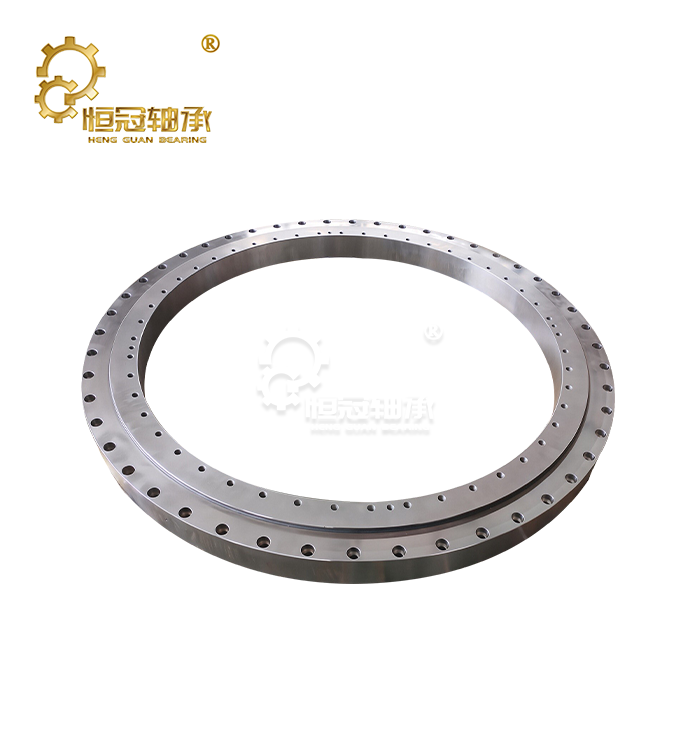
Mounting hole patterns
Gear specifications
Internal clearance
Customised options are especially helpful for big cranes where the bearing needs to fit perfectly with other parts of the structure. A thorough review by engineers before production helps make sure that the bearing works with the whole crane system and not just one part of it.
Gear Integration and Drive System Considerations
External and Internal Gear Configurations
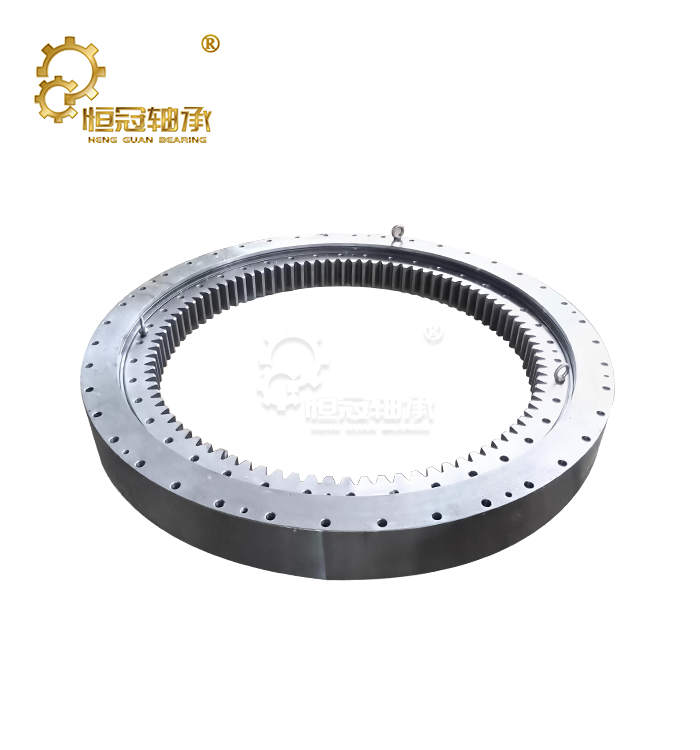
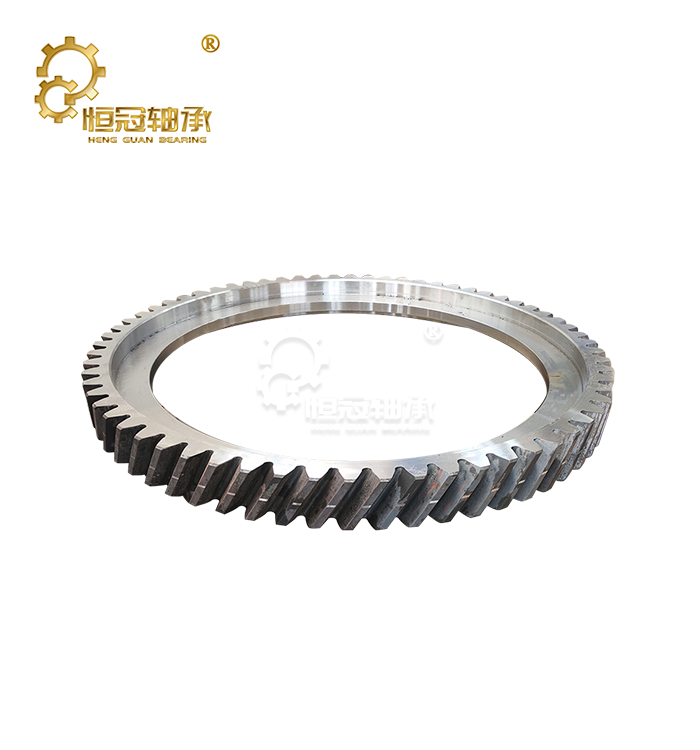
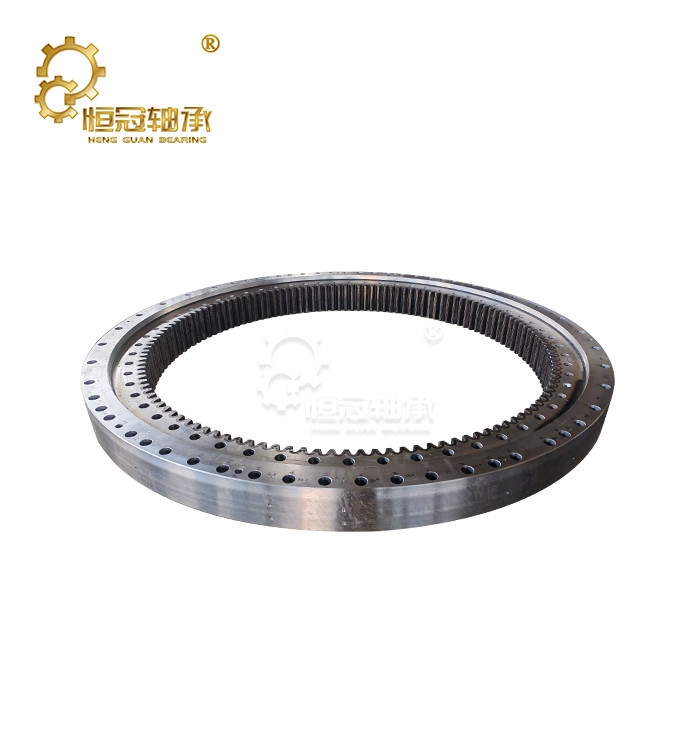
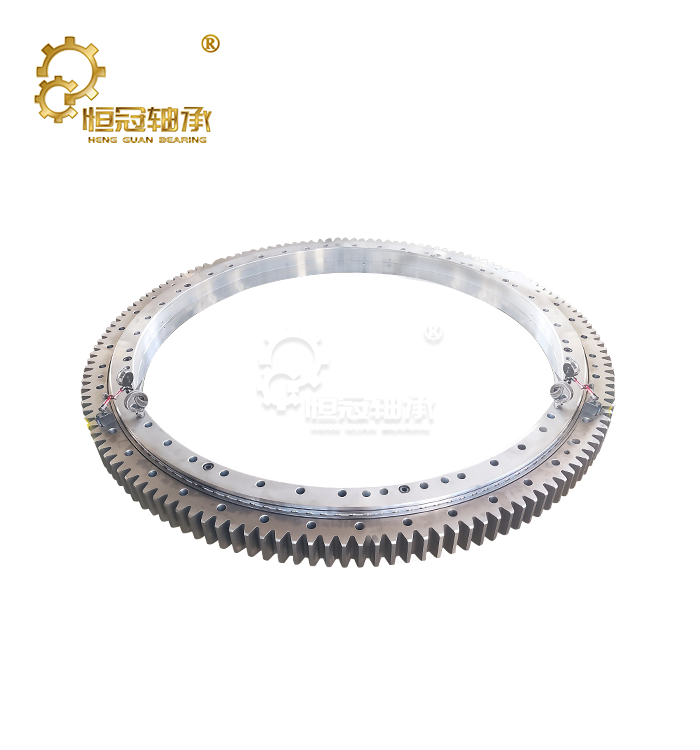
A lot of port crane slewing bearings have gear teeth built in to make rotation drive systems easier to use.
These are two common arrangements:
External Gear Slewing Bearings
External gear designs provide easier access for inspection and maintenance.
Advantages include:
Simple drive arrangement
Easy gear replacement
Convenient visual inspection
Internal Gear Slewing Bearings
Internal gear systems provide a more protected drive solution.
Benefits include:
Compact installation
Reduced exposure to external contamination
Better protection in limited spaces
The correct gear configuration depends on crane design, maintenance requirements, available installation space, and operating conditions.
Gear Accuracy and Rotation Performance
Gear machining accuracy affects:
Rotation smoothness
Noise levels
Drive efficiency
Service life
Poor gear accuracy may cause uneven tooth contact, vibration, and additional loads on the drive system.
For high-duty port cranes, manufacturers must carefully control:
Gear module accuracy
Tooth profile
Surface hardness
Alignment tolerance
Proper gear integration ensures that the bearing and drive system operate together efficiently.
Maintenance Strategies for Extending Bearing Service Life
Common Failure Modes in Port Crane Slewing Bearings
Understanding common failure patterns helps maintenance teams prevent unexpected downtime.
Typical failure modes include:
Raceway Wear and Spalling
Repeated heavy loading can create surface fatigue on raceways. Early signs may include:
Increased operating torque
Abnormal vibration
Unusual noise during rotation
Seal Damage
Damaged seals allow contaminants to enter the bearing, reducing lubricant performance and accelerating internal wear. Regular seal inspection is especially important in marine environments.
Lubrication Problems
Insufficient or contaminated lubrication can increase friction and accelerate component damage.
Maintenance teams should monitor:
Grease condition
Lubrication frequency
Temperature changes
Rotation resistance
Recommended Inspection Procedures
A structured inspection program helps identify problems before they become major failures.
Recommended checks include:
Visual inspection of seals and mounting areas
Lubrication condition assessment
Bolt torque verification
Rotation performance monitoring
Clearance measurement
For high-value port cranes, condition monitoring systems can provide additional information through:
Vibration monitoring
Temperature sensors
Load monitoring systems
Maintenance Strategies for Reducing Downtime and Operating Costs
Predictive Maintenance for Long-Term Reliability
Traditional maintenance methods often rely on fixed schedules, but heavy-duty port equipment requires a more condition-based approach. A port crane slewing bearing operates under changing loads, making real-time condition monitoring increasingly valuable.
Predictive maintenance methods can help identify early signs of bearing problems through:
Vibration analysis
Temperature monitoring
Rotation torque measurement
Lubricant condition inspection
Load monitoring data
These methods allow maintenance teams to schedule repairs before unexpected failures occur. For port operators, this approach reduces unplanned crane downtime and improves overall equipment availability. Because port cranes directly influence cargo handling efficiency, preventing unexpected bearing failures can provide significant economic benefits throughout the equipment lifecycle.
Lubrication Management for Heavy-Duty Applications
Proper lubrication is essential for maintaining smooth rotation and minimizing internal wear.
Port crane slewing bearings typically require lubricants that can withstand:
High contact pressure
Continuous rotation cycles
Marine humidity
Temperature variation
Contamination risks
A suitable lubrication program should include:
Correct grease selection
Proper lubrication intervals
Regular contamination checks
Monitoring of lubricant distribution
Insufficient lubrication can increase friction between rolling elements and raceways, while excessive lubrication may also create unnecessary resistance and heat generation. Maintenance schedules should therefore be developed according to actual crane operating conditions rather than general replacement intervals.
How OEM Buyers Should Evaluate Slewing Bearing Suppliers
Manufacturing Capability and Quality Control
Selecting the right supplier is as important as selecting the correct bearing design. A qualified manufacturer should demonstrate strong control over material processing, machining accuracy, heat treatment, and final inspection.
Important supplier evaluation factors include:
Raw material traceability
Heat treatment capability
Precision machining equipment
Quality inspection systems
Customized engineering support
Manufacturers with complete production capabilities can better control consistency between different bearing batches and provide more reliable long-term performance.
Engineering Support and Custom Design Capability
Port crane applications often involve unique operating conditions. A supplier should be able to support customers with engineering analysis rather than only provide standard products.
Technical support may include:
Load calculation assistance
Bearing type recommendation
Installation guidance
Maintenance suggestions
Customized structural design
For large port cranes, cooperation between the equipment manufacturer and bearing supplier during the design stage can help avoid problems caused by incorrect sizing or insufficient load evaluation.
Testing and Documentation Requirements
OEM buyers should look over the supplier's testing processes and technical paperwork before the final installation.
Some examples of important papers are:
- Certificates of materials
- Records of heat treatment
- Reports on dimensional inspection
- Results of load testing
- Documentation for quality control
Full paperwork makes it easier to find things and helps plan for future upkeep. Documentation is not only a quality requirement for critical port equipment, but it's also a key part of managing its whole life.
Technical Parameters and Selection Requirements
Key Specifications for Port Crane Slewing Bearing Selection
Selecting a suitable bearing requires evaluating multiple technical parameters rather than focusing on a single load rating.
Important specifications include:
Parameter | Importance |
|---|---|
Axial load capacity | Determines vertical load handling ability |
Radial load capacity | Evaluates resistance against horizontal forces |
Moment load capacity | Defines overturning resistance |
Bearing diameter | Influences the structural support capability |
Rotation speed | Affects lubrication and fatigue performance |
Gear specifications | Determines drive compatibility |
Operating temperature | Influences material and lubrication selection |
Sealing requirements | Protects against marine contamination |
These parameters should be analyzed together based on the crane's actual working environment.
Load Calculation Before Procurement
OEM buyers should gather a lot of information about how the bearing will be used before they buy one. This information should include:
- Types of cranes and their uses
- The most that can be lifted
- The largest working area
- Speed of rotation
- Cycle of duty
- Conditions in the environment
- How long should it last
With this knowledge, engineers can figure out the real working loads and suggest a good bearing design. If you only look at a bearing's pulling capacity, you might miss important moment loads or external factors that affect how reliable it will be in the long run.
Service Life Expectations and Lifecycle Value
There are a few things that affect how long a port crane slewing bearing lasts:
- Conditions of load
- How often does it work
- Quality of maintenance
- Exposure to the environment
- Correct installation
A bigger starting price doesn't always mean that the total cost will be higher. Better materials, more accurate production, and stronger rust protection in bearings may provide better term value by lowering the number of replacements and upkeep costs. When port operators compare prices, it's often better to look at the total cost of ownership rather than just the initial purchase price.
Procurement Checklist for Port Crane Slewing Bearings
Information Buyers Should Prepare Before Requesting a Quote
For a correct suggestion on a bearing, buyers should give:
- Model of equipment
- Dimensions for installing a bearing
- The most axial load
- The most radial load
Maximum moment of tipping
- Needs for rotation
- What gear do you need
- Setting up for work
- Important certifications
Giving sellers all the technical information they need helps them avoid making bad choices and makes conversations run more smoothly.
Questions to Ask Before Choosing a Manufacturer
Before finalizing a supplier, OEM buyers should evaluate:
- How much experience does the seller have with port cranes?
- Can the maker make bearing options that fit my needs?
- Are records of materials and output available?
- What kinds of inspections are done before delivery?
- Does the supplier offer technical support after the installation is done?
These questions help you find sellers who can keep your tools running smoothly for a long time.
Conclusion
To choose the right port crane slewing bearing, you need to know a lot about the load rates, structure design, weather conditions, and the supplier's skills. In harsh oceanic settings, these bearings must be able to handle complicated mixtures of axial forces, radial loads, and rolling moments. For OEM manufacturers and port operators, choosing the right bearing depends on more than just the basic specs. Controlling the heat treatment, the technology used for sealing, the accuracy of the measurements, planning for maintenance, and getting technical help all affect how well something works in the long term. Companies can make their cranes more reliable, cut down on downtime, and get more out of their lifting equipment over its lifetime by carefully analysing load needs, picking the right bearing setup, and working with experienced providers.
FAQ
1. What factors determine the load capacity of port crane slewing bearings?
How much weight something can hold relies on the type of bearing, the quality of the material, its dimensions, and how it was designed. Most of the time, three-row roller setups can hold the most weight, while single-row versions are smaller and better for lighter loads.
2. How do environmental conditions affect bearing specifications?
Marine settings need better rust protection, special sealing systems, and materials that can handle salt spray and changes in temperature. These things affect both the original requirements and the ongoing upkeep that needs to be done.
3. What maintenance intervals are recommended for port crane bearings?
Maintenance times rely on how often the bearings are used, the surroundings, and their specs. Routine inspections usually happen every 500 to 2000 hours of operation, and big maintenance tasks happen once a year or based on the results of condition tracking.
4. How do international standards impact bearing selection?
ISO and DIN standards establish minimum performance requirements and testing methods that ensure compatibility and safety. Following these standards ensures that the quality of the product is maintained and that regulations are followed in all places.
5. What are the key differences between bearing types for port applications?
A single-row bearing has a small size, a double-row bearing has more rotational capacity, and a three-row roller bearing can hold the most weight for heavy-duty uses. The choice relies on the specific needs of the job and the available space.
Partner with Heng Guan for Superior Port Crane Bearing Solutions
Heng Guan Bearing Technology makes the best slewing bearings for port cranes that are designed to work in the roughest sea environments. Our three-row roller slewing bearings are made with 42CrMo special alloy steel and GCr15SiMn rolling elements. They offer the highest load capacity and reliability for heavy-duty port equipment, stackers, and container gantry cranes. As a reliable company that has been making port crane slewing bearings for more than 20 years, we offer quality systems that are ISO9001-certified, unique design services, and full expert support to help you get the most out of your crane. Email our engineering team at mia@hgb-bearing.com to talk about your unique needs and find out how our precision-engineered bearings can help your port run more smoothly while lowering the total cost of ownership.
References
1. International Organization for Standardization. "Rolling bearings—Slewing bearings." ISO 12043-1:2007. 2007; Geneva: ISO Press.
2. American Society of Mechanical Engineers. "Load Ratings and Fatigue Life for Ball Bearings." This is what ASME/ANSI B3.5-1986 says. 1986: New York: ASME Press.
3. Harris, Tedric A., and Michael N. Kotzalas. "Essential Concepts of Bearing Technology: Rolling Bearing Analysis, Fifth Edition." Boca Raton: CRC Press, 2006.
4. Deutsches Institut für Normung. "Rolling bearings - Slewing bearings - Dimensions and tolerances." DIN 628-1 for 2002. 2002. Berlin: Beuth Verlag.
5. Society of Naval Architects and Marine Engineers. "Marine Crane Design and Operation Standards." Technical and Research Bulletin 4-25. Jersey City: SNAME Publications, 2019.
6. European Committee for Standardization. "Cranes - Safety requirements for design - Part 1: General." EN 13001-1:2013. Brussels: CEN Publications, 2013.

WHAT OUR CUSTOMERS SAY
Here is the customer's evaluation of us