




is an important load-bearing part between the stationary and the moving parts of the machine. During work, it may concurrently feel the load of the rotating assembly, the resistance from drilling, lateral forces and overturning moments. Contamination with dust, dirt, water and drilling fluids can also adversely influence bearing life if the sealing and lubrication systems are not adequately specified. For this reason the selection procedure should begin not with a bearing catalogue but with the operational parameters of the rig. Below is a guidance with the major technical aspects to consider and information to be provided when asking for a quotation to a slewing bearing manufacturer.
Selecting a slewing bearing for a drilling rig is not simply a matter of choosing the largest bearing that fits the available space. The bearing must match the rig's actual axial load, radial load, overturning moment, rotation speed, operating cycle, mounting structure, and working environment. A bearing that is adequate for a light foundation drilling application may be unsuitable for a heavy-duty rig exposed to continuous vibration and impact loading.The Drilling Rig Slewing Bearing is an important load-bearing part between the stationary and the moving parts of the machine. During work, it may concurrently feel the load of the rotating assembly, the resistance from drilling, lateral forces and overturning moments. Contamination with dust, dirt, water and drilling fluids can also adversely influence bearing life if the sealing and lubrication systems are not adequately specified. For this reason the selection procedure should begin not with a bearing catalogue but with the operational parameters of the rig. Below is a guidance with the major technical aspects to consider and information to be provided when asking for a quotation to a slewing bearing manufacturer.
Start with the rig's actual operating conditions.
Identify the Loads Acting on the Bearing
The first step is to establish the maximum and typical loads that the slewing bearing will experience. Three load components are particularly important:
Axial load
Radial load
Overturning moment
An axial load can come from the weight of the rotating equipment, drill string, tooling, and other components supported by the bearing. Radial load may result from drilling resistance, machine movement, structural deflection, and lateral forces transmitted through the drilling assembly. The overturning moment is affected by the location of the applied load relative to the bearing center.
These values should be taken from the rig's design calculations or measured operating data whenever possible. A generic assumption such as treating radial load as a fixed percentage of axial load is not appropriate for every drilling method.
For demanding applications, it is also useful to provide the manufacturer with both maximum loads and representative working loads. A bearing that can withstand a short peak load may still have insufficient fatigue life if the same load occurs repeatedly.
Consider the Load Spectrum, Not Only the Maximum Load.
Maximum load is only one part of the selection process. Drilling equipment often operates under variable loads, with periods of relatively stable rotation followed by sudden changes in drilling resistance.
For example, a rig may experience the following:
Low-load positioning.
Normal drilling rotation.
Increased resistance as the tool enters harder material.
Short-duration impact or vibration.
Tool withdrawal and repositioning.
This load spectrum affects bearing fatigue, raceway contact stress, gear loading, and lubrication requirements. If the rig operates continuously or has frequent load changes, the manufacturer should evaluate the duty cycle rather than selecting the bearing from a single static load value.
Calculate the Overturning Moment Carefully
The overturning moment is often one of the most important parameters for a drilling rig slewing bearing.
A simple first-order relationship is the following:
M = F × L
where M is the overturning moment, F is the relevant applied force, and L is the perpendicular distance from the bearing center to the force line.
In an actual drilling rig, however, several forces may act simultaneously. The position of the drilling tool, mast geometry, rotating assembly weight, machine inclination, and external forces can all affect the resulting moment.
For this reason, procurement teams should provide the bearing supplier with the actual load case or engineering drawing whenever possible. The manufacturer can then check the combined axial load, radial load, and moment against the bearing's allowable operating conditions.
Choose the bearing type for the application.
Four-Point Contact Ball Bearings
Four-point contact ball slewing bearings can be suitable where the application requires a relatively compact structure and combined axial, radial, and moment load capacity.
Their design can provide good rotational performance while keeping the bearing section relatively compact. They may be considered for drilling equipment with moderate loading and suitable duty cycles.
However, a four-point contact design should not automatically be selected simply because it is smaller or less expensive. If the rig is exposed to severe impact, high overturning moments, or demanding continuous operation, a roller-based design may provide a more appropriate solution.
Crossed Roller Designs
Crossed roller slewing bearings use rollers arranged in alternating orientations. This arrangement can provide good rigidity and combined load capacity in applications where space and rotational accuracy are important.
Their suitability depends strongly on bearing size, load direction, rotation speed, and operating conditions. They are not a universal replacement for three-row roller bearings on heavy drilling equipment.
Three-Row Roller Bearings
Three-row roller slewing bearings are often considered for applications requiring high load capacity and substantial overturning moment resistance.
The separate roller arrangements allow the bearing to manage different components of the applied load. This can make the design attractive for heavy drilling machinery where structural stiffness and load capacity are major concerns.
However, three-row construction is not automatically the best choice for every rig. It generally involves a larger and heavier structure and may require more installation space. The final selection should therefore be based on the complete load case, bearing dimensions, drive arrangement, and mounting structure.
Evaluate Bearing Materials and Raceway Hardening
Select Materials According to the Duty Cycle
Common Drilling Rig Slewing Bearing ring materials include alloy steels selected for their strength, toughness, machinability, and ability to achieve the required raceway properties after heat treatment. Materials such as 42CrMo4 or comparable alloy steels may be used for demanding applications, depending on the manufacturer's design and applicable material specification.
The important point is not simply to request a particular steel grade. The complete material and heat-treatment process should be evaluated.
Ask the supplier for relevant documentation covering:
Raw material grade and certificate
Chemical composition
Heat-treatment process
Raceway hardness
Hardness depth or profile where applicable
Dimensional inspection
Non-destructive testing when specified
Final inspection records
ASTM A534, for example, addresses carburizing steels for anti-friction bearing manufacture. It should not be treated as a universal specification for the heat treatment of every slewing-bearing component. The applicable material standard should be identified according to the actual bearing design and purchase specification.
Check Raceway Hardening Rather Than Looking at Hardness Alone
Raceway hardness is important because the raceway is exposed to repeated rolling contact. However, a single hardness number does not fully describe bearing quality.
The supplier should be able to explain the following:
How the raceway is hardened.
How the hardened zone is controlled.
How the transition to the tougher core is verified.
How hardness consistency is inspected.
Which quality criteria are used for the finished raceway.
For large slewing bearings, consistency around the entire raceway is particularly important. A localized defect or poorly controlled heat-treatment zone can create premature wear even when the reported average hardness appears acceptable.
Match the Sealing System to the Drilling Environment
Protect Against Dust, Mud, and Water
Drilling sites are rarely clean environments. Abrasive dust, soil particles, water, drilling mud, and lubricant contamination can enter the bearing area if the sealing arrangement is not suitable.
The seal design should therefore be selected according to the actual environment rather than using the same seal specification for every project.
Important questions include:
Is the rig used indoors or outdoors?
Is it exposed to heavy rain?
Is drilling mud present?
Is abrasive dust continuously generated?
Will the bearing be washed during equipment cleaning?
What temperature range will the seal experience?
The seal material must also be compatible with the lubricant and environmental temperature.
Consider Seal Design and Maintenance Access
A sealing system should not only prevent contaminants from entering. It should also help retain grease and remain serviceable throughout the expected operating cycle.
For applications exposed to heavy contamination, suppliers may offer different lip configurations or sealing arrangements. The appropriate solution depends on bearing geometry, rotation speed, temperature, lubricant, and expected contamination level.
Instead of specifying a seal solely because it is described as “heavy duty,” ask the supplier to explain its intended operating environment and maintenance requirements.
Match Lubrication to Speed, Load, and Temperature
Select the Correct Grease
Grease selection affects friction, temperature, wear, and service life. The grease should be compatible with the bearing materials, seals, operating temperature, load, and rotation speed.
The initial grease quantity and relubrication interval should follow the bearing manufacturer's recommendations. A universal statement such as filling a fixed percentage of the internal bearing volume is not suitable for every slewing bearing design.
Over-greasing can increase churning and operating temperature, while insufficient lubrication can increase raceway and rolling-element wear.
Plan Lubrication Around the Working Cycle
A drilling rig that operates for long periods under heavy loads may require a different lubrication strategy from a machine used intermittently.
The maintenance plan should specify:
Grease type
Initial filling quantity
Lubrication points
Relubrication interval
Recommended lubrication method
Inspection frequency
Conditions requiring more frequent lubrication
If the bearing has an integrated gear, the gear teeth may also require a separate lubrication specification from the rolling raceway.
How to Procure the Right Drilling Rig Slewing Bearing?
Defining Technical Specifications and Performance Requirements
A thorough set of specifications for a drilling rig slewing bearing is the first step to a successful purchase. Include the highest weight of the drill string, the length of the Kelly bar, the typical rock types that will be met, and the number of hours that the rig will be used each day. Set limits on the bore diameter based on the size of the attachment plate and the maximum height allowed by chassis space. Include things about the surroundings, like temperature ranges, humidity levels, and the amount of dust contact. Supplier Qualification and Certification Verification
Use strict criteria to evaluate possible sellers. Getting ISO9001 approval shows that you care about quality management systems, but you should learn more about how to handle the manufacturing process. Ask for inspection records from recent production runs that include data on checking the dimensions, material certifications from steel sources, and heat treatment charts that show the right temperature profiles and soak times.
OEM Partnerships Versus Standardized Procurement
Original equipment manufacturers (OEMs) often define their own special bearing designs that work best with their drilling platforms, particularly for components such as the drilling rig slewing bearing. OEM partnerships ensure perfect dimensional fit and may include package deals covering installation tooling, spare parts, and extended warranties. While this approach simplifies procurement, it also limits competitive bidding, potentially leading to higher prices.
Negotiating Terms and Managing Logistics
When you negotiate a contract, you should talk about more than just unit prices. Set up clear warranty terms that spell out the time periods of coverage, the conditions under which the guarantee applies, and how to file a claim. If you buy a lot of bearings for a fleet of drilling rigs, you can get savings. Talk about tiered prices based on how much you plan to buy each year. Longer payment terms make it easier to handle cash flow for drilling projects that need a lot of money.
Installation and Maintenance Best Practices
Pre-Installation Inspection and Preparation
The right way to place bearings starts before they even get to the drilling spot. Get the fixing areas ready by getting rid of paint, rust, and old gasket material. Use precise straightedges to check the flatness of the flanges. Any distortion greater than 0.5 mm across the diameter causes stress clusters that speed up bearing failure. To get an even-fitting contact, either machine curved flanges, flat ones, or put in shim packs.
Installation Procedures and Alignment Techniques
Putting in a bearing requires careful accuracy. Place the bearing on the mounting plate so that the bolt holes are lined up. Support the weight of the unit to keep it from warping. Do not drop the bearing or hit it against the fastening surfaces. For units with a diameter greater than 2000 mm, use lifting gear with spreading bars that spread the load evenly around the bearing circle.
Lubrication Schedules and Condition Monitoring
How you handle lubrication has a direct effect on how long a bearing lasts. Set up the initial greasing steps, which usually include filling the raceways with a certain amount of grease—about 10 to 15 percent of the internal void volume for sealed bearings. When there is too much lubrication, there is too much internal pressure and high working temperatures. When there is not enough lubrication, there is border lubrication, which speeds up wear.
Troubleshooting Common Issues and Extending Service Life
Strange noises during spinning are a sign of internal problems that need to be looked into. Grinding sounds mean that there are sharp bits between the rolling elements and the raceways. If you hear clicking or popping sounds, it means that the wheels or tracks are broken. If something hums or whines at frequencies that match the speed of spin, it means that the bearings aren't well-oiled or that the internal space has been lost due to thermal expansion.
Conclusion
To choose the best drilling rig slewing bearing, you need to carefully look at the load requirements, material specs, weather conditions, and the supplier's abilities. The three-row roller configurations come in bore sizes ranging from 800mm to 7000mm, so they can be used on everything from small research rigs to huge oil drilling platforms. Choosing materials like 42CrMo alloy steel rings with GCr15 rolling elements ensures that the structure will last in harsh natural conditions. Sealing systems that use oil-resistant NBR materials keep drilling fluid and gritty dust that are common in mine operations from getting into internal parts. A good procurement process measures technical performance against the total cost of ownership, which includes not only the original bearing price but also help for installation, warranty coverage, and the need for long-term upkeep.
|
|
FAQ
1. What is the typical service life of a drilling rig slewing bearing?
Service life depends on how often something is used and how well it is maintained. When used for modest drilling, well-maintained bearings can usually last between 15,000 and 20,000 hours of use. Heavy-duty mine in abrasive rock may need new bearings every 8,000 to 12,000 hours, but lighter base drilling can make bearings last longer than 25,000 hours. Consistent lubrication plans, proper fitting alignment, and replacing contamination seals quickly all have a big effect on how long something lasts.
2. Can slewing bearings be customized for unique drilling rig designs?
When you buy from expert makers, the ability to customize is one of the biggest benefits. To meet the needs of each drilling platform, non-standard bore sizes, unique bolt designs, changed cross-section heights, and built-in gear configurations are used. Engineers can figure out the best way to set up the rollers based on the types of loads that will be used in your application. Customization usually adds 4 to 8 weeks to the lead time, but it provides exact answers that aren't offered in regular catalogs.
3. What are the early warning signs that a slewing bearing needs replacement?
Keep an eye out for working temperatures that rise above the baseline. This could mean that the bearings aren't properly oiled or that there is internal wear. Strange noises like grinding, clicking, or humming during spinning are signs of damage that is getting worse. When you see a seal breaking down and grease or dirt getting in, you need to fix it right away. If there is more rotary resistance or locking in certain places, it means that the raceways are damaged. Condition tracking can help find these signs early on, stopping failures before they get out of hand and letting replacements happen during regular maintenance times.
Partner with Heng Guan for Your Drilling Rig Slewing Bearing Requirements
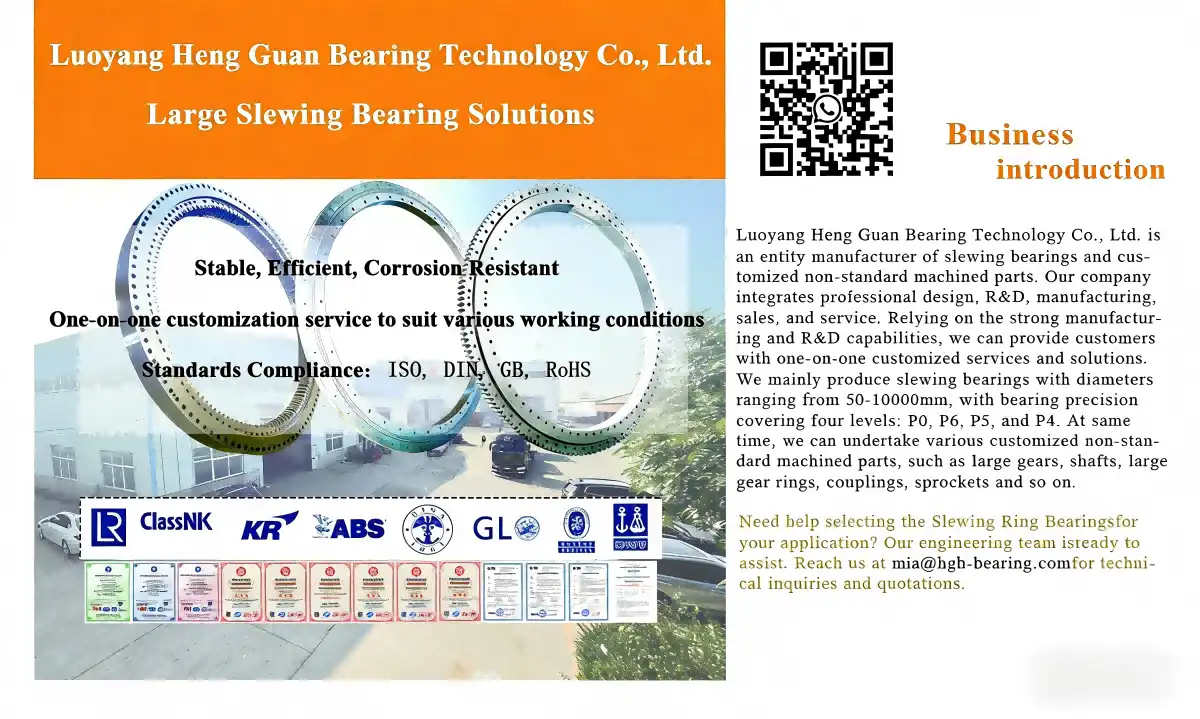
Heng Guan brings more than 20 years of experience making specialized bearings straight to your drilling projects. Our Luoyang factory is ISO9001-certified and makes custom Drilling Rig Slewing Bearing solutions with bore sizes from 800mm to 7000mm. These are made for oil research, mining, and geotechnical uses. The high-strength 42CrMo alloy steel construction and three-row roller reinforcement give it a great load capacity and protection from the elements, as seen in more than 50 countries. Our team of more than 50 engineers offers full technical support from the initial design stage through installation help, making sure that the bearings you choose are perfect for the job. Email our skilled drilling rig slewing bearing supplier team at mia@hgb-bearing.com to talk about your project needs and get full technical specs that are made just for your equipment.
References
1. American Bearing Manufacturers Association. (2021). Load Ratings and Fatigue Life for Rolling Bearings in Heavy Industrial Applications. ABMA Standards Publication.
2. Harris, T.A., & Kotzalas, M.N. (2020). Advanced Concepts of Bearing Technology: Rolling Bearing Analysis (6th ed.). CRC Press.
3. ISO 76:2006. Rolling Bearings — Static Load Ratings. International Organization for Standardization.
4. Palmgren, A. (2018). Ball and Roller Bearing Engineering: Design Principles for Extreme Load Applications (3rd ed.). SKF Technical Publishing.
5. Wensing, J.A. (2019). On the Dynamics of Ball Bearings in Heavy Machinery: Load Distribution and Contact Mechanics. Journal of Tribology and Bearing Technology, 45(3), 287-304.
6. Xu, H., & Zhang, L. (2022). Slewing Bearing Design for Mining and Drilling Equipment: Material Selection and Heat Treatment Optimization. International Journal of Mechanical Engineering and Applications, 10(2), 45-59.

WHAT OUR CUSTOMERS SAY
Here is the customer's evaluation of us