




How to Replace a 020.30.900 Slewing Bearing Safely?
It is crucial to replace a slewing bearing appropriately to ensure compact equipment continues to operate safely and effectively. If you run equipment with a 020.30.900 slewing bearing, knowing the correct order of repair helps prevent expensive damage and wasted downtime. At Heng Guan Bearing, we usually advise clients through this procedure, particularly those using a small excavator slewing bearing 900mm. So this article will take you through all the key steps, from inspection to final testing.
What Should You Check Before Replacing a 020.30.900 Slewing Bearing?
Evaluate the present state of the assembly before commencing removal. Check for play, wobble, strange noise, oil leaks, or obvious wear on the raceway surface. In the last stage of service life, a 020.30.900 slewing bearing is commonly characterized by pitting or discoloration of the rolling parts.
Because this type is widely used as a small excavator slewing bearing 900mm inspect the surrounding mounting bolts and housing for corrosion or elongation as well. Taking the torque values, bolt patterns, and existing clearances beforehand can make the replacement procedure much easier and limit the amount of guessing involved.
| Inspection Item | What to Look For | Action Needed |
|---|---|---|
| Raceway surface | Pitting, discoloration | Replace if worn |
| Mounting bolts | Corrosion, elongation | Replace full set |
| Grease condition | Contamination, hardening | Flush and refill |
| Rotation smoothness | Noise, resistance | Test before removal |
How Do You Safely Remove the Old 020.30.900 Slewing Bearing?
Removal should begin only after the machine is secured and power sources are disconnected. Loosen bolts gradually using a diagonal pattern rather than working around the circle sequentially, which helps avoid warping the housing. The 020.30.900 slewing bearing weighs approximately 250 kg, so always use rated lifting equipment rather than manual handling. As you lift the old bearing away from the mounting surface, inspect the area beneath it for hidden damage or debris.
Many customers contact our technical team at mia@hgb-bearing.com during this stage for guidance on lifting points and safe handling procedures specific to their excavator model.
| Key Parameter | 020.30.900 Specification |
|---|---|
| Structure | Double-row unequal-diameter ball, gearless (02 series) |
| Outer diameter / Bore | 1,042 mm / 758 mm |
| Total height | 124 mm |
| Raceway center diameter | 900 mm |
| Ball diameter | 30 mm |
| Weight | ≈ 250 kg |
| Static axial load rating | ≈ 2,580 kN |
| Outer / Inner bolt circles | 998 mm × 30 holes / 802 mm × 22 holes (M20) |
| Ring material | 50Mn / 42CrMo forged, triple-ring |
| Interchangeable with | SNR30/900 (direct replacement) |
Mounting Surface Inspection and Bearing Alignment
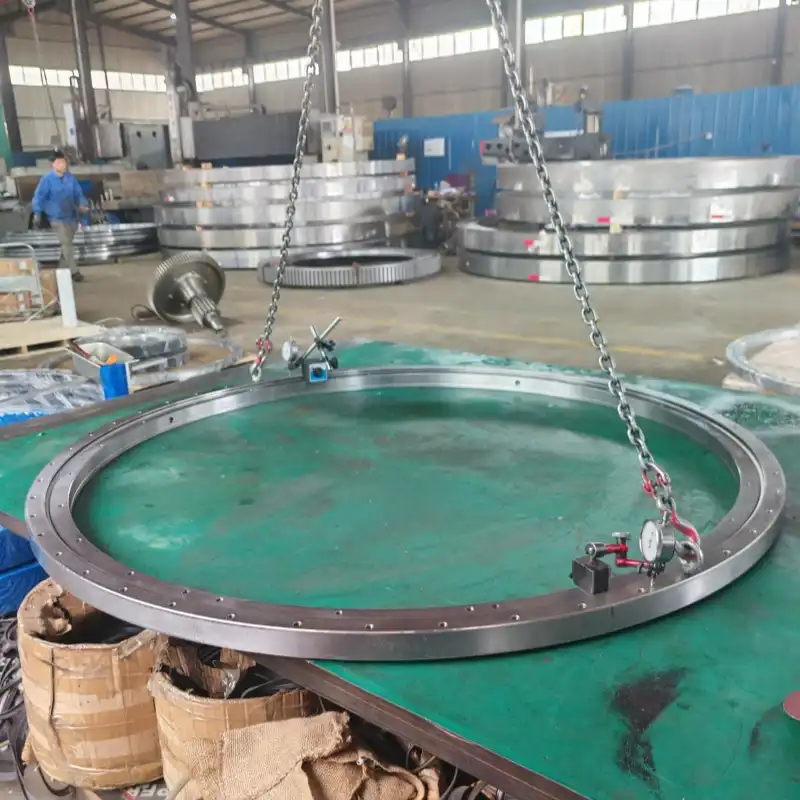
With the old unit removed, the mounting surface needs careful attention before installing the replacement. Use a precision level to check flatness, clear away old sealant or debris, and confirm the 30 outer and 22 inner M20 bolt holes have not deformed under previous loads. Even a well-manufactured 020.30.900 slewing bearing can fail prematurely if installed on an uneven surface. Alignment matters just as much — dial indicators help verify concentricity between the bearing and the rotating structure.
For any small excavator slewing bearing 900mm application, this step is particularly important since compact machines often operate under variable, high-frequency loads that expose alignment errors quickly.
How Should You Install and Torque the New 020.30.900 Slewing Bearing?
The replacement bearing is installed by gently lowering it onto the prepared mounting surface. The bolts should be tightened progressively, in a cross-pattern sequence, using a calibrated torque wrench, to equally distribute the stress on the housing. 020.30.900 Torque levels provided by the manufacturer must be strictly obeyed. Insufficient or excessive tightening might result in early failure. This gearless model is driven by an individual swing drive. Please verify that the pinion arrangement of your machine matches the bearing version you have ordered.
Geared versions are available in the same 900 mm series: 021.30.900 (external, module size 8 or 10) and 023.30.900 (internal). In these versions, the gear mesh clearance must be checked before the final tightening. To assist the first-time installer, we may provide torque charts and installation drawings on request to make this step easier.
| Installation Step | Recommended Practice |
|---|---|
| Bolt tightening sequence | Diagonal, staged torque |
| Torque verification | Calibrated torque wrench |
| Gear mesh check | Confirm before final tightening (geared versions) |
| Manual rotation test | Check for smooth movement |
Final Lubrication, Testing, and Safety Inspection
Once installation is complete, apply the recommended grease type evenly around the raceway and rotate the bearing manually to check for smoothness. Gradually introduce powered rotation while monitoring for unusual noise or temperature increases. This final phase confirms whether the 020.30.900 slewing bearing is seated and functioning correctly. Re-torque all bolts after a short operational period, since slight settling is normal.
A documented safety inspection covering bolts, seals, and lubrication points helps maintain long-term reliability for your small excavator slewing bearing 900mm. In normal excavator service, this double-row structure delivers 40–60% higher load capacity than a single-row four-point contact ball bearing of the same size, which is why it is the mainstream choice for 10–25 ton machines.
| Maintenance Item | Recommended Interval |
|---|---|
| Grease replenishment | Every 250 operating hours |
| Bolt torque re-check | After the first 50–100 hours, then quarterly |
| Seal inspection | Monthly |
| Full raceway inspection | Annually or 2,000 hours |
Conclusion
Careful inspection, removal, and installation ensure long-lasting performance. Heng Guan 020.30.900 Slewing Bearing remains dedicated to quality craftsmanship and reliable technical support — trust our expertise, built on 30+ years of slewing bearing design and exports to more than 50 countries, for your next bearing replacement.
FAQ
Q1: How long does a 020.30.900 slewing bearing typically last?
A: Lifespan depends on load and maintenance, but regular inspection and timely relubrication significantly extend service life.
Q2: Can I replace this bearing without professional help?
A: With proper tools, rated lifting equipment for the 250 kg unit, and torque specifications, experienced technicians can complete replacement safely.
Q3: What grease is recommended for a small excavator slewing bearing 900mm?
A: Lithium-based grease is generally suitable unless otherwise specified by the manufacturer.
Q4: How do I know if the torque values are correct?
A: Always follow manufacturer torque charts and verify using a calibrated wrench.
Q5: Does Heng Guan Bearing offer custom sizing?
A: Yes, our team can design bearings from 50 mm to 10,000 mm in diameter, tailored to specific excavator models and load requirements.
Q6: What is the lead time for a replacement 020.30.900 slewing bearing?
A: Standard gearless units ship in 3–4 weeks; custom geared configurations take 5–6 weeks.
Need a 020.30.900 Slewing Bearing? Contact Heng Guan Bearing Today
Ready to replace your 020.30.900 Slewing Bearing with confidence? Heng Guan Bearing offers expert guidance, quality components, and personalized support. Contact our team today at mia@hgb-bearing.com for technical assistance, product recommendations, or a custom quote for your equipment.
References
1. International Organization for Standardization, ISO 76:2006 — Rolling Bearings — Static Load Ratings.
2. International Organization for Standardization, ISO 281:2007 — Rolling Bearings — Dynamic Load Ratings and Rating Life.
3. American Bearing Manufacturers Association, ANSI/ABMA STD 26.2-2014 — Load Ratings for Slewing Bearings.
4. National Development and Reform Commission, JB/T 2300-2011 — Slewing Bearings for Construction Machinery.
5. Harris, T. A., and Kotzalas, M. N., Rolling Bearing Analysis, 5th edition, CRC Press.
6. Brändlein, J., Eschmann, P., Hasbargen, L., and Weigand, K., Ball and Roller Bearings: Theory, Design, and Application, 3rd edition, Wiley.

WHAT OUR CUSTOMERS SAY
Here is the customer's evaluation of us